



Pet Sitting Market Trends, Leading Companies, Company Revenue / Sales Performance, Retail Sales, Production Volume, Consumer Spending, Market Penetration, Competitive Landscape, and Industry Outlook
The pet sitting market reached USD 3.60 billion in 2027. The market growth is attributed to the increasing number of pet adoptions and rising disposable incomes. Several such trends were evaluated by our Senior Researcher, Vidyesh Swar, to curate this report. His report benefits multiple stakeholders involved in the market, including pet sitting companies, online pet care startups, private equity firms, and adjacent pet care businesses.
Source: https://www.precedenceresearch.com/pet-sitting-market
 Get a Sample
 Report Description


Pet Sitting Market Growth, Demand, and Production Forecast 2036
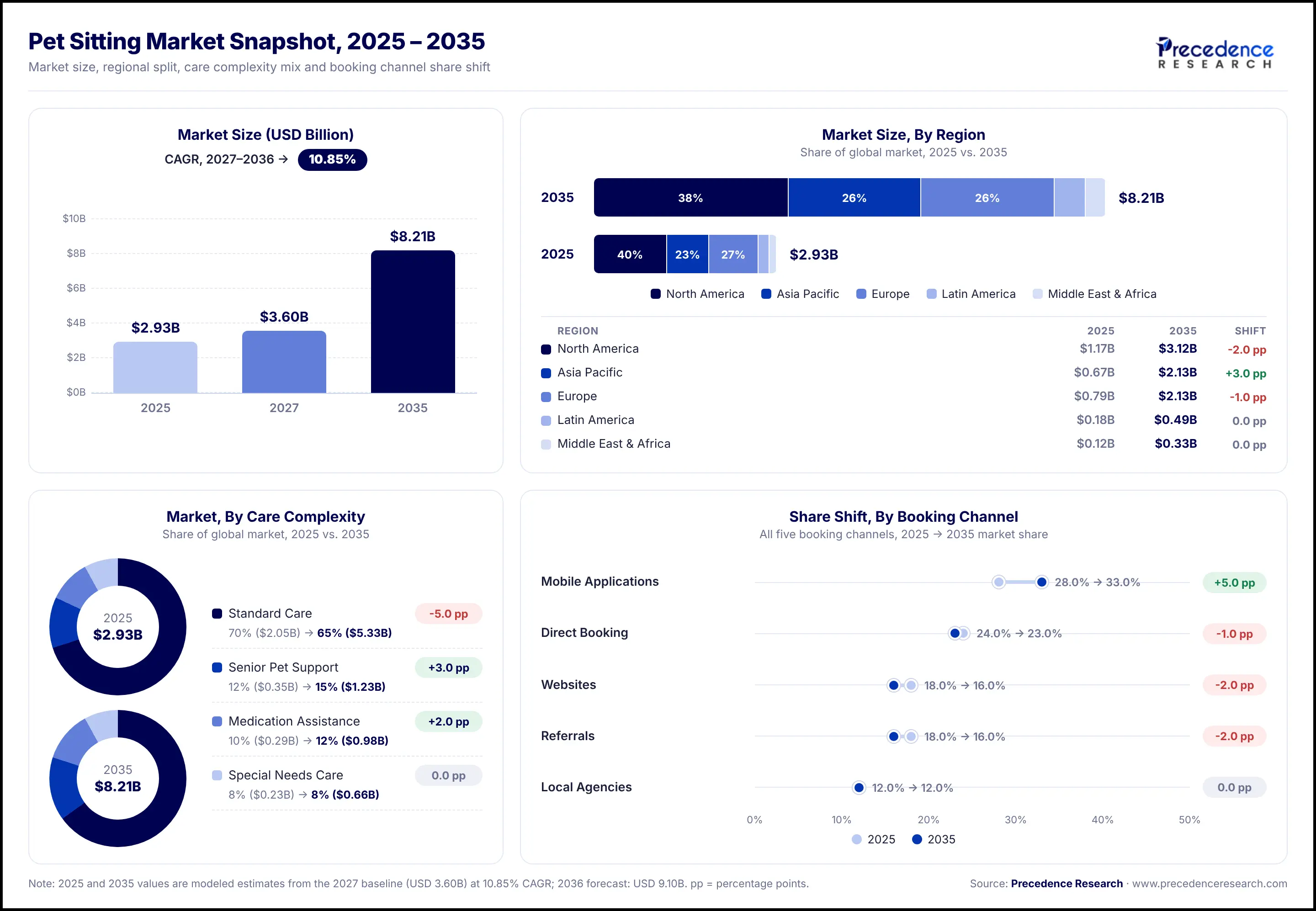
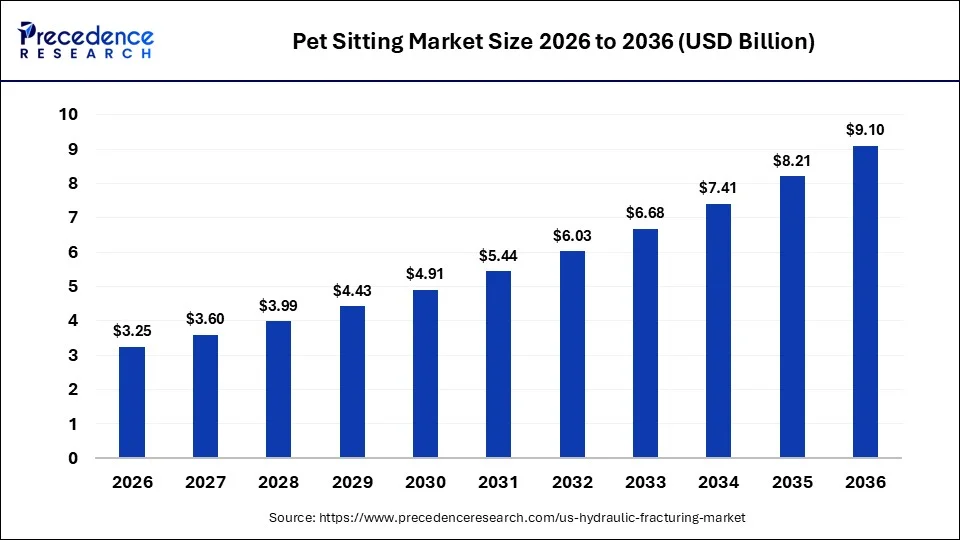
The global pet sitting market size is forecasted to expand from USD 3.60 billion in 2027 to USD 9.10 billion by 2036, growing at a CAGR of 10.85% from 2027 to 2036.
Key Takeaways
Market Size & Growth Outlook
- Market size in 2026: USD 3.25 billion
- Estimated market size in 2027: USD 3.60 billion
- Projected market size by 2036: USD 9.10 billion
- CAGR (2027–2036): 10.85%
Regional Market Spotlight
- North America market share 2026: 40%
- Europe market share 2026: 27%
- Asia Pacific market share 2026: 23%
Segmental Spotlight
- Dogs segment share 2026: 48%
- Pet owner's home care location segment share 2026: 62%
- Drop-in visits segment share 2026: 30%
Pet Sitting Market Size 2026 to 2035
The pet sitting industry is experiencing significant growth due to rising pet ownership and increasing demand for reliable, professional pet care services. Growing preference for personalized care, digital booking platforms, and specialized services is expected to support industry expansion throughout the forecast period.
Can Double-Digit Growth Be Sustained as Digital Discovery Expands and Professional Care Gains Share?
A consistent market model must therefore separate pet sitting from the broader pet-care services economy. Growth is expected to depend on increasing service penetration, booking frequency, premium care adoption, and the formalization of previously informal transactions.
It is important for the forecast to capture demand growth separately from selling price growth. Wage inflation, length of stay, additional pets, vacation premiums, or special care could all lead to price rises rather than a corresponding rise in service volume. For the platforms, gross booking value and net revenue should also be separated, as the former does not equal the latter.
The most useful forecast should capture the volume of transactions, booking value per transaction, number of repeat bookers, and platform monetization. The market could grow fast in transaction value while each supplier is under pressure on margins due to customer acquisition cost, sitters' incentives, and service recovery cost.
Coverage Highlights
- Various base, upside, and downside scenarios based on frequency of bookings, market coverage, pricing, and economy.
- Revenue growth decomposition into volume, pricing, premiumization, and channel-mix effects.
- Regional and service-level contribution to incremental market revenue.
- Analysis of sensitivity to repeated business, customer loyalty, commissions, and transaction value.
Would Dog Sitting Stay the Top Earner with Cat Care and Specialized Services Expanding Beyond the Base Market?
Pet sitting segmentation requires a distinction between the animal being cared for, the service delivered, the location of care, and the commercial channel.
Dogs represent the largest established revenue pool in available market estimates, while cats are identified as a comparatively attractive growth segment.
Cats can be particularly compatible with scheduled home visits because many owners prefer to maintain their animals' familiar surroundings rather than move them into a boarding environment.
The interaction between service duration and frequency. While overnight stays could result in larger reservations focused on holidays and vacation times, drop-ins would generate repeat business from pet owners who need everyday services. Multi-pet families might also result in bigger booking amounts without necessarily having to spend extra time traveling to accommodate the pets.
Coverage Highlights
- Revenue, share, growth, and forecast contribution by pet type and service category.
- Drop-in versus overnight versus extended-stay booking economics.
- At-home versus sitter-hosted care, with clear separation from conventional boarding.
- Digital marketplace, direct-provider, agency, and recurring booking segmentation.
- Identification of the largest, fastest-growing, highest-value, and underserved segments.
Pet Sitting Market Segment Analysis
Pet Sitting Market by Pet Type 2026 Share & Size
| Segments | 2026 Share | 2026 Market Value (USD Billion) |
| Dogs | 48.00% | 1.559 |
| Cats | 31.00% | 1.007 |
| Birds | 5.00% | 0.162 |
| Fish | 3.00% | 0.097 |
| Small Mammals | 6.00% | 0.195 |
| Reptiles | 2.00% | 0.065 |
| Other Pets | 5.00% | 0.162 |
Source: Expert Interview, Secondary Sources, Precedence Research Database, Precedence Research Analysts and Researcher
Dogs are estimated to lead because they typically require regular walks, feeding, exercise, companionship, and more frequent supervised care. Cats represent the second-largest segment, supported by drop-in visits and feeding services for owners who travel or work away from home
Pet Sitting Market by Service Type 2026 Share & Size
| Segments | 2026 Share | 2026 Market Value (USD Billion) |
| Drop-in Visits | 30.00% | 0.974 |
| Daytime Sitting | 20.00% | 0.65 |
| Overnight Sitting | 25.00% | 0.812 |
| Live-in Care | 10.00% | 0.325 |
| Extended Stays | 15.00% | 0.487 |
Source: Expert Interview, Secondary Sources, Precedence Research Database, Precedence Research Analysts and Researcher
Drop-in visits are estimated to hold the largest share because they provide a flexible, comparatively affordable option for feeding, walking, and checking on pets. Overnight sitting also accounts for a substantial portion of spending, particularly for dogs, pets requiring companionship, and owners taking longer trips
Pet Sitting Market by Care Location 2026 Share & Size
| Segments | 2026 Share | 2026 Market Value (USD Billion) |
| Pet Owner's Home | 62.00% | 2.014 |
| Sitter's Home | 28.00% | 0.909 |
| Other Agreed Care Settings | 10.00% | 0.325 |
Source: Expert Interview, Secondary Sources, Precedence Research Database, Precedence Research Analysts and Researcher
The pet owner's home is estimated to dominate because familiar surroundings can reduce disruption to pets' routines and allow sitters to follow established feeding, exercise, and medication schedules. Care at a sitter's home remains an important alternative for owners seeking longer supervision or a home-based environment outside their own property.
Pet Sitting Market by Booking Model 2026 Share & Size
| Segments | 2026 Share | 2026 Market Value (USD Billion) |
| One-Time | 45.00% | 1.462 |
| Recurring | 35.00% | 1.137 |
| Subscription or Membership-Supported | 20.00% | 0.65 |
Source: Expert Interview, Secondary Sources, Precedence Research Database, Precedence Research Analysts and Researcher
One-time bookings are estimated to lead because occasional travel, holidays, and unexpected scheduling needs create immediate demand for pet care. Recurring bookings and memberships are supported by working households, repeat travel, and owners who value reliable sitters and predictable service arrangements.
Pet Sitting Market by Provider Type 2026 Share & Size
| Segments | 2026 Share | 2026 Market Value (USD Billion) |
| Independent Sitters | 35.00% | 1.137 |
| Professional Agencies | 15.00% | 0.487 |
| Digital Marketplaces | 30.00% | 0.974 |
| Managed Networks | 20.00% | 0.65 |
Source: Expert Interview, Secondary Sources, Precedence Research Database, Precedence Research Analysts and Researcher
Independent sitters are estimated to account for the largest share, reflecting the fragmented and locally delivered nature of pet care services. Digital marketplaces also represent a substantial segment by connecting pet owners with available sitters, while professional agencies and managed networks compete through screening, service coordination, and more standardized processes
Pet Sitting Market by Customer Type 2026 Share & Size
| Segments | 2026 Share | 2026 Market Value (USD Billion) |
| Individual Owners | 40.00% | 1.299 |
| Multi-pet Households | 25.00% | 0.812 |
| Frequent Travelers | 20.00% | 0.65 |
| Working Households | 15.00% | 0.487 |
Source: Expert Interview, Secondary Sources, Precedence Research Database, Precedence Research Analysts and Researcher
Individual owners are estimated to represent the largest primary customer group because pet sitting serves a broad range of routine and occasional needs. Multi-pet households can generate higher spending per booking, while frequent travelers and working households support repeat demand for dependable care
Pet Sitting Market by Booking Channel 2026 Share & Size
| Segments | 2026 Share | 2026 Market Value (USD Billion) |
| Mobile Applications | 28.00% | 0.909 |
| Websites | 18.00% | 0.585 |
| Direct Booking | 24.00% | 0.78 |
| Referrals | 18.00% | 0.585 |
| Local Agencies | 12.00% | 0.39 |
Source: Expert Interview, Secondary Sources, Precedence Research Database, Precedence Research Analysts and Researcher
Mobile applications are estimated to lead because they simplify sitter discovery, scheduling, payments, messaging, and review access. Direct booking remains competitive through repeat relationships, while referrals and local agencies benefit from trust, personal recommendations, and established community connections.
Pet Sitting Market by Care Complexity 2026 Share & Size
| Segments | 2026 Share | 2026 Market Value (USD Billion) |
| Standard Care | 70.00% | 2.274 |
| Senior Pet Support | 12.00% | 0.39 |
| Medication Assistance | 10.00% | 0.325 |
| Special Needs Care | 8.00% | 0.26 |
Source: Expert Interview, Secondary Sources, Precedence Research Database, Precedence Research Analysts and Researcher
Standard care is estimated to dominate because most routine bookings involve feeding, walking, companionship, cleaning, and basic supervision. Senior pet support, medication assistance, and special needs care represent smaller but important segments that can require additional sitter experience, more detailed instructions, and more intensive supervision
Pet Sitting Market by Region 2026 Share & Size
| Segments | 2026 Share | 2026 Market Value (USD Billion) |
| North America | 40.00% | 1.299 |
| Europe | 27.00% | 0.877 |
| Asia-Pacific | 23.00% | 0.747 |
| Latin America | 6.00% | 0.195 |
| Middle East and Africa | 4.00% | 0.13 |
Source: Expert Interview, Secondary Sources, Precedence Research Database, Precedence Research Analysts and Researcher
North America is estimated to hold the largest regional share, supported by established paid pet-care services, digital booking platforms, and consumer willingness to pay for convenience and trusted care. Europe benefits from established pet ownership and demand for professional services, while Asia-Pacific offers growth potential through urbanization, changing household structures, and increasing adoption of digital service platforms
What are the Main Drivers and Challenges of the Pet Sitting Market?
The demand environment is supported by a large and increasingly service-oriented pet-owning population. In the United States, approximately 94 million households owned at least one pet in 2024, and the figure reached approximately 95 million in the 2025 survey cycle. The total cost incurred by the pet industry of the United States was $158 billion in 2025, highlighting the extent of the larger spending environment, but this number should not be taken to mean the cost of pet sitting services.
There are three factors that impact paid pet sitting demands. These include:
- The time element arising out of travel.
- Humanization of pets, making them feel at ease with familiar surroundings.
- Urban work-life trends of individuals.
However, pet ownership does not automatically convert into paid service demand. Owners might rely on family, friends, neighbors, or self-help services. Financial pressure can result in reduced length of stay, reduced fees paid for accommodations, or moving towards less expensive options.
Supply constraints are equally critical. Reliable sitters must have the necessary skills, be available at the proper times, and be in the right place. This can cause local shortage problems for holidays even if there is an adequate number of providers overall in the market. Late cancelations, transit time between bookings, and poor service quality can affect supply and loyalty.
The best companies will focus on reliability and reuse of their services as opposed to just customer acquisition. Booking ease might help them draw clients, but loyalty will be determined by dependability, openness, backup plans, and high-quality treatment.
Coverage Highlights
- Pet ownership, travel, work patterns, and household demographics as demand indicators.
- Price sensitivity, informal-care substitution, and economic pressures.
- Cancellation risks, service dependability, seasonal peaks, and the availability of local sitters.
- Customer retention, repeat booking rates, and premium-care adoption.
- Demand scenarios for multi-pet, senior pet, and specialized care services.
How Can Providers Monetize Premium Care Without Making Routine Sitting Unaffordable?
Pricing of pet sitting services mainly revolves around transactions whereby prices are charged based on time taken to make visits, overnight stays, number of pets, location, and booking period. Publicly visible U.S. pricing benchmarks indicate that standard drop-in visits often fall in the range of approximately USD 20-35 for a 30-minute visit, while overnight services can range from approximately USD 75-150 per night. Rates differ greatly from one marketplace to another.
Pricing is not directly comparable unless the care commitment is standardized. A short feeding visit, a one-hour visit involving medication, an overnight stay, and continuous live-in care have different labor requirements. The addition of charges for holidays, additional pets, transportation, and specialized services could significantly boost the transaction's final value.
In case of individual sitters, the gross booking revenue needs to cover travel expenses, scheduling, communication with clients, insurance, materials, taxes, and gaps between bookings. In case of marketplaces, it all depends on the fee that is taken, payments, marketing expenses, customer support, and trust and safety measures. An increase in booking revenue does not necessarily equate to increased profit.
It is important for providers to consider prices from two perspectives: the contribution per service hour and the customer lifetime value. The first approach could provide regular utilization and the second one could lead to a higher revenue per transaction.
Coverage Highlights
- Pricing benchmarks by visit duration, overnight care, live-in service, and pet type.
- Regional and seasonal pricing variation, including holiday and last-minute premiums.
- Multi-pet, medication, senior pet, and specialized care surcharges.
- Earnings of providers compared to customer payments, commissions, and transaction costs.
- Customer acquisition cost, repeat booking economics, and contribution margin drivers.
Why Can Local Sitter Shortages Persist in a Fragmented Global Market?
Pet sitting has limited conventional manufacturing or inventory capacity. Supply is, however, driven by willing sitters, their available time, geographical spread, experience, and flexibility in accepting bookings at prevailing prices. The relevant utilization metric is therefore the proportion of available sitter hours converted into paid service hours, rather than factory capacity utilization.
The size of a provider network in total numbers does not always guarantee that they have enough coverage at peak times or particular areas. Just like that, a sitter who seems to be busy could be unable to accommodate extra appointments because of travel time and service time among others.
The market's supply-demand balance is best assessed at city and neighborhood levels. Indicators include number of booking requests per sitter, acceptance rate, time to fulfillment, cancellation rate, price premiums per season, and requests that require alternative caregivers.
Coverage Highlights
- Active provider numbers, available hours, booking demand, and local fulfillment rates.
- Seasonal imbalances and peak-period pricing.
- Sitter utilization, travel-time efficiency, and cancellations.
- Geographic gaps between pet-owner demand and qualified provider availability.
- Platform incentives and agency recruitment strategies.
Where is Value Captured Between Customer Acquisition and Reliable Care Delivery?
The value chain of pet sitting involves customer identification, booking, sitter identification and matching, service provision, payment, evaluation, and repeat business. Unlike goods-based markets, the principal operating inputs are labor, trust infrastructure, customer acquisition, and scheduling coordination.
Independent contractors get more revenue from the service, although they need to do their own marketing, handling of payments, insurance, and administration. The digital platforms could handle the discovery and management of transactions, although they would have to pay for all of the technical support, verification, dispute resolution, and liquidity of the marketplace. The managed agency could provide additional training, standardization, back-up, and customer service.
Key Coverage
- Provider recruitment, screening, onboarding, and customer acquisition costs.
- Platform commissions, payment processing, insurance, and service-support expenses.
- Direct-provider versus agency versus marketplace economics.
- Revenue retention, repeat bookings, and customer lifetime value.
- Operational bottlenecks in matching, scheduling, and emergency coverage.
What are the Technological Innovations of the Pet Sitting Market?
Customers' methods for finding sitters, comparing providers, setting up payments, and keeping an eye on care are all being altered by technology. Mobile booking, verified reviews, messaging, calendar management, digital payments, and photo updates are established marketplace capabilities. More advanced possibilities involve automation of scheduling, demand forecasting, matching, and home monitoring if the consent of the owners and sitters is obtained.
There is a need for a tangible commercial advantage that can be achieved through higher conversion rate, reduced cancellations, lower support costs, increased retention rate, and efficient utilization of providers. Matching is only useful if done taking into account important considerations such as location, availability, suitability of animals, experience of providers, and care needs.
Remote monitoring can improve the sense of security but will not take the place of the provision of care in person and emergency assistance. Personal data of users, access information to homes, secure payments, and dangers of over-dependence on automated advice should be handled.
Coverage Highlights
- Mobile applications, booking systems, scheduling tools, and digital payments.
- Review verification, identity screening, and trust-and-safety infrastructure.
- Automated matching, predictive scheduling, and customer retention tools.
- Connected home monitoring, photo updates, and service communication.
- Technology investments, platform differentiation, and quantifiable business results.
How Do Animal Rights, Liability, and Data Protection Influence Market Formalization?
Pet sitting is a service market whose regulatory requirements vary by country, state, municipality, and service model. For instance, in the case of England, doggy daycare centers and boarding at home can come under the licensing regime but taking care of dogs at the place of their owners does not fall under the licensing regime according to the animal activity guidelines applicable there.
A range of issues may have to be considered including business registration, taxation, animal welfare, consumer protection, privacy, insurance, employee classification, and local regulations for activities like boarding and transport. Requirements applicable to an individual sitter may differ from those applicable to an agency or platform.
Sustainability plays a lesser role compared to the manufacturing industry, although the movement from one appointment to another results in the consumption of fuel and creation of emissions. Route planning and grouping appointments could help increase efficiency and cut down any unnecessary movement.
Coverage Highlights
- Country- and service-specific licensing and animal-welfare requirements.
- Customer contracts, emergency protocols, liability insurance, and dispute settlement.
- Data privacy, payment security, and home access information management.
- Employment classification and independent-provider compliance.
- Environmental factors, travel expenses, and route efficiency.
Which Customers Offer the Highest Repeat Revenue and Most Attractive Service Economics?
The major target customer segments consist of travel-loving individuals, working families, multiple pet owners, pets that need medications or special routines, and families that want reliable regular visits. These customer segments differ in booking frequency, cost sensitivity, and their readiness to pay for reliability.
Travelers can create high-yield overnight and long-term bookings but may only be in higher demand during holidays. Working families will provide regular daytime needs. The cat owners might like visits at home, whereas the dog owners would need more supervision according to the animal's routine.
Customer acquisition should therefore be evaluated alongside booking recurrence and contribution margin. A high-spending customer who books only once may be less valuable than a customer who books routine visits throughout the year. On the other hand, if travel distance, cancelations, and service complexity are inexpensive, recurrent reservations may lose money.
Coverage Highlights
- Customer cohorts by travel frequency, household type, pet type, and care needs.
- Average booking value, booking frequency, retention, and customer lifetime value.
- Direct bookings versus platform-acquired customers.
- Trust, cost, availability, communication, and continuity are all considered while making a purchase.
- Underserved needs in senior-pet care, multi-pet households, and specialist services.
Will Scaled Marketplaces Outperform Local Experts in Trustworthiness, Retention, and Reliability?
The pet sitting industry is fragmented since the service delivery depends on the availability of local providers, geographic proximity, trust, and quality of care, despite the fact that the demand aggregation is done through digital platforms in more than one location. Competition is defined by density of sitters, brand awareness, customer ratings, booking success rate, security measures, and reliability.
Scale alone is unlikely to guarantee competitive leadership; the strongest business models will be those that translate network size into dependable local service delivery and repeat customer bookings. Markets benefit from greater diversity of providers and wider reach through technology, whereas local experts and babysitters can distinguish themselves through personal attention and connections within the community.
Competition is divided among digital marketplaces, managed service networks, franchise and local agency networks, specialist platforms, and independent providers. There is competition between these models on different parameters: marketplaces compete on access and choice of providers; managed service networks compete on consistent operations and support; franchise/agency networks compete on local coverage and processes; specialist networks cater to specific needs in care; and independent providers compete on reputation and referral.
What matters is whether the right operating model is selected based on what customers are looking for, not necessarily whether scale can be achieved without it. Companies working with customers looking for convenience may do well in digital aggregations, whereas customers needing overnight care, medicine assistance, or care continuity may look for special knowledge and accountability in service.
An important issue is financial comparability of these business models. GBV of a marketplace is the total value of all transactions conducted through it, and it cannot be considered to be equivalent to recognized revenue of the platform. Revenue of an agency may include the full cost charged to the customer, whereas an independent sitter's income would be limited to customer payment only.
The most relevant competitive benchmarks include take rate, booking frequency, customer retention, provider utilization, customer acquisition cost, contribution margin, and cancellations, in addition to geographic reach and provider quality. The rest of the report goes on to cover business model distinctiveness, competitive positioning, trust and safety, reliability of the service offered, and economic foundations for scaling.
The competitive analysis can also be supplemented by data from the company level that includes provider type, geographic reach of operations, service offering, booking methodology, geographic reach, pricing, commission/fee structure, where applicable, customer ratings, safety measures, and financial metrics. Data from the company level can be segmented by region, business model, service specialization, and scale of operations, making like-to-like benchmarking possible.
Tentative Leading Company Universe
| Company | Headquarters/base | Market Position | Core Strength |
| Rover | Seattle, United States | Global marketplace | Sitter discovery and bookings |
| Wag! | United States | Digital platform | On-demand pet-care services |
| Fetch! Pet Care | United States | Franchise network | Managed local care |
| PetBacker | Singapore | International marketplace | Multi-service provider discovery |
| Pawshake | Europe/international | Regional marketplace network | Home visits and pet sitting |
| TrustedHousesitters | United Kingdom | Membership platform | House sitting and pet care |
| Mad Paws | Australia | Regional marketplace | Pet sitting and related services |
| Holidog | France | European marketplace | Pet-care matching |
| Care.com | United States | Adjacent care marketplace | Household and caregiver discovery |
| PetSitter.com | North America | Provider marketplace | Local sitter discovery |
| Pet Sitters International | United States | Industry organization | Professional network and education |
| National Association of Professional Pet Sitters | United States | Industry organization | Professional standards and education |
| Time To Pet | United States | Software provider | Scheduling and business operations |
| Precise Petcare | United States | Software provider | Client and schedule management |
| Pet Sitter Plus | United Kingdom | Software provider | Agency operations |
Why Must Booking Value Be Separated from Recognized Revenue?
The available market evidence does not support assigning precise global pet sitting shares to every company in the universe. Private firms, small-scale providers do not reveal segment revenue, and the platform companies may separate their gross booking revenue from the net revenue.
The full competitive analysis will base its calculation on the same denominator, which is the total paid revenue for pet sitting services excluding any adjacent activities that are not specifically accounted for. The transaction market share and service market share must be calculated independently if there is enough evidence available.
Which Operating Metrics Show a Sustained Competitive Advantage?
| Benchmark | What it Reveals |
| Relevant service revenue | Actual exposure to pet sitting rather than total corporate revenue |
| Gross booking value | Scale of transactions facilitated |
| Revenue take rate | Platform monetization relative to eligible bookings |
| Repeat-booking rate | Customer retention and demand predictability |
| Active sitters and geographic coverage | Network depth and fulfillment capability |
| Average booking value | Service mix and customer spending |
| Cancellation and complaint rates | Reliability and service-quality risks |
| Customer acquisition cost | Efficiency of growth investment |
| Contribution margin | Profitability after variable service and transaction costs |
| Provider retention | Stability of the supply network |
The strongest competitive positions are likely to emerge where geographic density, repeat customer relationships, and trust systems reinforce each other. National coverage is certainly important, but the availability of the sitter locally will still be the deciding factor.
Can Specialist Care Command a Defensible Premium?
Portfolio diversification has moved from offering more services to meeting the unique requirements of the customer. The general marketplaces can offer drop-in services, overnight stays, dog walking and sitting hosted by the sitter, while specialists can focus on providing services for cats, senior pets, or customers who wish for continuity of services from one person.
Technology benchmarking should involve verification of reviews, identification verification, booking options, cancellation help, emergency services, payment security, and communication. Those who incorporate these aspects into their service delivery process will have an easier time retaining their clients compared to those who rely on cost alone.
Direct Booking a Better Margins Solution but a Marketplace Problem?
While digital marketplaces can reduce discovery costs and facilitate payment processes, they also charge fees and can own key parts of the customer experience. Independent nannies are able to skip commission fees when making bookings independently but need to pay for marketing, scheduling, payment processes, and customer support themselves.
Agencies are able to stand out with their consistency and back-up options. On the other hand, software providers are part of another layer of the ecosystem that helps independent business owners handle bookings, reminder processes, payment processes, and customer data management despite not being customer acquisition companies themselves.
In the full report, channel economics are compared in terms of acquisition cost, conversion rate, repeat usage, provider retention, commission policy, service quality, and customer ownership.
Will Consolidation Enhance Network Coverage and Subscriber Retention?
Recent strategic activity should be evaluated through acquisitions, geographic expansion, technology investment, partnerships, and adjacent-service integration. The 2025 integration of Gudog into Rover illustrates how a marketplace can consolidate customer relationships and provider networks across markets.
Possible reasons for transactions may be entering new markets, gaining access to a ready sitter network, acquiring specialized client groups, or expanding scheduling and payment options. However, the value of an acquisition will depend on retaining customers and sitters, the cost of integration, compliance regulations, and maintaining service quality locally.
The report follows the value of transactions that are disclosed, the rationale for the transaction, geographic reach, capabilities acquired, and performance metrics after the transaction. The report also evaluates whether consolidation is raising or lowering competitive barriers.
What are the Potential Opportunities and White Spaces of the Pet Sitting Market?
The most tangible opportunities will be in customers who cannot satisfy their needs through the standard booking process. Care for seniors, medication management, multiple pets in one household, recurring visits during the day, and holiday coverage are some examples. The segments mentioned above can generate higher transaction amounts; however, their viability is determined by service complexity, training requirements, insurance, and price sensitivity.
Other opportunities may involve:
- Repeatable Services: Changing occasional visits to regular schedule.
- Catsitting Specialization: Creating a network of specialists in catsitting at home.
- Premium Overnight Services: Monetizing continuity, communication, and individualized attention.
- Underserved Geographies: Growing into communities with low availability of qualified babysitters.
- Digitization of Agency: Assisting local operators in decreasing their administrative burden.
- Customer Retention: Using rebooking reminders and continuity of care to reduce repeat-acquisition costs.
- Partnering with Pet Care Providers: Creating referral partnerships with related local businesses, subject to necessary precautions.
Each one needs to be measured in terms of the number of potential customers, frequency of bookings, value per booking, availability of the service provider, and the contribution margin that can be earned from it.
Pet Sitting Attractive Despite Low Entry Barriers and High Trust Requirements?
| Competitive Force | Indicative Assessment | Market-Specific Rationale |
| Supplier power | Medium | Qualified, reliable sitters can be scarce locally and during peak periods. |
| Buyer power | Medium to high | Customers can compare providers, prices, reviews, and informal alternatives. |
| Threat of new entrants | High | Basic service entry requires limited capital, although trust and network development take time. |
| Threat of substitutes | High | Friends, family, neighbors, boarding, and other care arrangements compete for demand. |
| Competitive rivalry | High | Local providers and digital platforms compete on availability, reliability, pricing, and reputation. |
Under What Circumstances Will Expansion Be Profitable Instead of Being Just an Increase in Sales?
The political and legal environment is made up of animal welfare laws, local commercial regulations, consumer protection, taxes, and data privacy. The economic environment impacts disposable income, travel spending, earnings, and cost of paying for the care of animals. The social environment includes the pet humanization trend, household structure, and expectations of animal welfare. Technology impacts on discovery, scheduling, payment and communications, while environmental concerns relate mainly to travel efficiency and logistics.
An attractive market is one where there is high pet ownership, readiness to pay, possibility for repeat booking, and sufficient provider density that facilitates service provision. Where there are markets with high demand and little sitter availability, there might be room for agencies and specialty networks.
The full assessment differentiates highly attractive, attractive, moderate, and challenging opportunities according to market growth, competitive intensity, service economics, local regulation, customer retention, and operating requirements.
What Services or Business Models Could Grab the Next Round of Growth in Pet Sitting?
The base case assumes continuing adoption of technology, gradual formalization of services, and ongoing customer demand for customized care. The upside case assumes increased success in booking repeat visits, expansion of specialist services, and effective matching of providers. The downside case contemplates issues of affordability, lower travel-linked demand, increased labor costs, safety incidents, and increasing competition.
Durable growth will depend less on the number of providers listed and more on the number of reliable, repeatable service relationships. Companies that blend local delivery, clear pricing, customer assurance, and efficiency have a greater chance of turning market expansion into revenues.
Key Strategic Questions
- What are the principal differences between paid pet sitting, boarding, and adjacent pet-care services?
- Which pet types and service categories generate the largest revenue pools?
- What parts have the highest growth and premium pricing potential?
- How do drop-in, overnight, and extended stay bookings compare in terms of revenue and profitability?
- What role do commissions play on the platform, income for providers, and cost to acquire customers?
- Which geographic areas have the highest growth and professional service penetration?
- How does the availability of sitters, seasonality of demand, and local network density impact fulfillment?
- Which digital platforms, specialist providers, and managed-service businesses are most relevant to the competitive landscape?
- What kind of data can be used to assess market share without the confounding effect of gross booking value versus earned revenue?
- What aspects of trust, safety, and technology actually create differentiation?
- What are the impacts of licensing, animal welfare considerations, insurance, and data security on market entry?
- Where can senior pet care, multi-pet services, and recurring bookings create underserved opportunities?
- What is the potential for consolidation and alliances to alter the provider network and geographic footprint?
- Which models are best suited to grow sustainably and generate strong margins?
Pet Sitting Market Segments
By Pet Type
- Dogs
- Cats
- Birds
- Fish
- Small Mammals
- Reptiles
- Other Pets
By Service Type
- Drop-in Visits
- Daytime Sitting
- Overnight Sitting
- Live-in Care
- Extended Stays
By Care Location
- Pet Owner's Home
- Sitter's Home
- Other Agreed Care Settings
By Booking Model
- One-Time
- Recurring
- Subscription or Membership-Supported
By Provider Type
- Independent Sitters
- Professional Agencies
- Digital Marketplaces
- Managed Networks
By Customer Type
- Individual Owners
- Multi-pet Households
- Frequent Travelers
- Working Households
By Booking Channel
- Mobile Applications
- Websites
- Direct Booking
- Referrals
- Local Agencies
By Care Complexity
- Standard Care
- Senior Pet Support
- Medication Assistance
- Special Needs Care
By Region
- North America
- Europe
- Asia-Pacific
- Latin America
- Middle East and Africa
For inquiries regarding discounts, bulk purchases, or customization requests, please contact us at sales@precedenceresearch.com
Frequently Asked Questions
Tags





Ask For Sample
No cookie-cutter, only authentic analysis – take the 1st step to become a Precedence Research client
 Get a Sample




 sales@precedenceresearch.com
 Schedule a Meeting
