



Plastic Waste Management Market Size, Key Companies, Company Product Portfolio, Production Economics, Trade Analysis, Material Efficiency, Market Penetration, Pricing Strategy, and Sustainability Trends
Plastic Waste Management Market (By Service: Collection, Recycling, Incineration, Landfills; By Polymer: Polypropylene, Low density polyethylene, High density polyethylene, Polyvinyl chloride, Terephthalate, Others; By Source: Residential, Commercial, Industrial; By End Use: Packaging, Textile, Consumer product, Transportation, Building & construction, Electrical & electronics, Others) - Global Industry Analysis, Size, Trends, Leading Companies, Regional Outlook, and Forecast 2026 to 2035
Source: https://www.precedenceresearch.com/plastic-waste-management-market
 Get a Sample
 Table Of Content


What is the Plastic Waste Management Market Size?
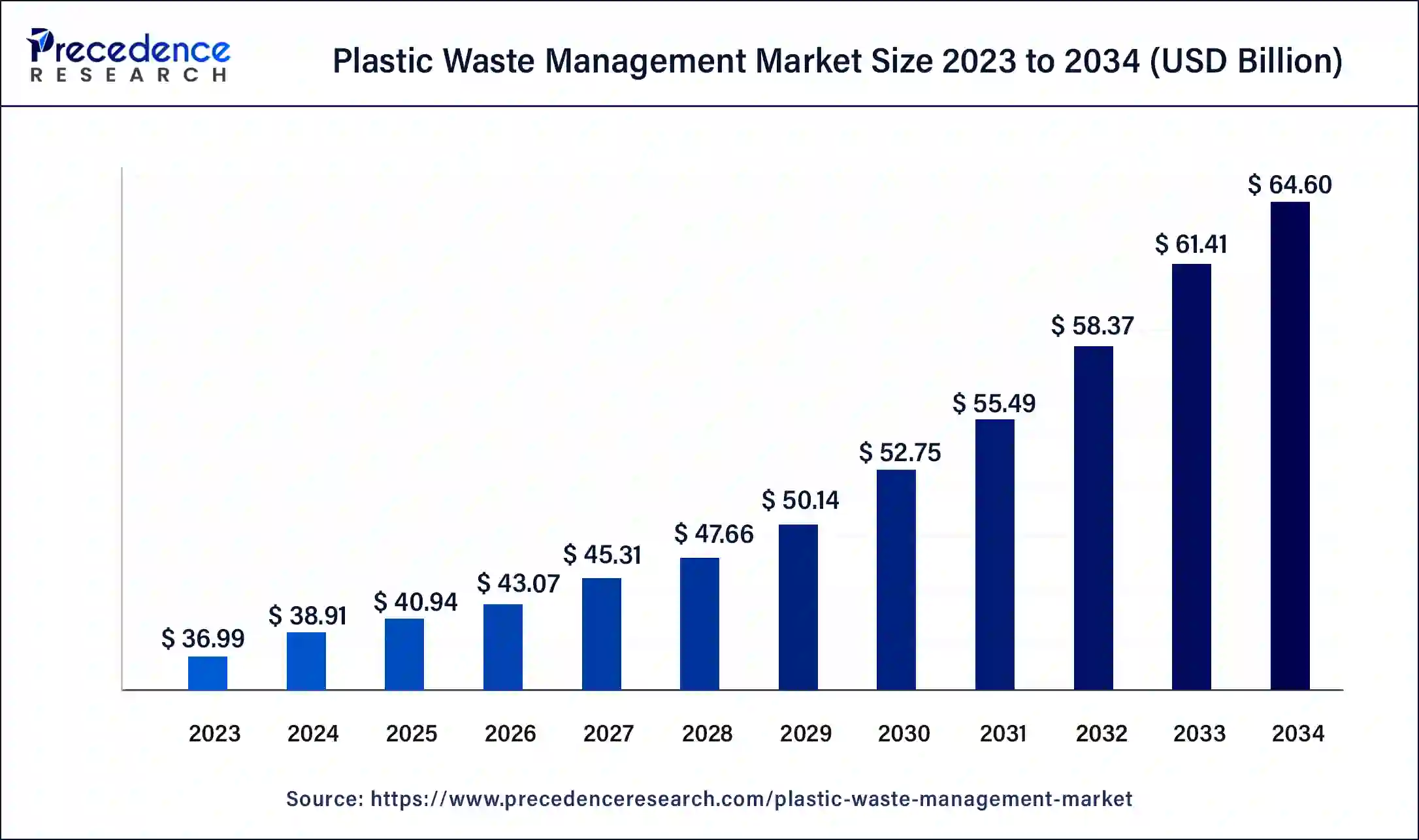
The global plastic waste management market size is estimated at USD 40.94 billion in 2025 and is predicted to increase from USD 43.07 billion in 2026 to approximately USD 67.69 billion by 2035, expanding at a CAGR of 5.16% from 2026 to 2035. The market is driven by growing environmental regulations, sustainability initiatives, and growing awareness of plastic waste management among consumers.
Market Highlights
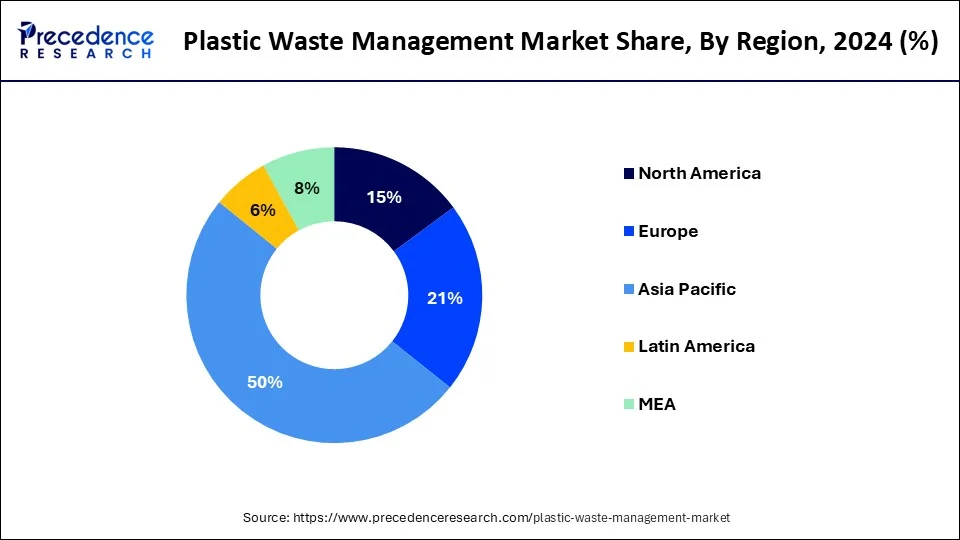
- Asia Pacific dominated the global market with the highest market share of 50% in 2025.
- North America region is estimated to expand the fastest CAGR between 2026 and 2035.
- By service, the recycling segment has held the largest market share in 2025.
- By polymer type, the polypropylene segment captured the biggest revenue share in 2025.
- By source, the residential segment registered the maximum market share in 2025.
- By end use, the packaging segment is estimated to hold the highest market share of 45% in 2025.
Market Overview
The plastic waste management market encompasses the collection, segregation, recycling, treatment, and disposal of plastic waste generated from residential, commercial, industrial, and municipal sources. The market is experiencing steady growth due to increasing environmental concerns regarding plastic pollution, stringent government regulations promoting waste reduction and recycling, and rising investments in circular economy initiatives. Growing consumer awareness of sustainability, coupled with advancements in recycling technologies and waste processing infrastructure, is further driving market expansion. Additionally, the increasing adoption of recycled plastics across packaging, automotive, construction, and consumer goods industries is creating new opportunities for market growth.
How is AI Impacting the Plastic Waste Management Market?
Artificial intelligence (AI) is transforming the plastic waste management market by improving the efficiency and accuracy of waste collection, sorting, and recycling processes. AI-powered vision systems and robotic sorting technologies can identify and separate different types of plastics with greater precision, reducing contamination and increasing recycling rates. Additionally, AI-driven analytics help optimize collection routes, predict waste generation patterns, and enhance operational efficiency, enabling waste management companies to reduce costs and improve resource recovery.
Plastic Waste Management Market Growth Factors
- The plastic waste management market is growing due to rising concerns of plastic pollution, and strict environmental regulations are encouraging governments and industries to invest in recycling infrastructure and sustainable waste management solutions.
- Growing demand for recycled plastics from packaging, automotive, construction, and consumer goods is creating new opportunities for plastic recycling companies.
- Continuous advancement in chemical and mechanical recycling technologies is increasing recovery rates and supporting plastic waste management.
- The growing use of packaged foods and rising population are generating large plastic waste volumes, driving the need for efficient plastic waste management.
Government Initiatives
- Germany: Many corporations in the region are adopting sustainability initiatives set by the government that directly impact the market. As businesses increasingly recognize the importance of corporate social responsibility, they are increasingly committing to reducing their plastic footprint.
- U.S: The region is witnessing substantial growth as industries and the government focus on recycling technologies, reducing landfill waste, and promoting circular economy initiatives. Advancements in mechanical and chemical recycling processes, coupled with supportive regulations and rising demand for recycled plastics are helping in driving innovation and investment across this sector.
- China: The government is enacting laws that mandate recycling and impose penalties for non-compliance. The region has also introduced extended producer responsibility (EPR) regulations, requiring manufacturers to take responsibility for the entire lifecycle of their products. This shift is compelling companies to invest in sustainable waste management solutions.
- Japan: Advanced sorting technologies, such as AI-driven systems, are being increasingly implemented in order to improve the efficiency of material recovery facilities. These innovations not only help to streamline operations but also increase the purity of recycled materials, making them more valuable in the market.
- The UAE: The government and private entities are seen increasingly allocating significant funds in order to help improve recycling facilities and waste processing technologies. This facilitates better collection, sorting, and recycling of plastic waste, which is beneficial for achieving higher recycling rates.
What are the Major Trends in the Market?
- Growing Adoption of Advanced Recycling Technologies: Chemical recycling and other advanced recycling methods are gaining traction as they enable the recovery of high-quality materials from difficult-to-recycle plastic waste.
- Expansion of Circular Economy Initiatives: Governments and businesses are increasingly promoting circular economy models that prioritize plastic reuse, recycling, and resource recovery to reduce environmental impact.
- Increasing Use of AI and Automation: Smart waste sorting systems, robotics, and AI-powered monitoring solutions are being adopted to improve recycling efficiency and reduce operational costs.
- Rising Investments in Recycling Infrastructure: Public and private sector investments are expanding recycling facilities and waste processing capabilities to address growing volumes of plastic waste.
- Stricter Environmental Regulations: Governments worldwide are implementing regulations targeting single-use plastics, extended producer responsibility (EPR), and recycling targets, driving demand for effective plastic waste management solutions.
Plastic Waste Management Market Outlook
- Industry Growth Overview: The plastic waste management market revolves around the generation of plastic waste and the protection of human health and the environment. A proper collection and disposal system prevents the contamination of water, air, and soil. The United Nations Environment Programme (UNEP) International Environmental Technology Centre (IETC) introduced the national action plan on plastic waste management 2021-2030.
- Sustainability Trends: These include best practices for addressing plastic waste such as measurement, regulatory and policy interventions, partnerships, behavioral and educational campaigns, and innovation. Plastic products are durable, versatile, and lightweight. Addressing plastic waste is advantageous in terms of reduced health impact, reduced consumption, increased recycling rates, and more.
- Startup Ecosystem: Startups are introducing creative solutions to tackle the plastic pollution challenge. These solutions cover different technological areas, such as biodegradable substitutes, circular economy models, and standard recycling techniques. Startups take preventative steps to encourage the reuse and recycling of products by providing incentives to consumers.
- Global Expansion: According to the National Center for Biotechnology Information (NCBI), global research estimated that plastic production could increase by 650 million tons by 2050. The integration of alternative products holds promise for advancements in the overall management of plastic waste. The rising per capita consumption and population growth are driving the global increase in plastic waste.
Market Scope
| Report Coverage | Details |
| Market Size in 2025 | USD 40.94 Billion |
| Market Size in 2026 | USD 43.07 Billion |
| Market Size by 2035 | USD 67.69 Billion |
| Growth Rate from 2026 to 2035 | CAGR of 5.16% |
| Base Year | 2025 |
| Forecast Period | 2026 to 2035 |
| Segments Covered | Service, Polymer, Source, End Use, and Region |
| Regions Covered | Asia Pacific, North America, Europe, Latin America, Middle East and Africa |
Market Dynamics
Driver
Increasing Environmental Regulations and Sustainability Initiatives
Growing concerns about plastic pollution and its impact on ecosystems are encouraging governments worldwide to introduce stricter waste management regulations and recycling targets. Policies such as extended producer responsibility (EPR) programs and plastic reduction initiatives are pushing industries to adopt efficient plastic waste management solutions. These regulatory measures are increasing demand for recycling infrastructure, waste processing technologies, and sustainable waste management practices.
Restraint
High Cost of Recycling Infrastructure and Processing
The high capital investment required for advanced recycling facilities, collection systems, and waste processing technologies limits market growth, particularly in developing regions. Additionally, challenges such as inefficient waste segregation, contamination of recyclable materials, and fluctuating prices of recycled plastics affect profitability. These factors can discourage businesses from adopting large-scale plastic waste management solutions.
Opportunity
Adoption of Advanced Recycling Technologies
Advancements in technologies such as chemical recycling, AI-based sorting systems, and automated waste processing are creating new growth opportunities in the plastic waste management market. These innovations improve recycling efficiency, enable the recovery of difficult-to-recycle plastics, and support the transition toward a circular economy. Increasing investments from governments and private companies in sustainable waste solutions are expected to further accelerate market expansion.
Segments Insights
Service Insights
Why Did the Recycling Segment Dominated the Plastic Waste Management Market?
The recycling segment registered its dominance in the global market in 2025, as the government and industries increasingly emphasize resource recovery and circular economy practices. Growing demand for recycled materials in the packaging, automotive, and consumer goods sectors has strengthened the importance of recycling services. Stringent environmental regulations and rising awareness about plastic pollution are encouraging investments in recycling infrastructure, supporting the expansion of this segment in the market.
The collection segment is expected to grow at the fastest CAGR over the forecast period. The collection services form the foundation of the market by ensuring efficient gathering and transportation of plastic waste from different sources. The increasing population and rising waste generation have increased the need for the organized collection of plastic waste. The municipal authorities and private waste management companies are providing a smart garbage collection system, which drives the growth of the segment in the market.
Polymer Type Insights
The Polypropylene Segment Held the Largest Market Share in 2025
The polypropylene segment dominated the plastic waste management market with the largest share in 2025, supported by its widespread use in packaging, automotive components, textiles, and household products. Rising demand for recycled polypropylene from manufacturers seeking sustainable raw materials is supporting segment growth. Polypropylene is easily available, inexpensive, and adaptable to a variety of production techniques, making it ideal for both domestic and industrial uses.
The low density polypropylene segment is expected to expand rapidly in the coming years. The growth of the segment is mainly driven by its wide use in films, shopping bags, squeeze bottles, and flexible packaging applications. Growing consumption of packaged products has led to higher volumes of LDPE waste, creating strong demand for efficient collection and recycling systems. Governments and industries are increasingly promoting the recovery of flexible plastics to reduce environmental impact.
Source Insights
What Made Residential the Leading Segment in the Plastic Waste Management Market?
The residential segment led the market in 2025, accounting for a considerable revenue share. This is mainly due to increasing consumption of packaged foods, household products, and daily-use plastic items. Rising urbanization and changing lifestyles have led to greater volumes of domestic plastic waste. Governments are promoting waste segregation and recycling awareness among households to improve collection efficiency.
The commercial segment is expected to witness the fastest growth over the forecast period. Commercial establishments such as retail stores, offices, restaurants, and hospitality facilities generate considerable amounts of plastic waste, making this segment an important contributor to the market. Increasing emphasis on sustainability and regulatory compliance has encouraged businesses to adopt responsible waste management practices. The growing use of sustainable packaging continues to support the expansion of this segment.
End Use Insights
What Made Packaging the Dominant Segment in the Plastic Waste Management Market?
The packaging segment dominated the global market with a major share in 2025 because of the extensive use of plastic materials across food, beverages, healthcare, and consumer goods industries. Rising environmental concerns and regulations aimed at reducing plastic pollution are increasing the demand for recycling and waste recovery solutions. Continuous growth in packaged product consumption further strengthens the importance of this segment in the market.
The consumer product segment is expected to witness the fastest growth over the forecast period because of the extensive use of plastics in household goods, electronics, toys, and personal care products. Companies are increasingly focusing on sustainable product design and circular economy strategies to reduce plastic waste. Growing environmental awareness among consumers is supporting the market growth.
Regional Insights
What is the Asia Pacific Plastic Waste Management Market Size?
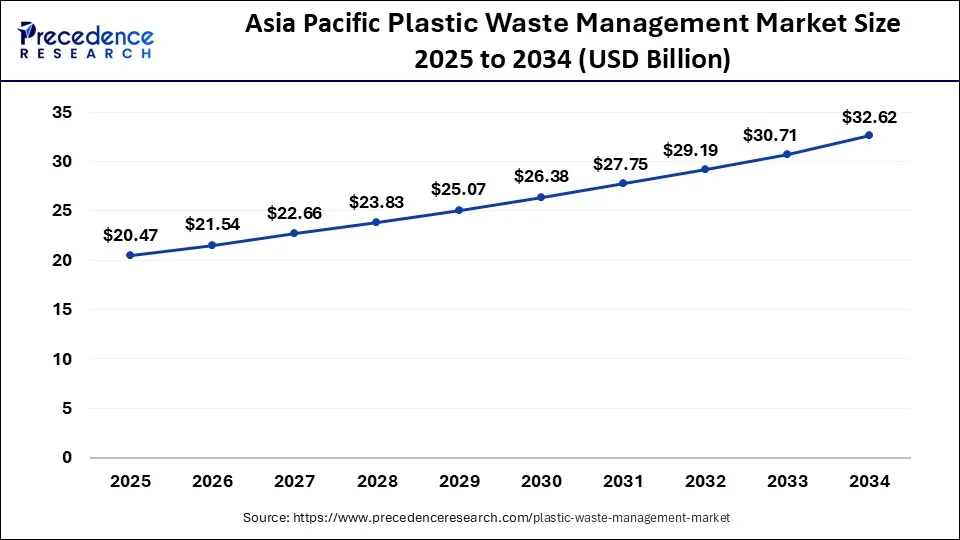
The Asia Pacific plastic waste management market size is estimated at USD 20.47 billion in 2025 and is predicted to be worth around USD 21.54 billion by 2035, at a CAGR of 5.29% from 2026 to 2035.
What Made Asia Pacific the Dominant Region in the Market?
Asia Pacific dominated the plastic waste management market by capturing the largest share in 2025, driven by its large population, high consumption of plastic and significant waste generation volumes. Rapid urbanization and industrial growth, particularly in countries like China, India, and Japan, have increased the need for efficient waste collection and recycling systems. The growing use of single-use plastic products such as bottles, caps, and packaging is significantly contributing to the plastic waste problem. Growing awareness of plastic pollution is driving market development throughout the Asia Pacific.
Efforts and Initiatives in Asia Pacific
- The ASEAN Regional Action Plan for Combating Marine Debris, a regional strategy focused on addressing marine plastic pollution in the ASEAN region by enhancing coordination and collaboration at regional and international levels.
- The Southeast Asia Regional Program on Combating Marine Plastics (SEA-MaP) project, overseen by the World Bank and funded by the International Development Association, aims at promoting plastic circularity by mitigating plastic consumption, increasing plastic recycling and minimizing plastic leakages in ASEAN Member States.
- The "Strengthening Plastic Pollution Management in Asia and the Pacific" project, also known as the Mekong and Pacific Project, is part of the United Nations Environment Programme's (UNEP's) CounterMEASURE initiatives. The project funded by the Government of Japan aims at improving monitoring, assessment, and systematic management of plastic pollution with informed policymaking in the Mekong River Basin and Pacific Island Countries.
China Market Trends
China dominates the Asia Pacific plastic waste management market, driven by its large-scale waste generation and extensive investments in recycling and waste processing infrastructure. The government in China emphasizes sustainability goals and promotes policies focused on environmental protection, resource efficiency, and the circular economy development, which has accelerated market growth. Expanding recycling capacity continues to strengthen China's position in the regional market.
India Market Trends
India is emerging as a significant player, spurred by rapid urbanization and its informal waste-picker network. This landscape is undergoing a substantial transformation with rigorous EPR mandates compelling brand owners to adopt circular practices and invest in formal recycling, turning waste challenges into structured and high-value investment opportunities.
What Makes North America the Fastest-Growing Region in the Market?
North America is expected to grow at the fastest CAGR during the forecast period. The growth is driven by increasing investments in advanced recycling technologies, waste-to-energy projects, and circular economy programs. The region has strong environmental regulations and corporate sustainability commitments, which encourage higher plastic recovery and recycling rates. The growing demand for recycled materials from the packaging, automotive, and consumer goods industries is further supporting market expansion.
U.S. Market Trends
The U.S. holds the largest share of the North American plastic waste management market, due to its well-established waste management industry and rising investments in mechanical and chemical recycling facilities. The government in the region has strong regulations, such as Extended Producer Responsibility (EPR) laws and single-use plastic bans, which are shifting the focus toward a circular economy and supporting sustainability goals.
How is the Opportunistic Rise of Europe in the Market?
Europe is expected to grow at a significant CAGR in the upcoming period in the plastic waste management market. The growth is supported by environmental policies and circular economy objectives. The region has established comprehensive waste collection and recycling systems that encourage material recovery and resource efficiency. The increasing investment in the region in advanced technologies, recycling facilities, and sustainable packaging solutions has strengthened market development.
Germany Market Trends
Germany dominates the European plastic waste management market, supported by its highly developed recycling infrastructure and strong environmental sustainability. The country has implemented efficient waste segregation practices and producer responsibility frameworks that support high recycling rates. The continuous advancement and technology development, including AI-driven sorting and new chemical recycling facilities, to enhance its packaging regulations, further contribute to the market growth.
What Drives the Latin American Plastic Waste Management Market?
The Latin American market is mainly driven by strong government environmental regulations and improved waste collection systems. The expansion of urban areas led to increased plastic waste production, requiring plastic waste management and recycling. Public and private sector investments in recycling infrastructure are gradually improving recovery rates across the region. Growing awareness of environmental sustainability is supporting the market growth.
Brazil Market Trends
Brazil leads the Latin American plastic waste management market due to its large population, significant waste generation volumes, and expanding recycling sector. The country has witnessed increasing investments in waste collection, sorting, and recycling facilities to address environmental challenges. Government programs promoting waste reduction and resource recovery continue to support market development.
Why is the Market Within the Middle East & Africa Gaining Momentum?
The plastic waste management market within the Middle East & Africa is growing, supported by governments' focus on environmental protection and sustainable waste handling practices. Rapid urbanization, population growth, and increasing plastic consumption have created greater demand for efficient waste management systems. The region has strict environmental regulations, growing awareness, and is shifting toward circular economy initiatives, which are propelling industries to invest in enhanced recycling and waste disposal infrastructure.
Saudi Arabia Market Trends
Saudi Arabia dominates the Middle East & Africa plastic waste management market in 2025, supported by substantial investments in waste management infrastructure and sustainability programs. The country is actively promoting recycling and resource recovery as part of broader environmental and economic initiatives. Increasing industrial activity and rising focus on circular economy practices continue to create opportunities for advanced plastic recycling solutions across the country.
Government Initiatives in the Plastic Waste Management Market
China
- In March 2026, China's action plan was developed to accelerate waste treatment capacity in the next five years. It aims to use 4.5 billion tonnes of solid waste and recycle 510 million tonnes by 2030. (Source: https://packagingeurope.com)
United States
- In February 2026, research analysis focused on microplastics and packaging due to a major problem of plastic pollution in the U.S. Research estimated that plastic use in the U.S. will be more than double that of 2019. The recycling companies, policymakers, manufacturers, and waste managers have the tools to reduce plastic consumption, pollution, and production.(Source: https://www.pew.org)
Germany
- In October 2025, the Ministry of Environment and the United Nations Development Programme (UNDP) in Jordan launched the ‘Circular Solutions to Plastic Pollution' project to remove single-use plastic materials in Jordan's food and beverage sector. This project was funded by the Global Environment Facility (GEF), and it aims to reduce health and environmental risks caused by plastic waste. It aims to cut 17,000 tons of greenhouse gas (GHG) emissions and 5,000 tons of plastic waste over the next five years. (Source: https://www.undp.org)
Brazil
- In October 2025, the UN Environment Programme reported that countries unite in Brazil at the inaugural plastic reboot annual conference to cut plastic pollution and advance circular solutions. The event is revolutionary for the USD 108 million GEF-funded global programme. It is further advancing the private sector, multilateral action and collaboration across governments and civil society. (Source: https://www.unep.org)
Saudi Arabia
- In May 2026, the International Trade Administration reported that waste management is a top priority for Saudi Arabia due to fast urbanization, high population growth, and economic development. The country aims to divert 90% of waste from landfills by 2040, and Saudi Arabia amounts to 110 million tonnes of total municipal solid waste produced by the country annually. (Source: https://www.trade.gov)
Investments/Revenue in the Plastic Waste Management Market
- In May 2026, Clean Harbors announced its first quarter financial results for 2026; revenues increased to $1.46 billion and net income increased to $63.2 million. The company also reported that technical services revenue increased by 5% on demand for recycling and disposal services, including PFAS-related work and higher project activity. (Source: https://ir.cleanharbors.com)
- In February 2026, Waste Connections Inc. announced that it has previewed two AI efficiency projects and highlighted about $330 million in acquired annualized revenue with 19 acquisitions in 2025. The company is making efforts on its renewable natural gas facility plans and continues AI-driven tech advancements. (Source: https://www.wastedive.com)
Supply Chain Analysis - Plastic Waste Management Market
- Research, Development, and Design
This focuses on developing new materials and designing products that are easily recyclable to prevent contamination, and advancing recycling technologies.
Key Players: BASF, Dow, LyondellBasell, and Veolia. - Collection and Aggregation
This involves gathering plastic waste from residential, commercial, and industrial sources.
Key Players: Waste Management, Inc, Republic Services, Biffa, and Veolia.
Sorting and Pre-processing
In this, the collected waste is sorted by polymer type and color to ensure purity, which is critical for high-value recycling.
Key Players: Tomra Systems ASA, MBA Polymers, KW Plastics, and Clear Path Recycling. - Recycling and Processing
This focuses on sorting and cleaning the plastics to create new raw materials and produce recycled resin.
Key Players: Indorama Ventures, Berry Global, Loop Industries, Agilyx, and Plastipak Packaging.
Competitive Landscape
The plastic waste management market is dominated by leading companies in AI-powered sorting technologies, massive collection networks, and global mechanical and chemical recycling operations. The global market leaders are Veolia Environnement S.A., SUEZ, WM/Waste Management, Inc., Republic Services, Inc., and Waste Connections, Inc. They offer core products like reverse vending machine systems, chemical pyrolysis technology, post-consumer recycled resins, bulk sorting infrastructure, etc. The primary market targets are commercial sorting centers, chemical plants, global polymer manufacturers, municipalities, FMCG packaging plants, industrial manufacturers, etc. R&D investments focus on AI sortation, chemical recycling, and bio-based polymers. The key R&D technologies are optical sorters, automated robotics, enzymatic breakdown, depolymerization, pyrolysis, etc.
Plastic Waste Management Market Companies
- SUEZ: SUEZ offers comprehensive plastic waste management solutions, thus, covering the entire value chain from collection along with sorting to recycling and high-quality material recovery.
- Waste Connections Inc.: Waste Management Inc. provides comprehensive plastic waste management services, aiming on residential and commercial recycling via single-stream technology, advanced material recovery facilities utilizing optical sorting and robotics.
- Clean Harbors: Clean Harbors provides comprehensive end-to-end hazardous along with non-hazardous plastic waste management, which includes collection, transportation, and disposal or recycling services. They cater to industrial, manufacturing, as well as commercial clients, using their extensive North American network to guarantee regulatory compliance and encourage sustainability through proper waste handling.
- Waste Connections Inc.: Waste Connections Inc. offers integrated recycling for plastics, along with landfills, transfer stations, as well as specialized E&P waste treatment, positioning itself as a major player in North American resource recovery.
Other Major Key Players
- Veolia Environment
- Covanta Holding Corporation
- Stericycle
- Remondis SE
- Biffa
Recent Developments
- In January 2026, a student-centered initiative aimed at combating climate change through the control of plastic pollution was launched in Kathmandu. The Climate Smart School program has been introduced by South Asian Youth for Sustainable Development (SAYS) with the support of the Konrad Adenauer Foundation (KAS). The initiative was launched on January 16 at NIC Academy in Sanobharyang, Kathmandu. (Source: https://github.com)
- In January 2026, it was reported that more of Victoria, Australia's hard-to-recycle plastics, including soft plastics, will be diverted from landfill and transformed into new products, following a $4 million government and industry investment. Four new projects will build the capacity, capability, and resilience of Victoria's resource recovery sector by increasing plastics recycling by 16,700 tonnes annually. These projects will boost jobs in the Victorian circular economy. (Source: https://minister.dcceew.gov.au)
- In March 2025, Resynergi, a visionary in modular advanced plastic recycling technology, announced the commercial launch of its proprietary Resynergi Modules, in collaboration with Lummus Technology. By leveraging the Continuous Microwave Assisted Pyrolysis (CMAP) Technology engineered by Lummus, the Resynergi Modules offer a decentralized, cost-effective solution for recycling plastic.
- In January 2025, UN Development Programme (UNDP) collaborated with The Coca-Cola Foundation (TCCF) for strategic scaling of plastic waste in Asia. The scaling up initiative by UNDP will receive a $15 million grant from TCCF and is set to launch in nine Asian countries, including Bangladesh, Bhutan, Cambodia, India, Maldives, Nepal, Philippines, Sri Lanka, and Vietnam.
- The mergers and acquisitions, partnerships, new product development, business expansions, collaborations, supply contracts, agreements, and contracts are some of the important marketing strategies used by the major market players to maintain their market position.
Segments Covered in the Report
By Service
- Collection
- Recycling
- Incineration
- Landfills
By Polymer
- Polypropylene
- Low density polyethylene
- High density polyethylene
- Polyvinyl chloride
- Terephthalate
- Others
By Source
- Residential
- Commercial
- Industrial
By End Use
- Packaging
- Textile
- Consumer product
- Transportation
- Building & construction
- Electrical & electronics
- Others
By Region
- North America
- Europe
- Asia-Pacific
- Latin America
- Middle East & Africa
For inquiries regarding discounts, bulk purchases, or customization requests, please contact us at sales@precedenceresearch.com
Frequently Asked Questions





Ask For Sample
No cookie-cutter, only authentic analysis – take the 1st step to become a Precedence Research client
 Get a Sample




 sales@precedenceresearch.com
 Schedule a Meeting
