



Polyurethane Foam Market Size, Key Companies, Product Segmentation, Application Demand, Company Revenue Performance, Competitive Landscape, Regional Dynamics, and Growth Forecast
Vidyesh Swar, a Chemical and Materials Industry Expert, estimates the polyurethane foam market at USD 330.60 billion in 2026, with the market projected to reach USD 110.3 billion by 2034 at a CAGR of 8%. Major polyurethane foam market companies such as Bayer AG, BASF SE, Covestro AG are competing across key material and application segments, including by product, by application.
Source: https://www.precedenceresearch.com/polyurethane-foam-market
 Get a Sample
 Table Of Content


Polyurethane Foam Market Size and Forecast 2026 to 2034
The global polyurethane foam market size was estimated at USD 59.59 billion in 2026 and is predicted to increase from USD 55.18 billion in 2025 to approximately USD 110.3 billion by 2034, expanding at a CAGR of 8% from 2026 to 2034.

Polyurethane Foam Market Key Takeaways
- In terms of revenue, the polyurethane foam market is valued at 55.18 billion in 2025.
- It is projected to reach 110.3 billion by 2034.
- The market is expected to grow at a CAGR of 8% from 2025 to 2034.
- Asia Pacific led the global market with the highest market share of 45% in 2025.
- By Product, the flexible foam segment is projected to record a remarkable market share between 2025 and 2034.
- By Application, the construction segment contributed the largest revenue share in 2025.
Market Overview
Polyurethane foam is a synthetic cellular-structured porous material derived from the reaction of polyols and diisocyanates. Its structure is a composite of a gas phase and a solid phase. The solid phase is prepared from polyurethane elastomer.
Polyurethane foam is a widely used polymer that is available in two forms i.e., flexible foam and rigid form. Rigid polyurethane foams are utilized for numerous insulation applications pertaining to construction and refrigeration.
Rigid polyurethane foam is energy efficient and helps in reducing energy costs. Flexible polyurethane foams are particularly used as a cushioning substance in various end-use industries such as furniture, packaging, transportation, bedding, automotive interiors, and carpet underlay. The use of flexible polyurethane foam is becoming popular as it can be created in almost any shape and variety. These flexible foams are also durable, light, comfortable, and supportive.
Automotive companies are using polyurethane forms for reducing the weight of electric vehicles (EVs). This makes the electric vehicle lighter and more efficient, which allows the passenger to travel longer distances per charge.
Government support in the form of subsidies and tax incentives is expected to encourage the manufacturing sector in countries such as India and China. This is anticipated to promote bio-based polyurethane to replace conventional polymers.
Environmental benefits of polyurethane foams include clean incineration and high recyclability for reduced wastage, pollutant filtration, and greater sustainability. However, several government authorities and federal agencies are concerned about the detrimental health effects of isocyanates used in polyurethane production.
The penetration of polyurethane foams is anticipated to increase owing to properties such as superior insulation that is ideal for walls and roofs in new homes. The use of polyurethane foams in buildings helps to reduce noise levels and maintain a uniform temperature. Increasing expenditure on construction in countries such as Indonesia, India, United Arab Emirates, Qatar, and South Korea due to rising urban population coupled with strong industrial sector growth is anticipated to fuel the market growth.
Growing population, infrastructure projects, loan facilities, increasing per capita income, and government support are the supporting factors that are expected to boost the construction market growth in the coming years.
Market Scope
| Report Coverage | Details |
| Market Size in 2024 | USD 51.09 Billion |
| Market Size in 2025 | USD 55.18Billion |
| Market Size by 2034 | USD 110.30 Billion |
| Growth Rate from 2024 to 2034 | CAGR of 8% |
| Largest Market | North America |
| Fastest Growing Market | Asia Pacific |
| Base Year | 2024 |
| Forecast Period | 2025 to 2034 |
| Segments Covered | Product, Application, and Region |
| Regions Covered | North America, Europe, Asia-Pacific, Latin America and Middle East & Africa |
Market Dynamics
Polyurethane is a common polymer that is used to prepare foam, especially for furniture. Polyurethane foam is relatively soft and has an elastic open-cell structure which is preferable for lightweight and delicate items. Polyurethane foam is also used for those products that are very sensitive to vibration. FOAMplus, polyurethane foam packaging is a highly popular packaging solution that tends to negate the requirement for large storage areas needed for pre-fabricated packaging.
Polyurethane foams are found in the armrests, seats, and headrests of many vehicles. The cushioning properties of polyurethane foams help in reducing the stress and fatigue usually associated with driving. As per CEIC Data, the sale of passenger cars in the U.S. was reported to be 3,350,050 units in December 2021. This figure is a notable rise from the previous figure of 2,302,989 units sold in June 2021. In developing countries, the construction of new roads further boosts the demand for private passenger cars. Thus, the rising production of vehicles boosts the requirement for particular polyurethane foams.
In January 2020, Covestro AG collaborated with Recticel NV/SA for developing mattresses from end-of-life mattresses. This collaboration was aimed to create a circular economy in the polyurethane foam market that would help both companies in decreasing the usage of raw materials involved in the production of polyurethane foams.
Wanhua Chemical Group Co., Ltd. acquired a 100% stake in Chematur Technologies AB for $134 million in August 2019. Chematur Engineering AB provides technologies for all major offerings in the polyurethane field. Owing to this acquisition, the position of Wanhua Chemical Group Co., Ltd. has strengthened in the polyurethane foam market. Such collaborations and acquisitions are expected to support the polyurethane foam market growth substantially from the supply side.
Segments Insights
Product Insights
The global polyurethane foams market is segmented into rigid foam, flexible foam, and spray foam. The flexible foam segment is expected to hold a significant market share during the forecast period. Flexible polyurethane foam is broadly utilized as a cushioning material in the production of seating, mattresses, and specialty items. Flexible polyurethane foam is produced by reacting a polyol blend (containing surfactants, catalysts, cell opener, blowing agent, etc.), with a Toluene Diisocyanate (TDI) and Methylendiphenyl Diisocyanate (MDI).
Rigid polyurethane foams are predominantly utilized in the insulating of buildings, doors, and appliances. Installers make use of rigid polyurethane foam for insulating garage doors and entry doors, and the process can be discontinuous or continuous. For appliances, rigid polyurethane foam is installed to insulate drink machines, ice machines, hot water heaters, and among other applications. Structural rigid polyurethane foams are can be used for architectural trim, floatation, chair backs, and signage.
The prominent construction uses for rigid polyurethane foams include concrete lifting, house sheathing, aforementioned ditch breaks, and pole setting. The foam is either injected or sprayed via a low-pressure gun delivery system.
In 2020, as per the Economic Impact Study commissioned by the Building Owners and Managers Association of the U.S. (BOMA), the establishment of business offices is increasing in the United States. Various governments in the Middle East region emphasize developing the real estate industry through numerous commercial and residential projects. Thus, expanding commercial and residential construction activities boost the demand for furniture, which enhances the requirement for respective polyurethane foams.
Application Insights
The global polyurethane foams market is segmented into bedding & furniture, transportation, packaging, automotive, construction, electronics, footwear, and other applications. The construction segment had the highest revenue share in 2024, and it is expected that it would continue to dominate the market during the study period as a result of the growing residential real estate sector.
As per the analysts, the turnover in the real estate industry in Germany in 2021 reached a record high of € 337 billion ($381.61 billion). The residential sector in China is predicted to expand at a promising rate in near future. As of 2022, the urbanization rate in China was 64.7% and this rate is predicted to reach 75-80% by 2035. In February 2022, banks in almost 90 cities in China cut mortgage rates in order to boost the sales and buying power of the purchaser in the residential property market in the country. Thus, the expanding construction sector improves the demand for polyurethane foams required in buildings and houses.
Polyurethane foam is most often used in freezers and refrigerators that are responsible for maintaining thermal isolation with respect to exterior environments. Rigid polyurethane foam is applied particularly between the outer metal casing of freezers and the inner liner made of polyethylene. In 2020, Gorenje decided to build a new production hall for freezers and refrigerators. This new hall is expected to increase the freezer and refrigerator production capacity by an additional 750,000 units per year.
Regional Insights
Asia Pacific Polyurethane Foam Market Size and Growth 2024 to 2034
The Asia Pacific polyurethane foam market size was exhibited at USD 22.99 billion in 2024 and is projected to hit around USD 50.19 billion by 2034, growing at a CAGR of 8.12% from 2025 to 2034.
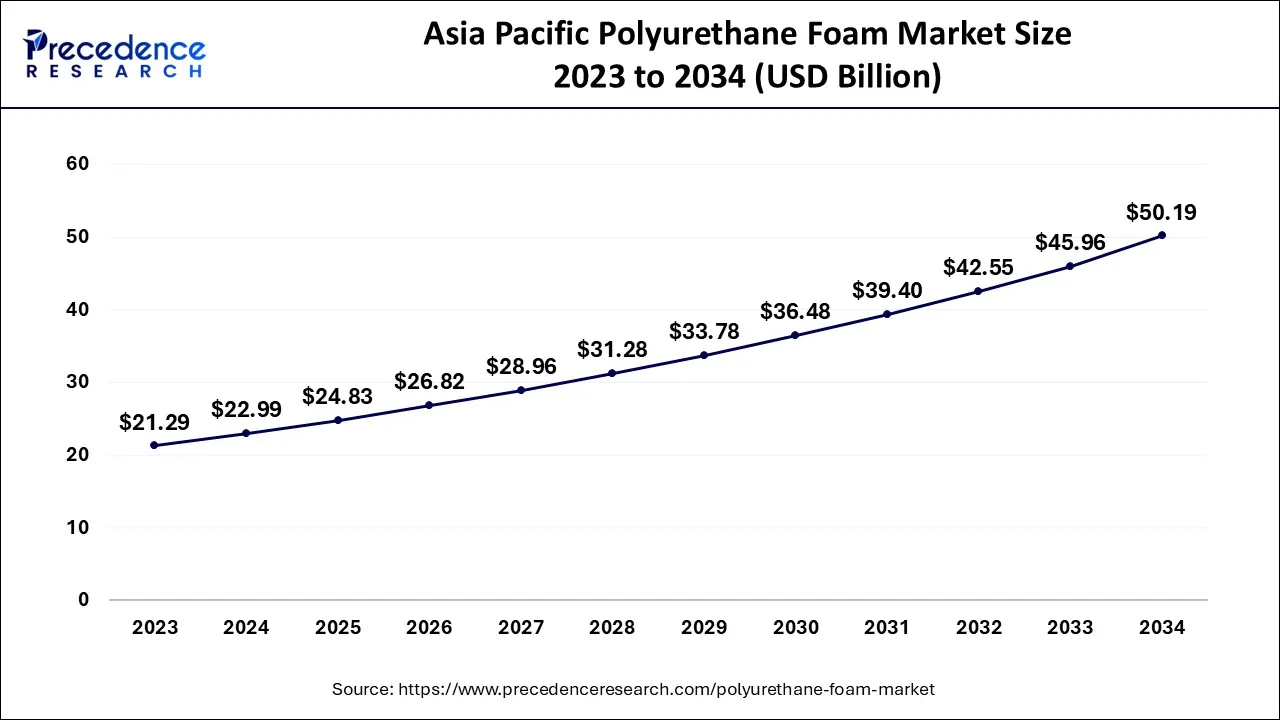
In 2023, Asia Pacific (APAC) held the largest revenue share. Factors such as increasing demand for polyurethane foams from various end-user industries and the expanding footprint of the global players dealing in polyurethane foams are anticipated to boost the polyurethane foam market growth in the region. Approximately 178,000 new houses are forecasted to be constructed in Australia in the fiscal year 2025. India has made significant progress in many Sustainable Development Goals (SDGs) and the per capita income of the country increased to ₹ 1,97,000 ($2,411.08) by the end of 2022. Thus, the rising count of houses and increasing per capita income boosts the demand for furniture & bedding in the Asia Pacific region.
In the coming years, Germany's hotel industry is set to expand with 364 additional properties and 57,926 rooms. Hamburg, the home to Germany's largest seaport, is all set to have 23 new hotels and 5,625 extra rooms in near future. In the capital city of Berlin, 19 hotels are expected to open, which will add up to 4,121 new rooms. The French hotel market is anticipated to have 96 additional properties and 15,485 rooms during the forecast period. Thus, expanding hotel industry creates significant demand for polyurethane foams required for freezers, beds, refrigerators, and hotel mattresses.
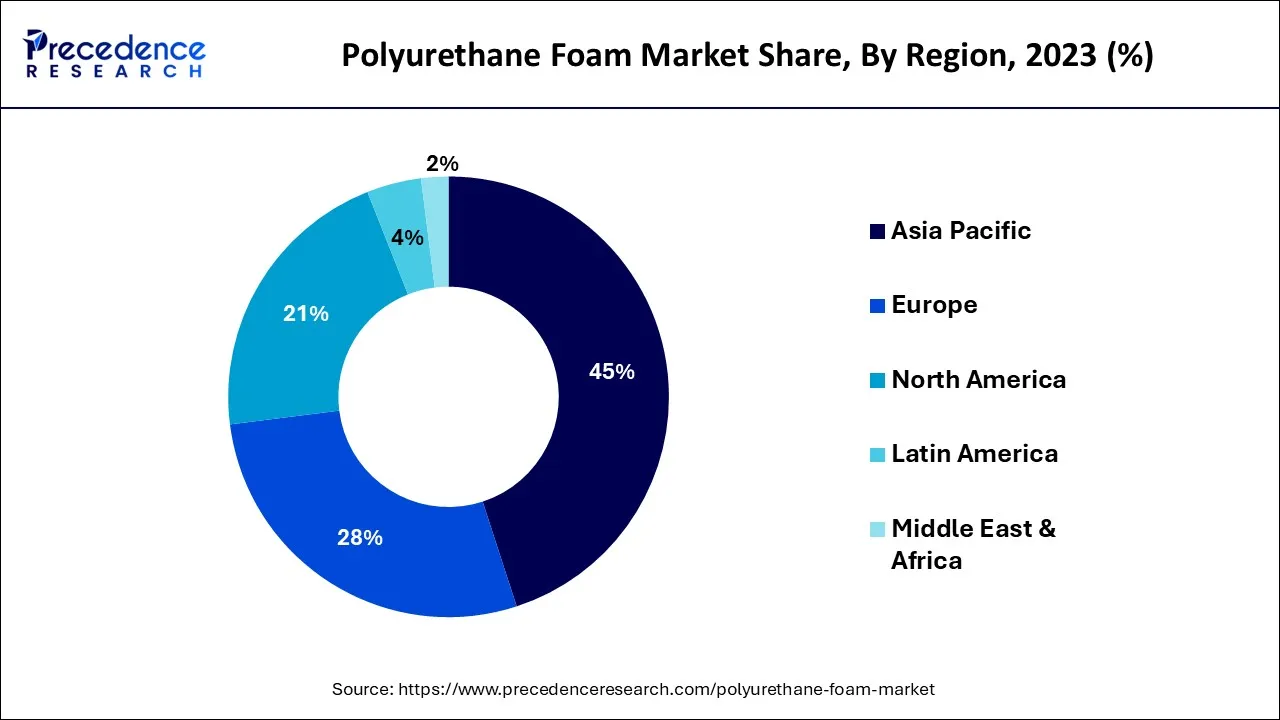
North America is estimated to be the fastest-growing market for polyurethane foam during the study period. North America is the most developed continent owing to the presence of nations with favorable economic policies, high gross domestic product (GDP), and early adoption of advanced infrastructures.
The immigrant population is rising notably in Canada since past few years. Canada's population is rising at almost double the pace of each G7 country. Approximately 4/5th of the 1.8 million population rise from 2016 to 2021 was attributable to the new arrivals in Canada, either as temporary or permanent immigrants. While the pandemic of COVID-19 slowed the movement of people across the world, nearly 185,000 permanent immigrants arrived in Canada in the financial year 2020. Thus, the rising population in Canada is creating immense scope for the automobile industry. Thus, the rise in the demand for new vehicles creates a significant opportunity for polyurethane foam required in vehicles.
Competitive Landscape
The polyurethane foam market is driven by green building mandates, energy efficiency, rapid expansion of cold chain and e-commerce infrastructure, bio-based innovation, and premiumization of furniture, bedding, and automotive interiors. The global market leaders are BASF SE, Covestro AG, The Dow Chemical Company, Huntsman Corporation, and Wanhua Chemical Group Co., Ltd. The top foam producers, converters, and specialists are Recticel NV/SA, Rogers Corporation, Saint-Gobain S.A., Sealed Air Corporation, UFP Technologies, Inc., and INOAC Corporation. The core product offerings are next-gen sustainable polyether polyols, CQ-configurator, low-emission PU foam technology, MDI-based rigid insulation systems, bio-based and low-VOC polyurethane foams, etc. The major R&D focus areas are low-GWP blowing agent regulations, stringent global energy-efficiency mandates, and circular economy demands. The major R&D innovation trends are CO2-based and recycled polyols, automotive lightweighting, EV co-development, and compliance with new codes.
Company Profiles
BASF SE
- HQ: Ludwigshafen, Germany
- Founded: 1865
- Ownership: Publicly traded company
- Business Overview: BASF SE prioritizes localized expansions, sustainable raw materials, and a portfolio that streamlines under its ‘winning ways' corporate strategy. The major end-use markets for this company are automotive, building insulation, and bedding and furniture.
- Products: Spray Polyurethane Foam (SPF) Systems, rigid foams, sandwich insulation panels, flexible foams and raw materials, specialized formulations and PU additives, and microcellular polyurethane and particle foams.
- Geographic Presence: BASF SE has a global footprint across 93 countries with 234 production sites globally.
- Revenue: BASF SE generated sales revenue of €59.7 billion for the full year 2025.
- Recent Development: In July 2026, BASF SE strengthened its position in the global market and achieved major progress on portfolio and restructuring measures. The company also stated a price increase due to surface technologies, chemicals, materials, and industrial solutions.
- Key Strategies: Portfolio and capital allocation, boost speed and autonomy, transform the green transition, win performance culture, net-zero production, targeted innovation, AI productivity, etc.
Bayer AG
- HQ: Leverkusen, Germany
- Founded: 1863
- Ownership: Publicly traded company and a multinational stock corporation
- Business Overview: Bayer AG is a life sciences company focused on its crop science and consumer health divisions. Bayer AG has separated its polymer and plastics raw material division into an independent company named Covestro AG.
- Products: Industry-standard raw materials such as Desmodur and Baymer by Covestro AG, and polyurethane operations under ADNOC's international investment umbrella, XRG.
- Geographic Presence: Bayer AG operates with 89,237 employees and has its global headquarters in Germany and in more than 80 countries across the world.
- Revenue: Bayer AG reported group sales of €24.277 billion for the first half of 2026, and sales revenue of €10.872 billion for Q2 2026.
- Recent Development: In March 2026, Bayer AG delivered its upgraded 2025 ambition and projects for 2026 by focusing on strategic priorities. The company expected 2026 to be a year of stable earnings and solid sales on a currency-adjusted basis.
- Key Strategies: Financial recovery and litigation management, crop science, pharmaceuticals, consumer health, agricultural AI, sustainability, decarbonization, net-zero targets, and high-impact commercial innovation.
Chemtura Corporation
- HQ: Philadelphia, Pennsylvania, U.S.
- Founded: 2005
- Ownership: Wholly owned subsidiary of LANXESS AG
- Business Overview: The growth of Chemtura Corporation is propelled by energy-efficient, sustainable building insulation rules and lightweight automotive trends. The company's former polymer and urethane assets are related to the legacy Chemtura portfolio.
- Products: Flame retardant additives, polyurethane prepolymers and elongators, legacy Chemtura formulations, highly functional flame retardants, and isopropylphenyl phosphate variants.
- Geographic Presence: Chemtura Corporation operates 20 sites across 11 countries, and it sells specialty chemicals to customers in over 100 countries.
- Revenue: Chemtura Corporation reported annual sales of approximately $1.61 billion.
- Recent Development: In April 2026, Lanxess inaugurated a new blending plant at the Jhagadia site. This facility will aim to manufacture specialty lubricant additives from the company's vast portfolio.
- Key Strategies: Aggressive portfolio management, industrial performance products, industrial engineered products, strategic realignment toward greener technology, capital expenditure, global expansion, and operational excellence.
Covestro AG
- HQ: Leverkusen, North Rhine-Westphalia, Germany
- Founded: 2015
- Ownership: Owned by XRG P.J.S.C.
- Business Overview: Covestro AG holds a focus on circular alignment and an economy model, and aims for net-zero emissions by 2050. The major rationales behind the industrial growth are global investments and partnerships, and capital increases.
- Products: Rigid and semi-rigid foam systems, semi-rigid PU systems, specialized semi-rigid formulations, an integrated rigid PU foam wall insulation formulation, polyol components, etc.
- Geographic Presence: Covestro AG operates globally with 13 R&D hubs and 46 production sites that are distributed across Asia Pacific, North America, and the EMLA regions.
- Revenue: Covestro AG generated full-year group sales revenue of EUR 12.9 billion for fiscal year 2025.
- Recent Development: In June 2026, Covestro AG (Covestro Materials) opened new possibilities for AI-era electronics during COMPUTEX 2026. It has been reported that the new needs for electronic components and system design are driven by the rapid advancement of AI.
- Key Strategies: Optimize, Grow, and Transform strategy, sustainability and climate commitments, structural market alignment, digitalization, strategic partnerships, etc.
Dow Inc.
- HQ: Midland, Michigan, U.S.
- Founded: 2019
- Ownership: Publicly traded company owned by public shareholders and large institutional investors
- Business Overview: Dow Inc. has implemented localized price increases, major asset restructuring, and circular recycling initiatives. It supplies rigid and flexible foam solutions that are used in building cold chain appliances, thermal insulation, furniture, and automotive cushioning.
- Products: Core raw materials and intermediates, flexible foam solutions, rigid foam and insulation systems, automotive and EV specialties, processing additives and surfactants, and sustainability and circular economy offerings.
- Geographic Presence: Dow Inc. operates a massive global network with sales, business activities, and customer service for manufacturing operations across 30 countries and approximately 160 countries.
- Revenue: Dow Inc. reported revenue of $12.09 billion for the second quarter of 2026.
- Recent Development: In January 2026, Dow Inc. launched a comprehensive plan referred to as Transform to Outperform to enable improved returns by raising the competitive industry benchmark for growth and productivity. This plan will simplify operations and streamline its end-to-end processes.
- Key Strategies: Transform to Outperform strategy, circularity and sustainability focus, asset optimization, circular solutions, decarbonisation, etc.
Polyurethane Foam Market Companies
- BASF SE
- Bayer AG
- Chemtura Corporation
- Covestro AG
- Dow Inc.
- Dupont
- Elliot Co.
- Foamcraft Inc.
- Future Foam
- Huntsman Corporation
- Reciticel
- Rogers Corp.
- Saint-Gobain S.A.
- Sekisui Chemicals
- Trelleborg AG
- UFP Technologies
- Woodbridge Group
Recent Developments
- In December 2025, BASF SE launched WALLTITE RSB spray polyurethane foam insulation, aiming to advance sustainability in construction materials. The new products meet growing demand for more sustainable building materials. (Source: https://www.basf.com)
- In November 2025, SIBUR, a Russian petrochemical giant, launched a revolutionary solution in shell-type thermal insulation materials. The company aims to introduce next-generation polyurethane foam shells for pipeline protection. (Source: https://www.indianchemicalnews.com)
Segments Covered in the Report
By Product
- Rigid Foam
- Flexible Foam
- Spray Foam
By Application
- Bedding & Furniture
- Transportation
- Packaging
- Automotive
- Construction
- Electronics
- Footwear
- Others
By Geography
- North America
- Europe
- Asia-Pacific
- Latin America
- The Middle East and Africa
For inquiries regarding discounts, bulk purchases, or customization requests, please contact us at sales@precedenceresearch.com
Frequently Asked Questions





Ask For Sample
No cookie-cutter, only authentic analysis – take the 1st step to become a Precedence Research client
 Get a Sample




 sales@precedenceresearch.com
 Schedule a Meeting
