



Electric Vehicle Charging Station Market Revenue to Attain USD 548.05 Bn by 2035
Published: 14 May 2026
Author: Precedence Research



Electric Vehicle Charging Station Market Revenue and Trends 2026 to 2035
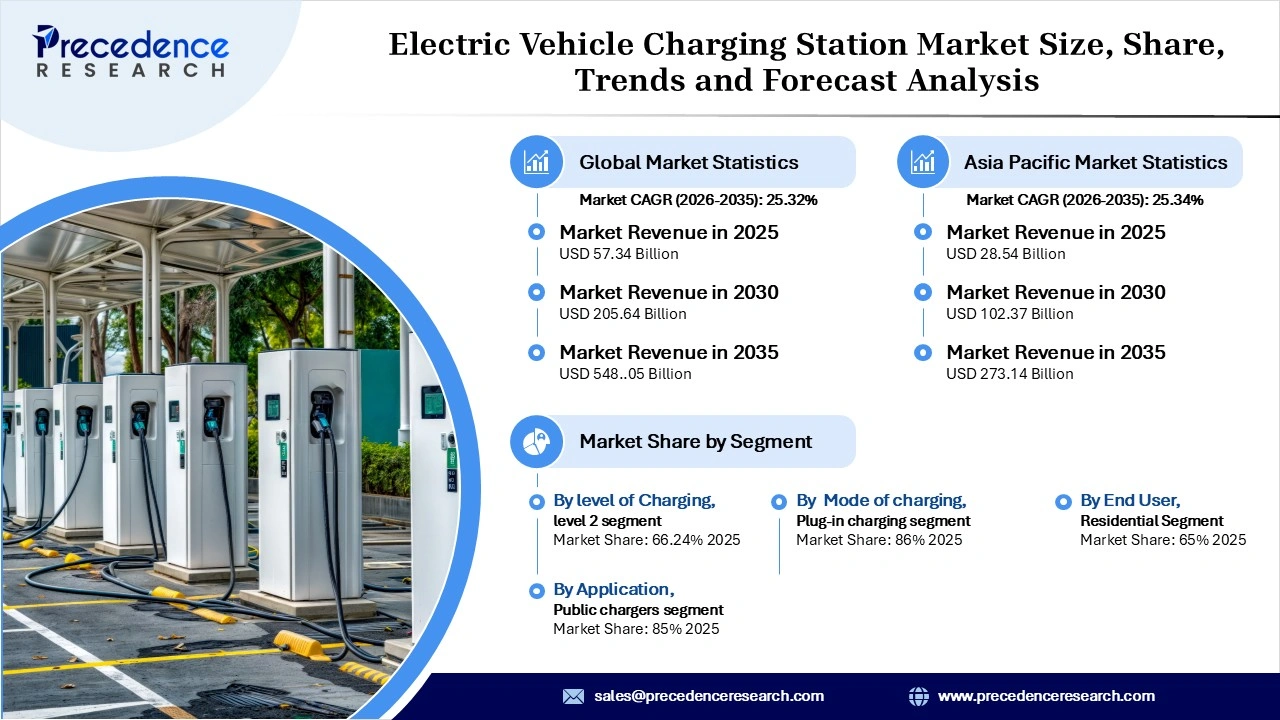
The global electric vehicle charging station market revenue stood at USD 57.34 billion in 2025 and is projected to increase from USD 73.92 billion in 2026 to approximately USD 548.05 billion by 2035, expanding at a CAGR of 25.32% from 2026 to 2035. Electric vehicle (EV) charging station is a significant aspect of global change towards sustainable and low-emission transportation. It promotes the increased use of electric vehicles by ensuring the infrastructure required in convenient and efficient charging.
Market briefly
The electric vehicle charging station market deals with the growth, installation, and operation of electric vehicle charging systems in residential, commercial, and public areas. It has diverse forms of charging, which include slow, fast, and ultra-fast chargers, accommodating the diverse user requirements. The market is stimulated by the growth of EVs, favorable policies in the country, and growing environmental awareness. Moreover, the growth of charging networks and innovation in the development of charging technologies are boosting the development of the market at a global scale.
Market Forecast
India’s EV Infrastructure Plan 2025–26 focuses on strengthening the electric mobility ecosystem by expanding charging networks and encouraging EV adoption. The strategy emphasizes widespread deployment of charging stations across cities, highways, and semi-urban areas to improve accessibility. Government support through initiatives like FAME II Scheme and upcoming programs is driving infrastructure growth and subsidies. The plan also promotes the integration of renewable energy sources such as solar and wind into charging systems. Public-private partnerships with companies like Tata Power and BPCL are accelerating implementation. Despite challenges like high costs and infrastructure gaps, the initiative aims to boost EV adoption, create jobs, and reduce carbon emissions.
Secondary Data
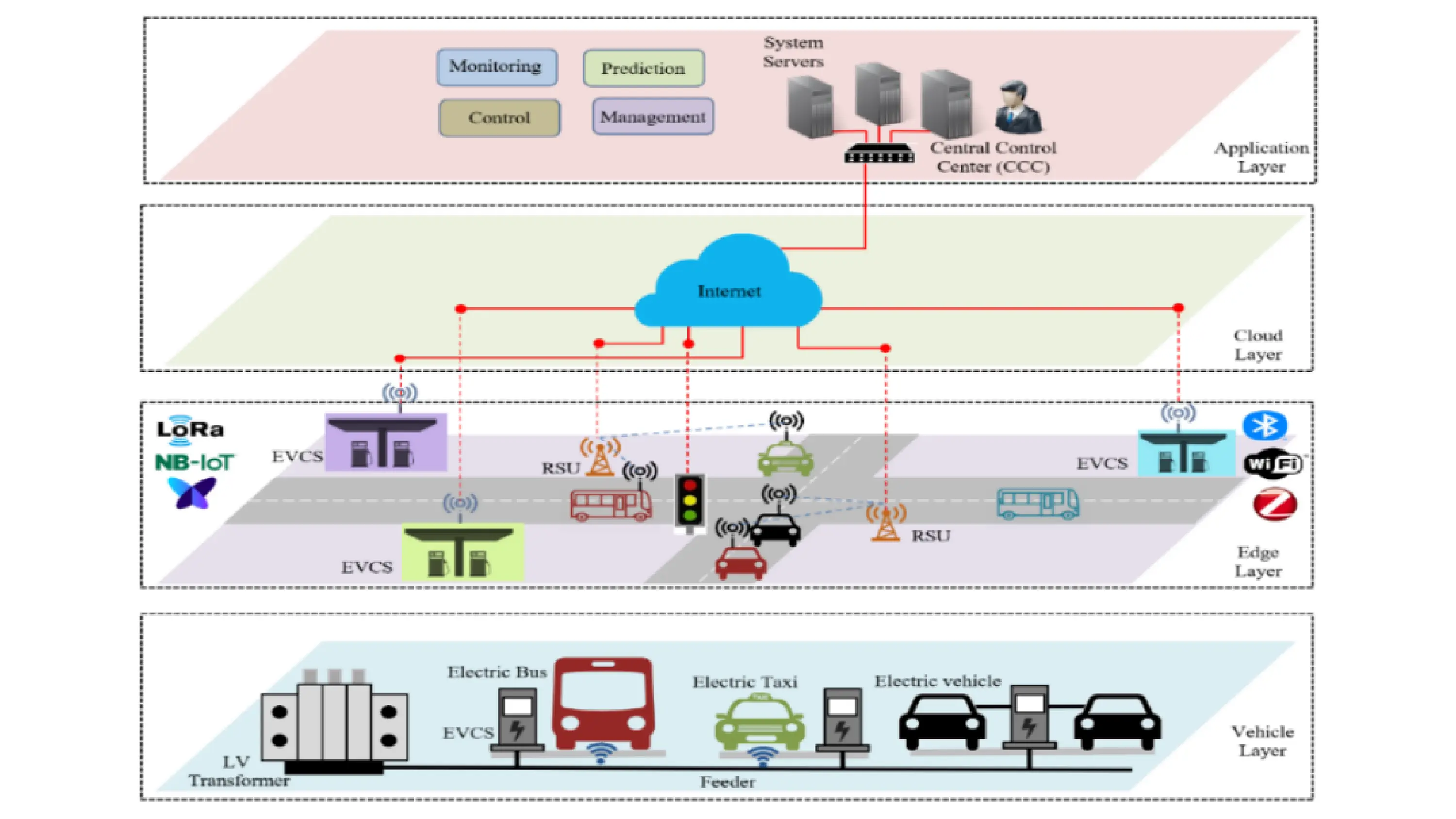
The diagram illustrates a layered smart architecture of the Electric Vehicle (EV) Charger Market, showing how power infrastructure, charging stations, communication networks, and central management systems interact to enable efficient EV charging.
At the Vehicle Layer (bottom), electric vehicles such as electric buses, taxis, and private cars connect to Electric Vehicle Charging Stations (EVCS). Power is supplied from the low-voltage (LV) transformer through feeders, ensuring regulated electricity delivery to different charging points based on vehicle type and charging demand.
Above this is the Edge Layer, which includes local EV charging stations (EVCS and LVCS), roadside units (RSUs), and connected vehicles. This layer enables real-time data exchange between vehicles, chargers, and nearby infrastructure using short-range and wide-area communication technologies such as Bluetooth, Wi-Fi, LoRa, and NB-IoT. Edge intelligence allows fast decision-making for load balancing, user authentication, and fault detection.
The Cloud Layer acts as the central communication backbone, aggregating data from distributed charging stations and vehicles via the internet. It supports data storage, analytics, remote diagnostics, and software updates, enabling interoperability across geographically dispersed charging networks.
Regional Insight
Asia Pacific stands at the forefront of the EV charging station market, driven by stringent emission regulations and an ambitious push toward green mobility. The European Union’s climate policies and clean transport directives have catalyzed investments in public and private charging infrastructure. Urban centers are witnessing rapid deployment of ultra-fast chargers and smart grids that integrate renewable energy sources. Public-private collaborations are fostering interoperability, allowing drivers to access multiple charging networks seamlessly. Additionally, subsidies and incentives for EV adoption continue to strengthen infrastructure expansion across highways and residential areas.
With significant global influence, China has heavily invested in developing one of the world’s most extensive charging infrastructures, strongly supported by government backing and its status as the largest EV market. Striving towards a greener transport future, India is pushing forward with electric mobility by offering subsidies and establishing a growing network of public and private charging points. Japan is integrating its EV expansion with sustainability goals by deploying advanced charging technologies and working towards a carbon-neutral future. Emphasizing innovation, South Korea is leading with smart and renewable-powered charging stations and expanding its EV-ready urban infrastructure.
Latin America
The Middle East and Africa are gradually electrifying their mobility landscape, signaling the early stages of a transformative transition. Rising environmental consciousness and economic diversification plans are driving interest in EV infrastructure development. Governments across the region are beginning to integrate clean energy objectives into national transport strategies. The expansion of solar-powered charging stations aligns with the region’s abundant renewable resources, particularly in the Gulf countries. However, challenges such as limited grid capacity, high setup costs, and low EV penetration still temper the market’s full potential. Despite these obstacles, growing investment from international automakers and energy players marks the beginning of a new electric era.
Saudi Arabia is spearheading this evolution under its Vision 2030 initiative, which includes electrification of transportation as a core sustainability goal. The UAE follows closely, with Dubai and Abu Dhabi deploying public and private charging networks to support the growing fleet of electric cars. South Africa is emerging as a continental hub, with early infrastructure being introduced alongside clean energy reforms. Egypt’s government-led collaborations are paving the way for local production and installation of charging units. Morocco is integrating EV infrastructure into its renewable energy ecosystem, leveraging its leadership in solar projects. Collectively, these nations illustrate the region’s slow yet steady march toward sustainable mobility.
Segmental Insights
Level of Charging
The Market of electric vehicle charging stations is dominated by Level 2 charging because it offers a middle ground between speed and affordability in charging. It is popularly known in homes, businesses, and community applications, and it is quicker than the regular Level 1 systems. This is because these chargers normally run on 240 V and hence are applicable for daily charging. Their comparatively cheaper costs of installation than fast chargers facilitate large-scale implementation. Level 2 chargers remain the most popular ones to be used in the day-to-day situation due to the growing number of EV owners.
The fastest-growing segment is Level 3 charging, which is also referred to as DC fast charging because the charges take a much shorter time to charge vehicles. It is especially appropriate on the highways and commercial centres as well as long-distance routes. This segment is experiencing investments due to the increasing demand for fast and convenient ways of charging. Both governments and individual participants are quickly building fast-charger networks to facilitate EV adoption. With increasing technology, Level 3 chargers are becoming more efficient and more available.
Charging Station
Wireless charging is becoming predominant because it is convenient and has enhanced technology that allows you to charge devices without the use of physical connectors. It enables EVs to be charged via electromagnetic means, thereby improving the user experience, as well as minimizing wear and tear. This technology is especially appealing to high-end cars and the mobility solutions of the future. Its growth is being aided by the increased investment in smart infrastructure. Wireless charging is likely to get more widespread as the level of innovation continues.
Station-based charging is the solution with the greatest rate of growth because of the fast development of the public and commercial networks of charging stations. These stations are well-positioned within cities, highways, and commercial areas to enhance accessibility. The increased use of EVs is also fuelling the need to have widespread charging stations. Integration with digital payment systems and smart monitoring enhances usability. The piece keeps growing with investment in charging at a large scale by governments and companies.
Vehicle Type
It is dominated by battery electric vehicles (BEVs) since they are fully powered by electricity and must be charged on a regular basis. The growing demand towards zero-emission mobility has made BEVs faster towards its adoption worldwide. These cars have the advantage of government subsidies and battery technology. An increasing environmental consciousness amongst the consumer society is also encouraging their demand. Consequently, most of the charging infrastructure is being used by BEVs.
Plug-in hybrid electric vehicles (PHEVs) are the fastest-growing segment as they offer a combination of electric and conventional fuel options. The ability to go far in one direction and flexibility to the user is achieved because of this dual capability. There is growing consumer interest in transitional technologies, which is driving their usage. Charging infrastructure development is also supporting their growth. PHEVs are a blend between conventional and fully electric vehicles.
Installation Type
Portable charging solutions prevail because they are flexible and convenient to the EV owners. They are portable and may be used in other places thus becoming the best choice of chargers in times of emergency or when people have to charge their devices. They do not need much installation and are affordable to the individual user. This segment is being fueled by the growing demand by residential consumers. They are also very flexible, hence a popular choice among early-stage EV users.
The quickest-expanding category is fixed charging installations due to its dependability and greater efficiency. These chargers have become a permanent installation at homes, workplaces and even in places of public use. They are reliable, and long lasting. Their adoption is increasing due to increased infrastructure investments. Fixed installations are on the rise as EV usage rises.
Connector Type
The market is dominated by AC charging since it is prevalent both in homes and in business places. It is inexpensive and can be used with most electric cars. The chargers AC are recommended in the case of over-night or extended charging. Their presence at all costs makes them a common option among EV users. The affordability and ease of AC charging make it domineering.
The most rapidly expanding category is normal charging as more residential users adopt this type of charging. It also offers an easy and cost-effective solution to the daily charging requirements. The household installation of simple charging systems is increasing due to increases in EV ownership. This would be the segment of low cost and convenience. It is actively developing together with the EV market.
Application Insights
Public charging stations are the leading players in the market since they offer the necessary infrastructure to EV users during their travels. They are well-positioned in both urban areas, on highways, and in commercial centers. These stations maximize the distance range and facilitate long distances. They are growing through government endeavours and through investments by individuals. Public charging is a crucial element in facilitating extensive EV adoption.
The residential EV ownership is rising, which makes residential charging the most rapidly developing segment. Home charging is convenient, saves on costs and is easy to access. Customers like to charge their cars at home at night. With new technology, the use of private chargers is more efficient and more affordable. This portion will expand at a high rate of EV penetration.
Mounting Type
Charging stations that can be mounted on the walls prevail since they are smaller in size and can be installed both at home and at the workplace. They are simple to set up and deliver an orderly and tidy charge solution. These are often used in workplaces, garages, and parking places. They are very popular due to their affordability and practicality. Wall-mounted solutions are still the most popular as EV usage increases.
The quickest growing category is the pedestal-mounted chargers because they are most appropriate to install in social and business sites. They are outdoors and can be used by many people. Their adoption is driven by increasing demand and use of the infrastructure of public charging. These chargers are durable and can be placed anywhere. With the growth of urban infrastructure, the use of pedestal-mounted solutions is rising.
Top Companies in the Electric Vehicle Charging Station Market
- ABB Ltd. (Offers a complete range of EV charging solutions, from compact AC wallboxes for homes to robust DC fast-charging stations and innovative bus-charging systems for public transit.)
- Charging point inc.(Operates one of the world's largest open EV charging networks, connecting drivers with numerous charging spots across North America and Europe.)
- EVgo Services LLC. ( A leading provider of public fast-charging networks in the United States, specializing in DC fast charging.)
- Allego (A major independent operator of public EV charging networks across Europe, with a network spanning numerous countries.)
- Schneider Electric (Provides comprehensive solutions that address the full energy ecosystem for EV charging, from electrical protection and safety to load management and software.)
- Blink Charging Co. (Offers a full suite of EV charging solutions, including the design, ownership, and operation of Level 2 and DC fast-charging stations across the United States.)
Segments Covered in the Report
By Level of Charging
- Level 1
- Level 2
- Level 3
By Charging Station Type
- AC Charging
- DC Charging
- Wireless Charging
By Power Output
- <11KW
- 11KW-50KW
- >50KW
By Supplier Type
- OE Charging Station
- Private Charging Station
By Vehicle Type
- Passenger Cars
- Battery Electric Vehicle (BEV)
- Plug-in Hybrid Vehicle(PHEV)
- Heavy Commercial Vehicles
- Light Commercial Vehicles
- Two-wheelers & Scooters
By Installation Type
- Fixed
- Portable
- Residential
- Commercial
By Connector Type
- Normal Charging
- Type 2
- CCS
- CHAdeMO
- Tesla SC
- GB/T
By Application
- Private
- Public
By Mounting Type
- Wall Mount
- Pedestal Mount
- Ceiling Mount
By Charging Service
- EV Charging Service
- Battery Swapping Service
By End User
- Commercial EV Charging Stations
- Commercial Public EV Charging Stations
- On-Road Charging
- Parking Spaces
- Destination Chargers
- Commercial Private EV Charging Stations
- Fleet Charging
- Captive Charging
- Commercial Public EV Charging Stations
- Residential EV Charging Stations
By Region
- North America
- Europe
- Asia-Pacific
- Latin America
- Middle East and Africa
Get this report to explore global market size, share, CAGR, and trends, featuring detailed segmental analysis and an insightful competitive landscape overview @ https://www.precedenceresearch.com/sample/1003
You can place an order or ask any questions. Please feel free to contact us at sales@precedenceresearch.com |+1 804 441 9344