



Quadruped Robot Market Trends, Companies, Revenue / Sales Performance, Manufacturing Yield, Fab Capacity, Export & Import Dynamics, Supply Chain Analysis, Competitive Landscape, and Growth Forecast
Quadruped Robot Market (By Type: Service Robots, Inspection Robots, Rescue Robots, Research Robots; By Technology: Autonomous Navigation, Remote Control, Tele-operated; By Application: Defense, Logistics, Construction, Healthcare, Others) - Global Industry Analysis, Size, Trends, Leading Companies, Regional Outlook, and Forecast 2026 to 2035.
Source: https://www.precedenceresearch.com/quadruped-robot-market
 Get a Sample
 Table Of Content


What is the Quadruped Robot Market Size in 2026?
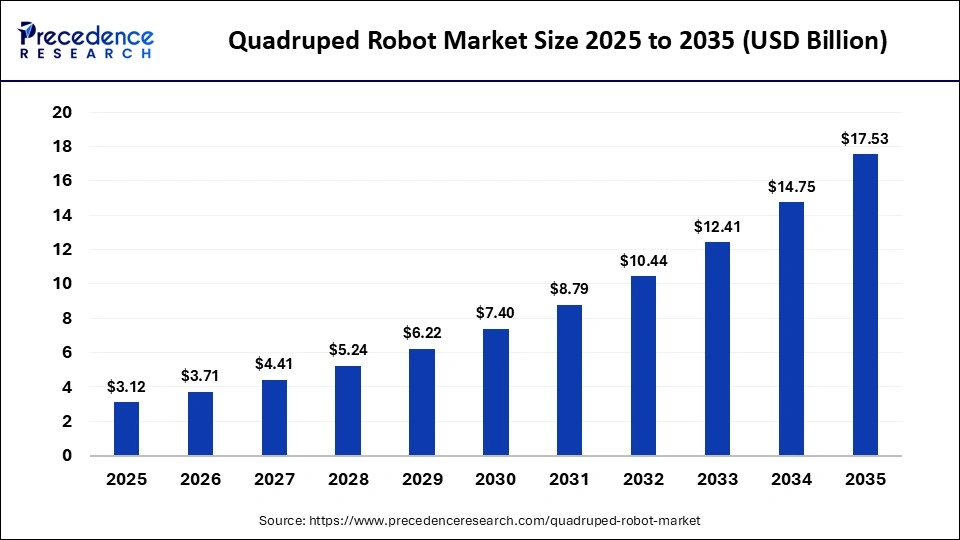
The global quadruped robot market size was calculated at USD 3.12 billion in 2025 and is predicted to increase from USD 3.71 billion in 2026 to approximately USD 17.53 billion by 2035, expanding at a CAGR of 18.84% from 2026 to 2035.This market is growing due to increasing demand for advanced mobility robots capable of operating in complex, hazardous, and uneven environments across industries such as defense, industrial inspection, logistics, and disaster response.
Key Takeaways
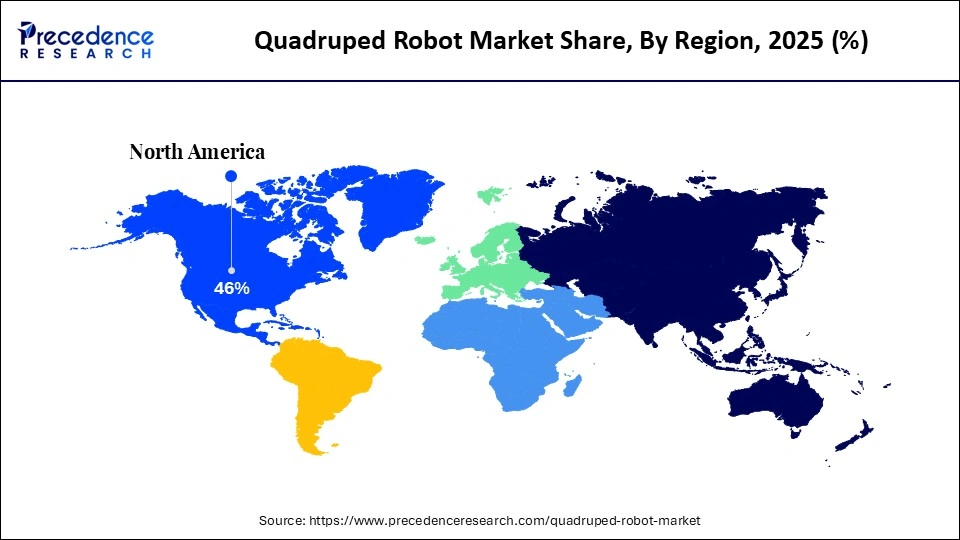
- North America dominated the market with the largest share of 46% in 2025.
- Asia Pacific is expected to grow at the fastest CAGR between 2026 and 2035.
- By type, the research robots segment held the biggest market share in 2025.
- By type, the service robots segment is expected to expand at a significant CAGR between 2026 and 2035.
- By technology, the autonomous navigation segment contributed the highest market share in 2025.
- By technology, the remote control segment is expected to grow at a strong CAGR between 2026 and 2035.
- By application, the defense segment held a major market share in 2025.
- By application, the logistics segment is expected to expand at the fastest CAGR from 2026 to 2035.
What Drives the Growth of the Quadruped Robot Market?
The quadruped robot market is witnessing strong growth as industries are adopting robots capable of navigating confined spaces, stairs, and uneven terrain, where wheeled robots are ineffective. Demand is being driven by an increase in applications in disaster response, logistics, industrial inspection, defense, and surveillance. With further improvements in autonomy and dependability brought about by technological advances in AI sensors and battery efficiency, quadruped robots are becoming a viable option for demanding and complex operational settings.
Future Market Overview
- Smart City Infrastructure Monitoring: Increasing development of smart cities is generating demand for robotic security and inspection solutions.
- Hazardous Environment Operations: The rising need to reduce human exposure in high-risk industrial settings is creating long-term opportunities.
- Agricultural Automation Expansion: Adoption in agriculture for crop monitoring and farm management presents strong growth potential.
- Government Robotics Funding: Growing public investments in robotics research and defense modernization are supporting industry expansion.
- Healthcare Logistics Applications: Hospitals are exploring quadruped robots for internal logistics and remote assistance services.
- Construction Site Monitoring: Utilization in construction projects for inspection and real-time data collection is increasing.
- Affordable Model Development: Production of cost-effective quadruped robots can expand adoption among small and medium enterprises.
- IoT and Cloud Integration: Integration with IoT platforms is enabling real-time analytics and predictive maintenance capabilities.
- Rising Venture Capital Investments: Increasing funding in robotics startups is accelerating technological advancements and market growth.
How are Government Initiatives Supporting the Quadruped Robot Market?
Government initiatives are playing a vital role in accelerating the growth of the quadruped robot market through increased funding for robotics research, defense modernization, and AI development programs. Autonomous systems are being purchased by numerous nations for use in border security, military surveillance, and disaster relief. Advanced robotic platforms are being developed by startups and established businesses with the support of national robotics missions, innovation hubs, and public sector grants. Additionally, there is a sustained need for quadruped robotic solutions due to government-sponsored infrastructure monitoring initiatives and smart city projects.
Why is the Quadruped Robot Market Resilient?
| Factor | Market Impact |
| Defense Demand | Stable military spending ensures consistent procurement and long-term contracts |
| Industrial Automation | Growing use in inspection and monitoring supports steady adoption. |
| Hazardous Operations | Essential role in high-risk environments sustains continuous demand |
| AI Advancements | Ongoing improvements in autonomy and sensors enhance efficiency and reliabilityc |
| Diverse Applications | Usage across defense, logistics, construction, and disaster response reduces dependency risks |
| Government & R&D Support | Public funding and innovation programs strengthen long-term growth |
| Private Investments | Venture capital and partnerships accelerate commercialization. |
| Smart Infrastructure Growth | Rising smart city projects create sustained future opportunities |
How is Artificial Intelligence Transforming the Quadruped Robot Market?
Artificial intelligence plays a crucial role in advancing the quadruped robot market by facilitating real-time obstacle detection, autonomous navigation, and adaptive decision-making in challenging situations. These robots can analyze terrain, identify objects, and dynamically modify their movements thanks to AI-powered algorithms, which increase operational efficiency and safety. By facilitation data driven insights, predictive maintenance, and route optimization, machine learning capabilities further improve performance. The range of applications for quadruped robots in the fields of defense, industrial inspection, logistics, and disaster response is rising dramatically as AI technology develops.
Major Trends in the Market
- Defense and Military Application: Increasing adoption of quadruped robots for surveillance, reconnaissance, and tactical operations in complex terrains is strengthening market demand.
- Growth in Industrial Inspection: Rising deployment in oil & gas, mining, and power generation facilities is improving operational safety and efficiency.
- AI-Powered Autonomy: Integration of artificial intelligence enables smarter navigation, obstacle detection, and real-time decision-making capabilities.
- Advanced Sensor Integration: Incorporation of LiDAR, thermal imaging, and 3D vision systems is enhancing precision and expanding application areas.
- Disaster Response Deployment: Growing use in emergency rescue and disaster management operations is supporting market expansion.
- Battery and Energy Efficiency Improvements: Continuous advancements in battery life and energy optimization are increasing operational duration.
- Warehouse and Logistics Automation: Expanding automation in warehouses is creating new roles for quadruped robots in monitoring and material handling.
- Strategic Industry Collaborations: Partnerships between robotics manufacturers and technology firms are accelerating innovation and commercialization.
Market Scope
| Report Coverage | Details |
| Market Size in 2025 | USD 3.12 Billion |
| Market Size in 2026 | USD 3.71 Billion |
| Market Size by 2035 | USD 17.53 Billion |
| Market Growth Rate from 2026 to 2035 | CAGR of 18.84% |
| Dominating Region | North America |
| Fastest Growing Region | Asia Pacific |
| Base Year | 2025 |
| Forecast Period | 2026 to 2035 |
| Segments Covered | Type, Technology, Application, and Region |
| Regions Covered | North America, Europe, Asia-Pacific, Latin America, and Middle East & Africa |
Segment Insights
Type Insights
What Made Research Robots the Dominant Segment in the Quadruped Robot Market?
The research robots segment dominated the market with the largest share in 2025 because of their strong demand from robotics labs, defense research organizations, and universities. These robots are frequently used to test advanced sensor systems, AI integration, and mobility algorithms. The dominance of the segment is also aided by significant investments in robotics innovation and prototype creation. Research organizations also favor platforms that are adaptable for technological advancement and experimentation.
The service robots segment is expected to grow at the fastest CAGR in the coming years because of the growing use of these robots in commercial and industrial areas for tasks related to facility management, delivery services, security patrols, and inspections. Quadruped service robots offer agility in navigating complex environments, such as crowded spaces or uneven terrain, where traditional wheeled robots struggle. Their demand is increasing due to growing automation trends in various industries, and improved dependability and cost savings are also facilitating quick adoption.
Technology Insights
Why Did the Autonomous Navigation Segment Dominate the Quadruped Robot Market?
The autonomous navigation segment dominated the market in 2025 because robots that can function autonomously in challenging environments have become more and more necessary in industries. AI-powered terrain adaptation, obstacle avoidance, and mapping improved operational effectiveness. Autonomous systems are preferred by organizations to minimize human intervention. This technology is critical for applications in defense, industrial inspection, disaster response, and logistics, where reliability, precision, and reduced operator dependency are essential, driving strong adoption across industries. The leadership of this segment is also reinforced by technological developments in sensors and machine learning.
The remote control segment is expected to grow at the fastest CAGR in the coming years, owing to the growing need for defense and hazardous operations. Operators are able to oversee tasks from a safe distance with the help of remotely controlled robots. In high-risk industrial sites and surveillance, these robots are especially helpful. Growing defense modernization initiatives are also driving segmental growth.
Application Insights
Why Did the Defense Segment Dominate the Quadruped Robot Market?
The defense segment dominated the market while holding the largest share in 2025 due to the increased need for versatile, mobile robots in surveillance, reconnaissance, and tactical operations. Quadruped robots are widely used by military forces in difficult terrain where human mobility is restricted. The demand for these robots in the industry is further driven by higher international defense budgets. Their ability to carry sensors, weapons, and communication equipment, combined with enhanced autonomy and reliability through AI and sensor technologies, has driven widespread adoption in defense applications.
The logistics segment is expected to grow at the fastest CAGR in the coming years due to rising supply chain intelligence and warehouse automation. Quadruped robots assist in facility inspection, inventory monitoring, and navigating complex warehouse environments. Growth is driven by the expansion of smart warehouses and e-commerce, as businesses invest in automation to boost productivity and reduce reliance on human labor.
Regional Insights
North America Quadruped Robot Market Size and Growth 2026 to 2035
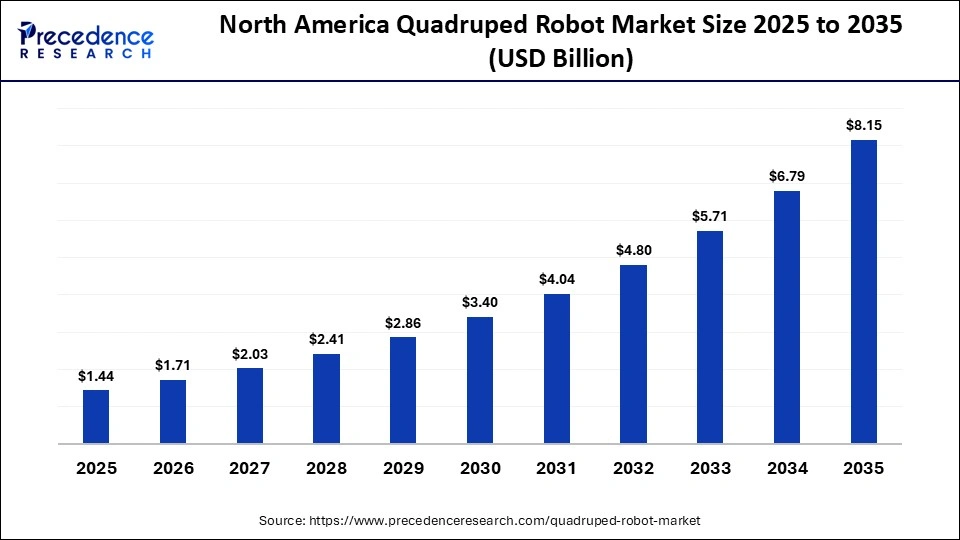
The North America quadruped robot market size is estimated at USD 1.44 billion in 2025 and is projected to reach approximately USD 8.15 billion by 2035, with a 18.93% CAGR from 2026 to 2035.
What Made North America the Dominant Region in the Quadruped Robot Market?
North America dominated the market by capturing the largest share in 2025 due to significant technological advancements and high defense spending. Prominent robotics innovators and reputable research institutions are present in the region, supporting the ongoing development and commercialization of quadruped robots. The region's leadership position in the market is further strengthened by the early deployment of AI-powered robotics in military security and industrial inspection applications. The region also benefits from strong R&D investments, well-established manufacturing infrastructure, and supportive government initiatives for robotics and AI deployment.
U.S. Quadruped Robot Market Size and Growth 2026 to 2035
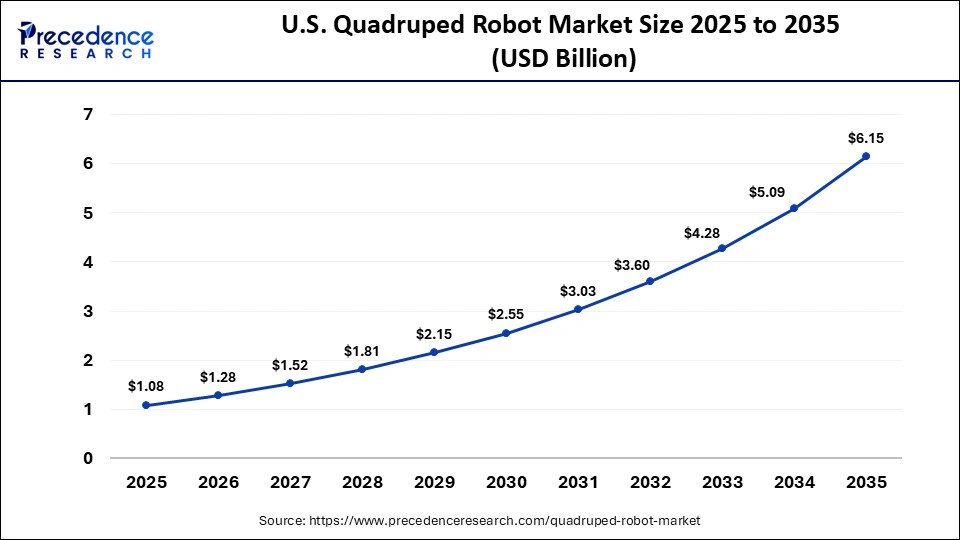
The U.S. quadruped robot market size is calculated at USD 1.08 billion in 2025 and is expected to reach nearly USD 6.15 billion in 2035, accelerating at a strong CAGR of 19.00% between 2026 and 2035.
U.S. Quadruped Robot Market Trends
The U.S. is a major contributor to the North American market, supported by significant investments in advanced robotics research and defense modernization. A strong presence of AI-focused startups and established tech companies supports the development and deployment of autonomous systems. Market growth is further fueled by expanding applications in security, logistics automation, and industrial inspection, alongside government-backed research initiatives and military contracts that increase demand for quadruped robots.
Why is Asia Pacific Considered the Fastest-Growing Region in the Market?
Asia Pacific is expected to grow at the fastest CAGR in the coming years because of growing defense capabilities and fast industrial automation. The market is expanding due to rising investments in robotics innovation across smart city projects, infrastructure monitoring, and manufacturing. To increase productivity, nations in the region are progressively incorporating automation and artificial intelligence technologies. Rates of adoption are increasing due to increased funding from the public and private sectors.
India Quadruped Robot Market Trends
India is emerging as a high-growth market within the Asia Pacific because of rising expenditures on industrial automation and defense technology. Demand is being driven by government programs assisting with smart infrastructure projects, robotics, and AI development. Market growth is fueled by rising automation solution adoption in logistics and inspection applications, as well as expanding manufacturing activities. Also bolstering the nation's market potential is the expanding robotics startup ecosystem.
How is the Opportunistic Rise of Europe in the Quadruped Robot Market?
Europe is expected to grow at a significant rate in the market due to the rising adoption of robots in public safety, defense, and industrial inspection applications. Demand is further driven by manufacturing sectors emphasizing automation and Industry 4.0 initiatives. Companies like ANYbotics are supporting regional growth by developing robotic solutions capable of operating in hazardous and complex environments.
Germany Quadruped Robot Market Trends
Germany is a key contributor to the European quadruped robot market, supported by its strong smart factory ecosystem and advanced industrial automation. Rising investments in AI and defense applications are boosting demand, while research organizations like the Fraunhofer Society drive innovation and technological advancement in robotics.
How is Latin America Growing in the Quadruped Robot Market?
Latin America is emerging as a significantly growing region in the global market. This growth is driven by intense demand for automation in harsh environments, such as mining and energy, where rugged terrain and safety risks make traditional robots ineffective. Countries like Chile and Brazil are prioritizing safety and efficiency in mining, oil, and gas, utilizing quadruped robots to navigate rugged terrain, unstable rocks, and tunnels, reducing human risk. Growing demand to automate, reduce maintenance times, and improve safety in the manufacturing and construction sectors is driving adoption.
Brazil Market Trends
Brazil is revolutionizing its heavy industries by testing AI-powered, quadruped robots for massive-scale reforestation and advancing autonomous mining to tackle labor shortages and boost efficiency in rugged terrain. Supported by rising investment in industrial partnerships, this tech-driven approach is transforming environmental action, accelerating reforestation, and optimizing agricultural monitoring.
How will the Middle East and Africa grow in the Quadruped Robot Market?
The Middle East and Africa region has significant growth in the market. This is due to heavy investment in industrial automation, infrastructure modernization, and security, particularly in the GCC countries. Major projects, such as Saudi Arabia's NEOM and urban expansions in the UAE, are incorporating robotics for 3D reality capture, structural monitoring, and construction site surveys to manage complex, large-scale projects efficiently. Governments in the UAE and Saudi Arabia are heavily investing in AI and robotics to diversify economies and enhance smart manufacturing.
The UAE Market Trends
The UAE is cementing its status as a global technology leader by integrating advanced autonomous quadruped robots into critical infrastructure, securing oil and gas sites, and enhancing urban surveillance. As part of a rapid digital transformation, these agile robot dogs are driving operational efficiency while the nation simultaneously pivots toward cutting-edge, AI-powered health rehabilitation, highlighting a futuristic, tech-driven skyline.
Supply Chain Analysis – Quadruped Robot Market
- Research and Development
This focuses on advancing locomotion algorithms, AI-driven perception, sensor fusion, and battery efficiency to handle unstructured environments.
Key Players: Boston Dynamics, ANYbotics, Unitree Robotics, Ghost Robotics, Deep Robotics, and ETH Zurich. - Manufacturing and Hardware Assembly
This involves highly complex assembly requiring specialized components and additive manufacturing for lightweight, strong bodies.
Key Players: Unitree Robotics, Boston Dynamics, DEEP Robotics, ANYbotics, and Ghost Robotics. - Autonomy, Integration, and Payload Customization
This focuses on integrating software, AI, and mission-specific payloads to turn hardware into actionable solutions for obstacle avoidance and developing RaaS software platforms.
Key Players: Boston Dynamics, ANYbotics, and Unitree Robotics. - Logistics, Deployment, and Maintenance
This involves specialized logistics to ship robots to industrial sites, followed by onsite installation, calibration, and long-term maintenance contracts.
Key Players: BD, ANYbotics, and Unitree.
Quadruped Robot Market Companies
- Boston Dynamics
- Unitree Robotics
- ANYbotics
- Ghost Robotics
- DEEP Robotics
- Swiss-Mile
- Agility Robotics
- Keybotic
- MAB Robotics
- WEILAN
- Honeybee Robotics
- Clearpath Robotics
Recent Developments
- In February 2026, Yokogawa Electric Corporation announced a partnership with ANYbotics to integrate OpreX Robot Management Core software with ANYmal robotic inspection solutions. This integration enables centralized management of multiple robot types, automating maintenance tasks and improving safety in industrial environments. The collaboration supports autonomous plant operations by allowing robots like ANYmal X to perform monitoring in hazardous conditions.(Source: https://www.yokogawa.com)
- In January 2026, MirrorMe Technology (Shanghai) partnered with Hangzhou Kaierda Welding Robot to launch the industrial-grade quadruped Apollo and establish an "R&D plus high-end manufacturing" consortium to drive its mass production.(Source: https://autonews.gasgoo.com)
- In December 2025, Pudu Robotics debuted at iREX 2025 in Tokyo, unveiling the PUDU D5 Series, a next-generation industry-grade autonomous quadruped robot. The series combines high-performance computing with all-terrain mobility and includes both legged and wheeled models.(Source: https://www.pudurobotics.com)
- In May 2025, DEEP Robotics announced the launch of the Lynx M20, a new mid-sized wheeled-legged robot for industrial environments. The robot features four-wheel drive and can reach a top speed of 15 km/h, capable of overcoming obstacles up to 200 mm. It is designed for efficient hazardous inspections, balancing the speed of wheels with the mobility of legs.(Source: https://www.deeprobotics.us)
Segments Covered in the Report
By Type
- Service Robots
- Inspection Robots
- Rescue Robots
- Research Robots
By Technology
- Autonomous Navigation
- Remote Control
- Tele-operated
By Application
- Defense
- Logistics
- Construction
- Healthcare
- Others
By Region
- North America
- Europe
- Asia-Pacific
- Latin America
- Middle East & Africa
For inquiries regarding discounts, bulk purchases, or customization requests, please contact us at sales@precedenceresearch.com
Frequently Asked Questions





Ask For Sample
No cookie-cutter, only authentic analysis – take the 1st step to become a Precedence Research client
 Get a Sample




 sales@precedenceresearch.com
 Schedule a Meeting
