



3D Printing Robot Market Size, Key Companies, Company Market Share, Chip Production Volume, Wafer Capacity, Technology Adoption, Pricing Trends, Competitive Positioning, and Demand Analysis
3D Printing Robot Market (By Component: Robot Arms, Software, 3D Printing Heads; By Robot Type: Articulated Robots, SCARA Robots, Cartesian Robots, Polar Robots, Delta Robots, Other; By Application: Tooling, Functional Part Manufacturing, Prototyping; By End-user: Culinary, Automotive, Construction, Fast-moving Consumer Goods (FMCG), Aerospace & Defense, Others) - Global Industry Analysis, Size, Trends, Leading Companies, Regional Outlook, and Forecast 2026 to 2035
Source: https://www.precedenceresearch.com/3d-printing-robot-market
 Get a Sample
 Table Of Content


What is the 3D Printing Robot Market Size?
The global 3D printing robot market size accounted for USD 2.17 billion in 2025 and is predicted to increase from USD 2.49 billion in 2026 to approximately USD 8.33 billion by 2035, expanding at a CAGR of 14.40% from 2026 to 2035. The market growth is driven by the increasing demand for robotics in the aerospace, healthcare, and construction industries.
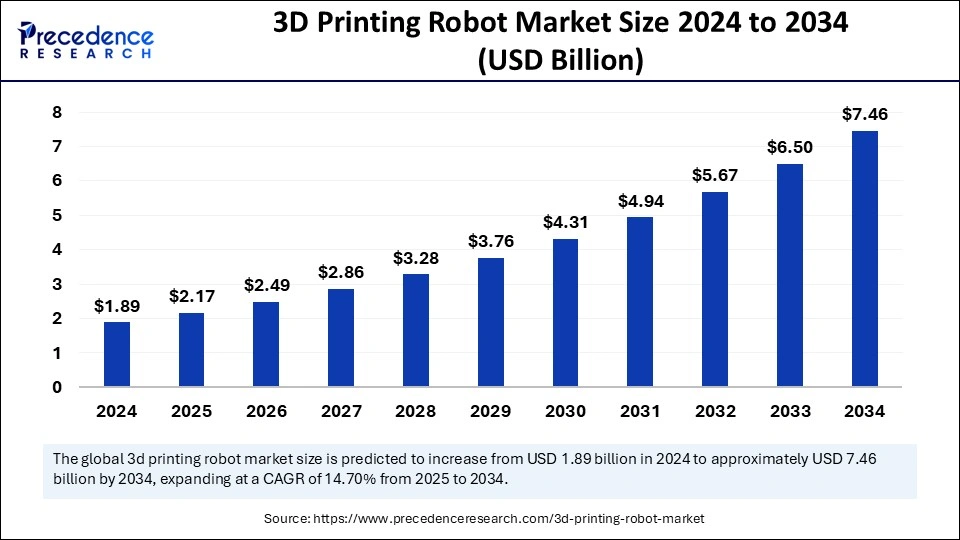
3D Printing Robot Market Key Takeaways
- North America dominated the 3D printing robot market with the largest share of 36% in 2025.
- Asia Pacific is anticipated to witness the fastest growth during the forecast period.
- By component, the robot arms segment held the dominant market share in 2025.
- By component, the software segment is expected to grow at the fastest rate between 2026 to 2035.
- By robot type, the articulated robots segment held the largest share of the market in 2025.
- By robot type, the SCARA robots segment is projected to grow at a significant CAGR over the studied years.
- By application, the prototyping segment led the global market in 2025.
- By application, the functional part manufacturing segment is projected to expand rapidly in the coming years.
- By end-user, the aerospace & defense segment dominated the market in 2025.
- By end-user, the construction segment is projected to grow at a notable rate in the near future.
What is the 3D Printing Robot?
The 3D printing robot market is witnessing significant growth due to the rising government initiatives to promote additive manufacturing to create innovative products. 3D printing robots are integrated with robotic arms and printing technology, which help build complex structures automatically. These robots find applications in various industries, such as automotive, construction, and aerospace. They help with prototyping, tooling, and final production. The rising adoption of 3D printing robots in the defense industry to accelerate the development of equipment further supports market growth.
Role of Artificial Intelligence in 3D Printing Robots
Integrating artificial intelligence (AI) algorithms in 3D printing robots automates operations and improves efficiency. AI algorithms analyze design parameters and optimize the design of 3D-printed objects. AI also monitors 3D printing processes in real-time, ensuring consistent quality. The implementation of AI-driven 3D printing robots helps businesses optimize their design procedures while achieving higher productivity levels. Moreover, these robots reduce material losses, leading to reduced production costs.
3D Printing Robot Market Growth Factors
- Advancements in AI and Automation: The integration of AI-driven controls and real-time monitoring in 3D printing robots is expected to enhance precision and efficiency in manufacturing.
- Demand for Customization: Increasing demand for customized products in the healthcare, automotive, and fashion sectors is projected to drive the adoption of robotic 3D printing.
- Expanding Applications in Aerospace: Expanding the use of 3D printing robots for developing lightweight and complex aerospace components is anticipated to accelerate market growth.
- Increasing Usage in the Medical Field: The rising usage of 3D printing robots in bioprinting and developing personalized medical implants is expected to boost the growth of the market.
- Reshoring of Manufacturing: The trend of reshoring production to reduce supply chain risks is expected to increase reliance on 3D printing solutions in various industries.
Market Outlook
- Industry Growth Overview: The demand of automation encourages the use of robotic additive manufacturing in the production settings of the customized production settings around the world.
- Sustainability Trends: Robotics integration will decrease the waste of material and will facilitate localized environmental production systems on a global basis.
- Global Expansion: Europe is progressing with robust aerospace, automotive, and Industry operations in favour of robotic printing technology.
- Major investors: ABB, KUKA AG, FANUC Corporation, Siemens AG, GE Additive, 3D Systems Corporation develop robotic technology.
Market Scope
| Report Coverage | Details |
| Market Size by 2035 | USD 8.33 Billion |
| Market Size in 2025 | USD 2.17 Billion |
| Market Size in 2026 | USD 2.49 Billion |
| Market Growth Rate from 2026 to 2035 | CAGR of 14.40% |
| Dominated Region | North America |
| Fastest Growing Market | Asia Pacific |
| Base Year | 2025 |
| Forecast Period | 2026 to 2035 |
| Segments Covered | Component, Robot Type, Application, End-user, and Regions |
| Regions Covered | North America, Europe, Asia-Pacific, Latin America and Middle East & Africa |
Market Dynamics
Drivers
Increasing Adoption in Aerospace and Defense
The increasing adoption of 3D printing robots in the aerospace sector is driving the growth of the 3D printing robot market. 3D printing enables the creation of complex and lightweight components with intricate designs, reducing the overall weight of aircraft and spacecraft. It also allows for rapid prototyping, reducing the time required for production cycles. 3D printing robots enable the on-demand manufacturing of spare parts with stronger structural designs. In addition, there is a high adoption of additive manufacturing in the defense sector to develop military aircraft, driving the growth of the market. In March 2025, Tom Enders, a Former CEO of Airbus, urged Europe to shift attention from major arms projects to nimble new technologies like robotic drones, a crucial part of the military. The industry-wide acceptance of 3D printing robots for making complex, lightweight structural components with exceptional strength represents a widespread shift to improve operational efficiency in both the aerospace and defense industries.
- In February 2025, Firestorm Labs received a USD 100 million contract from the U.S. Air Force to develop and deliver additive-manufactured unmanned aerial systems (UAS).
Restraint
High Initial Investment
The high costs of 3D printing robots are expected to hinder the growth of the 3D printing robot market. 3D printing robots require additional hardware and software for their optimized functionality, which adds to the overall cost. Multiple financial resources are required to procure and start 3D printing robot operations, creating challenges for SMEs. Moreover, operating and maintaining 3D printing robots requires comprehensive knowledge. Thus, the limited availability of skilled workforce limits the adoption of 3D printing robots, restraining market growth.
Opportunity
Focus on Industrial Automation
A strong emphasis on industrial automation creates immense opportunities for the 3D printing robot market. 3D printing robots automate various mundane tasks, freeing up workers for other complex tasks. Moreover, these robots minimize defects in manufacturing operations, enhancing overall productivity. Governments around the world are also promoting the usage of advanced automation technologies, encouraging businesses to invest heavily in industrial automation solutions, including robotics. The rising government investments in the industrial sector further propels market growth. Industrial funding makes it easy for industries to deploy 3D printing robots in production lines, as it removes manual work while controlling production expenses.
Segment Insights
Component Insights
The robot arms segment dominated the 3D printing robot market with the largest share in 2025. This is mainly due to their versatility and precise execution of additive manufacturing processes. The freedom of robotic arms extends to the creation of intricate shapes with the capacity to print items extending beyond one meter in dimensions. The 3D printing heads use five or six directional movements on an axis to draw complex shapes, which produce detailed components without supplemental support systems. Furthermore, large-scale 3D printing production received transformational development through robotic arms designed to layer concrete materials during print. Robotic arms have the ability to adapt to various tasks, making them ideal tools in manufacturing.
The software segment is expected to grow at the fastest rate in the coming years. The market benefits from advanced software that makes 3D printing robots work harmoniously with production systems through real-time process control capabilities. Advanced features built into software include path-planning automation with error detection and optimization features that improve 3D printing operational efficiency. Furthermore, as industries continue implementing 3d printing technology, the need for advanced software solutions is expected to grow. Software delivers consistent results, reduces operational costs, and enhances the overall efficiency of manufacturing processes.
Robot Type Insights
The articulated robots segment held the largest share of the 3D printing robot market in 2025. This is mainly due to their versatility and precision in additive manufacturing processes. The multiple rotary joints in articulated robots enhance maneuverability, which allows users to create complex designs larger than one meter across all dimensions. The five- or six-axis movements let the articulated robots follow complicated paths, which enables the creation of intricate components needing no extra support structures. Furthermore, the automotive and aerospace industries heavily use articulated robots to produce intricate designs and maximize production efficiency.
The SCARA robots segment is projected to grow at a significant CAGR over the studied years. SCARA robots offer a parallel-axis joint placement design that gives them X-Y compliance with Z-axis rigidity that enables precise, delicate assembly operations. The four-axis SCARA robot utilizes two parallel arm sections that move together in one plane, while its fourth axis enables the rotational motion of the end-effector to fulfill multiple 3D printing tasks. These robots function with printers to print complex designs and operate automated post-processing systems for support removal and inspection work while advancing the printing scale using multi-material capabilities.
Application Insights
The prototyping segment dominated the 3D printing robot market in 2025. The segment growth is driven by the rise in the need for rapid prototyping. It accelerates product development across various industries. 3D printing robots enable manufacturers to create complex prototypes, which facilitate fast design evaluation through numerous iterations. Rapid prototyping enables companies to accelerate production cycles and launch new products promptly with increased production volumes.
The functional part manufacturing segment is projected to expand rapidly in the coming years. The segment growth can be attributed to the ongoing advances in materials and simultaneous printing innovations. Many industries now depend on automated 3D printing machines that create functional parts with unusual designs that conventional production techniques find difficult to replicate. Furthermore, the manufacturing industry relies on functional part production to complete the production cycles. The rising demand for high-strength components and customized 3D printed parts in aerospace and automotive industries further support segmental growth.
End-user Insights
The aerospace & defense segment held the largest share of the 3D printing robot market in 2025. This is mainly due to the rise in the demand for components that are lightweight and feature complex geometries and exceptional performance. The aerospace and defense industries heavily use 3D printing and robotic solutions to develop efficient aircraft structures and durable defense equipment. 3D printing enables aircraft manufacturers to develop intricate and customized components that enhance the overall performance of aircraft. It reduces tooling requirements and cuts down both production expenses and material waste. The rise in defense expenditure to improve infrastructure further bolstered the segment.
The construction segment is projected to grow at a notable rate in the near future. Robots are significantly gaining traction in the construction sector owing to the rising need for automation in construction operations. The construction industry adopts 3D printing robots for building affordable structures with stronger materials while minimizing dependence on human labor. 3D printing robots can quickly produce a building without human intervention. In March 2025, Australia's first 3D-printed multistory house is being built using robotic cranes.
Regional Insights
What is the U.S. 3D Printing Robot Market Size?
The U.S. 3D printing robot market size was exhibited at USD 590 million in 2025 and is projected to be worth around USD 2,313 million by 2035, growing at a CAGR of 14.64% from 2026 to 2035.
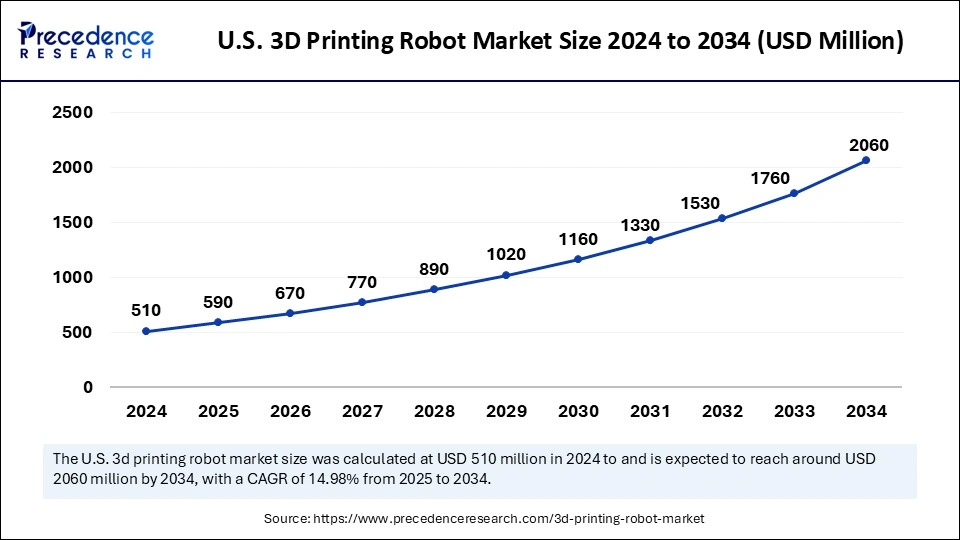
North America led the 3D printing robot market by capturing the largest share in 2025. This is mainly due to its strong industrial base, with various industries investing heavily in additive manufacturing. The region boasts some of the leading aircraft and spacecraft manufacturing companies that are investing heavily in 3D printing to accelerate development cycles. Furthermore, the region is an early adopter of 3D printing and robotics, which bolstered the market growth in the region.
The U.S. is a major contributor to the market growth. The U.S. government is actively promoting innovations in manufacturing technologies. There is a strong emphasis on industrial automation, with automotive, construction, and manufacturing industries investing in advanced automation solutions, supporting market growth.
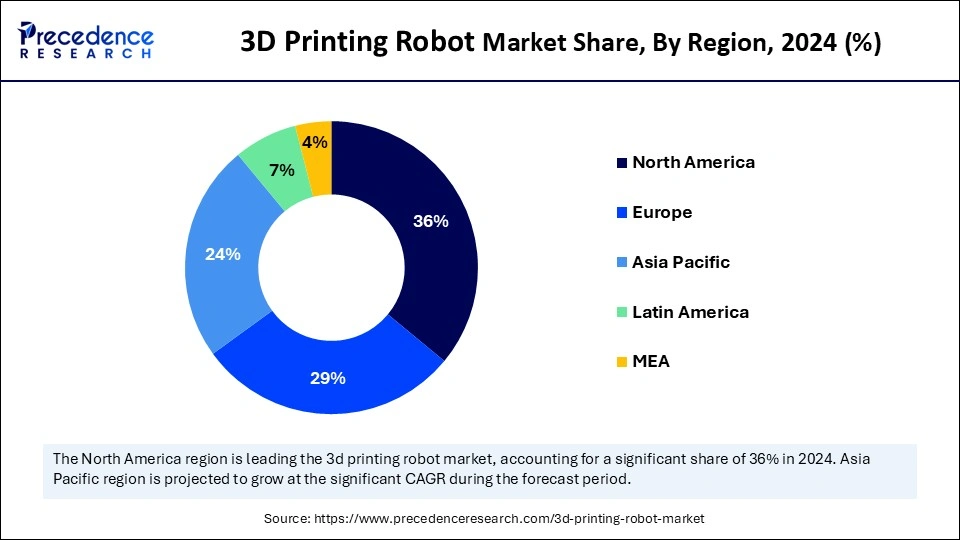
Asia Pacific is projected to witness the fastest growth in the market during the forecast period. The rising focus on industrial automation and improving manufacturing capabilities are expected to boost the growth of the market in the region. Governments around the region are promoting the use of advanced technologies to support industrial automation. The rapid industrialization further supports regional market growth. China stands out as a major player in the market. According to the Ministry of Industry and Information Technology (MIIT), for August 2024, China remained the global leader in industrial robot markets for the 11th consecutive year. China surpassed 430,000 industrial robot units in terms of production in 2023, while robots installed during that year captured half of the overall market volume. China demonstrates its strong dedication to implementing robotic 3D printing into massive manufacturing operations focused on the automotive and consumer electronics industries.
Europe is expected to witness notable growth in the coming years. The European 3D printing robot market growth is attributed to the rising demand for additive manufacturing among industries for creating sustainable production, lightweight materials, and customized solutions. In September 2024, the European Space Agency (ESA) reached an important feat when it completed the launch of Metal 3D Printer to the International Space Station (ISS). The technological breakthrough offers improved capabilities for production within space exploration missions while enabling developments for lunar infrastructure. There is a heightened adoption of robotics and 3D printing in the automotive sector. The German automotive industry heavily uses 3D printing robots to design sophisticated cars and improve production efficiency. Furthermore, the dedication of European entities toward integrating robotic 3D printing in every sector supports market growth.
Value Chain Analysis of the 3D Printing Robot Market
- Raw Material Procurement: Procurement of high-purity silicon ingots and special chemicals in manufacturing foundational robotic electronic systems.
Key players: Shin-Etsu Chemical, Sumco, GlobalWafers - Wafer Fabrication: The production of the integrated circuits through serious chemical procedures that allow robot intelligence and the ability to provide precise systems in operation.
Key players: Samsung Foundry, Intel, GlobalFoundries - Photolithography and Etching: The printing of circuit patterns by exposure to ultraviolet light and the formation of structures by selective chemical etching.
Key players: ASML, Nikon, Canon - Doping and Layering: This allows alteration of electrical characteristics using the introduction of impurities and the deposition of films of conductive or insulating thin materials.
Key players: Applied Materials, Lam Research, Tokyo Electron - Assembly and Packaging: Additive manufacturing of functional robotic control systems by incorporating tested semiconductor chips into the manufacturing system.
Key players: ASE Technology, Amkor Technology, JCET Group
3D Printing Robot Market Companies
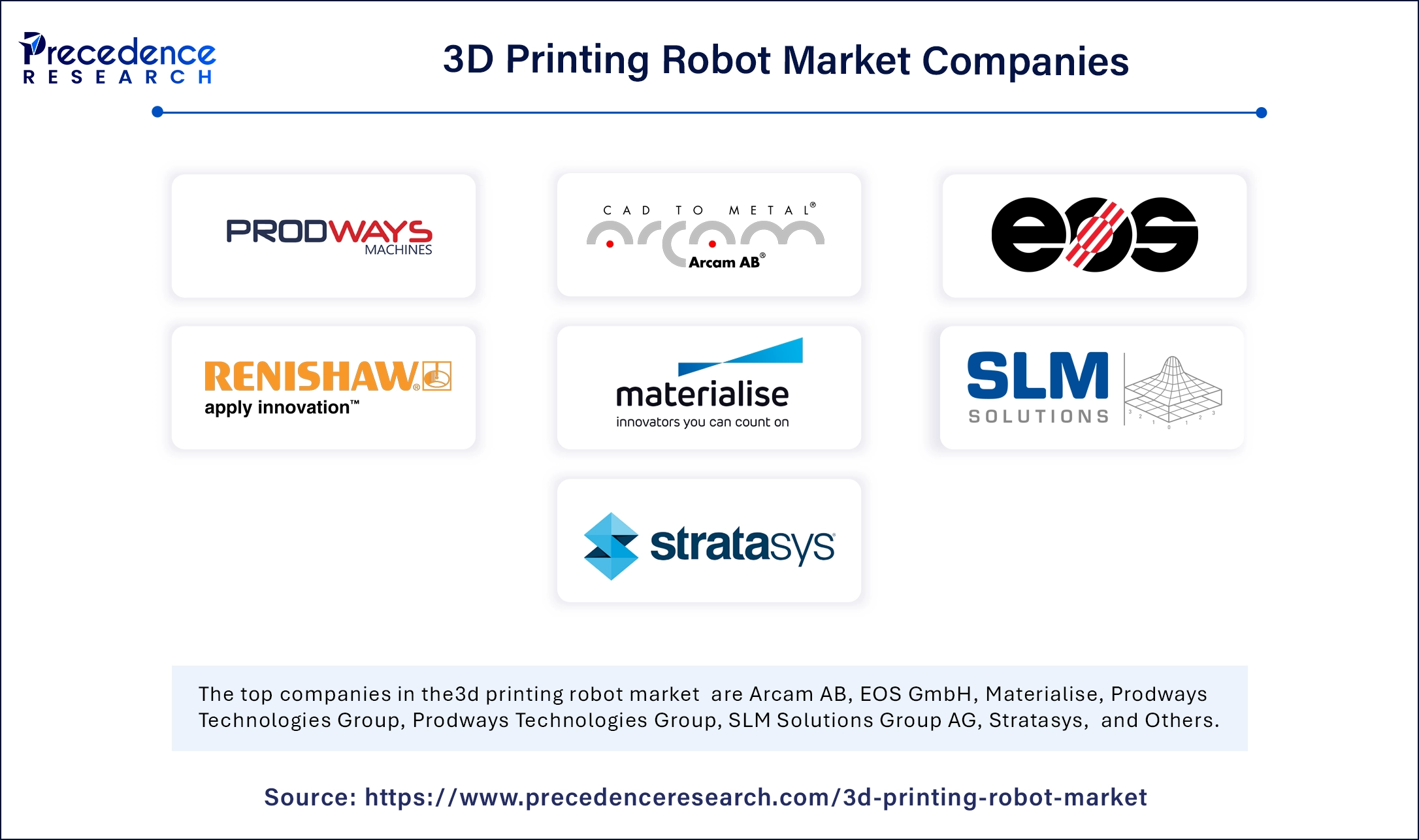
- Arcam AB: It deals in electron beam melting systems and metal powders that manufacture lightweight, high-strength robotic parts that are used in aerospace and industrial manufacturing and production.
- EOS GmbH: Sells industrial laser sintering devices and materials to allow the production of complex robotic parts and lightweight structural chassis.
- Materialise: Provides a software system that streamlines robotic designs, automates the preparation of builds, and oversees the additive manufacturing processes effectively.
Other Major Key Players
- Prodways Technologies Group
- Renishaw plc
- SLM Solutions Group AG
- Stratasys
Recent Developments
- In August 2025, Rapid Fusion launched an AI 'print assistant' to improve its robotic additive manufacturing systems. The technology optimizes customer solutions for complex components in automotive, aerospace, construction, medical, and military industries.
- (https://www.themanufacturer.com )
- In May 2025, Starbucks is launching its first 3D-printed store in Brownsville, Texas, at 2491 Boca Chica Boulevard. This drive-thru-only location, opening this week, was built in collaboration with PERI 3D Construction, utilizing a robotic arm to layer concrete, similar to a printer depositing ink onto paper, marking a shift in construction methods. (https://etedge-insights.com )
- In January 2024, RIC Technology announced the launch of its latest printer, the RIC-M1 PRO compact modular robotic arm, at the World of Concrete (WOC) 2024. This new printer features a wider footprint than previous models, enhanced automation, and an intelligent material delivery system. RIC Technology claims that the RIC-M1 PRO is a cost-effective, time-saving solution that reduces labor demands, addressing the global housing shortage.
- In April 2024, Meltio, a developer of metal 3D printing technology, partnered with Michigan-based industrial automation firm Accufacture to introduce Alchemist 1. This new large-scale robotic Directed Energy Deposition (DED) 3D printing workcell is made in the U.S. and is powered by Meltio's laser metal deposition (LMD) technology. Alchemist 1 is optimized for producing large-scale, fully dense metal parts and is designed for easy integration into existing production lines.
- In February 2025, ENCY Software unveiled version 1.0.5 of its ENCY and ENCY Robot products. The latest update includes a range of new features aimed at improving additive manufacturing operations. Notably, the new corner feed feature allows ENCY users to have complete control over extrusion or deposition rates throughout the entire process. This enhancement is intended to minimize material waste and optimize efficiency by using less material and reducing the need for finishing work.
Segments Covered in the Report:
By Component
- Robot Arms
- Software
- 3D Printing Heads
By Robot Type
- Articulated Robots
- SCARA Robots
- Cartesian Robots
- Polar Robots
- Delta Robots
- Other
By Application
- Tooling
- Functional Part Manufacturing
- Prototyping
By End-user
- Culinary
- Automotive
- Construction
- Fast-moving Consumer Goods (FMCG)
- Aerospace & Defense
- Others
By Region
- North America
- Europe
- Asia Pacific
- Latin America
- Middle East and Africa
For inquiries regarding discounts, bulk purchases, or customization requests, please contact us at sales@precedenceresearch.com
Frequently Asked Questions
Tags





Ask For Sample
No cookie-cutter, only authentic analysis – take the 1st step to become a Precedence Research client
 Get a Sample




 sales@precedenceresearch.com
 Schedule a Meeting
