



Silicon Tetrachloride Market Size, Key Companies, Company Production Capacity, Raw Material Pricing, Export & Import Analysis, Manufacturing Cost, Market Share, and Demand Forecast
Silicon Tetrachloride Market (By Grade: Technical Grade, Electronics Grade, By Derivatives: Fumed Silica, Polysilicon; By Application: Silicone Rubber, Optic Fiber Preform, Chemical Intermediate, Others) - Global Industry Analysis, Size, Trends, Leading Companies, Regional Outlook, and Forecast 2026 to 20355
Source: https://www.precedenceresearch.com/silicon-tetrachloride-market
 Get a Sample
 Table Of Content


What is the Silicon Tetrachloride Market Size?
The global silicon tetrachloride market size is calculated at USD 2.64 billion in 2025 and is predicted to increase from USD 2.73 billion in 2026 to approximately USD 3.68 billion by 2035, expanding at a CAGR of 3.45% from 2025 to 2034. The rising demand for electronic devices and fiber optic cables is projected to boost market growth in the coming years.
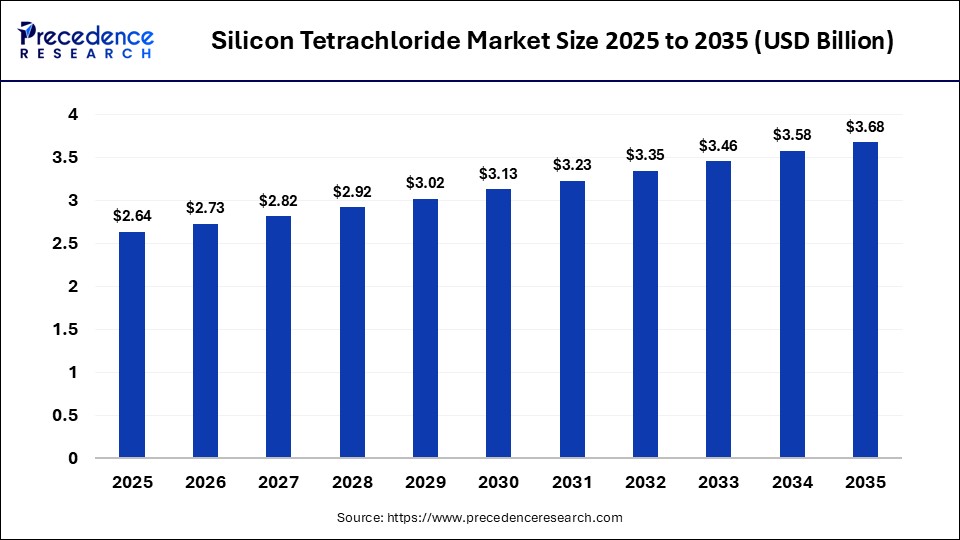
Silicon Tetrachloride Market Key Takeaways
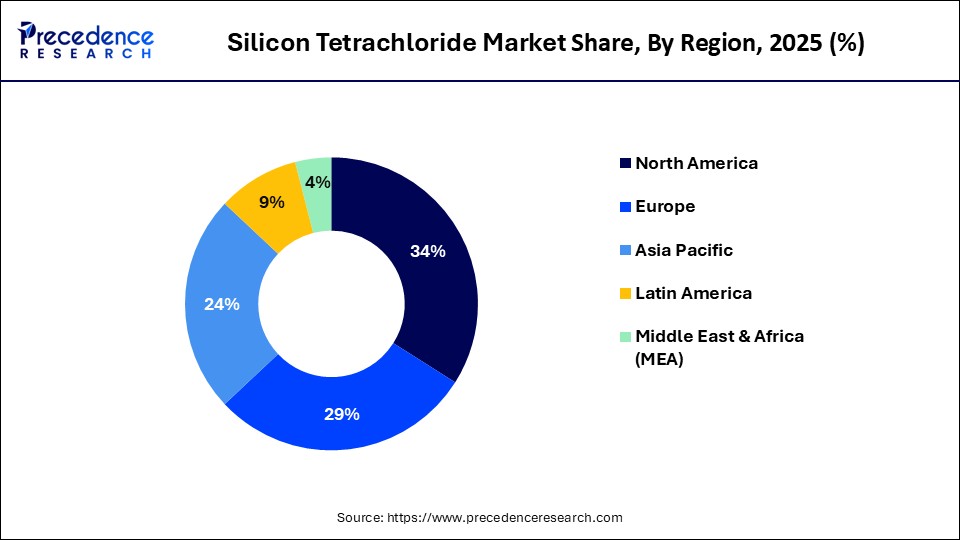
- North America led the silicon tetrachloride market with the largest market share of 34% in 2025.
- By grade, the electronics grade segment accounted for the biggest market share in 2025.
- By application, the chemical intermediate segment generated the highest market share in 2025.
What is the Role of AI in silicon tetrachloride?
The electronics industry is experiencing remarkable growth, specifically due to the escalating reliance on smart devices and Internet of Things (IoT) devices. The surge in demand for these devices necessitates producing high-purity silicon, which is utilized in refining processes that ensure the silicon meets the rigorous standards required for modern electronics, ensuring optimal performance and efficiency. However, AI plays a key role in producing high-purity silicon. AI can optimize production processes and help control quality, thereby leading to increased production of high-purity silicon.
Major Trends in the Silicon Tetrachloride Market
Rising consumption of silicon tetrachloride for polysilicon manufacturing is the primary driver of the silicon tetrachloride market. Hence, burgeoning demand for polysilicon is ultimately propelling the growth of the silicon tetrachloride market. Solar technology is among the fastest-growing segment in the energy and power industry. More than 90% of the solar cells are manufactured from polysilicon. Growing energy demand, environmental concerns regarding fossil fuels, rapidly declining cost of photovoltaic cells, and increasing awareness regarding green energy are some of the factors likely to boost the demand for polysilicon. Furthermore, huge investment in solar technology from several governments across the globe is further stimulates silicon tetrachloride consumption in solar applications.
Fiber optics is considered the backbone of the 21st-century's advanced growth, especially in the communication sector. Germanium tetrachloride (GeCl4) along with silicon tetrachloride (SiCl4) are the major raw materials used for optical fiber manufacturing. Optical fibers are manufactured from processes like plasma chemical vapor deposition/modified chemical vapor deposition where high purity silicon tetrachloride is required. Since the last decade, optical fiber is witnessing significant growth owing to the rapidly advancing telecom industry, deployment of 3G/4G/5G, LTE, FTTX, and growing integration of IoT are likely to propel the demand for optical fiber.
The growing need for optical fiber for a high-speed broadband network is likely to create lucrative opportunities for silicon tetrachloride, especially in under developed and developing economies. The share of internet users was less than 1% of the total population in 1995 and which is increased to around 40% in 2016. The growing trend towards IoT is likely to boost the demand for fiber optics which positively affects the silicon tetrachloride. Even during the pandemic, several companies such as Apple, Samsung, and Google among others have introduced their IoT-based products at Consumer Electronics Show (CES) and Mobile World Congress. Fiber optics are likely to grow at more than 10% of CAGR during the next five years which is likely to support the growth of the silica tetrachloride during the forecast period.
Market Outlook
- Industry Growth Overview: The silicon tetrachloride market is growing, driven by its significant role in the production of high-purity silicon for the semiconductor and solar sectors, as well as its use in manufacturing optical fibers for high-speed communications.
- Global Expansion: The silicon tetrachloride market is experiencing global expansion, as growing demand for high-purity silicon in solar cells, semiconductors, and optical fibers, along with its applications in creating fumed silica for coatings and adhesives. North America is dominant in the market due to the increasing renewable energy industry and progress.
- Major investors: The major players and investors in the silicon tetrachloride market are leading worldwide chemical, materials, and technology organizations. It includes Evonik Industries AG, Dow Inc., Hemlock Semiconductor Corporation, Wacker Chemie AG, and Shandong Xinlong Group Co., Ltd.
Silicon Tetrachloride Market Growth Factors
- High demand for smartphones and other hand-held multimedia devices
- Growing demand for fiber optics
- Development of advanced communication equipment
- Increasing applications of fiber optics in aerospace and oil and gas industries
- High growth in the consumer electronics sector
- Growing semiconductor market
- Increasing market for solar PV
- Launch of 5G services
Market Scope
| Report Highlights | Details |
| Market Size in 2025 | USD 2.64 Billion |
| Market Size in 2026 | USD 2.73 Billion |
| Market Size by 2035 | USD 3.68 Billion |
| Growth Rate From 2026 to 2035 | CAGR of 3.38% |
| Base Year | 2025 |
| Forecast Period | 2026 to 2035 |
| Segments Covered | Grade, Derivatives, Application |
| Regional Scope | North America, Europe, Asia Pacific, Latin America, Middle East & Africa (MEA) |
Segments Insights
Grade Insights
Which Grade Segment Dominated the Silicon Tetrachloride Market?
The technical grade segment held a dominant position in the market in 2025 due to its widespread adoption in various sectors, including construction, automotive, and pharmaceutical industries. Primary uses of technical-grade silicon tetrachloride include the manufacturing of fumed silica, silicone rubber, and as an intermediate for basic silicon chemicals.
The electronics grade segment is expected to grow with the highest CAGR in the market during the studied years. Technical-grade silicon tetrachloride undergoes purification to develop electronic-grade silicon tetrachloride. It is widely preferred due to its high purity of about 99.9999%. Electronic-grade silicon tetrachloride is commonly used as a raw material for the production of optical fibers, silicon wafers, and semiconductors.
Derivatives Insights
Why did the Polysilicon Segment Dominate the Silicon Tetrachloride Market?
The polysilicon segment held the largest market share in 2025 due to the rapidly expanding semiconductor industry. Silicon tetrachloride is the primary raw material for producing polysilicon. From microchips in our phones and computers to photovoltaic cells lining solar cells, polysilicon enables key innovations that drive human progress. Polysilicon is preferred over pure silicon due to its high resistivity and distinct electrical advantages.
The fumed silica segment is expected to expand rapidly in the market with a CAGR of XX% in the coming years. Fumed silica is produced by flame hydrolysis of silicone tetrachloride at temperatures above 1,000oC. It is used as a rheology modifier in the coatings industry, as sealants and adhesives in sealant formulations, and as an anti-caking agent in cosmetics and the food industry. As a well-established nanomaterial, fumed silica continues to find new frontiers in nanotechnology and advanced materials.
Application Insights
How the Silicone Rubber Segment Led the Silicon Tetrachloride Market?
The silicone rubber segment led the market in 2025 due to its high durability and resistance to a wide range of chemicals and environmental factors. Liquid silicone rubber can be molded into complex shapes with minimal waste. Silicone rubber is widely used in electronics, aerospace, construction, automotive, and consumer products. It offers superior advantages, such as temperature resistance, weather and UV resistance, and biocompatibility.
The optic fiber preform segment is expected to gain the highest market share between 2026 and 2035. Silicon tetrachloride is a core essential raw material for the optical fiber industry. The construction of global hyperscale data centers has driven a surge in demand for high-speed optical fibers. The growing deployment of 5G and the large-scale implementation of gigabit fiber-to-the-home result in an increase in the procurement volume of high-purity silicon tetrachloride.
Regional Insights
U.S. Silicon Tetrachloride Market Size and Growth 2026 to 2035
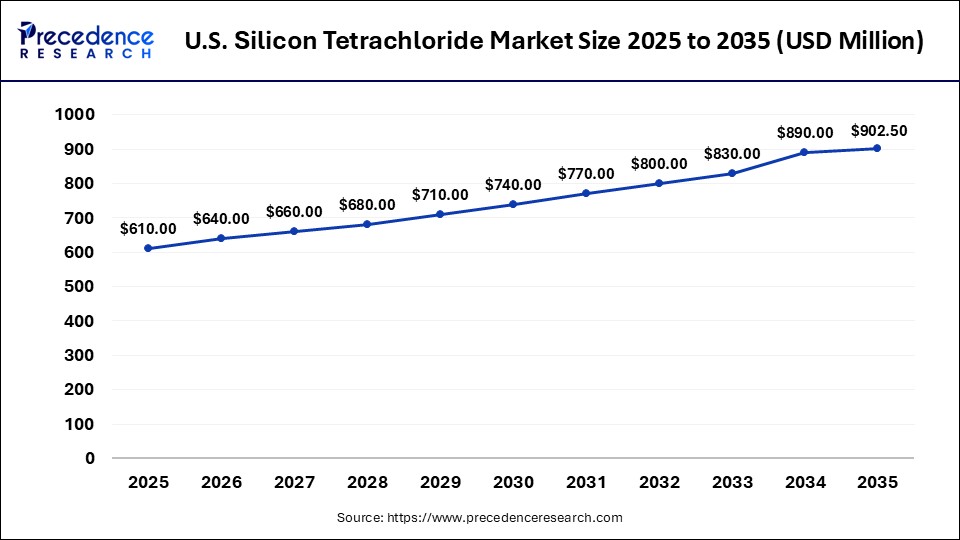
The U.S. silicon tetrachloride market size is evaluated at USD 610 million in 2025 and is predicted to be worth around USD 902.50 million by 2035, rising at a CAGR of 3.99% from 2026 to 2035
Comprehensive research and development
The comprehensive research account covers substantial projections and inclinations of silicon tetrachloride throughout chief regions encompassing Africa, Asia Pacific, Europe, Latin America, North America, Middle East, and. By region, silicon tetrachloride market is led by Asia Pacific due to high demand for fiber optics and high smartphone use. North America accounted for subsequent highest stake chiefly due to existence of skilled professionals and early adoption of latest communication technologies. Asia-Pacific is also estimated to observe a rapid progress rate, in consequence of increasing outlay by governments on state-of-the-art technologies.
- In December 2024, the China Securities Regulatory Commission (CSRC) approved polysilicon derivatives to address rising price volatility and structural imbalances between supply and demand in the solar-grade polysilicon.
Skilled labor and low costs
The U.S. is a worldwide leader in semiconductor innovation and manufacturing. High-purity silicon tetrachloride is a significant material for manufacturing the ultra-pure silicon wafers used in microchips, integrated circuits, and modern electronic devices. The U.S. maintains a substantial market share in high-value chemicals and materials novelty, which drives the growth of the market.
Growing electronics and semiconductor manufacturing
Asia Pacific is the fastest growing market a leading position in electronics production, solar panel production, and a great, increasing demand for these products. Major countries such as China and Japan are significant producers and consumers, driven by large-scale production in the semiconductor, electronics, and renewable energy sectors, which contribute to the growth of the market.
Support for sustainable energy
China leads globally in manufacturing, especially in electronics and solar panels. Since silicon tetrachloride is essential for both industries, high demand from these sectors boosts its production. The Chinese government actively supports the expansion of high-tech sectors like semiconductors and solar energy, further fueling market growth.
Europe: Technological advancements
Europe is seeing significant market growth because it has robust industrial and manufacturing sectors, such as automotive and aerospace, which heavily rely on silicon-based materials. The region also emphasizes research and development (R&D), promoting innovation in advanced materials and high-tech manufacturing.
UK: Advanced manufacturing sector
The UK has a well-developed industrial sector and sophisticated manufacturing skills that enable the production and utilization of silicon tetrachloride. Strong research and development resources drive innovation in materials and purification techniques, which are vital for creating the high-purity silicon tetrachloride needed in advanced technological applications.
Value Chain Analysis - Silicon Tetrachloride Market
Raw Material
The raw materials for silicon tetrachloride are silicon compounds like silicon dioxide, mixed with carbon, ferrosilicon, or silicon carbide, which are then reacted with chlorine gas
- Key Players: Merck KGaA
Chemical Synthesis and Processing
Silicon tetrachloride is synthesized and processed by reacting silicon or silicon-containing compounds with chlorine gas at high temperatures, often with catalysts
- Key Players: Momentive Specialty Chemicals and Wacker Chemie AG
Compound Formulation and Blending:
The process involves blending the silica or ferrosilicon with carbon, then heating the combination by passing chlorine gas through it. The resultant SiCl4 is then purified through condensation and distillation.
- Key Players: Evonik Industries AG and Air Products and Chemicals, Inc
Top Vendors in the Silicon Tetrachloride Market & Their Offerings
|
Company |
Headquarters |
Key Strengths |
Latest Info (2025) |
|
Niskayuna, New York |
Operational excellence |
Momentane's advanced silicone solutions are engineered for sustainability, performance, and innovation. |
|
|
Germany |
Technological and innovation leadership |
Heraeus is prioritizing geographical expansion, with new Phase III facilities opening in Costa Rica. |
|
|
Linde Plc |
Dublin, Ireland |
Technological and engineering expertise |
In April 2025, Linde announced that it would increase its supply of ultra-high-purity atmospheric, process, and specialty gases to Samsung's world-class semiconductor manufacturing complex in Pyeongtaek, South Korea. |
|
Evonik Industries AG |
Germany |
Increasing sustainability and innovation |
In January 2025, Evonik launched Smart Effects, a new entity counting 3,500 employees worldwide, born from the strategic merger of its Silica and Silanes business lines that will be part of "Advanced Technologies" within the new company organization. |
|
Dow Corning (Dow) |
Midland, Michigan |
High-performance product portfolio |
In September 2025, Dow launched DOWSIL EG-4175 Silicone Gel, a highly reliable protective solution for next-generation insulated gate bipolar transistor (IGBT) modules that operate at higher voltages. |
Major Key Players
- Air Products and Chemicals Inc.
- Tokuyama Chemicals (Zhejiang) CO. Ltd.
- OCI Co. Ltd.
- Shandong Xinlong Group Co. Ltd.
- Hubei Jingxing Service and Technology Co. Ltd.
- Air Liquide S.A.
- American Elements
Recent Development
- In May 2026, Wacker Chemie AG reduced its stake in Siltronic AG, a leading supplier of silicon wafers for the semiconductor industry. The former is satisfied with the latter's development and reaffirmed Wacker Chemie's continued support for Siltronic's strategic direction. (Source: https://www.chemanalyst.com)
- In July 2025, HPQ Silicon Inc. announced the update of its shareholders on progress from its proprietary Fumed Silica Reactor (FSR) pilot project, developed in partnership with PyroGenesis Inc. The project aims to develop a new generation of low-carbon, plasma-based fumed silica production. (Source: https://hpqsilicon.com)
Segments Covered in the Report
By Grade
- Technical Grade
- Electronics Grade
By Derivatives
- Fumed Silica
- Polysilicon
By Application
- Silicone Rubber
- Optic Fiber Preform
- Chemical Intermediate
- Others
By Geography
- North America
- Asia Pacific
- Europe
- Latin America
- Middle East and Africa
For inquiries regarding discounts, bulk purchases, or customization requests, please contact us at sales@precedenceresearch.com
Frequently Asked Questions





Ask For Sample
No cookie-cutter, only authentic analysis – take the 1st step to become a Precedence Research client
 Get a Sample




 sales@precedenceresearch.com
 Schedule a Meeting
