



Small Caliber Ammunition Market Size, Key Companies, Company Market Share, Aircraft Production, Defense Spending, Procurement Trends, Technology Adoption, Competitive Positioning, and Market Outlook
Small Caliber Ammunition (By Casing Material: Brass, Steel, Polymer/Hybrid; By Size: 5.56 mm, 7.62 mm, 9 mm, 0.50 Caliber [12.7 mm], Shotshells; By End-Use Application: Military, Law Enforcement & Homeland Security, Commercial / Civilian) - Global Industry Analysis, Size, Trends, Leading Companies, Regional Outlook, and Forecast 2026 to 2035
Source: https://www.precedenceresearch.com/small-caliber-ammunition-market
 Get a Sample
 Table Of Content


What is the Small Caliber Ammunition Market Size?
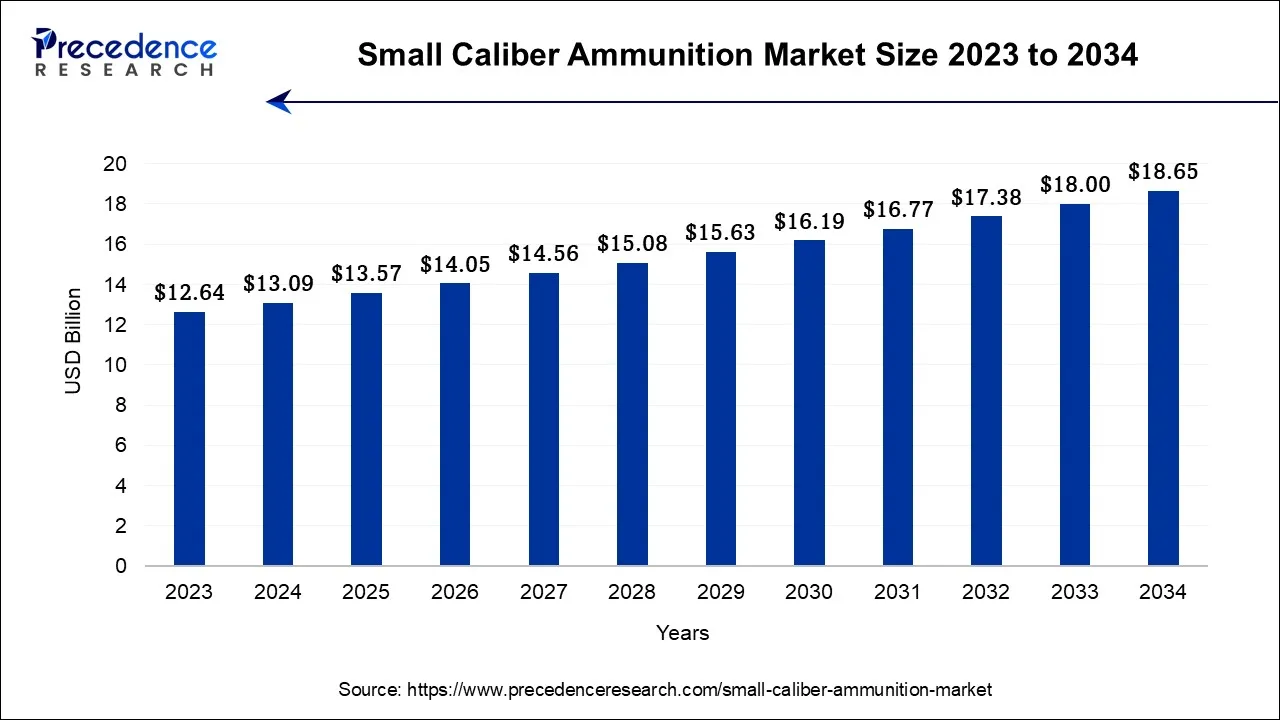
The global small caliber ammunition market size is expected to be valued at USD 10.31 billion in 2025 and is predicted to increase from USD 10.81 billion in 2026 to approximately USD 15.08 billion by 2035, expanding at a CAGR of 3.77% over the forecast period from 2026 to 2035. This growth is due to growing military & commercial sectors, along with advanced ammunition technology.
Market Highlights
- North America has held the biggest revenue share of 56.07% in 2025.
- By Size, the 5.56 mm segment contributed the largest revenue share of 29% in 2025.
- By end-use application, the military segment captured the largest market share of 58% in 2025.
- By casing material, the brass segment registered the highest market share of 73% in 2025.
- By casing material, the polymer/hybrid segment is anticipated to grow at the fastest CAGRof 7.01% over the projected period.
What is Small Caliber Ammunition?
Small caliber ammunition typically encompasses cartridges in calibers such as .22, .38, .45, 5.56mm, 9mm, and .223, which are widely used in handguns, rifles, and shotguns. This type of ammunition is crucial in military, law enforcement, and civilian contexts due to its efficiency, affordability, and versatility across various firearms. The small caliber ammunition industry is poised for transformative growth, driven by escalating global tensions and initiatives for military modernization.
How is AI contributing to the Small Caliber Ammunition Industry?
AI has a major role in the entire process of ammunition design and manufacturing, logistics, training, and finally, by allowing inspection to be carried out automatically, maintenance to be predicted, the optimization of trajectories, management of smart inventory, simulations, rolling, analyzing, and so on. This is accomplished by improving the accuracy, reliability, safety, and efficiency of the entire development, production, deployment, and operational training processes over the entire globe.
Small Caliber Ammunition Market Growth Factors
The small caliber ammunition market revolves around the production and distribution of ammunition designed for firearms with bore diameters typically below 50 calibers. It serves a diverse range of users, including civilian gun owners, law enforcement agencies, and military forces.
This small caliber ammunition market dynamics are shaped by various factors, including geopolitical developments, global security concerns, and civilian gun ownership trends. Several key trends and growth drivers are influencing the market.
One significant trend is the rising demand for self-defense ammunition among civilian consumers, driven by concerns about personal safety. Additionally, military modernization efforts across the globe are fueling demand for technologically advanced small caliber ammunition. The increasing popularity of sport shooting and competitive shooting events is another factor contributing to market growth.
Moreover, there are opportunities for businesses in the small caliber ammunition market. Investments in research and development to create innovative and eco-friendly ammunition can set companies apart in a competitive market. Expanding into emerging markets with growing security concerns and military needs offers a pathway for growth. Collaboration with law enforcement agencies to develop specialized ammunition for their specific requirements can be a lucrative opportunity.
Small Caliber Ammunition Market Drivers
- Factors such as rising terrorist threats, increased gun use for personal safety, and the expansion of military modernization programs are propelling the global market.
- Additionally, the development of lightweight ammunition and the growing popularity of sport shooting and competitive events are expected to create new growth avenues in the market in the coming years.
- The small caliber ammunition industry is also significantly influenced by the growth of law enforcement and security sectors. Increased funding for police departments and private security firms has heightened the demand for training and operational requirements, leading to a steady need for a supply of small-caliber ammunition.
- Advancements in ballistics technology are enhancing the performance of small-caliber ammunition. Innovative designs and materials are optimizing accuracy, range, and lethality, benefiting both defense and civilian applications.
Market Outlook
- Industry Growth Overview: The military modernization, new defense budgets raised, and more and more civilian shooting participants are the drivers for the market to expand further.
- Sustainability Trends: The focus is changing to green ammunition, lead-free projectiles, alternative materials, etc., all of which are reducing environmental impact issues.
- Global Expansion: Growth is still global, with North America and the Asia Pacific defense procurement being the regions with the strongest momentum.
- Major Investors: Olin Corporation, General Dynamics, Northrop Grumman, BAE Systems, Nammo, and Elbit Systems are some of the major investors.
Market Scope
| Report Coverage | Details |
| Market Size in 2025 | USD 10.31 Billion |
| Market Size in 2026 | USD 10.81 Billion |
| Market Size by 2035 | USD 15.08 Billion |
| Growth Rate from 2026 to 2035 | CAGR of 3.77% |
| Largest Market | North America |
| Base Year | 2025 |
| Forecast Period | 2026 to 2035 |
| Segments Covered | By Size, By End-Use Application, and By Casing Material, and Region |
| Regions Covered | North America, Europe, Asia-Pacific, Latin America, and Middle East & Africa |
Market Dynamics
Driver
Military modernization and sport shooting
Military modernization initiatives worldwide are propelling the small caliber ammunition market's growth. As armed forces upgrade their weaponry, there's a heightened demand for advanced small caliber ammunition. These modernization efforts prioritize ammunition with improved accuracy, ballistics, and versatility to enhance soldier performance. Consequently, manufacturers are developing cutting-edge rounds to meet these requirements, driving demand in the civilian and military sectors, and fostering innovation in the small caliber ammunition market.
Moreover, Sport shooting has significantly boosted the small caliber ammunition market by driving demand for high-quality ammunition. Enthusiasts participating in competitive shooting events, such as target shooting and practical shooting sports, require precise and reliable ammunition to enhance their performance. This demand has led to the development of specialized small caliber rounds, propelling manufacturers to produce innovative, accurate, and consistent ammunition to cater to the growing sport shooting community, thereby increasing overall market demand.
Restraints
Regulatory restrictions and safety concerns
Regulatory restrictions act as a significant restraint on the small caliber ammunition market. Stringent firearms regulations and legal limitations in various regions can impede market access, sales, and growth potential. These restrictions often result in increased compliance costs, reduced market size, and complexities in navigating the legal landscape. As a result, manufacturers and suppliers in the small caliber ammunition market must contend with a challenging regulatory environment that affects demand and profitability.
Moreover, Safety concerns can significantly restrain market demand in the small caliber ammunition market. Increased safety regulations and public awareness regarding the potential hazards associated with ammunition use and storage can lead to reduced consumer interest and sales. Additionally, stringent safety standards can increase manufacturing and compliance costs, impacting pricing and profitability. These concerns can influence both civilian and government procurement decisions, affecting the overall market demand for small caliber ammunition.
Opportunities
Diversification, innovation and technology
Diversification in the small caliber ammunition market can boost market demand by expanding product offerings beyond ammunition. Companies can introduce complementary products such as firearms accessories, optics, and gear, attracting a broader customer base. This approach not only increases revenue streams but also strengthens brand loyalty and customer retention. Diversification reduces dependency on a single product category and makes businesses more resilient, enhancing their overall competitiveness and market demand.
Moreover, Innovation and technology advancements have a profound impact on the small caliber ammunition market, driving increased demand. Consumers and military forces seek ammunition with improved accuracy, reduced recoil, and enhanced terminal ballistics. Manufacturers that invest in innovative bullet designs, propellants, and production techniques can offer superior products, appealing to both civilian and military markets. Technological innovations propel market growth by satisfying the demand for more effective and efficient small caliber ammunition.
Segment Insights
Size Insights
What made 5.56 mm the Dominant Segment in the Small Caliber Ammunition Market?
The 5.56 mm segment dominated the market in 2025 and is expected to expand fastest during the forecast period, due to growing modernization programs, rising usage, and increasing demand for military. The 5.56 mm caliber is commonly utilized in assault rifles that are designated as standard equipment within military forces, as it provides an optimal balance of lethality, accuracy, and recoil control, rendering it particularly advantageous in contemporary combat scenarios. Its lightweight nature enables soldiers to transport a greater quantity of ammunition, thereby enhancing operational efficiency during extended missions.
Small Caliber Ammunition Market Revenue, by Size, 2023 to 2025 (USD Million)
| Size | 2023 | 2024 | 2025 |
| 5.56 mm | 1,569.94 | 1,644.88 | 1,733.97 |
| 7.62 mm | 984.55 | 1,011.74 | 1,046.11 |
| 9 mm | 1,706.62 | 1,755.66 | 1,817.33 |
| 0.50 Caliber [12.7 mm] | 661.26 | 693.33 | 731.40 |
| Shotshells | 429.33 | 440.03 | 453.75 |
End-Use Application Insights
Why did the Military Segment Dominate the Small Caliber Ammunition Market in 2025?
The military segment dominated the market in 2025 and is expected to grow at the fastest CAGR in the coming years because global defense budgets continue to experience upward trends as nations seek to modernize their armed forces. Small-caliber ammunition, which is critical for infantry and tactical units, remains a fundamental procurement item that supports sustained demand. The prevalence of ongoing regional conflicts and increasing security concerns has led to increased stockpiling and recurrent procurement of ammunition by military and law enforcement agencies. In response to evolving security threats and the necessity for modernized military capabilities, governments worldwide are substantially increasing their defense expenditures. This surge in investment is not only transforming global military capabilities but is also generating an unparalleled demand for high-quality manufacturing expertise across a diverse range of environments.
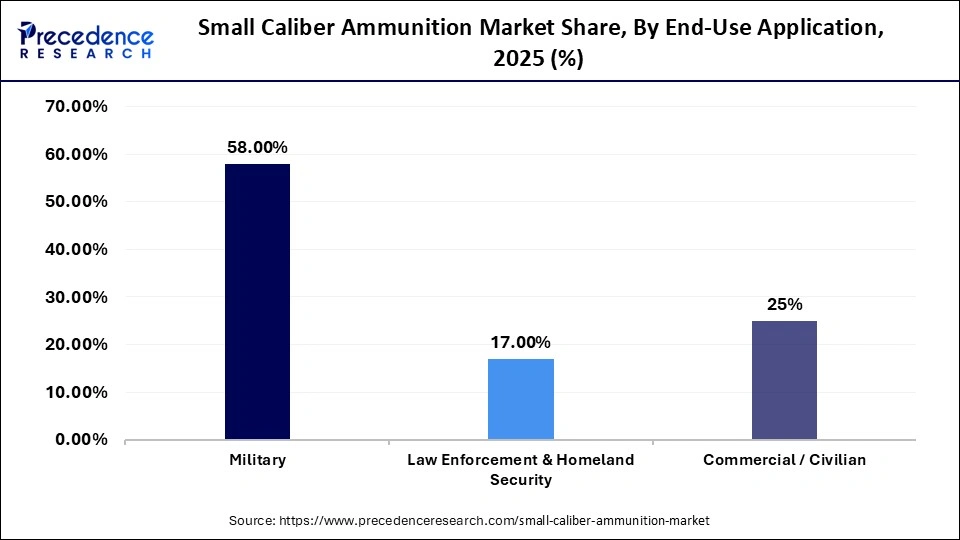
The growing defense spending and a greater emphasis on advanced combat preparedness also drive the segment. The modernization of armed forces is becoming a top priority for many nations, which is increasing the use of next-generation ammunition. Demand is also being accelerated by the growth of special operations forces and the increased focus on counterterrorism efforts. The segment is also driven by increased participation in joint military exercises and international defense collaborations.
Small Caliber Ammunition Market Revenue, by End-Use Application, 2023 to 2025 (USD Million)
| End-Use Application | 2023 | 2024 | 2025 |
| Military | 2,492.33 | 2,602.10 | 2,733.55 |
| Law Enforcement & Homeland Security | 775.05 | 799.38 | 829.62 |
| Commercial / Civilian | 2,084.32 | 2,144.16 | 2,219.39 |
Casing Material Insights
Which Casing Material Segment Held the Largest Small Caliber Ammunition Market Share in 2025?
The brass segment held the largest market share in 2025 due to the long-term reliability, durability, and versatility of application associated with this ammunition type. Brass as casing material continues to be the preferred choice for various military and non-military applications because of its commendable performance record, ease of manufacturability, and accessibility in the industry. The inherent flexibility and strength of brass allow it to expand appropriately under pressure within the chamber, ensuring sustained power, accuracy, and structural integrity. Consequently, advancements in brass cartridges have firmly positioned them among the premier choices in the firearm industry.
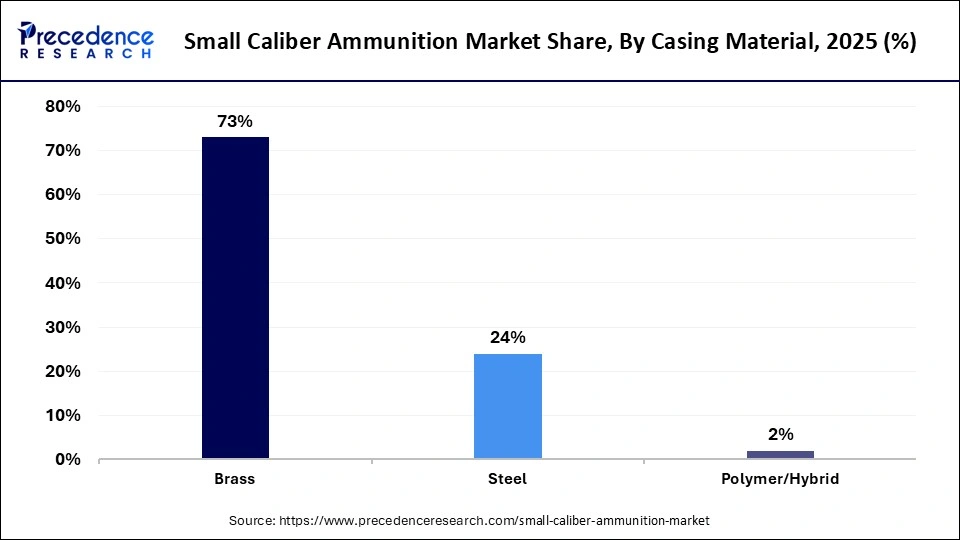
The polymer/hybrid segment is expected to grow at the fastest rate during the forecast period. Polymer/hybrid is a lightweight, proprietary plastic that demonstrates superior durability compared to brass and other metals traditionally used in weapon systems. Polymer cartridges effectively absorb heat expelled from the casing, mitigating the risk of overheating in machine guns. This type of ammunition represents a significant innovation, achieving an average weight reduction of 30% when compared to conventional bullets. Polymer/hybrid casings lower manufacturing and transportation expenses while supporting innovation in modern ammunition design, boosting their adoption across defense & commercial sectors.
Small Caliber Ammunition Market Revenue, by Casing Material, 2023 to 2025 (USD Million)
| Casing Material | 2023 | 2024 | 2025 |
| Brass | 4,177.95 | 4,333.11 | 4,522.14 |
| Steel | 1,033.74 | 1,061.01 | 1,095.71 |
| Polymer/Hybrid | 140.01 | 151.52 | 164.71 |
Regional Insights
Which Region Dominated the Small-Caliber Ammunition Market in 2025?
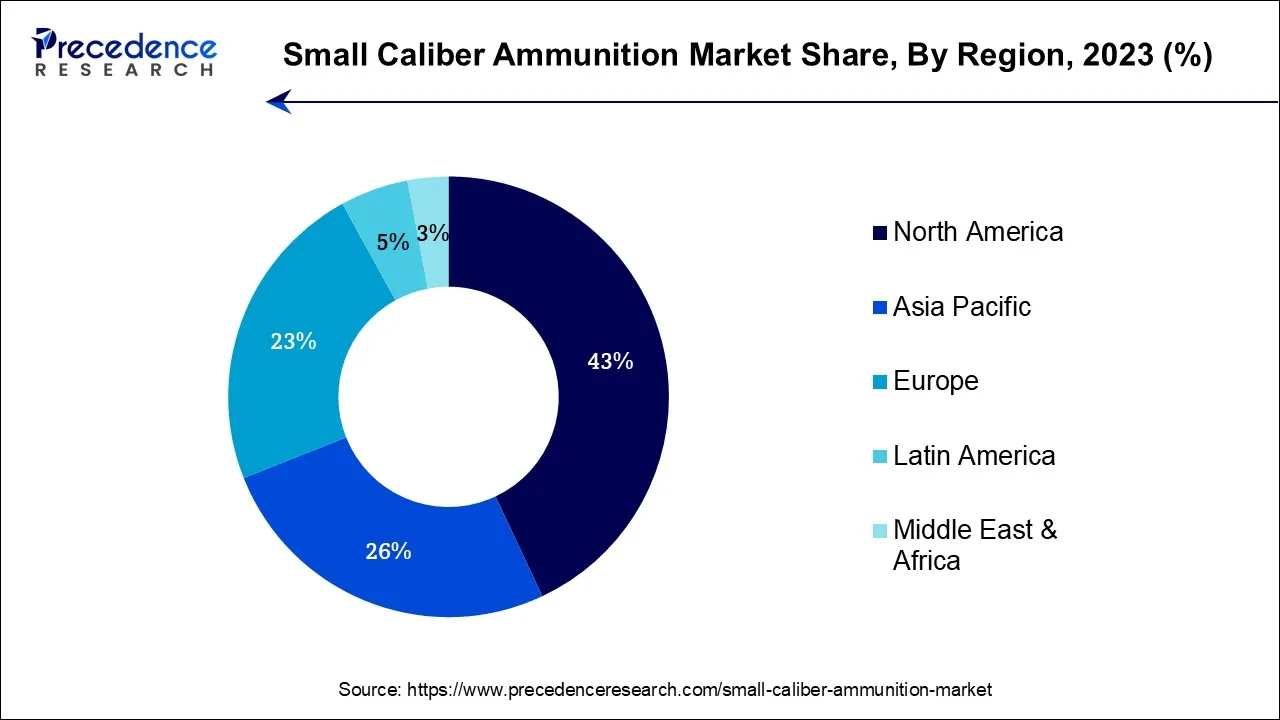
North America dominated the small-caliber ammunition market in 2025, driven by increasing defense budgets, civilian gun ownership, technological advancements, and evolving regulatory frameworks. The demand for ammunition is rising across military, law enforcement, and civilian sectors, making North America one of the largest and most dynamic ammunition markets globally. The region also faces regulatory changes and safety concerns, prompting manufacturers to focus on compliance and safety features in their products, reflecting evolving consumer needs and government regulations.
U.S. Small-Caliber Ammunition Market Trends
The U.S. market opportunities primarily focus on next-generation military ammunition, with the demand for non-lead products driven by environmental regulations being one of the key factors influencing the commercial sector. The U.S. Army's Capability Program Executive Ammunition and Energetics (CPE A&E), located at Picatinny Arsenal in New Jersey, is leading a significant transformation of the nation's small-caliber ammunition industrial base, marking it as one of the Army's highest modernization priorities.
What is the U.S. Small Caliber Ammunition Market Size?
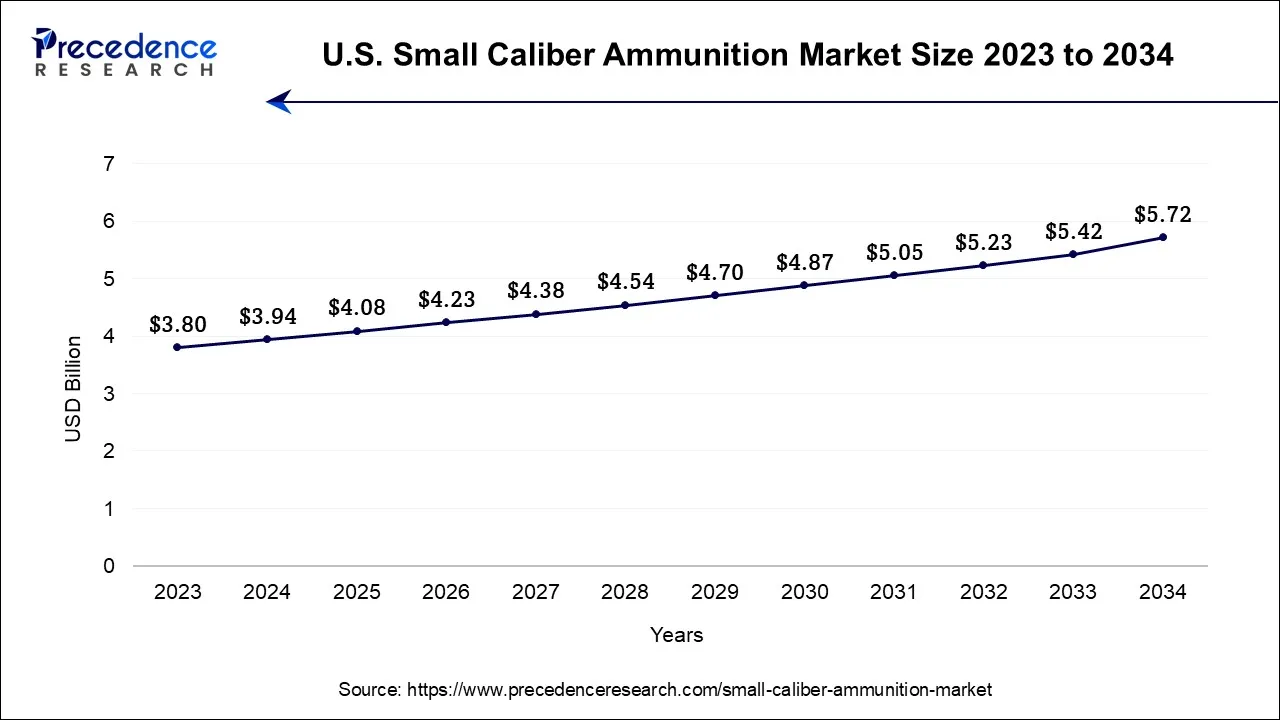
The U.S. small caliber ammunition market size is accounted for USD 5.31 billion in 2025 and is projected to be worth around USD 6.6 billion by 2035, poised to grow at a CAGR of 2.11% from 2026 to 2035.
Asia Pacific Small-Caliber Ammunition Market Trends
The Asia Pacific small-caliber ammunition market is experiencing the fastest growth due to various factors. Heightened security concerns, increased military expenditures, and a surge in participation in shooting sports are contributing to sustained demand. Military modernization initiatives in countries like India, China, and Australia are further stimulating the need for small caliber ammunition. Additionally, the rising popularity of sport shooting and recreational shooting activities is boosting the market for small-caliber rounds. Increased concerns about personal safety have led to higher civilian demand for self-defense ammunition.
India Small-Caliber Ammunition Market Trends
In India, there is significant potential in the small ammunition market, bolstered by recent positive policy developments aimed at strengthening the local defense industry. This industrial momentum is supported by a clearer strategic framework. India's National Defence Policy 2024 signifies the maturation of earlier Make in India efforts, explicitly including ammunition production as a core component of the defense production base, with targets set for both domestic sufficiency and global exports.
Europe Small-Caliber Ammunition Market Trends
Europe small-caliber ammunition market is driven by the need for modernizing military operations amidst rapid changes in warfare and rising investments by homeland security and law enforcement agencies. There is a growing emphasis on precision and accuracy in the market. Sport shooting and competitive shooting events are gaining popularity, leading to increased demand for high-quality ammunition. Furthermore, there is a strong focus on regulatory compliance and environmental sustainability, which is prompting increased research and development of eco-friendly ammunition solutions.
Germany Small-Caliber Ammunition Market Trends
The German small-caliber ammunition market, supported by NATO commitments, defense upgrading initiatives, and effective law enforcement, is seeing key trends such as an increased interest in personal defense and competitive shooting sports. Demand is also growing due to the establishment of new law enforcement agencies and an increase in training programs. The adoption of smart and precision-guided ammunition, along with the development of eco-friendly and lead-free alternatives, is driving market growth.
Latin America Small-Caliber Ammunition Market Trends
Latin America small-caliber ammunition market is expanding rapidly. This regional growth is also fueled by military modernization, internal security needs, and rising civilian demand for recreational shooting and hunting. The Middle East is increasingly investing in advanced ammunition for defense purposes while addressing sustainability concerns through eco-friendly innovations, such as lead-free and biodegradable bullets. Additionally, the market is witnessing developments in smart bullets, guided munitions, and non-lethal options for law enforcement.
Brazil Small-Caliber Ammunition Market Trends
In Brazil, the expansion of civilian firearm ownership and the sporting culture have significantly influenced small-caliber ammunition consumption. The country is advancing with military and police modernization programs, expanding its export capacity, and sustaining civilian demand for small-caliber ammunition.
Middle East and Africa Small-Caliber Ammunition Market Trends
The Middle East and Africa small-caliber ammunition market is driven by ongoing conflicts and high military alert levels, resulting in consistent demand across the region. Cross-border tensions and regular missile exchanges have led to increased usage of small arms, artillery, and air defense munitions. Many governments are raising defense spending and rebuilding their stockpiles to remain prepared for any situation. Countries continue to procure both conventional and precision ammunition to maintain readiness.
Saudi Arabia Small-Caliber Ammunition Market Trends
Saudi Arabia is significantly investing in its local ammunition production capacity to reduce its dependence on overseas suppliers and enhance self-reliance in defense manufacturing. This initiative aligns with the objectives of the Vision 2030 plan, which seeks to diversify the Kingdom's economy by reducing reliance on oil and expanding its industrial sector. By increasing domestic manufacturing, Saudi Arabia aims to build its own industrial base and mitigate the risks associated with purchasing arms from other countries, which often tie sales to unrelated issues.
Small Caliber Ammunition Market-Value Chain Analysis
- Feedstock Procurement: sourcing, purchasing, managing logistics, raw materials, ammunition production
Key players: Olin Corporation (Winchester Ammunition), Thales - Chemical Synthesis and Processing: executing reactions of materials into ammunition components
Key players: Incitec Pivot, Chemring Group, Hanwha Corp - Compound Formulation and Blending: combining propellants, primers, proportions safety characteristics
Key Players: D&M Holding Company (White River Energetics), Thales (Australian Munitions/ADI Powders) - Quality Testing and Certification: conducting evaluations, ensuring safety regulatory compliance
Key players: Elbit Systems Ltd. (in-house testing), Thales (Australian Munitions) - Packaging and Labelling of Small Caliber Ammunition: storage, distribution, compliance
Key Players: D&M Holding Company (solutions provider for packaging cells), Remington Ammunition, Hornady Manufacturing Company
Competitive Landscape
The small caliber ammunition market is characterized by a dynamic and competitive landscape, influenced by factors such as the increasing demand for recreational shooting, law enforcement, and military applications. Prominent players, including Federal Premium Ammunition, Remington Arms Company, and Winchester Ammunition, are at the forefront of the industry, each implementing distinct strategies to augment their market positioning. The future outlook for the global market suggests a highly competitive and somewhat fragmented environment. In order to maintain a competitive advantage, major industry participants are consistently adopting various growth strategies. This strategic approach promotes informed decision-making and assists businesses in sustaining their competitive edge within a dynamic and evolving market landscape.
Small Caliber Ammunition Market Companies
- Northrop Grumman Corporation: Northrop Grumman Corporation brings to the market state-of-the-art small and medium caliber ammunition that is accurate-reliable-performance consistent with the modern warfare requirements for the forces.
- General Dynamics Corporation: General Dynamics Corporation has a wide variety of ammunition ready to supply, as well as providing innovative ordnance solutions through its specialized divisions, all tailor-made to support the military's operational needs worldwide.
- BAE Systems PLC: BAE Systems PLC manufactures and sells small arms ammunition that is produced using very sophisticated manufacturing processes, and the supply chains that are very reliable, compliant, and supportive of the defense industry all over the globe.
Other Major Key Players
- Denel SOC Ltd
- Remington Arms Company LLC
- CBC Global Ammunition
- RUAG Group
- MESKO
- Nammo AS
- Olin Corporation
- CCI Ammunition
- Elbit Systems Ltd
- Ordnance Factory Board (OFB)
- PT Pindad
Recent Developments
- In June 2026, Shell Shock Technologies, LLC (SST), a prominent innovator in the ammunition sector, announced the agreement on principal commercial terms for a strategic collaboration with CBC Global Ammunition, one of the world's largest ammunition manufacturers. This partnership aims to focus on the industrialization and global commercialization of SST's proprietary NAS3™ hybrid case technology.
- In June 2025, Polish manufacturer Mesko quintupled small-caliber ammunition production capacity from 20 million to 250 million rounds annually by launching four new lines. The company is now achieving one million cartridges daily.
- In January 2025, Belgium's FN Herstal launched the SAAT project on 6 January 2025, a four-year initiative with a European consortium to create a common standard for small arms ammunition. The launch is enhancing interoperability and strategic autonomy in defence.
- In 2023, Vista Outdoor's Sporting Products division has unveiled a new name as it approaches separation from the parent company. The rebranding reflects the division's evolving identity and strategic focus in the outdoor sporting goods industry.
- In 2022, Sig Sauer has secured a contract to manufacture the Next-Gen Squad Weapon (NGSW). This significant achievement positions Sig Sauer as a key player in supplying advanced firearms for the military's next-generation infantry squad.
- In 2021, India has signed a significant deal with Russia to procure AK-203 assault rifles. This agreement aims to enhance the country's military capabilities and replace older weapons with more modern and efficient firearms.
- In 2021, Indonesia's PT Pindad has embarked on exporting small arms munitions. This strategic move aims to expand the company's international presence and contribute to global security by providing high-quality small arms ammunition to interested markets.
- In 2021, Philippines awarded a contract to Brazilian arms manufacturer Taurus Armas to fulfill a requirement for more than 12,000 new Taurus T4 5.56 x 45mm automatic rifles. In 2019, SIG Sauer USA was awarded a contract to deliver 2,702 SIGM400 rifles.
Segments Covered in the Report
By Casing Material
- Brass
- Steel
- Polymer/Hybrid
By Size
- 5.56 mm
- 7.62 mm
- 9 mm
- 0.50 Caliber [12.7 mm]
- Shotshells
By End-Use Application
- Military
- Law Enforcement & Homeland Security
- Commercial / Civilian
By Geography
- North America
- Europe
- Asia-Pacific
- Latin America
- Middle East and Africa
For inquiries regarding discounts, bulk purchases, or customization requests, please contact us at sales@precedenceresearch.com
Frequently Asked Questions





Ask For Sample
No cookie-cutter, only authentic analysis – take the 1st step to become a Precedence Research client
 Get a Sample




 sales@precedenceresearch.com
 Schedule a Meeting
