



Thermal Interface Materials Market Size, Key Companies, Company Market Share, Production Capacity, Raw Material Pricing, Export & Import Analysis, Manufacturing Cost, Market Share, and Demand Forecast
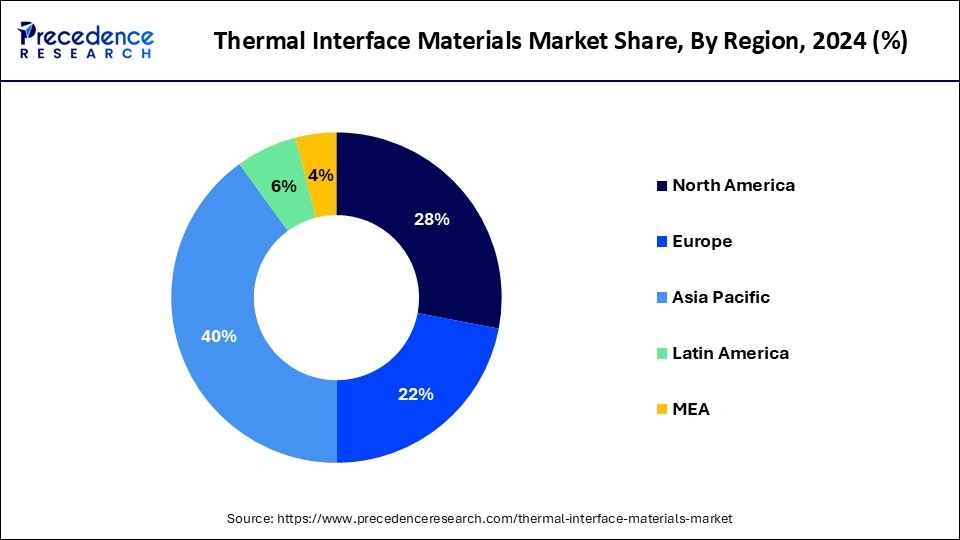
The global thermal interface materials market was valued at USD 5.16 billion in 2026 and is projected to grow to USD 13.64 billion by 2035, expanding at a CAGR of 11.44% from 2026 to 2035. Growth is fueled by the increasing adoption of semiconductors, AI-powered data centers, electric vehicles (EVs), consumer electronics, and 5G infrastructure, all of which require advanced thermal management solutions. Asia Pacific accounted for over 40% of the global market share in 2025, driven by its strong electronics manufacturing base, while North America and Europe are witnessing steady growth supported by advancements in high-performance computing, healthcare devices, and renewable energy applications.
Source: https://www.precedenceresearch.com/thermal-interface-materials-market
 Get a Sample
 Table Of Content


Thermal Interface Materials Market Size and Forecast 2026 to 2035
The global thermal interface materials market size was exhibited at USD 4.62 billion in 2025 and is projected to grow from USD 5.16 billion in 2026 to approximately USD 13.64 billion by 2035, expanding at a CAGR of 11.44% from 2026 to 2035. The rapidly expanding semiconductor industry, technological advancements, and the widespread adoption of thermal interface materials across multiple industries.

Thermal Interface Materials Market Key Takeaways
- In terms of revenue, the market is valued at $ 4.62 billion in 2025.
- It is projected to reach $ 12.44 billion by 2035.
- The market is expected to grow at a CAGR of 11.63% from 2026 to 2035.
- Asia Pacific led the global market with the highest market share of 40% in 2025.
- By Product, the greases & adhesives segment has held the largest market share of 40% in 2025.
- By Application, the computer application segment captured the biggest revenue share of 27% in 2025.
Market Overview
The thermal interface materials market refers to the development and manufacturing of products that conduct heat between two or more solid mating surfaces. Thermal interface materials are cost-effective, energy-efficient passive thermal management solutions for maintaining optimal temperatures in electronic devices and components. These solutions are widely used in LEDs, computer processing units like GPUs, and voltage-changing devices like transformers and resistors.
AI Impact on Thermal Interface Materials
Artificial intelligence (AI) is completely redefining how companies view thermal interface materials (TIMs) from an economic viewpoint due to its role in speeding up both R&D efforts as well as producing improvements in efficiency. By utilizing simulation and predictive analytic tools powered with AI, businesses are able to develop TIMs that are superiorly manufactured with excellent thermal conductivity and reliability, thereby reducing time frames and costs throughout the entire development cycle.
Demand for newer types of TIMs is growing rapidly due to the greatly increased thermal loads being created by both AI-based data centers and high-performance computers, therefore requiring the use of new types of TIMs, such as carbon-based composite materials, and phase change materials. Additionally, AI allows for improved quality control and monitoring of TIM performance on production lines, subsequently increasing product consistency while also reducing waste. Lastly, recent industry publications demonstrate that AI-optimized thermal materials are becoming key distinctions in the supply chain as suppliers target the electric vehicle, 5G, and data center markets.
Thermal Interface Materials Market Growth Factors
Increasing consumer dependence on electronic items like tablets, smartphones, the advent of advanced electronics for the automotive industry, and rising affluence among the middle-class population expected to prosper significant demand for the product among various manufacturers across the globe.
In addition, the thermal interface materials are known to offer effective heat management solutions that are essential in improving the overall performance of a device, this in turn expected to fuel the growth of the industry over the forecast time period.
Key Trends Transforming the Thermal Interface Materials Market
- EV Electronics: The increase in electric vehicles is driving a need for advanced thermal interface materials which will aid battery packs, power electronics, and systems to maintain a level of safety, maintain operational life of components, and provide consistent performance under high thermal loads.
- Miniaturization of Devices: Consumer electronics and industrial components continue to get smaller, resulting in increased heat density. As a result, manufacturers are looking for thinner, more efficient thermal interface materials to dissipate heat in compact and complex device designs.
- High-Performance Fillers: The use of advanced fillers such as graphene, boron nitride, and metal oxides is also increasing as they provide significant improvements in thermal conductivity while preserving electrical insulation to support the development of next-generation semiconductors and high-powered parts.
- Material Innovation: Material innovation is continuing with the development of Phase Change Materials, Gap Fillers, and other elastomeric-based TIMs; these innovations will help manufacturers meet their changing thermal management needs in the automotive, telecommunications, and data center market
Market Scope
| Report Highlights | Details |
| Market Size in 2035 | USD 13.64 Billion |
| Market Size in 2026 | USD 5.16 Billion |
| Market Size by 2025 | USD 4.62 Billion |
| Growth Rate from 2026 to 2035 | CAGR of 11.44% |
| Largest Market | Asia Pacific |
| Base Year | 2025 |
| Forecast Period | 2026 to 2035 |
| Segments Covered | Product, Application, and Region |
| Regions Covered | North America, Europe, Asia-Pacific, Latin America, and Middle East & Africa |
Segment Insights
Product Insights
Which Product Segment Dominated the Thermal Interface Materials Market?
The greases & adhesives segment held a dominant position in the market in 2025 due to their ease of use and superior properties. Greases are usually heated before applying due to their high viscosity. It helps wet the contact surfaces, lowers the interfacial resistance, and improves performance. The demand for thermal adhesives is increasing due to their long-term reliability and their superior mechanical bond properties.
The phase change materials segment is expected to gain the highest market share between 2026 and 2035. Phase change materials (PCMs) are preferred over greases as they can change from a solid-state to a viscous liquid at 55-65 oC. They are used due to their ease of use, unique phase-changing characteristic, and the ability to maintain the conformability and wetting properties of a fluid.
Application Insights
How the Computer Segment Dominated the Thermal Interface Materials Market?
The computer segment held the largest market share in 2025, as thermal interface materials reduce thermal resistance and prevent overheating. Thermal interface materials are usually applied between computer processing units, such as CPUs, GPUs, and TPUs, and cooling hardware. The increasing adoption of computers and laptops promotes the demand for thermal interface materials.
The telecom segment is expected to witness the fastest growth in the market over the forecast period due to advancements in internet connectivity technology and the increasing penetration of smartphones. Smartphones require slim, high-powered consumer devices that require compact, multifunctional thermal management solutions. The shifting trend toward smaller devices with more densely packed PCB system components also augments the segment's growth.
Thermal Gap Pad Compression Rules by Material Type
| Material Type | Recommended Compression | Thermal Conductivity Range |
| Ceramic-filled | 15-35% | 3-20 W/mK |
| Silicone-based | 20-40% | 1-8 W/mK |
| Phase-Change | 10-30% | 2-12 W/mK |
| Graphite-enhanced | 25-45% | 5-25 W/mK |
Thermal interface materials (TIMs) are crucial for tracking heat in electronic devices,to ensure their performance, reliability and longevity. As the electronic components continue to shrink in terms of size while developing in complexity and power, smooth thermal management procedure becomes even more complicated. Additionally, to receive optimal thermal performance needs precise thermal gap pad compression. As it lowers thermal interface opposition by avoiding air pockets and to make sure intimate link between the mating surface and filler material. The link between thermal performance and thermal gap pad compression results in predictable design. Starting compression quickly lowers thermal opposition as air voids collapse. Several thermal gaps need a compression between 10-50% of their actual thickness to receive a particular thermal performance.
Regional Insights
Asia Pacific Dominated the Thermal Interface Materials Market in 2025
The Asia Pacific led the market with the highest revenue share of more than 40% in 2025 owing to the presence of large manufacturing base for various industries in the region. Apart from the manufacturing base, reduced corporate taxes, increase in household incomes, drop in Goods & Services Tax (GST), health awareness among consumers, favorable government policies, and changing lifestyle has potentially influenced the growth of the thermal interface materials industry in the region.
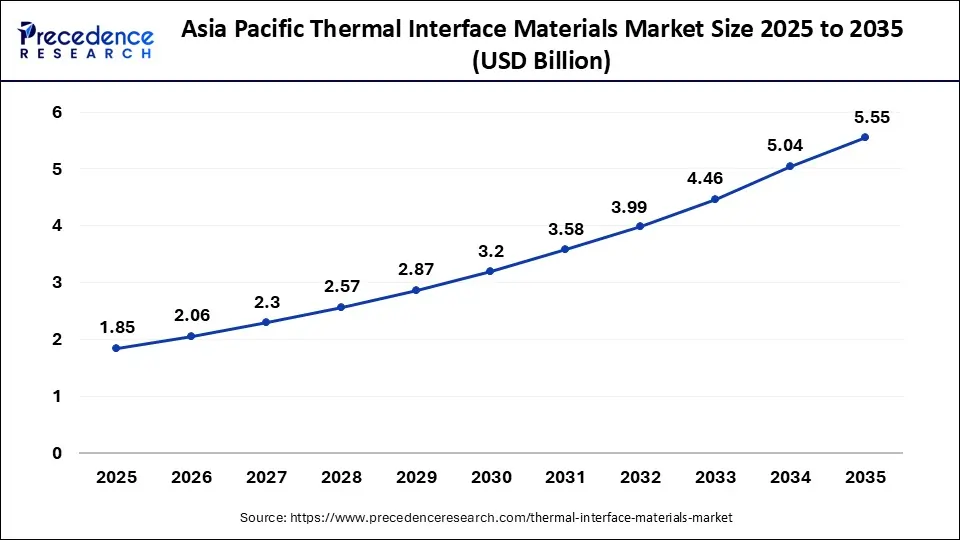
Asia Pacific Thermal Interface Materials Market Size and Growth 2026 To 2035
The Asia Pacific thermal interface materials market size was anticipated at USD 1.85 billion in 2025 and is expected to be worth USD 5.54 billion by 2035, with a notable CAGR of 11.61% from 2026 to 2035.
China
Due to its vast electronics production capabilities, its large production volume of batteries for electric vehicles (EVs), and having many semiconductor assembly facilities, China is the most powerful country within the Asia Pacific region. China's continuous growth in consumer electronics exportation and data center expansion along with its supporting government initiatives for the development of advanced materials has created an ongoing demand for thermal interface materials in the Chinese marketplace.
North America and Europe Show Strong Growth Potential
North America and Europe were the other most promising markets in the thermal interface material; however the sales in the region was deeply impacted with the outbreak of COVID-19 that has declined the share contribution of the region to the market, as most of the parts & components and products for medical devices and automotive industry were imported from China. Besides this, the healthcare sector in the region seems to have a promising future, thereby impel the market growth for the thermal interface materials in the regions.
The North America thermal interface market is anticipated to grow significantly in the upcoming period. The growth is majorly driven by growing demand for highly advanced electronics devices such as high-performance computing systems, consumer electronics and others. Heat dissipation should be done efficiently with evolving technologies, as they generate massive amounts of heat while working. Thus, thermal interface materials play a critical role in the safety of electronic components by ensuring their thermal management with such materials. These materials are supportive in increasing the lifespan of device by reducing extra heat generation and fueling the demand in North America.
U.S. Thermal Interface Materials Market Trends
The thermal interface materials market in the U.S. is witnessing a substantial growth rate as the government of the U.S. is focusing on the adoption of renewable energy sources instead of traditional energy sources to develop sustainable practices in the energy sector. Sectors like LED lighting, industrial automation and energy storage systems require highly advanced thermal management techniques with authentic practices creating a push for thermal interface materials usage in the U.S.
Europe Thermal Interface Materials Market Trends
The European thermal interface materials market is observing a notable growth rate in 2025. Demand for advanced thermal interface materials has witnessed a significant surge over a recent period due to an increasing rate of consumer electronics such as smartphones. Gaming devices, personal computers and others, along with the adoption of electric vehicles. Manufacturers in Europe are also looking for solutions to develop highly advanced and efficient thermal interface materials that also comply with stringent regulations set by authorities in terms of authenticity and reliability of the product.
Germany
Due to Germany's strong automotive engineering base, continuing growth in its EV ecosystem, and having many manufacturers producing industrial electronics, Germany is the most dominant country within Europe. Germany has high levels of demand from the marketplace; the need for the efficient thermal management of power systems, charging stations, and automation equipment drives the continuous demand for advanced thermal interface materials in Germany.
Why Latin America is Emerging Quickly in Hospital Services Market?
Latin America represents a developing market for thermal interface materials due to gradual development in areas of electronics assembly, automotive production and renewable energy projects. Growth through increased levels of digitalization, development of telecommunications and growth in the use of energy-efficient devices provide many salient opportunities. The small current size of the market will continue to provide strong growth through improved manufacturing capability.
Brazil
Brazil is the leader of the Latin American region when measured on the basis of automotive production followed by growth in electronics assembly and increasing investment in renewable energy systems. Additionally, increasing demand for thermal management products used within power electronics and industrial applications positions Brazil as a primary growth driver for the region.
How Middle East and Africa Advancing in Hospital Services Market?
The Middle East and Africa are experiencing tremendous growth as investments are made in infrastructure such as power systems, data centers and the diversification of industries. The overall trend toward increasing thermal management in energy systems, telecom equipment, and industrial electronics are also having a major impact on the growth of markets through increased demand for the use of thermal interface materials. Governments supporting digital transformation and renewable energy also contribute to the growth of the market through increased thermal interface material usage.
UAE
UAE is the leader of this region, with rapid development of data centers, smart city projects, and increased investments in renewable energy. In the UAE, as with other countries, the increased number of advanced electronic devices deployed within the telecom, energy and industrial sectors continues to drive demand for thermal interface materials that operate at high efficiency.
Thermal Interface Materials Market Companies
- Dow Corning Company
- The 3M Company
- Honeywell International, Inc.
- Parker Chomerics
- Indium Corporation
- Henkel AG & Co, KGaA
- Momentive Performance Materials, Inc.
- GrafTech International Ltd.
- Laird Technologies, Inc.
- Fuji Polymer Industries Co., Ltd.
- AIM Specialty Materials
- Shin-Etsu Chemical Co. Ltd.
- Wakefield-Vette, Inc.
- DK Thermal
- AOS Thermal Compounds LLC
- SEMIKRON
Recent Developement
- In May 2026, Dow announced the launch of DOWSIL TC-3120 Thermal Gel, a silicone-based material, to optimize heat transfer and provide optical-grade cleanliness. The product can minimize oil bleeding and condensed outgassing – contaminants that can reduce the reliability of optics and electronics. (Source: https://corporate.dow.com)
- In March 2026, Parker Chomerics launched the Cho-Therm HV Series, a range of thermally conductive interface pads, offering enhanced electrical insulation for automotive and industrial applications. The series combines thermal dissipation performance and electrical isolation with vibration damping properties. (Source: https://www.ivtinternational.com)
- In November 2025: Motion Industries completed its acquisition of Sunset Industrial, a Cerritos, California-based industrial distributor of power transmission parts and lubrication solutions, expanding its West Coast services and customer reach.
- In July 2025: Foundation Investment Partners acquired industrial and safety products distributor AAA Industrial Supply, combining it with Spartan Tool Supply to expand product lines, markets, and ecommerce capabilities under unified leadership.
- In July 2025: Trinity Hunt Partners acquired a majority stake in Blackhawk Supply, launching a new HVAC distribution platform and appointing experienced executives to scale the business nationally.
Segments Covered in the Report
This research study comprises complete assessment of the market by means of far-reaching qualitative and quantitative perceptions, and predictions regarding the market. This report delivers classification of marketplace into impending and niche sectors. Further, this research study calculates market size and its development drift at global, regional, and country from 2021 to 2035. This report contains market breakdown and its revenue estimation by classifying it on the basis of product, application, and region:
By Product
- Elastomeric Pads
- Tapes & Films
- Greases & Adhesives
- Metal Based
- Phase Change Materials
- Others
By Application
- Computer
- Telecom
- Medical Devices
- Consumer Durables
- Industry Machinery
- Automotive Electronics
- Others
By Region
- North America
- Asia Pacific
- Europe
- Latin America
- Middle East and Africa
For inquiries regarding discounts, bulk purchases, or customization requests, please contact us at sales@precedenceresearch.com
Frequently Asked Questions





Ask For Sample
No cookie-cutter, only authentic analysis – take the 1st step to become a Precedence Research client
 Get a Sample




 sales@precedenceresearch.com
 Schedule a Meeting
