



White Oil Market Size, Key Companies, Company Market Share, Production Capacity, Raw Material Pricing, Export & Import Analysis, Manufacturing Cost, Competitive Positioning, and Demand Forecast
White Oil Market (By Application: Adhesives, Agriculture, Food, Pharmaceutical, Personal Care, Textile, Polymers, Others) - Global Industry Analysis, Size, Trends, Leading Companies, Regional Outlook, and Forecast 2025 to 2034
Source: https://www.precedenceresearch.com/white-oil-market
 Get a Sample
 Table Of Content


What is the White Oil Market Size?
The global white oil market size is valued at USD 2.25 billion in 2025 and is predicted to increase from USD 2.36 billion in 2026 to approximately USD 3.45 billion by 2034, expanding at a CAGR of 4.84% from 2025 to 2034. The growing demand for white oil from the pharmaceutical, cosmetics, and personal care industries boosts the growth of the market.

White Oil Market Key Takeaways
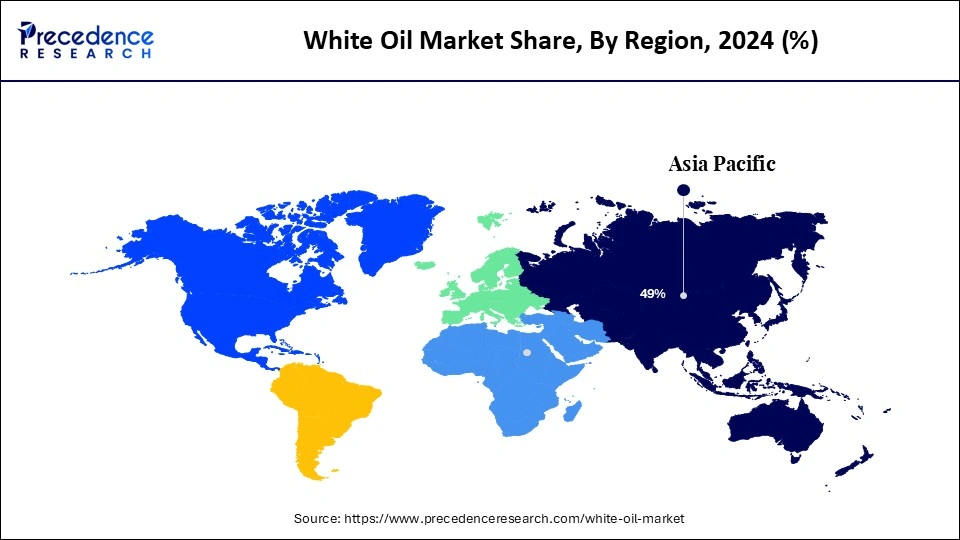
- Asia Pacific dominated the white oil market with the largest share of 49% in 2024.
- Europe is expected to expand at the fastest CAGR during the forecast period.
- By application, the personal care segment dominated the market with the highest share in 2024.
- By application, the adhesives segment is expected to witness significant growth in the coming years.
How does AI Transforms the White Oil Supply Chain and Quality Control?
White oil producers can now market their goods internationally without heavily depending on physical presence, thanks to the quick expansion of artificial intelligence technologies. As AI technologies gain popularity in the development of industrial and chemical products, businesses can more easily reach niche markets and streamline supply chains. Real-time logistics tracking can be possible due to AI technologies. Integrating AI technologies in manufacturing processes significantly improves the production volume of white oil. Moreover, AI helps in the quality control, ensuring white oil products meet stringent quality standards.
Market Overview
The white oil market is experiencing steady growth, driven primarily by its widespread applications across multiple industries, such as pharmaceuticals, cosmetics, personal care, plastics, and textiles. It is a favored ingredient in formulations where consistency and safety are crucial due to its high-purity chemical stability and nontoxic qualities. White oil is used extensively in products like lotions, creams, and ointments in industries like personal care and cosmetics because of its moisturizing qualities and ability to work well with other ingredients. White oil is also used extensively in the pharmaceutical industry for topical applications, drug formulations, and as a production processing aid.
Additionally, the plastic and polymer industries are contributing to the market's upward trajectory, utilizing white oil as a plasticizer and lubricant in manufacturing processes. The demand for highly refined white oil grades is increasing due to the increasing emphasis on quality and safety standards across end-use industries. Manufacturers are also able to serve niche markets thanks to advancements in processing technologies and a growing trend toward specialized applications, which guarantees ongoing business opportunities in the white oil sector.
- In 2025, the Indian government announced several initiatives to boost domestic oil production, including the New Exploration Licensing Policy and key legislative reforms. Launched to attract investments and ensure a stable supply of raw materials, these measures are set to benefit industries like white oil manufacturing by reducing reliance on imports.
White Oil Market Growth Factors
- Increasing Demand in Pharmaceuticals and Cosmetics: The high purity and nontoxic properties of white oil make it ideal for use in pharmaceutical and cosmetic products, driving demand in these industries.
- Rising Industrial Applications: White oil's versatility in industries like plastics, textiles, and food processing, where it acts as a lubricant, plasticizer, and processing aid, supports its growth.
- Regulatory Support and Safety Standards: Increasing emphasis on product safety and regulatory standards across industries, particularly in pharmaceuticals and cosmetics, is boosting the demand for high-quality white oil.
- Growing Focus on Sustainable and Safe Ingredients: With a rise in consumer preference for nontoxic, hypoallergenic ingredients, white oil's safe profile positions it well in the growing trend toward sustainability in personal care products.
White Oil Market Outlook
- Industry Growth Overview: The market is poised for strong growth, driven by increasing demand for pure, non-toxic ingredients in pharmaceuticals, cosmetics, and food processing. The rapid expansion of the personal care and pharmaceutical industries, where white oil is a vital base ingredient, further drives market growth.
- Development of Specialized Grade: There is a strong focus on developing high-purity, application-specific grades for cosmetics, pharmaceuticals, and polymers. Shifts in regional production, particularly toward Asia-Pacific, and volatility from crude oil prices also shape the market.
- Global Expansion: The market is experiencing steady growth due to increasing demand in sectors such as personal care, pharmaceuticals, and food processing, where it is valued for its purity, non-toxicity, and versatility. Emerging regions, particularly in Asia-Pacific, offer significant opportunities for market expansion, driven by rising industrialization, expanding consumer bases, and an increasing focus on healthcare and cosmetic products that require high-quality base oils.
- Major Investors: Major investors in the market include multinational corporations like ExxonMobil, Royal Dutch Shell, and Sasol, which contribute through their extensive production capabilities, research and development of high-quality refining processes, and strategic acquisitions of smaller players to expand market share. These companies drive innovation, ensure a steady supply of premium white oils, and help meet the growing demand across diverse industries such as personal care, pharmaceuticals, and food, thereby supporting the market's global growth.
- Startup Ecosystem: The startup ecosystem in the market is burgeoning, with innovative companies focusing on sustainable production methods, eco-friendly alternatives, and advanced refining technologies to cater to niche consumer needs. These startups contribute to the market by driving competition, introducing novel formulations for specialized applications such as organic cosmetics or green pharmaceuticals, and offering agile solutions that meet the evolving demand for high-purity, safe, and environmentally responsible white oils.
Market Scope
| Report Coverage | Details |
| Market Size by 2034 | USD 3.45 Billion |
| Market Size by 2025 | USD 2.25 Billion |
| Market Size in 2026 | USD 2.36 Billion |
| Market Growth Rate from 2025 to 2034 | CAGR of 4.84% |
| Dominated Region | Asia Pacific |
| Fastest Growing Market | Europe |
| Base Year | 2024 |
| Forecast Period | 2025 to 2034 |
| Segments Covered | Application, and Regions |
| Regions Covered | North America, Europe, Asia-Pacific, Latin America and Middle East & Africa |
Market Dynamics
Drivers
Innovative Formulation Techniques
The rising focus on developing innovative formulations is expected to drive the growth of the white oil market. The investments in R&D is rising to develop advanced white oil formulations that not only offer superior purity and stability but also provide additional benefits, such as longer shelf life or better absorption properties for personal care products. Concentrate on developing multifunctional products like white oil that can be applied to a range of sectors, such as food processing, pharmaceuticals, and cosmetics. Additionally, consider creating formulations that are simple to modify to satisfy the unique requirements of customers, adding value and encouraging brand loyalty. This could position the company as a pioneer in creating superior, cutting-edge white oil formulations.
Sustainability Through Green Refining
Researchers are developing eco-friendly refining methods that reduce carbon emission, water usage, and waste generation during the production of white oil, which drives the growth of the market. Examine the possibility of substituting components derived from petroleum with bio-based or renewable feedstocks as raw materials. Additionally, you could strengthen your sustainability credentials by incorporating renewable energy sources like wind or solar power into the refining process. By putting these green refining technologies into practice, businesses can satisfy growing regulatory requirements while also appealing to the growing number of environmentally conscious consumers. You can draw in customers who care about the environment as well as those looking to raise their sustainability profiles by establishing your brand as a leader in sustainability.
Restraints
Environmental Concerns and Regulations
Even though white oil is highly valued for its purity, the process of producing it mainly uses petroleum-based feedstock, which can have detrimental effects on the environment. As concerns about climate change grow around the world, governments are passing more stringent environmental laws that require carbon emissions to be reduced and raw materials to be sourced sustainably. White oil producers, especially those that use conventional refining techniques, may see an increase in operating costs as a result of complying with these regulations. Further complicating the white oil market is the possibility that demand for bio-based oils or other environmentally friendly ingredients will shift because of the mounting pressure to use greener substitutes.
Dependency on Oil Refining Technologies
The production of white oil is closely related to specialized refining technologies, which call for sophisticated infrastructure and technical know-how. The products' quality yield and cost-effectiveness can all be adversely impacted by inefficiencies or technological constraints in the refining process. Additionally, the refining and rising energy prices may make it harder for producers to keep profit margins. Furthermore, the capital-intensive nature of refining technology advancements may be a deterrent for smaller producers looking to innovate or improve their production capacities. Because of this dependence on expensive technology, it may be challenging for smaller players to expand or for new competitors to enter the market.
Opportunities
Rising Demand from the Personal Care Industry
The rising demand for white oil in the personal care industry creates immense opportunities in the white oil market. The purity, emollient qualities, and stability of white oil make it a popular ingredient in skincare, haircare, and cosmetic formulations. The need for safe and mild ingredients is rising as people become more conscious of personal hygiene and self-care, particularly in developing nations. Because white oil is hypoallergenic and non-comedogenic, it is perfect for makeup removers, baby care products, and sensitive skin care products. White oil is being used increasingly by companies specializing in clean labels and minimalist products. Manufacturers now have a great chance to customize formulations and packaging for the rapidly expanding personal care industry.
Digital Transformation and E-commerce Expansion
White oil producers can now market their goods internationally without heavily depending on physical presence, thanks to the quick expansion of digital channels in the B2B and B2C markets. As e-commerce platforms gain popularity in the procurement of industrial and chemical products, businesses can more easily reach niche markets and streamline supply chains. Real-time logistics tracking, virtual consultations, online sampling, and digital marketing are some of the tools that can improve customer satisfaction and retention. By using digital tools to increase visibility and credibility, this shift also enables smaller players to compete with larger corporations.
Application Insights
The personal care segment dominated the white oil market with the largest share in 2024. This is mainly due to the heightened adoption of white oil in cosmetics, lotions, baby oils, and moisturizers. White oil is suitable for formulations for sensitive skin because of its superior emollient qualities, non-comedogenic nature, and chemical stability. It is used as a base ingredient in the production of cosmetics. The rising consumer interest in skincare, hygiene, and clean-label products further sustains the segment's position. Strict safety regulations like those set by the FDA bad USP further support segmental growth.
The adhesives segment is expected to witness significant growth in the coming years. The growth of the segment can be attributed to the increasing demand for high-performance adhesives in the construction, automotive, and packaging industries. White oil is used in adhesives because it prevents cracking or breaking under stress. White oil is often used in making eco-friendly adhesives due to its water-resistant properties.
Regional Insights
Asia Pacific White Oil Market Size and Growth 2025 to 2034
The Asia Pacific white oil market size is exhibited at USD 1.10 billion in 2025 and is projected to be worth around USD 1.71 billion by 2034, growing at a CAGR of 5% from 2025 to 2034.
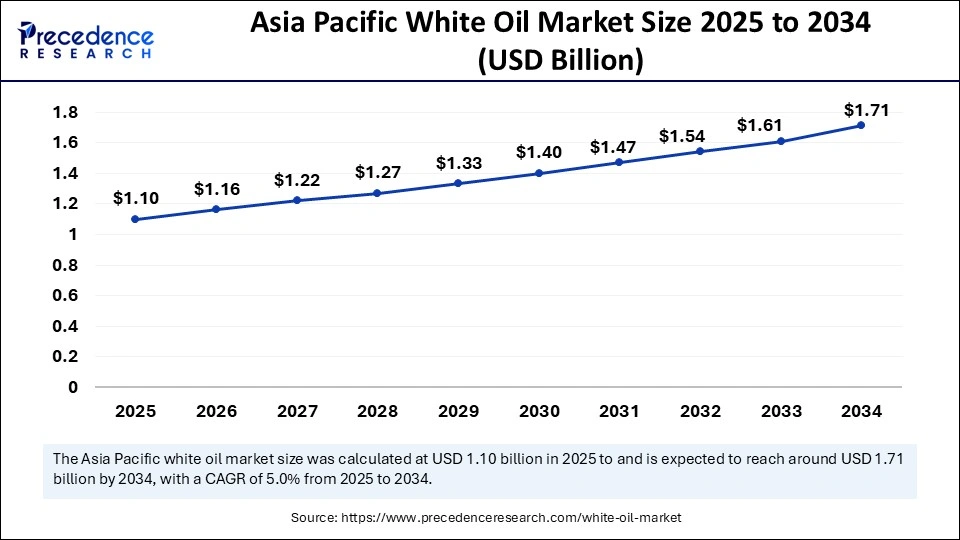
Asia Pacific dominated the white oil market with the largest share in 2024. This is mainly due to the increasing demand from adhesives, personal care, and pharmaceutical industries. One major factor in this leadership is the extensive use of white oil in skincare, infant care, and wellness products. There is a high adoption of white oil due to rising consumer awareness and a preference for high-purity ingredients. With the rising construction activities in emerging countries, there is a high demand for high-performance adhesives, in which white oil plays a key role in enhancing their properties. The rising industrial production further bolstered regional market growth.
India White Oil Market Trends
India plays a significant role in the market, spurred by rapid industrial growth, rising consumer awareness of health and skincare, and government-led initiatives. The market is marked by strong demand for white oils in the cosmetics and personal care sectors, particularly hair oils, alongside a growing pharmaceutical industry. Although the country depends on global companies for some high-end equipment, domestic manufacturers like Savita Oil Technologies and Gandhar Oil Refinery are increasing production capacity to meet growing demand and maintain a strong local supply chain.
What Makes Europe the Fastest-Growing Region in the Market?
Europe is expected to expand at the fastest CAGR during the forecast period. The growth of the European white oil market can be attributed to growing applications in various fields. The market in the region is expanding more quickly due to increased use in personal care, agriculture, and pharmaceuticals. Strict quality standards and regulatory compliance encourage the use of premium white oil. White oil is becoming more and more popular in the agriculture sector as it finds applications in pest control formulations. There is a strong emphasis on environmentally friendly practices. However, white oil is widely used in formulating eco-friendly products.
Germany White Oil Market Trends
Germany is a leading player in the European market, hosting major global chemical and pharmaceutical manufacturers. The market features high demand for high-quality, high-purity white oils to support its strong pharmaceutical, personal care, and industrial sectors. The country's dedication to sustainable practices and strict environmental rules foster innovation in energy-efficient manufacturing methods and products that meet top safety and environmental standards. Germany benefits from an established infrastructure and substantial investment in R&D for advanced, compliant white oil applications.
What Potentiates the Growth of the North America White Oil Market?
The market in North America is driven by a well-established industrial base, strict purity regulations, and a focus on high-value applications. The region is a hub of innovation, with major companies like ExxonMobil and Chevron investing in advanced refining technologies to produce high-purity, pharmaceutical, and food-grade white oils that meet rigorous safety standards. Demand remains strong across various sectors, including personal care, pharmaceuticals, and as a processing aid in plastics and polymers, with an increasing emphasis on sustainable and bio-based alternatives.
U.S. White Oil Market Trends
The U.S. dominates the North American market, making up most of the regional demand due to its strong industrial base and strict FDA regulations. Demand in the U.S. is mainly driven by the personal care and cosmetics sectors, with companies like ExxonMobil and Chevron using advanced purification methods to meet these demands. The U.S. government promotes domestic manufacturing and energy independence, further strengthening North America's market leadership and technological advantage.
How is the Opportunistic Rise of Latin America in the White Oil Market?
Latin America is seeing a strategic rise in the market, driven by growing applications in the personal care, pharmaceutical, food processing, and industrial sectors. The region's increasing population and higher disposable incomes are boosting demand for a wide range of consumer and healthcare products that rely on highly refined, non-toxic white oils as a key ingredient or base. Industrialization and infrastructure projects in countries like Brazil and Mexico are also increasing demand for high-quality lubricants and process oils in manufacturing, plastics, and polymer production.
Brazil White Oil Market Trends
Brazil leads the Latin American market, mainly due to a robust personal care industry where white oil is widely used in lotions, creams, and baby oils because of its safety and purity. The country's growing pharmaceutical and food processing industries further drive demand, with manufacturers focusing on quality and compliance with industry standards.
What Factors Drive the Middle East and Africa White Oil Market?
The market in the Middle East and Africa is mainly driven by the rising demand for high-purity white oils from the personal care, cosmetics, and pharmaceutical sectors. Increasing healthcare awareness and growing government support for the pharmaceutical industry, particularly in countries like Saudi Arabia and the UAE, are key growth factors. The market is also experiencing a rise in the use of food-grade white oils in food processing, along with a greater focus on sustainable and eco-friendly formulations to meet changing regulatory standards.
UAE White Oil Market Trends
The UAE is a major contributor to the MEA market, driven by its large infrastructure projects, rapid digitalization, and a strong focus on diversifying its economy. Key demand sectors include the pharmaceutical industry, where white oil is used in ointments and capsules, and the growing personal care and cosmetics industry, which values the oil's purity and skin-safe properties. The country is leveraging its strategic location as a logistics hub and is experiencing an increase in the use of high-quality, non-toxic white oils in food processing and industrial applications, in line with strict quality and safety standards.
Value Chain Analysis
- Raw Material Sourcing & Upstream Operations
This involves the exploration, extraction, and transportation of crude oil.
Key Players: ExxonMobil Corporation, Royal Dutch Shell, British Petroleum, and Sinopec Corporation. - Refining and Production
This focuses on refining crude oil into high-purity white oil, ensuring compliance with strict regulatory standards.
Key Players: ExxonMobil Corporation, Royal Dutch Shell N.V., Petro-Canada, Sasol, Renkert Oil, Inc., and H&R Group. - Distribution and Supply Chain Management
This manages the logistics of delivering the refined white oil to various end-user industries through wholesale distribution and managing dealer networks.
Key Players: Palmer Holland, Royal Dutch Shell Plc, and Petro-Canada Lubricants Inc. - Application and Value Integration
In this stage, the white oil is used as a base ingredient, lubricant, or emollient in diverse sectors such as pharmaceuticals, cosmetics, and food processing.
Key Players: Petro-Canada Lubricants Inc., Renkert Oil, Inc., Sonneborn LLC, and Royal Dutch Shell plc. - Aftermarket Support and Value-Added Services
This involves providing technical support, application guidance, and regulatory compliance assistance to end users.
Key Players: ExxonMobil, Sasol, BP, and Chevron.
Top Companies in the White Oil Market and Their Offerings
- ExxonMobil Corporation: Offers Marcol™ and ProPure™ white oils for Pharmaceuticals, cosmetics, food processing, plastics, and agriculture.
- Royal-Dutch Shell N.V.: Offers Ondina and Luminol™ refined oils for personal care products, pharmaceuticals, and general industrial uses.
- Sinopec Corporation: medicinal white Oil, Cosmetic White Oil for pharmaceuticals, personal care industries.
Petro-Canada: PURETOL™ and PRIMOL™ ultra-pure oils for food-grade lubricants, pharmaceuticals, and personal care products. - Renkert Oil, Inc.: Comprehensive line of white mineral oils for personal care, pharmaceuticals, plastics/polymers, textiles.
Other Key Players
- British Petroleum
- JX Nippon Oil & Energy Corporation
- Nynas AB
White Oil Market Companies
- British Petroleum
- Renkert Oil, Inc.
- ExxonMobil Corporation
- JX Nippon Oil & Energy Corporation
- Nynas AB
- Petro-Canada
- Royal-Dutch Shell N.V.
- Sinopec Corporation
Latest Announcement by Industry Leader
- In February 2024, Chevron Lummus Global (CLG) announced the commissioning of the world's largest white oil hydroprocessing unit at Hongrun Petrochemical (Weifang) Co., Ltd. in Shandong Province, China. The facility integrates CLG's advanced ISODEWAXING and ISOFINISHING technologies, enabling the production of ultra-pure white oil tailored to specific industrial needs. The Chief Executive Officer of CLG stated "This state-of-the-art facility sets a new benchmark in white oil production, reflecting our commitment to innovation and meeting the evolving demands of the industry.”
Recent Developments
- In March 2024, ExxonMobil Corporation announced the expansion of its white oil product line, targeting pharmaceuticals and cosmetic applications, with a focus on ultra-low aromatic content and enhanced purity standards. This move aligns with the rising global demand for highly refined oils in health and personal care. The company also emphasized sustainability in its production processes, improving its competitive edge.
- In January 2024, Calumet Specialty Products Partners launched a new range of food-grade white oils designed for direct contact applications in food processing and packaging. The oil meets FDA and NSF standards, ensuring safety for consumable use. This development strengthens Calumet's foothold in the food industry segment.
Segments Covered in the Report
By Application
- Adhesives
- Agriculture
- Food
- Pharmaceutical
- Personal Care
- Textile
- Polymers
- Others
By Regional
- North America
- Europe
- Asia Pacific
- Latin America
- Middle East and Africa
For inquiries regarding discounts, bulk purchases, or customization requests, please contact us at sales@precedenceresearch.com
Frequently Asked Questions





Ask For Sample
No cookie-cutter, only authentic analysis – take the 1st step to become a Precedence Research client
 Get a Sample




 sales@precedenceresearch.com
 Schedule a Meeting
