



5G IoT Market Size, Key Companies, Company Market Share, User Adoption, Technology Deployment, Revenue Growth, Competitive Positioning, and Demand Forecast
5G IoT Market (By Components: Solution, Services; By Enterprise Size: Large Enterprises, Small & Medium Enterprises; By Network Type: 5G Standalone (SA), 5G Non-standalone (NSA); By End User: Manufacturing, Healthcare, Energy and Utilities, Automotive and Transportation, Supply Chain and Logistics, Government and Public Safety, Agriculture, Others) - Global Industry Analysis, Size, Trends, Leading Companies, Regional Outlook, and Forecast 2026 to 2034
Source: https://www.precedenceresearch.com/5g-iot-market
 Get a Sample
 Table Of Content


What is the 5G IoT Market Size?
The global 5G IoT market size is accounted at USD 11.69 billion in 2025 and predicted to increase from USD 17.56 billion in 2026 to approximately USD 455.67 billion by 2034, expanding at a CAGR of 50.23% from 2026 to 2034.
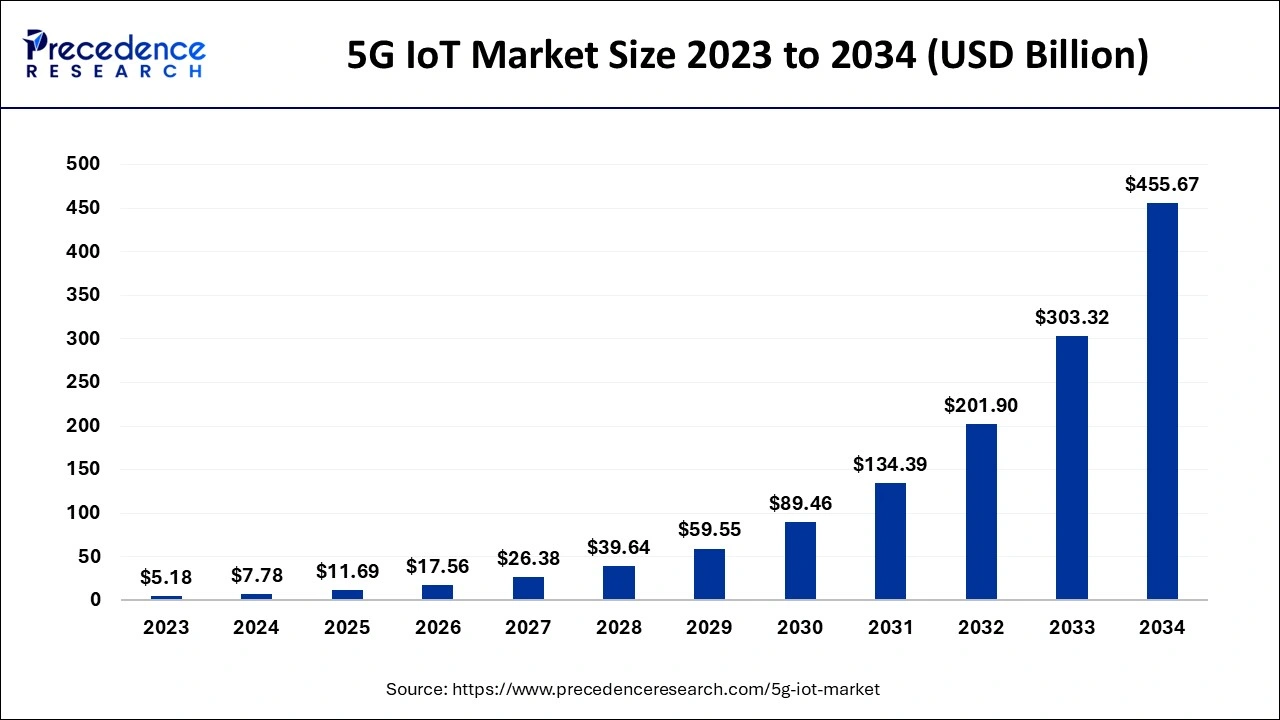
5G IoT Market Key Takeaways
- By component, the solution segment exhibited a market share of over 63% in 2024.
- By network type, the 5G non-standalone segment held a 59% revenue share in 2024.
- By enterprise size, the large enterprises segment accounted revenue share of over 70% in 2024.
- Asia-Pacific contributed the highest revenue share 39% in 2024.
Market Overview
5G is seeing rapid applications in a number of industries such as manufacturing, energy & utilities, healthcare, automobile sector, transportation, and in agriculture sector among others to boost business profitability and efficiency. In current times, this technology is helping to enable more stable, faster, and significantly secured connectivity to ensure advancement across a number of applications such as self-driving vehicles, AI-enabled robots on factory floors, and smart grids for renewable energy among others. Moreover, it is rapidly progressing in terms of meeting the diverse IoT use cases and requirements. For instance, according to various reports, 5G is anticipated to be around 10 times faster as compared with present LTE networks. This high speed of 5G is projected to help IoT devices in considerably faster data sharing and communication.
A commercial success of IoT devices is linked with its performance. Hence, 5G IoT is projected to be an essential trend in global IoT industry to meet requirements associated with a performance of IoT devices. 5G is enabling end users to remotely control more IoT devices in applications where real-time network performance is very critical. Such applications include, remote surgery and remote control of heavy machinery in a harmful environment, thus improving worker safety. For instance, as per the recent survey by Ericsson, 73% of healthcare executives expect that the 5G IoT will enable them to implement new products and services to enhance quality of life for the worldwide public.
What's Propelling the Explosive Expansion of the Global 5G IoT Market?
The global 5G IoT market is experiencing rapid expansion as industries globally deploy ultra-fast and low-latency networks to enable connected ecosystems. As the development of smart cities, autonomous vehicles, and industrial automation intensifies, 5G IoT is a critical enabler of real-time communications and intelligent operations. The market growth will be accelerated by the rising demand of Industry 4.0, the incorporation of AI capabilities, and the increasing need for edge computing and mission-critical IoT use cases.
5G IoT Market Growth Factors
The development of Industry 4.0 is one of the major contributors to global 5G IoT market. Under this revolution, manufacturers are actively incorporating innovative technologies, such as IoT, AI & machine learning, and cloud computing & analytics into their production facilities and operations. This has created demand for low latency and higher speeds of 5G technology for effective usage of wearables, automatic robots, and virtual reality (VR) headsets. 5G has considerably accelerated the IoT and given an additional boost to the industrial revolution 4.0. For instance, according to the studies, about 35% of manufacturers in U.S. uses data from smart sensors within their set-ups. In addition, the number of IoT devices has become comparatively higher than the number of actual human users of the Internet. For instance, according to the Bosch, there will over 70 billion connected devices around the globe by 2025, most of them are projected to be in use in industrial applications. This growth of the IoT devices is boosting growth of the global 5G IoT market.
Moreover, 5G technology has become a critical factor for the competitiveness among enterprises. Hence, there is an emerging need for large enterprise and well as SMEs to have access to 5G technology in support of their growth and ability to scale rapidly. This has led to the increased investment in this technology bu global organizations a greater speed in the transmissions, a lower latency, the possibility of implementing virtual networks (network slicing), greater capacity of remote execution, and a greater number of connected devices.
On the other hand, 5G IoT trend in healthcare sector is expected to create lucrative growth opportunities for the global market. There is an emerging usage of artificial intelligence (AI) and health-related IoT devices to monitor patients and making the recommendations related to the treatment of disease. Also, in past few years, healthcare sector is seeing an upsurge in use of wearable technologies including health trackers and other portable health monitoring devices. Such technologies are helping in predictive diagnostics, emergency health preparedness, and telemedicine. Furthermore, healthcare organizations are actively moving towards 5G and IoT technologies under their digital transformation plans. For instance, in January 2022, Proximie, is a global health technology platform focused on digitization of operating & diagnostic rooms partnered with Vodafone for 5G and IoT powered healthcare. Under this partnership, Vodafone is expected to help Proximie in acceleration of its expansion plans to provide 5G, IoT, and edge computing infrastructure.
Market Scope
| Report Coverage | Details |
| Market Size by 2034 | USD 455.67 Billion |
| Market Size in 2025 | USD 11.69 Billion |
| Market Size in 2026 | USD 17.56 Billion |
| Growth Rate from 2026 to 2034 | CAGR of 50.23% |
| Base Year | 2025 |
| Forecast Period | 2026 to 2034 |
| Segments Covered | Components, Enterprise Size, Network Type, End User, and Region |
| Regions Covered | North America, Europe, Asia-Pacific, Latin America and Middle East & Africa |
Segment Insights
Component Insights
Depending upon the component, the hardware segment is the dominant player and is anticipated to have the biggest impact on 5G IoT market. This segment includes 5G modules, sensors, gateways, and chips associated with the 5G IoT infrastructure. The integration of 5G technology with IoT hardware enables wireless network of IoT hardware to achieve high bandwidth, low latency, and faster data transmission. Hence, ongoing demand for 5G IoT and associated 5G IoT modules is primarily boosting growth of this segment.
Both of the module and components providers in global market are investing in research and development (R&D) and introducing innovative hardware solutions. This factor is opportunistic for growth of the hardware segment. For instance, in October 2021, Arm, the UK-based company specialized in designing of the architecture, announced the introduction of novel chip design offerings across the internet of things (IoT), 5G, and virtual hardware sectors. This launch includes, Arm Total Solutions for IoT which is projected to considerably accelerate development and return-on-investment (ROI) for IoT chip products.
End User Insights
Depending upon the end user, the manufacturing segment has dominated the 5G IoT market in 2024. In manufacturing sector, conjunction of 5G and IoT has provided manufacturers with an enhanced agility and flexibility in their digital transformation journey. Also, it has helped them accomplish their Industry 4.0 vision and ensure a superior customer satisfaction coupled with an increased ROI. Therefore, growing adoption of 5G IoT in global manufacturing industry is boosting growth of this segment.
Digitization and advancement of manufacturing ecosystem and processes with the help of 5G IoT is anticipated to create more efficient, flexible, and sustainable production lines. This has led to the development of smart factories. Such factories are aimed at creating a fully connected experience, enabling a number of manufacturing companies to realize benefits such as performance improvements, increased safety, and operational efficiencies.
Furthermore, introduction of various initiatives aimed at implementation of 5G IoT across the manufacturing industry is opportunistic for growth of the market. For instance, in January 2022, GSMA and 5G Alliance for Connected Industries and Automation (5G-ACIA) signed a MoU for collaboration on industrial manufacturing needs as well as service requirements. Under this agreement, GSMA and 5G-ACIA are projected to promote, collaborate, and advance an understanding of industrial 5G deployment considerations, such as networks, infrastructure options, devices, applications, and deployment models.
Regional Insights
Asia Pacific 5G IoT Market Size and Growth 2026 to 2034
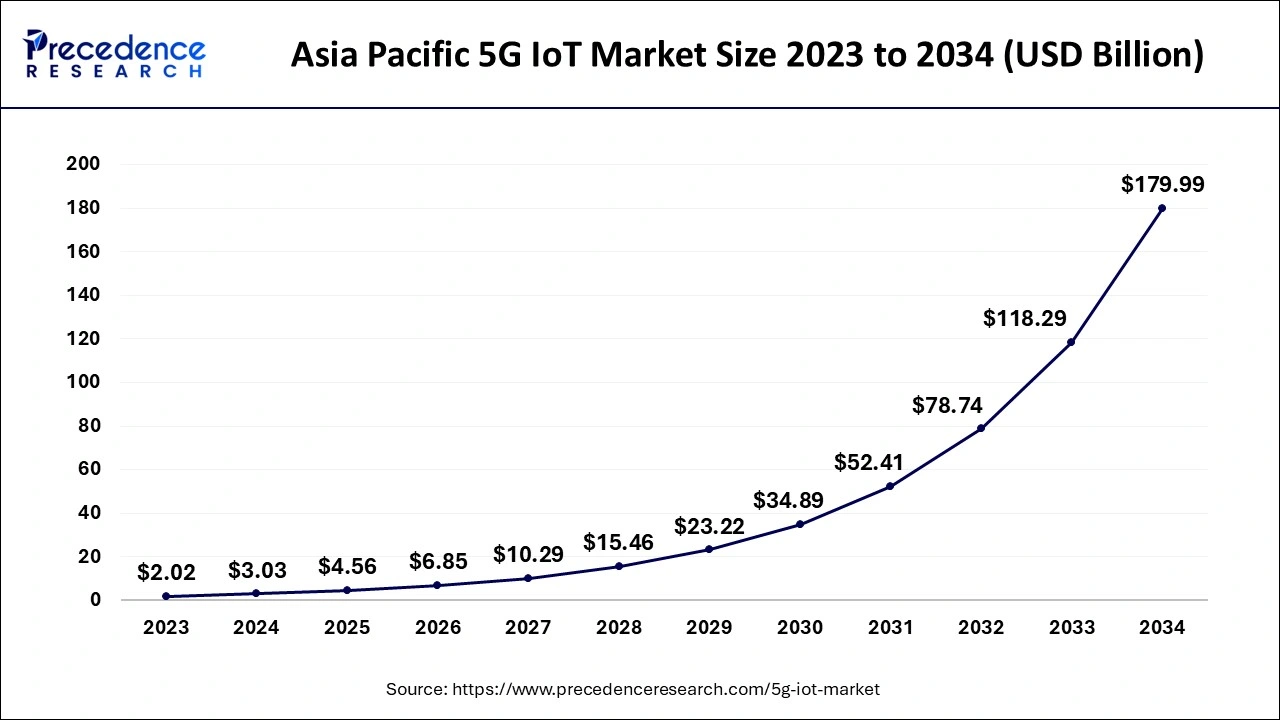
The Asia Pacific 5G IoT market size is evaluated at USD 6.85 billion in 2026 and is predicted to be worth around USD 179.99 billion by 2034, rising at a CAGR of 50.41% from 2026 to 2034.
The highest market share and dominant position in the 5G IoT market belongs to North America during the forecast period. This region includes U.S. and Canada. Growth of the market in this region is mainly attributed to strong industrial, logistics, and transportation sectors; growing need for faster connectivity; and technological innovations in the energy and telecommunication sectors. Also, increasing wireless 5G connections in the region is further projected to boost North America market. For instance, according to data from Omdia, North America accounted for a total of 44.6 million 5G connections by the end of second quarter of 2021, which is 67% quarter over quarter growth as compared to previous year.
In addition, this region is a home to leading 5G IoT industry leaders and has consequently witnessed comparatively higher R&D investment. This factor is expected to create lucrative growth opportunities for the 5G IoT market.
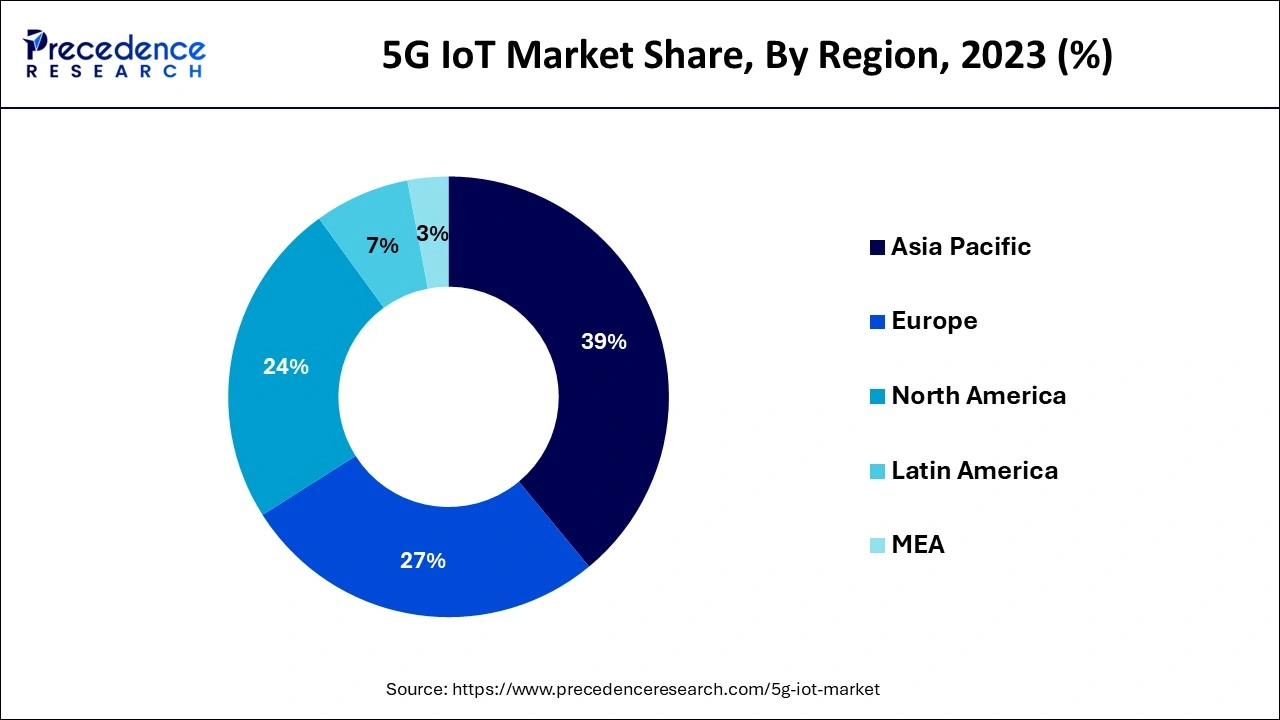
Asia-Pacific is considered as highest growing region in 5G IoT market. This region includes China, India, Japan, South Korea, and rest of the world. Ongoing investments in infrastructure in Asia-Pacific countries is boosting deployment trend of 4G and 5G networks. This has further led to the increased implementation of the 5G IoT services in the region. For instance, according to the data from the China Academy of Information and Communications Technology (CAICT), the country is expected to invest about $215 billion in the 5G network infrastructure by 2025. On the other hand, the number of 5G subscriptions are growing at rapid pace in this region. This is opportunistic for growth of Asia-pacific 5G IoT market. For instance, as per the Ericsson AB's latest Mobility Report, Asia Pacific is anticipated to be the one of the fastest growing region with about 10% of all subscriptions being 5G in 2023.
Furthermore, reduced prices for powerful sensors and controllers, increased connectivity, increased internet penetration, government initiatives associated with smart cities, and increased government spending on 5G technology in the region is projected to boost 5G IoT market.
North America: U.S. 5G IoT Market Trends
The U.S. market is experiencing rapid expansion, with the adoption of edge computing enabling data processing closer to devices to reduce latency and boost responsiveness. There is growing use of low power wide-area (LPWA) 5G technologies that make IoT devices more energy-efficient and affordable. Key verticals driving demand include automotive for connected vehicles, industrial automation, and healthcare monitoring.
Asia Pacific: China 5G IoT Market Trends
China's market is rapidly expanding, driven by large-scale smart city deployments and strong government backing. The deep rollout of 5G infrastructure is enabling massive machine type communications, especially for urban applications and industrial automation. As 5G RedCap modules (lightweight, low cost) become more affordable, IoT device adoption is accelerating across consumer and enterprise sectors. Edge computing and AI integration are enabling real time data processing, reducing latency, and enhancing intelligence in connected devices.
How's Latin America Managing the 5G IoT Evolution?
In Latin America, there has been a strong uptick in the 5G IoT space, powered by investment in telecom infrastructure and government-supported digital transformation initiatives. Countries such as Brazil, Mexico, and Chile are driving innovation with 5G-enabled smart cities and agriculture projects. There is also a surge of interest in connected health and logistics. Although the costs of deployment are high, growing partnerships between telecom operators and technology start-ups are fostering innovation and deployment.
What's Contributing to Europe Leading the 5G IoT Market?
Europe remains a global leader in the 5G IoT ecosystem, harnessing both supportive regulatory frameworks and commitment to research and development (R&D). Key markets such as Germany, the UK, and France are deploying 5G IoT across automotive, manufacturing, and public safety sectors. As a customer of the European Union (EU), there are synergies for the quick deployment of 5G IoT within the domains of data sovereignty, green connectivity, and cross-border interoperability.
These traits allow regional 5G IoT deployment to be deployed more seamlessly. They are also leading to the next wave of intelligent automation based on initiatives like the EU Digital Strategy 2030 Series in the industrial and consumer IoT segments.
Germany 5G IoT Market Trends
Germany's 5G IoT market is surging, largely driven by its strong industrial base and push for smart manufacturing under the “Industrie 4.0” framework. Low-latency, high-bandwidth 5G connectivity is enabling real-time data processing, predictive maintenance, and automation in Germany's automotive, logistics, and energy sectors. There is an increasing deployment of edge computing infrastructure to support distributed processing and reduce response times for critical IoT applications.
How Does the 5G IoT Market Value Chain Operate?
Value chains in the 5G Internet of Things (IoT) market have brought together actors from telecommunications, IoT device manufacturers, platform providers, and system integrators to deliver connected solutions for different industries. Each actor in the value chain plays a role in the completion of a cycle for connection, analysis, and automation in multiple sectors.
- Telecom Infrastructure Providers: The easiest way to consider connectivity in this market is to think of telecom infrastructure providers as the necessary technological enabler of 5G IoT connectivity. These companies deploy telecom infrastructure based on advanced network architectures like millimeter wave spectrum (mmWave) and network slicing that will provide high-speed.
- IoT Hardware and Device Manufacturers: Hardware and device manufacturers branch all the way from smart sensors to connected automobiles. These industries build devices that provide 5G IoT users with low-latency connections for real-time operation and data transmission.
- Software & Platform Integrators: Software and platform providers typically offer middleware, cloud services, and analytical tools that connect IoT hardware to AI-generated insights that will allow businesses to optimize operations and decision-making.
What Will the Global 5G IoT Industry Look Like in the Future?
- Industry Growth Outlook: The 5G IoT industry is estimated to be more than USD 380 billion by 2033, as driven by next-gen use cases in autonomous mobility, smart manufacturing, and healthcare IoT. The merging of AI with edge computing will also play a role in further reshaping the connected world.
- Sustainability Trends: Sustainable 5G IoT deployments are on the rise, with a stronger emphasis on energy-efficient networks, green base stations, and designing devices that fall within a circular lifecycle. For example, smart grids and eco-monitoring solutions are supporting carbon neutrality goals.
- Global Proliferation: Global adoption of 5G IoT is also exploding in regions such as Asia-Pacific, Europe, and North America as organizations expand use cases 5G-enabled use cases for smart cities, logistics, and digital healthcare.
- Startup Ecosystem: The startup ecosystem is alive and creating some change in the market for AI-based IoT use cases, edge analytics, and robotic applications for IoT. Startups are also bringing new opportunities for working with telecom operators and decreasing the time-to-market for IoT devices or creating new industry-focused technologies.
5G IoT Market Companies
- China Mobile
- AT&T Inc.
- Verizon Communications Inc.
- T-Mobile
- Vodafone
- Ericsson
- Huawei
- Deutsche Telekom
- Nokia
- SK Telecom
Recent Developments
- In February 2025, Myriota partners with Viasat to launch Myriota HyperPulse™, the first 5G NTN service optimized for the demands of remote IoT sensing. Myriota HyperPulse™ delivers connectivity for the most demanding IoT use cases where energy efficiency, security, and form factor intersect with the need for low latency and dependable reporting. (Source: https://iotbusinessnews.com)
- In May 2025, GCT Semiconductor Holding Inc., a leading designer and supplier of advanced 4G and 5G semiconductor solutions, and Giesecke+Devrient (G+D), a global provider of eSIM technology and developer of the first GSMA SGP.32 fully-certified product, announced their partnership to launch a cutting-edge SGP.32 eSIM solution with Integrated Profile Activation Device (IPAd) support for multi-network IoT devices. (Source: https://www.businesswire.com)
- In March 2025, Anritsu Corporation introduced the Virtual Signalling Tester NR Software MX844030PC, a software-based test simulator for developing 5G IoT chipsets and devices. The solution supports 5G IoT test by using a new simulator that operates in a virtual environment on a PC using advanced architecture, as well as a Software Defined Radio (SDR) those implements most conventional radio functions in software. (Source: https://timestech.in)
- In July 2021, China Mobile Group established a partnership with Huawei for building the World's Largest IoT support platform. Through this partnership, the two companies are projected to cooperate extensively to respond to service requirements in IoT through efficient O&M and service innovation.
Can 5G- Enabled IoT Unlock the Next Wave for Smart Innovation?
The market for 5G IoT is set for tremendous expansion due to technological advancements and growing demand for ultra-fast, low-latency connectivity provided by 5G. The growth opportunities are widespread in areas such as smart cities, autonomous vehicles, remote healthcare, industrial automation, and any area where fast data can be shared or accessed. With expanded network capabilities offered by 5G, companies can scale massive IoT deployments and access different business models. While many industries undergo digital transformation, the convergence of 5G and IoT has the potential to impact every operational aspect, improving productivity and facilitating new ways of working and innovating across the whole market, positioning it for a future with transformative opportunities.
Segments covered in the report
By Components
- Solution
- Hardware
- Platform
- Connectivity
- Services
By Enterprise Size
- Large Enterprises
- Small & Medium Enterprises
By Network Type
- 5G Standalone (SA)
- 5G Non-standalone (NSA)
By End User
- Manufacturing
- Healthcare
- Energy and Utilities
- Automotive and Transportation
- Supply Chain and Logistics
- Government and Public Safety
- Agriculture
- Others
By Region
- North America
- Europe
- Asia-Pacific
- Latin America
- Middle East & Africa (MEA)
For inquiries regarding discounts, bulk purchases, or customization requests, please contact us at sales@precedenceresearch.com
Frequently Asked Questions
Tags





Ask For Sample
No cookie-cutter, only authentic analysis – take the 1st step to become a Precedence Research client
 Get a Sample




 sales@precedenceresearch.com
 Schedule a Meeting
