



Armored Vehicle Market Size, Key Companies, Company Market Share, Vehicle Production Volume, Sales Performance, Export & Import Analysis, Technology Adoption, Competitive Positioning, and Demand Trends
Armored Vehicle Market (By Platform: Combat Vehicle, Combat Support Vehicle, Unmanned Vehicle; By Application: Defense, Commercial; By Mobility: Wheeled, Tracked; By Sales: OEM, Retrofit) - Global Industry Analysis, Size, Trends, Leading Companies, Regional Outlook, and Forecast 2026 to 2035
Source: https://www.precedenceresearch.com/armored-vehicle-market
 Get a Sample
 Table Of Content


What is the Armored Vehicle Market Size?
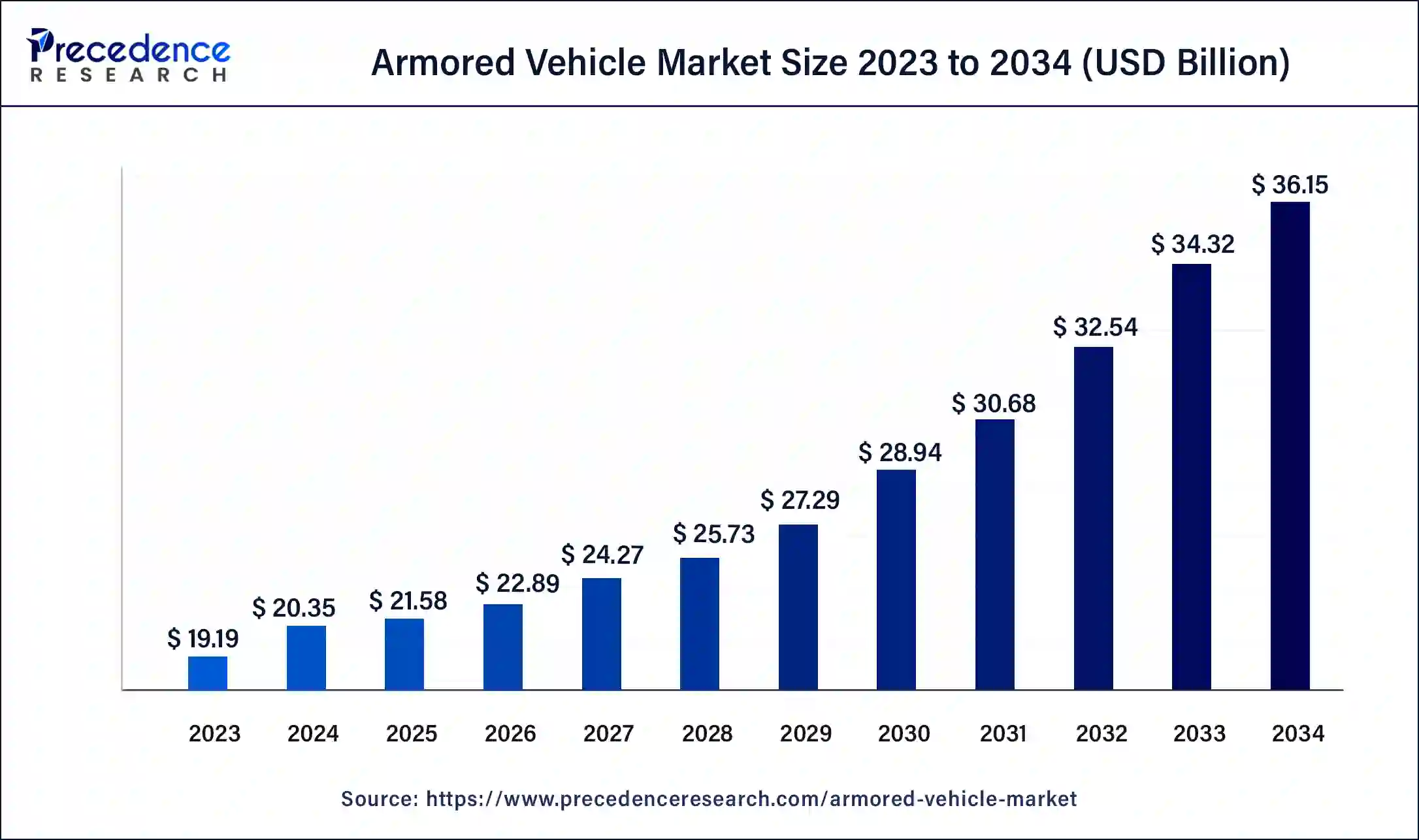
The global armored vehicle market size is calculated at USD 21.58 billion in 2025 and is predicted to increase from USD 22.89 billion in 2026 to approximately USD 37.95 billion by 2035, expanding at a CAGR of 5.81% from 2026 to 2035. Increasing demand for bulletproof vehicles is observed to boost the market's growth during the forecast period.
Armored Vehicle Market Key Takeaways
- In terms of revenue, the armored vehicle market is valued at $21.58 billion in 2025.
- It is projected to reach $37.95 billion by 2035.
- The armored vehicle market is expected to grow at a CAGR of 5.81% from 2026 to 2035.
- Asia Pacific holds for the largest market share.
- By platform, the combat support vehicles segment holds a remarkable market share.
- By platform, the combat vehicle segment is expected to grow at a CAGR of 2.7% from 2026 to 2035.
- By application, the defense segment is expected to dominate the market.
- By application, the commercial segment accounts a noteworthy share of the market.
- By mobility, the wheeled segment is predicted to grow at a CAGR of 3.3% from 2026 to 2035.
- By mobility, the tracked vehicle segment is projected to witness a notable increase between 2026 and 2035.
- By sales, The OEM segment is expected to dominate the market from 2026 to 2035.
Market Overview
An armored vehicle is an advanced vehicle that provides potential protection against bullets, rifles, and other hazardous projectiles. Such vehicles are designed to fight adverse situations for both commercial and defense users. Armored vehicles enable police officers, soldiers, troops, high-profile personalities, and even civilians in conflict areas to move confidently.
Armored vehicles are widely used in the defense sector as well as within the country's borders to enhance security and survivability. A typical armored vehicle consists of armed plates, primary weapons, bulletproof glasses, a command system, a navigation system, an engine, a fire control system, an observation system, armaments, frames, and other ballistic materials. Safety escort, protecting dignitaries, and self-defense are major purposes of armored vehicles.
Armored Vehicle Market Growth Factors
Geopolitical tensions are on the rise in Asia Pacific, Europe, and the Middle East due to shifting relations between countries. On the note of increasing geopolitical tensions between countries, the rising demand for advanced armored vehicles from the defense sector has supplemented the growth of the global armored vehicles market. Factors such as advancements in the defense sector, rising requirements for improved battle intelligence and technological competence are propelling the market's growth.
Furthermore, multiple European manufacturers are focused on developing uncrewed armored vehicles for the defense sector; this factor highlights the development in the armored vehicle market. However, the high cost of armored tanks and other military vehicles is likely to hinder the market's growth. Moreover, the rising need for monitoring naval and land borders and increasing demand for protective vehicles for government purposes is projected to boost the development of the armored vehicle market.
The production of autonomous vehicles and deployment of robotics in armored vehicles are observed to offer a remarkable shift to the global armored vehicle market.
Market Scope
| Report Coverage | Details |
| Market Size by 2035 | USD 37.95 Billion |
| Market Size in 2025 | USD 21.58 Billion |
| Market Size in 2026 | USD 22.89 Billion |
| Growth Rate from 2026 to 2035 | CAGR of 5.81% |
| Largest Market | Asia Pacific |
| Base Year | 2025 |
| Forecast Period | 2026 to 2035 |
| Segments Covered | Platform, Application, Mobility, Sales, and Region |
| Regions Covered | North America, Europe, Asia-Pacific, Latin America and Middle East & Africa |
Market Dynamics
Driver:
Rising demand for VIP security
The rising demand for VIP security in order to protect the lives of diplomats is driving the market for armored vehicles. The survivability and security of politicians, government officials, and other dignitaries have become a significant concern due to rising political tensions within the borders. Armored vehicles are designed to offer outstanding protection along with primary weapons, ballistic glasses, protective plates, armored covering, G.P.S., and siren system.
Armored vehicles are generally known for offering enhanced comfort, privacy, and higher protection than regular cars. The effectiveness provided by armored vehicles for high-profile individuals is increasing the demand for advanced armored vehicles.
Restraint:
Mechanical failures in the armored vehicles
Continuous movement and logistic strain can cause an occurrence of mechanical or electrical failure in the armored vehicle. The failed transmission system, engine breakdown, and jammed components in armored vehicles can result in disruption of operation in adverse situations such as the battlefield. Moreover, such failures often take time to get repaired and restored.
In such cases, the unavailability of supply vehicles may cause a severe hazard to the user. Thus, such mechanical and electrical failures act as restraining factors for the market's growth. However, the rising number of OEMs that ensure the servicing and guarantee of components to avoid such shortcomings is considered to reduce the occurrence of mechanical failures.
Opportunity:
Development of fuel-efficient armored vehicles
The requirement for fuel-efficient armored vehicles due to fluctuating fuel prices is creating many opportunities for companies to grow in the global armored vehicle market. Manufacturers are focusing on the development of hybrid or electric armored vehicles to reduce fuel consumption and enhance performance.
The rising transition to clean energy will increase the demand for electric or hybrid-engine armored vehicles from commercial and defense end-users in the upcoming years. Furthermore, rising government involvement and investment in advanced electric vehicles will support the development of fuel-efficient armored vehicles by offering profit-making opportunities for players. For instance, in October 2022, the U.S. Army announced testing and analyzing electric armored vehicles using General Motors' Ultium Platform.
Segment Insights
Platform Insights
The combat vehicle segment is projected to grow at a CAGR of 2.7% during the forecast period. Combat vehicles are designed for combat operations with operational mobility and defense capabilities. The combat vehicle segment is further segmented into battle tanks, armored personnel carriers, armored amphibious vehicles, lightly protected vehicles, and a self-propelled howitzer. The armored personnel carrier is the most lucrative segment.
Major players in the market, such as General Dynamics Corporation, Oshkosh Defense LLC., Lenco Industries Inc and International Armored Group, have shifted their focus to developing armored personal carriers. Armored personnel carriers are expected to witness a significant advancement in the upcoming years due to rising threats from the air and increasing demand for fuel-efficient armored vehicles from the defense sector.
The combat support vehicles segment holds a significant share of the global armored vehicle market. The combat support vehicles segment is further segmented into armored supply trucks, armored command and control vehicles, bridge-laying tanks, and repair and recovery vehicles. Armored supply trucks have enormous requirements.
The technological advancements in the global armored vehicle market are projected to boost the growth of unmanned armored vehicles. Unmanned armored vehicles are capable of operating during serious situations without an onboard human presence. Considering the future, unmanned armored vehicles will undoubtedly play a vital role in the defense sector. For instance, China has already deployed a research center for advanced unmanned armored vehicles for all manufacturers.
Application Insights
The defense segment is projected to dominate the global armored vehicle market. Rising government spending on the defense sector to boost the military's operational capabilities has boosted the demand for armored vehicles in the defense sector. The ongoing geopolitical tensions between Ukraine and Russia since 2022 have increased the demand for advanced armored vehicles. Armored fighting vehicles, tanks, personnel carriers, and light-protected vehicles for patrol troops are a few standard armored vehicles required in the defense sector. Moreover, the defense sector has an enormous demand for gun trucks which are armored vehicles with the availability of weapons for soldiers on the operation field.
The commercial segment holds a significant share of the market. Commercial armored vehicles are utilized for government officials, high-profile personalities, transportation of valuables, and moving people from conflict areas. The rising demand for armored vehicles for government needs propels the segment's growth. Commercial armored vehicles range from buses, ambulances, cars, and vans.
Mobility Insights
The wheeled segment is projected to grow at a CAGR of 3.3% during the forecast period. The wheeled armored vehicles offer better road performance with better fuel economy. The wheeled segment is further segmented into 4x4, 8x8, 10x10 12x12 wheeled vehicles. The rising demand for armored personnel carriers from the defense industry is projected to boost the demand for 8x8 wheeled armored vehicles.
The tracked vehicle segment is expected to witness a significant increase during the forecast period owing to the rising demand for armored fighting vehicles from the defense sector. Tracked armored vehicles offer more excellent traction and thus are considered an ideal fit for operations in the military.
Sales Insights
The OEM segment is projected to dominate the armored vehicle market during the forecast period. Governments are focused on offering contracts for armored vehicles to the original equipment manufacturers. OEMs guarantee the quality of vehicle parts, and such parts are only available through the dealership, which boosts the reliability of vehicles. The fierce competition in the market is prone to encourage the involvement of OEMs in the market during the forecast period. Furthermore, the rising retro fitment for turning fuel-based armored vehicles into electric vehicles is fueling the growth of the retrofit segment.
Regional Insights
What is the Asia Pacific Armored Vehicle Market Size?
The Asia Pacific armored vehicle market size was calculated at USD 6.91 billion in 2025 and is expected to reach around USD 12.15 billion by 2035, expanding at a CAGR of 5.81% from 2026 to 2035.
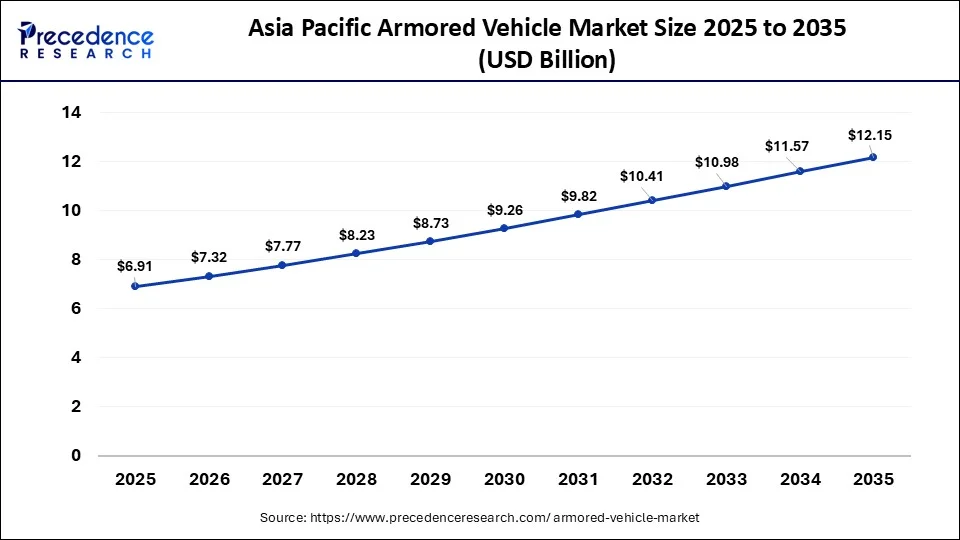
Asia Pacific is expected to dominate the market during the forecast period. The rising spending on the defense sector in India and China is considered to fuel the market's growth. The demand for new armored vehicles in Asia Pacific is growing on the note of replacing the aging armored vehicles and deploying advanced armored vehicles in the military. Furthermore, the rising capacities of local manufacturing companies in India, China, and Japan are observed to propel the market's growth.
The Indian Ministry of Defense awarded Mahindra Defence Systems (MDS) a contract to supply light specialist vehicles (LSVs) worth USD 146 million (INR 1,056 crore). The first batch will comprise 40 Armados. Under the contract, the company will deliver 1,300 LSVs from 2021 through 2025. The LSV order was fast-tracked amid the stand-off between the Indian Army and China's People's Liberation Army (PLA) along the Line of Actual Control (LAC). The countries are highly focusing on strengthening their local manufacturing capabilities to support their regional armed forces.
The allocations for the Ministry of Defense (MoD) in the Union Budget 2023-24, presented to Parliament by the Finance Minister of India on 1 February 2023, amounted to INR 5,93,537.64 crores, a 13% increase over BE 2022-23. (INR 5,25,166.15 crores).
Along with India and China, Japan's market for armored vehicles is flourishing since the country increased tests for new armored vehicles. For instance, in October 2022, the defense ministry of Japan confirmed that Japan had started trials of locally built armored vehicles.
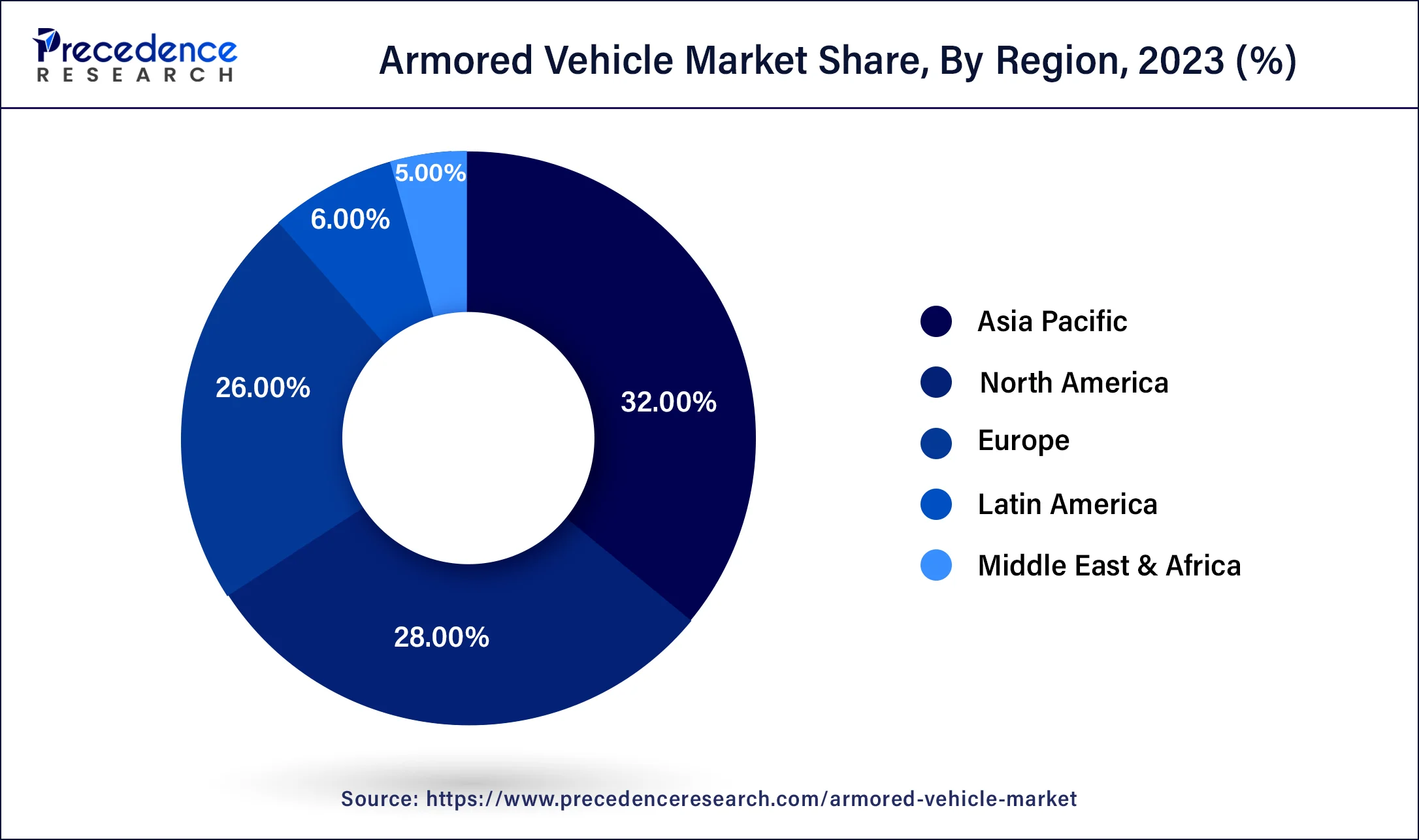
North America accounts for the largest share of the global armored vehicle market. The presence of major manufacturers in the region and substantial military budgets in the U.S. has supported the market's growth in North America. Moreover, the U.S. defense ministry is focused on deploying armored electric vehicles for efficient operational capabilities; this factor is observed to boost the market's growth during the projected period.
In addition, the surge in military & defense budgets is anticipated to fuel the market's revenue during the forecast period. For instance, in 2025, the United States spent USD 997 billion on defense, which is more than the next nine countries' spending combined. In comparison, China, which is the second biggest defense spender, spent USD 314 billion on military expenditures in 2025.
U.S. Market Trends
In the U.S. market, the growth factor is modernization initiatives that are substituting legacy platforms with next-generation armored vehicles. Emphasis on AI-enabled systems, network-centric warfare, and open architecture makes combat efficient. Further investment in hybrid propulsion and autonomous robotic combat vehicles contributes to better mobility, less risk to human life, and more capabilities on the battlefield.
Europe is another largest marketplace for armored vehicles. The rising demand for luxurious commercial vehicles in the region is boosting the deployment of armored vehicle parts. The sudden rise in cross-border conflicts is seen as a significant factor in increasing the demand for advanced armored vehicles in the region. Furthermore, rising defense modernization programs in various European countries are boosting the growth of the armored vehicle market.
Germany Armored Vehicle Market Trends
Germany plays a significant role in the global armored vehicle industry due to its advanced defense manufacturing sector and strong engineering expertise. The country focuses on producing technologically advanced armored vehicles with improved mobility, survivability, and digital battlefield integration. Ongoing modernization programs within European defense forces and increased NATO defense spending are driving demand for German armored platforms. Additionally, Germany remains a major exporter of armored vehicles to several allied nations.
The armored vehicle market in the Middle East and Africa is expected to grow at a CAGR of 2.5% during the forecast period. The risk of cross-border conflicts has forced the modernization of armored vehicles. The armored vehicle market in Africa shows steady growth. However, emerging economies and increasing military budgets will boost the growth of the armored vehicle market in Africa. The armored vehicle market in Latin America depends on battle tanks' development. Emerging economies in countries such as Brazil, Argentina and Mexico are anticipated to boost Latin America's market share in upcoming years.
Saudi Arabia Market Trends
The Saudi Arabian market is driven by the acquisition of modern armored vehicles to enhance defense capabilities. The need to protect borders and regional security challenges is met with high defense spending. Indigenization is also a priority in the country as it is seeking partnerships to establish local production capacities and cut reliance on foreign defense supply chains.
Brazil Market Trends
Brazil is pursuing a discriminatory modernization of armored forces, such as the personnel carrier and wheeled vehicle modernization. Refurbishment programs are assisted by domestic production capabilities. Internal security demands drive the demand, where the focus is on cars that provide a high level of ballistic protection to deal with organized crime and security issues in urban areas.
Armored Vehicle Market - Supply Chain Analysis
- Vehicle Manufacturing & Armor Integration: Armored vehicles are manufactured through the integration of reinforced steel, composite armor, ballistic glass, and advanced protection systems on military or security vehicle platforms for defense and security operations.
Key Players: BAE Systems, General Dynamics, Oshkosh Defense, Rheinmetall. - Quality Testing & Certification: Armored vehicles must meet ballistic protection standards, blast resistance certifications, vehicle safety requirements, and military quality assurance standards.
Key Authorities & Standards: NATO, U.S. Department of Defense, National Institute of Justice, International Organization for Standardization. - Distribution to End-Use Industries: Armored vehicles are supplied to military forces, law enforcement agencies, border security units, peacekeeping missions, and private security organizations.
Key Suppliers: BAE Systems, General Dynamics, Rheinmetall.
Armored Vehicle Market Companies
- BAE Systems: BAE Systems is one of the largest armored vehicle manufacturers globally, producing platforms such as infantry fighting vehicles, armored personnel carriers, and combat vehicles. Its portfolio includes advanced systems like the CV90 and AMPV, used by several military forces worldwide, emphasizing survivability, mobility, and integrated weapon systems.
- General Dynamics Corporation: General Dynamics manufactures a wide range of armored combat vehicles, including the Stryker and LAV series. The company supplies advanced land combat platforms and modernization solutions for military forces globally, supported by strong defense contracts and engineering expertise.
- Rheinmetall AG: Rheinmetall develops armored combat vehicles, infantry fighting vehicles, and armored logistics platforms. The company focuses on integrating advanced protection systems, digital battlefield technologies, and modular vehicle architectures for modern military operations.
- Oshkosh Defense: Oshkosh Defense specializes in tactical armored vehicles, including MRAPs and Joint Light Tactical Vehicles (JLTVs). Its platforms are widely used for troop transport, combat support, and logistics missions, offering enhanced mobility and blast protection.
- Krauss-Maffei Wegmann: Krauss-Maffei Wegmann (KMW) produces advanced armored vehicles, including the Leopard main battle tank and Boxer armored fighting vehicle. The company is known for heavy armored systems with high firepower, mobility, and battlefield survivability.
Other Major Key Players
- Northrop Grumman Corporation
- Lockheed Martin Corporation
- General Dynamics Corporation
Recent Developments
- In April 2026, Nurol Makina and Nadicorp Holdings announced the production of 4x4 armored vehicles locally in Malaysia, boosting the nation's protected mobility capabilities and establishing it as a regional hub for armored vehicle operations. (Source: https://www.armyrecognition.com )
- In February 2026, Belgium's 20-year industrial partnership aimed to enhance the Army's vehicle and weapon systems readiness. The Land Systems Logistic Support (LS²) alliance unifies maintenance and logistical support, involving key defense firms: John Cockerill Defense, FN Herstal, and Thales Belgium. (Source: https://thedefensepost.com )
- In January 2026, at the Italian Army Multifunctional Experimentation Center, the Leonardo Rheinmetall Military Vehicles Joint Venture delivered four Lynx KF-41 vehicles, marking the launch of the “A2CS” programme, following a contract for 21 new vehicles signed last year, attended by key officials.
(Source: https://www.rheinmetall.com )
Segments Covered in the Report
By Platform
- Combat Vehicle
- Combat Support Vehicle
- Unmanned Vehicle
By Application
- Defense
- Commercial
By Mobility
- Wheeled
- Tracked
By Sales
- OEM
- Retrofit
By Geography
- North America
- Europe
- Asia-Pacific
- Latin America
- The Middle East and Africa
For inquiries regarding discounts, bulk purchases, or customization requests, please contact us at sales@precedenceresearch.com
Frequently Asked Questions
Tags





Ask For Sample
No cookie-cutter, only authentic analysis – take the 1st step to become a Precedence Research client
 Get a Sample




 sales@precedenceresearch.com
 Schedule a Meeting
