



Artificial Lift System Market Size, Key Companies, Company Market Share, Power Generation Capacity, Energy Consumption, Pricing Trends, Investment Analysis, Competitive Positioning, and Demand Forecast
Artificial Lift System Market (By Type: Pressurized Water Reactor (PWR), Electric Submersible Pumps, Gas lift, Progressing Cavity Pumps, Jet pump, Others (hydraulic pumping systems and plunger lift); By Application: Onshore, Offshore; By Component: Pump, Motor, Cable System, Controller, Others; By Mechanism: Pump Assisted, Gas Assisted; By Well Type: Horizontal, Vertical) - Global Industry Analysis, Size, Trends, Leading Companies, Regional Outlook, and Forecast 2025 to 2034
Source: https://www.precedenceresearch.com/artificial-lift-system-market
 Get a Sample
 Table Of Content


What is the Artificial Lift System Market Size?
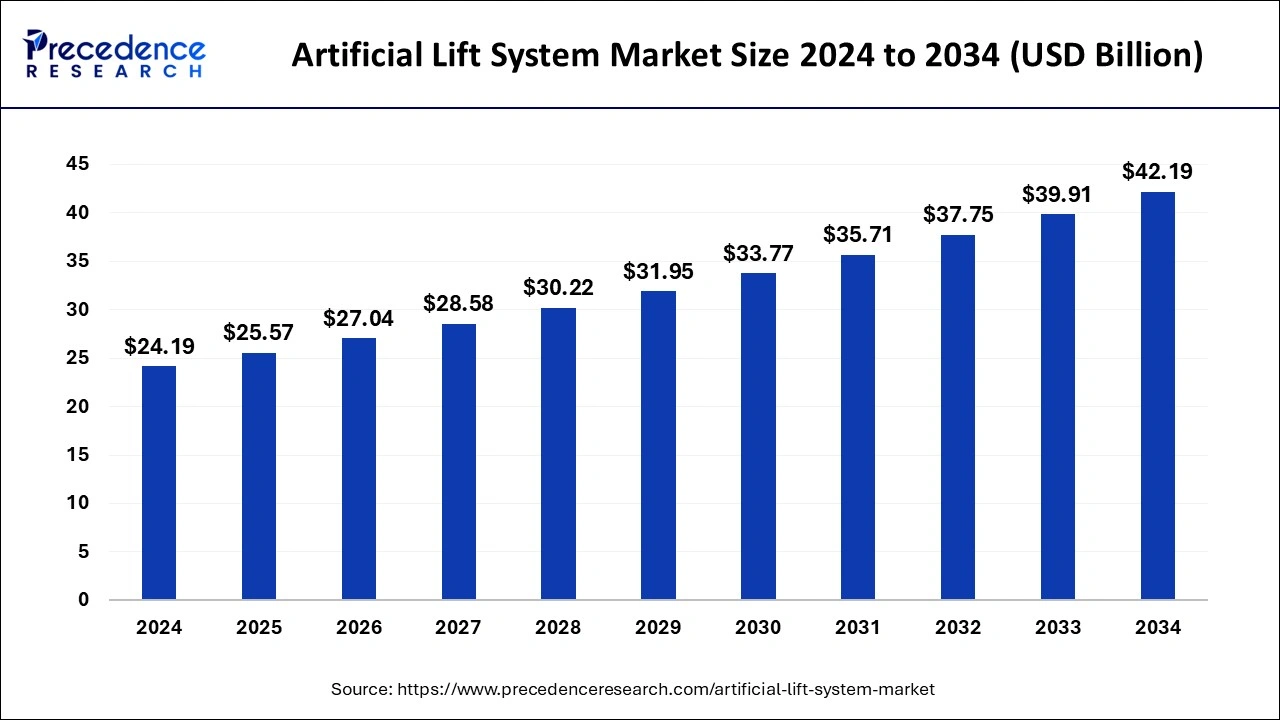
The global artificial lift system market size is calculated at USD 25.57 billion in 2025 and is predicted to increase from USD 27.04 billion in 2026 to approximately USD 42.19 billion by 2034, expanding at a CAGR of 5.72% from 2025 to 2034. The increasing number of matured oilfields in many regions leads to demand for these systems to enhance the productivity of the matured fields which helps the growth of the artificial lift system market.
Artificial Lift System Market Key Takeaways
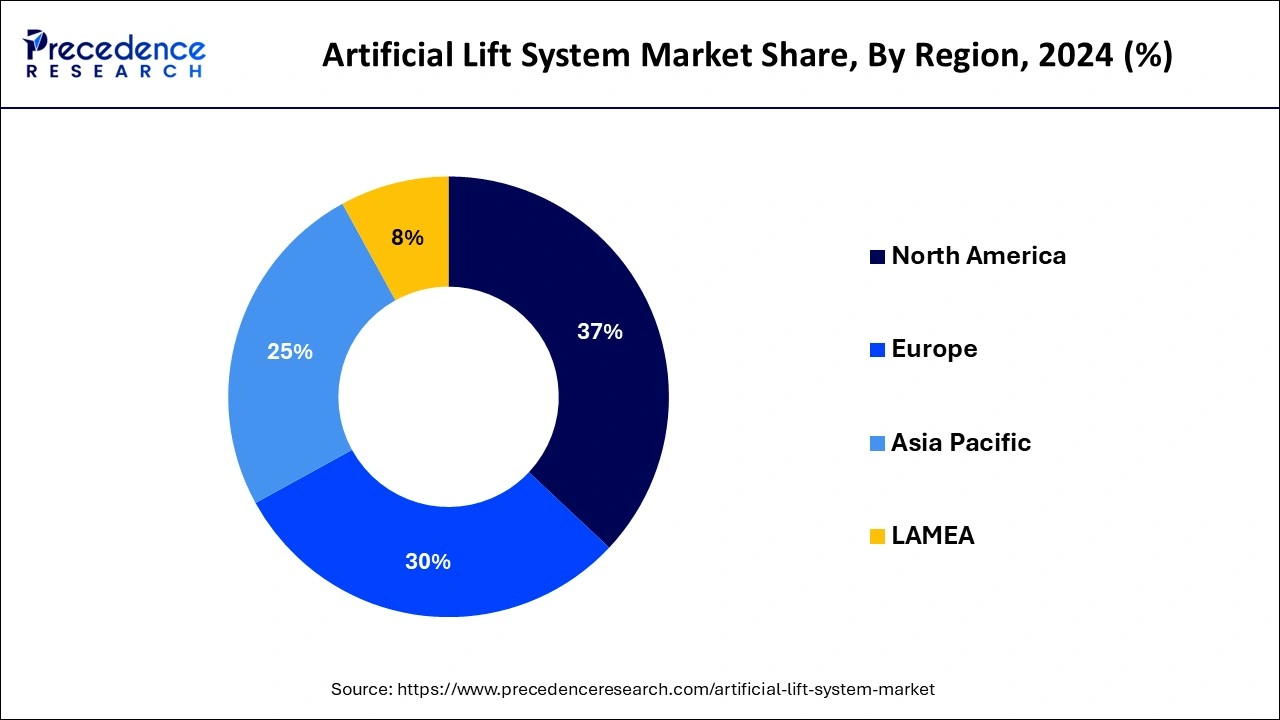
- North America dominated the global artificial lift systems market with the largest market share of 37% 2025.
- By type, the rod lift segment has held the largest market share in 2025.
- By type, the electric submersible pump (ESP) segment is expected to expand at the fastest CAGR during the projected period.
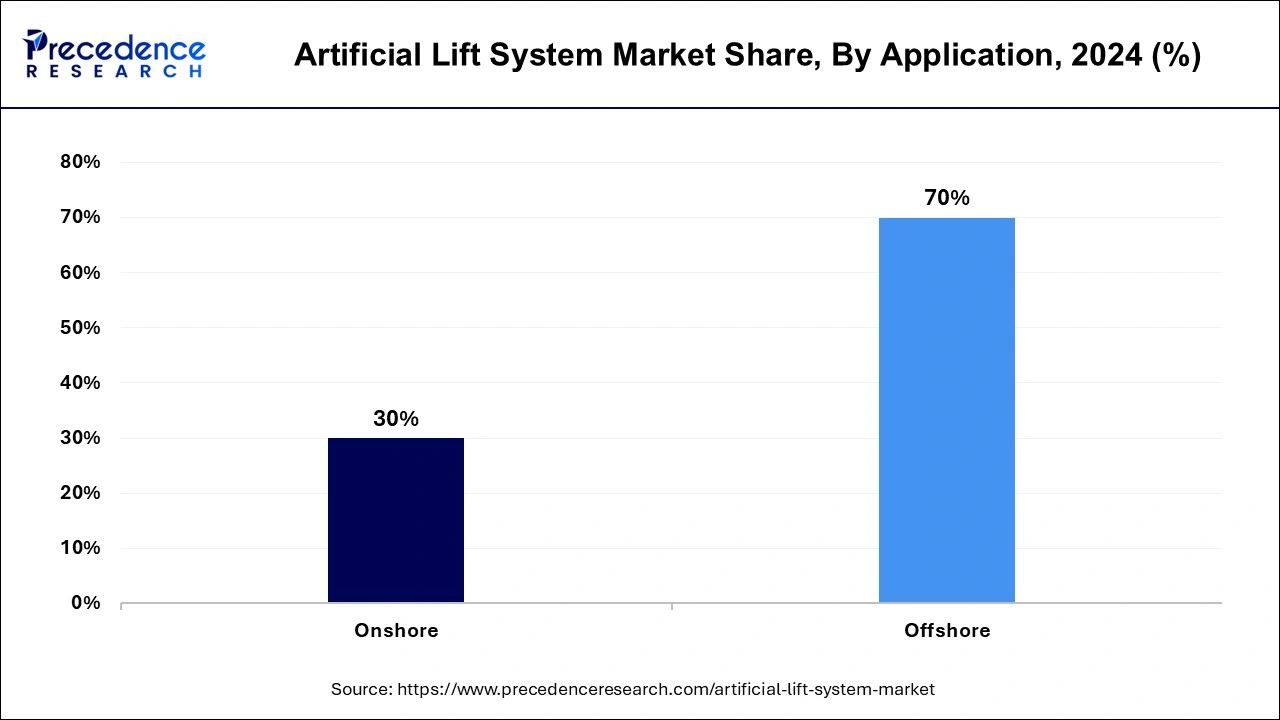
- By application, the offshore segment contributed the highest market share of 70% in 2025.
- By mechanism, the gas lift segment accounted for a major market share in 2025.
- By well type, the horizontal artificial lift systems segment captured the maximum market share in 2025.
Artificial Intelligence: The Next Growth Catalyst in Artificial Lift Systems
Artificial Intelligence (AI) algorithms are increasingly used to forecast equipment failures, improve decision-making, boost productivity levels, reduce operational costs, and analyze real-time data. The main benefits of AI in artificial lift systems include excellent capability of handling gas, compression remote from the well site, and ability to operate in deviated wellbores. It also helps to improve sustainability, reduce costs, and minimize downtime which helps the growth of the artificial lift system market.
Artificial Lift System Market Growth Factors
The artificial lift can be used to produce flow from a well that has no flow or to increase the rate of flow from a well that is already pumping. Many oil wells, as well as some gas wells, require artificial lift at some point throughout their life cycle to remove liquids from the formation and allow gas to flow at a faster pace. The artificial lift systems market is expected to grow in response to rising energy demand, industrialization, and population and urbanization. With increased energy consumption, so does reliance on traditional energy sources. Overexploitation of natural resources has resulted in the depletion of this resource. These reasons have increased the demand for advanced artificial lift systems for oil explorations from reserves, which is projected to drive artificial lift market demand throughout the projection period.
Rising expansion of the industrial manufacturing and transportation sectors oil consumption demand have been increased rapidly globally. To fulfill such rising demand for oil and other natural resource globally the demand for the artificial lift system market. Artificial lift systems are used for nonstop drilling to increase their output. However, the reservoir pressure in current wells is insufficient to bring fluids to the surface. The majority of wells across the world require some help to bring the hydrocarbon to the surface. The artificial lift system is device used for assessment of oil wells during high reservoir's oil pressure. Artificial lift systems assistance helps to increase the efficiency by 85-90% and helps in supplementing & maintaining reservoir's pressure.
Various types of artificial lifts are used depending on the well's features and technology availability, resulting in global market expansion in the coming years. Growing global oil consumption, as well as economic expansion in many industries such as transportation, aviation, and power generation, is all projected to contribute to increased hydrocarbon demand, which will lead to an increase in artificial lift demand in the coming years. Moreover, severe rivalry has prompted manufacturers to engage in product development in order to better meet the needs of customers. For example, Baker Hughes developed the LEAP adaptive assembly line in 2016 to increase oil and natural gas output while addressing technical challenges associated with unorthodox production. This method has contributed to increased efficiency, increased ultimate recovery, and optimized production.
Market Outlook
- Market Growth Overview: The Artificial Lift System market is expected to grow significantly between 2025 and 2034, driven by maximizing mature fields' potential, the rise of unconventional oil and gas, advancements in digital technologies, and rising worldwide energy demand.
- Sustainability Trends: Sustainability trends involve the increased energy efficiency through electrification and technologies like VSDs and high-efficiency motors. The integration of AI and digitalization enables predictive maintenance and optimized performance.
- Major Investors: Major investors in the market include SLB (Schlumberger Limited), Halliburton Company, Baker Hughes Company, and ChampionX Corporation.
- Startup Economy: The startup economy in the market is focused on AI and machine learning for optimization, novel hardware and sensor technology, and digital field services and IoT.
Instances to support the opportunity
- In April 2024, new two advanced artificial lift systems such as the Reda Agile compact wide-range electric submersible pump (ESP) system and the rodless Reda PowerEdge electric submersible progressive cavity pump (ESPCP) system launched by SLB.
Market Scope
| Report Coverage | Details |
| Growth Rate from 2025 to 2034 | CAGR of 7.30% |
| Market Size in 2025 | USD 25.57 Billion |
| Market Size in 2026 | USD 27.04 Billion |
| Market Size by 2034 | USD 42.19 Billion |
| Largest Market | North America |
| Base Year | 2024 |
| Forecast Period | 2025 to 2034 |
| Segments Covered | Type, Component, Application, Mechanism, Well Type, Geography |
| Regions Covered | North America, Europe, Asia-Pacific, Latin America, and Middle East & Africa |
Segments Insights
Type Insights
The rod lift segment dominated to the artificial lift system market by type. Artificial lift system uses surface power source for operating and exploring the downhole's pumps assembly. Quite a few pieces are used in both the subsurface and surface of the unit. This hoisting mechanism can pump up to 1,000 BPD depending on the size of the equipment. Rod lifts can handle gas and corrosion well during the artificial lift process and provide a high salvage value for downhole equipment. In the next years, such features are set to increase demand for artificial lift. As a result, the rod lift market is being driven by the growing need to avoid gas and corrosion management during artificial lift operations.
The electric submersible pump (ESP) segment is expected to expand at the fastest CAGR during the projected period. For use in large oil wells which have reached or past their peak oil production period, an electric submersible pump (ESP) is the best choice. Furthermore, the offshore electric submersible pump market is predicted to grow as a result of rich resources and increased investment. As a result, the artificial lift market is predicted to grow throughout the forecast period.
Application Insights
The offshore segment contributed the highest market share of 70% in 2024. The offshore section is likely to rise at the quickest rate over the forecast period. The offshore sector is relied upon to increment at the quickest rate over the forecast period. Artificial lift systems consist of several methods such as hydraulic pumping, ESP, gas lift, and others are widely used for offshore wells. Since offshore holds large unexplored reserves, companies have been looking for offshore areas for oil development. As a result, the offshore market requires more money than the onshore market. According to the IEA, 2,500–3,000 offshore operations will be decommissioned between 2019 and 2040 when they approach the end of their operational lives. The most mature shallow fields are found in the Gulf of Mexico and the North Sea.
The rising number of mature fields in the industry is expected to drive demand for onshore electric submersible pumps. The growing emphasis on heavy oil reservoirs, along with the demand for ESP systems in shale reservoirs, is likely to push corporate growth and the artificial lift industry even further.
Mechanism Insights
The gas lift segment accounted for a major market share in 2024. The prime factor contributing to the market growth includes less maintenance required to the gas lift compared to pump type lifts. In addition, gas lifts also are cost-effective in nature compared to pump lifts and are extensively used across several verticals and end use applications such as mining, oil & gas, and many others.
Well Type Insights
The horizontal artificial lift systems capture notable revenue share in the global artificial lift system market as well as register the fastest growth over the forthcoming years. The prime factors contributing towards the escalating growth of the segment includes significant discoveries related to shale gas reserves in North America region. North America region has discovered prominent reserve of shale gas in the past few years that contribute positively towards the market growth in present years along with high growth predictions for the future period.
Regional Insights
U.S. Artificial Lift System Market Size and Growth 2025 to 2034
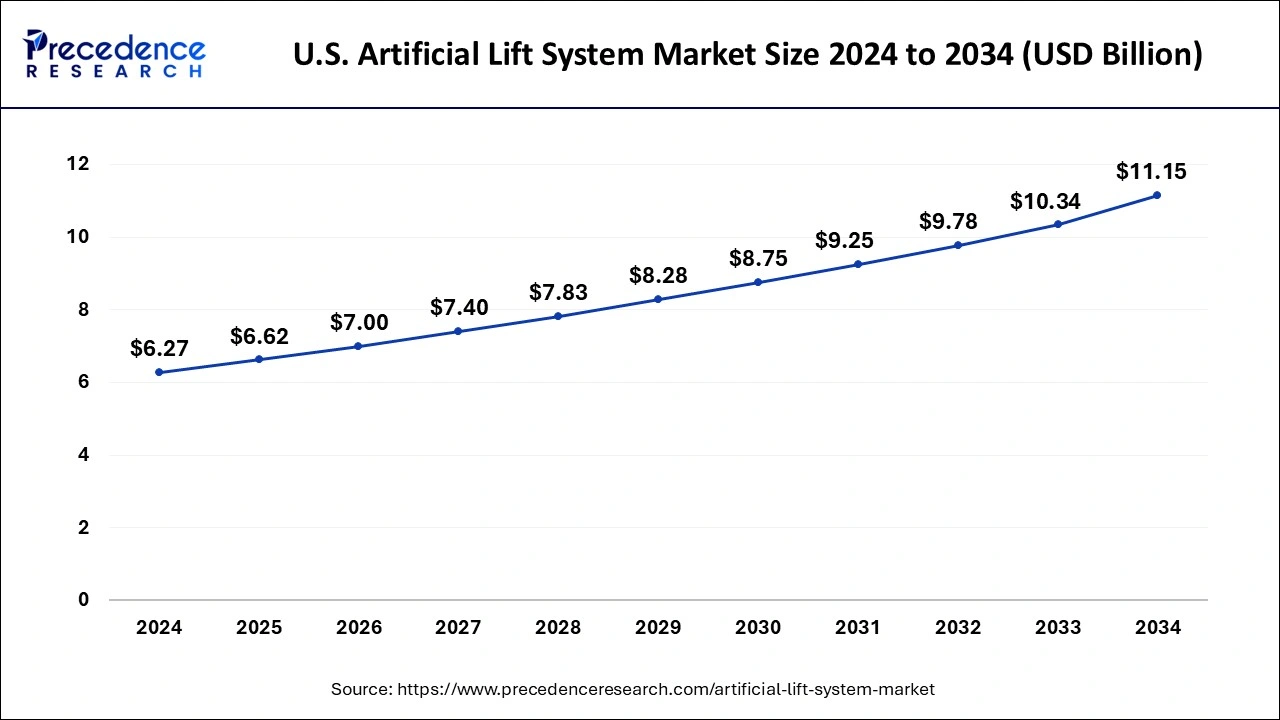
The U.S. artificial lift system market size is evaluated at USD 6.62 billion in 2025 and is predicted to be worth around USD 11.15 billion by 2034, rising at a CAGR of 5.92% from 2025 to 2034.
North America dominated the global artificial lift systems market with the largest market share of 37% 2024. The growing demand for artificial lift operations in mature and aging oil wells in the North American region helps the growth of the market. There is a high use of wireless supplies and solutions, which help the growth of the market. The United States and Canada are the leading countries for the aged and mature wells in North America.
U.S. Artificial Lift System Market Trends
U.S. widespread adoption of AI, automation, and real-time data analytics to optimize operations, enhance efficiency, and predict equipment failures. Electric Submersible Pumps (ESPs) dominate the market, with increasing investment in hybrid and energy-efficient solutions in both onshore and offshore applications.
Asia Pacific is expected to be the fastest-growing region during the forecast period. The rising need for gas in the Asia Pacific region helps to drive the artificial lift system market growth. The increasing populace in countries like China and India is expected to drive energy consumption which result in high exploration efforts and increasing regional demand throughout the forecast period.
China Artificial Lift System Trends
China's adoption of advanced technologies like AI, automation, and real-time monitoring to improve operational efficiency and maximize economic recovery. While dominated by national oil companies with a focus on onshore applications, there is a push to develop solutions for complex unconventional reserves.
How is Europe Rising in the Artificial Lift System Market?
Europe's artificial lift market is growing as operators maximize recovery from mature fields in the North Sea using advanced technologies. The integration of digitalization and automation with AI-powered monitoring for enhanced efficiency and reliability. The region is also focused on developing energy-efficient and low-emission solutions to balance production with sustainability goals and the broader energy transition.
United Kingdom Artificial Lift System Trends
The U.K. major push for digitalization, AI-powered automation, and the implementation of energy-efficient solutions to optimize production and meet sustainability goals. Despite challenges like high capital costs and market volatility, ongoing investment and strategic collaborations underscore the importance of robust artificial lift technologies in securing the UK's energy supply.
Artificial Lift System Market Value Chain Analysis
- Raw Material Sourcing and Component Manufacturing
This foundational stage involves procuring materials like specialized metals, polymers, and electronic components necessary for pumps, motors, and monitoring systems.
Key Players: Tenaris (sucker rods) - System Design and Engineering (R&D)
In this stage, major oilfield service companies and technology providers focus on research and development to design efficient, reliable, and advanced artificial lift systems.
Key Players: Major innovators like SLB, Halliburton, Baker Hughes, and ChampionX. - Manufacturing and Assembly
This stage involves the physical production and assembly of the entire lift system, including pumps, motors, downhole sensors, and surface control systems. - Distribution and Supply Chain
This involves storing, transporting, and delivering the complex artificial lift equipment to various oil and gas fields globally.
Key Players: Global oilfield service providers like SLB and Baker Hughes. - Installation and Commissioning
Specialized field crews and engineers install the artificial lift system into the oil or gas well.
Artificial Lift System Market Companies
- General Electric Company (GE): GE was a significant player through its oil and gas division (now part of Baker Hughes), providing a wide range of artificial lift equipment, including electric submersible pumps (ESPs), gas lift systems, and associated digital optimization services. Their contribution focused on leveraging their extensive industrial engineering expertise to provide reliable production solutions.
- Hitachi, Ltd.: Hitachi is a reported participant in the broader artificial lift systems market, likely contributing through its industrial solutions segment by providing electric motors, control systems, and related industrial equipment used in the operation of artificial lift systems. The core of their business contribution is in the provision of highly reliable products and digital solutions for industrial applications.
- Man Diesel & Turbo SE (now MAN Energy Solutions): This company contributes to the artificial lift market primarily by providing high-efficiency compression systems, which are integral components in gas lift applications used to enhance oil production. Their expertise lies in large-scale turbomachinery solutions designed for the energy sector.
- Neuman&Esser Group: Neuman&Esser specializes in manufacturing piston and diaphragm compressors, which are essential components for gas lift systems used to inject gas into oil wells to aid in extraction. Their contribution focuses on providing specialized compression technology to the oil and gas industry.
- Ebara Corporation: Ebara is a major manufacturer of pumps and turbomachinery, providing a wide array of industrial pumps and related equipment that can be utilized in various artificial lift system configurations. Their expertise in fluid dynamics and pump technology is a key contribution to the market.
- Ariel Corporation: Ariel is a leading manufacturer of natural gas compressors used in gas lift systems to boost production from oil and gas wells. They are known for providing durable, high-quality compression equipment essential for the gas-assisted lift mechanism.
- Mitsubishi Heavy Industries Compressor Corporation (MHI): MHI contributes to the market through its advanced compressor technology and systems, which are used in large-scale gas lift applications for major oil and gas production facilities. Their expertise in heavy industrial machinery provides robust solutions for the energy sector.
- Burckhardt Compression Holding AG: Burckhardt Compression is a global leader in compression systems, providing high-performance reciprocating compressors that are vital for gas lift applications in oil and gas production. Their focus is on high-pressure, specialty compression solutions for challenging environments.
- Atlas Copco Energas GmbH: Atlas Copco Energas supplies a variety of turbocompressors and expanders for the oil and gas industry, including equipment used in gas lift systems. They contribute by providing energy-efficient and reliable compression technology for enhanced oil recovery operations.
- Solar Turbine Inc. (Caterpillar Company): Solar Turbines provides industrial gas turbines and gas compressors used in the oil and gas industry, which power and operate gas lift systems for extracting hydrocarbons from wells. Their equipment is used for efficient and reliable power generation and compression in remote and demanding field conditions.
Latest announcement by industry leaders
- In October 2024, an order for 56 elevators and escalators from CRC Group for CRC The Flagship in Noida, Uttar Pradesh, India, was secured by Hitachi Building Systems and Hitachi Lift India.
Recent Developments
- In February 2024, a new Artificial Lift Geothermal Service Center in Celle Germany, was opened by Baker Hughes. It provides a facility for the assembly, maintenance, and testing of the company's geothermal pumps.
- In May 2024, a new GeoESP lifting pump for geothermal energy was introduced by Halliburton Co.
Segments Covered in the Report
By Type
- Pressurized Water Reactor (PWR)
- Electric Submersible Pumps
- Gas lift
- Progressing Cavity Pumps
- Jet pump
- Others (hydraulic pumping systems and plunger lift)
By Application
- Onshore
- Offshore
By Component
- Pump
- Motor
- Cable System
- Controller
- Others
By Mechanism
- Pump Assisted
- Gas Assisted
By Well Type
- Horizontal
- Vertical
By Geography
- North America
- U.S.
- Canada
- Europe
- U.K.
- Germany
- France
- Asia-Pacific
- China
- India
- Japan
- South Korea
- Malaysia
- Philippines
- Latin America
- Brazil
- Rest of Latin America
- Middle East & Africa (MEA)
- GCC
- North Africa
- South Africa
- Rest of the Middle East & Africa
For inquiries regarding discounts, bulk purchases, or customization requests, please contact us at sales@precedenceresearch.com
Frequently Asked Questions





Ask For Sample
No cookie-cutter, only authentic analysis – take the 1st step to become a Precedence Research client
 Get a Sample




 sales@precedenceresearch.com
 Schedule a Meeting
