



Offshore Wind Energy Market Trends, Leading Companies, Company Revenue / Sales Performance, Installed Capacity, Production Output, Grid Expansion, Market Share, Technology Adoption, and Industry Outlook
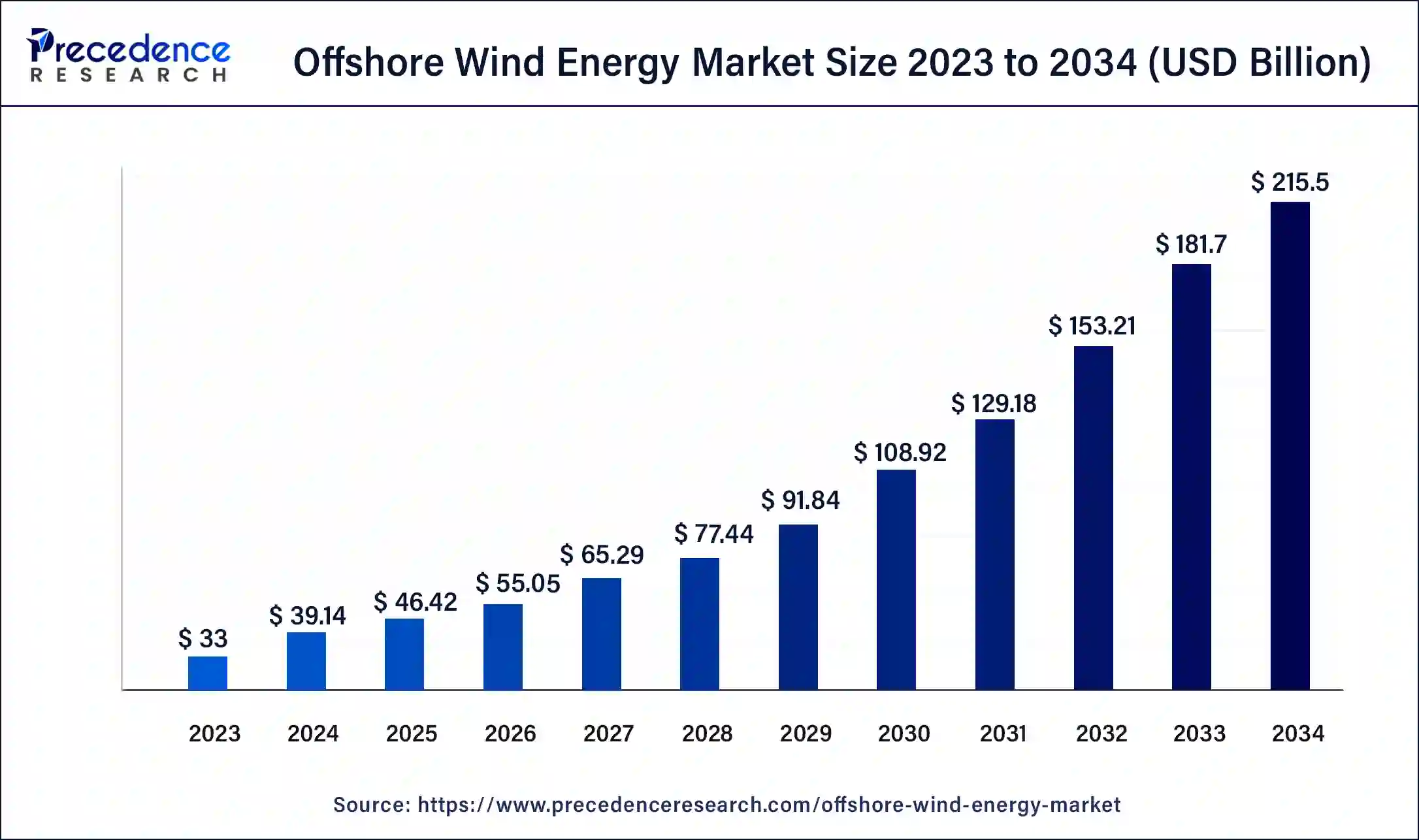
According to energy and power expert Laxmi Narayan, the offshore wind energy market has reached USD 55.05 billion in 2026 and is expected to grow to USD 245.76 billion by 2035, registering a CAGR of 18.14%. The offshore wind energy market companies such as Siemens Gamesa, Prysmian Group, Nexans are playing a key role in market expansion, with major opportunities emerging across Components, Depth, Capacity segments.
Source: https://www.precedenceresearch.com/offshore-wind-energy-market
 Get a Sample
 Table Of Content


What is the Offshore Wind Energy Market Size?
The global offshore wind energy market size accounted for USD 55.05 billion in 2026 and is expected to reach around USD 245.76 billion by 2035, expanding at a CAGR of 18.14% from 2026 to 2035.
Offshore Wind Energy Market Key Takeaways
- In terms of revenue, the market is valued at $46.42 billion in 2025.
- It is projected to reach $245.76 billion by 2035.
- The market is expected to grow at a CAGR of 18.14% from 2026 to 2035.
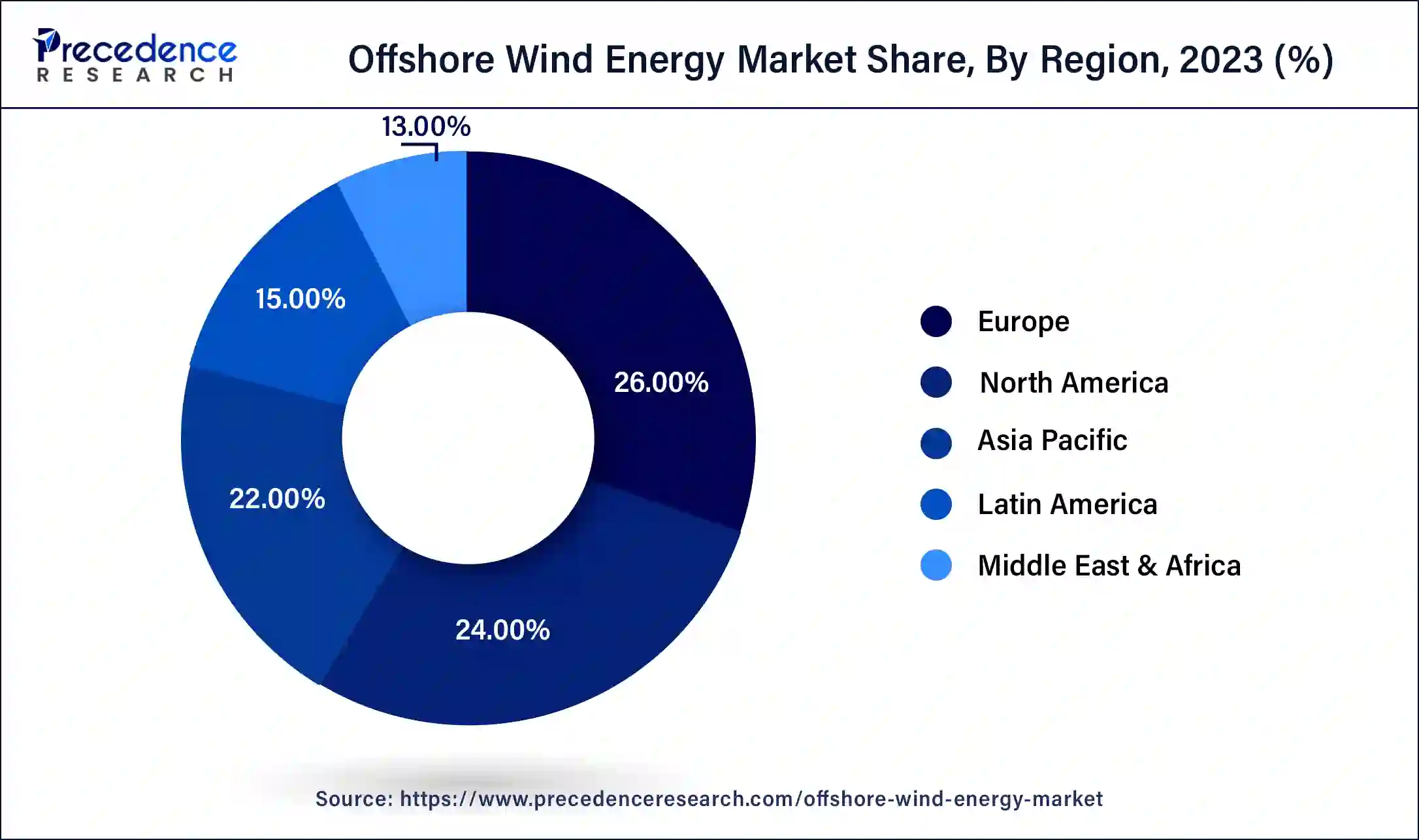
- Europe led the global market with the highest market share of 26% in 2025.
- By location, the shallow water segment has held the largest market share in 2025.
- By components, the turbines segment captured the biggest revenue share in 2025.
Offshore Wind Energy Market Growth Factors
The offshore wind energy market has a great potential to supply large amounts of clean and renewable energy to satisfy the demands of Electricity in cities along the american coastlines. There are about 40 projects in the developmental stage across the United States of America. The production of electricity to run offshore wind power is larger as compared to that on land. United Kingdom holds the maximum capacity of the total worldwide offshore wind power followed by China. The cost of installation is higher as compared to that on land but the generation of electricityis significant.
The European Commission has estimated that there will be a potential increase in the future through the offshore projects. The offshore wind market provides many economic benefits to the local communities as they generate jobs. It is a renewable energy source that does not emit any pollutants in the atmosphere also they do not consume any water. This technology will reduce the carbon footprint as it is the aim of may countries across the globe. It is the cleanest form of energy which uses advanced technology and it doesn't disrupt or affect any farm operations. It also helps in reducing our dependence on the fossil fuels.
Depending on the size of the wind turbines it can generate a revenue upto$10000 in a year. This technology sustains the capability to become RES technology to meet the demand of the global needs. Even though COVID affected many things yet 2020 happened to be the second highest year for the installation. This technology happens to be the best as believed by many nations but the governments need to meet the commitments and work better on this industry.
Market Scope
| Report Coverage | Details |
| Market Size in 2025 | USD 46.42 Billion |
| Market Size in 2026 | USD 55.05 Billion |
| Market Size by 2035 | USD 245.76 Billion |
| Growth Rate from 2026 to 2035 | CAGR of 18.14% |
| Largest Market | North America |
| Fastest Growing Market | Euorpe |
| Base Year | 2025 |
| Forecast Period | 2026 to 2035 |
| Segments Covered | Components, Location, Depth, Capacity, Region |
| Regions Covered | North America, Asia Pacific, Europe, Latin America, Middle East and Africa |
Market Dynamics
Driver
Shift Towards Green Electricity
Growing demand for green electricity around the globe and carbon neutrality objectives of government agencies will fuel offshore wind farm deployments across the world. Growing investments in big turbine capacity, floating wind power plants, and coastal power grids would help in driving the market forward.
Restraints
High Upfront Costs
High installation costs, complicated marine construction projects, and time-consuming environmental clearance processes act as restraints to offshore wind energy market development. Disruptions in supply chains, constraints related to offshore cables, and difficulties of maintenance in offshore environments impact market development.
Opportunity
Increasing Investments in Offshore Wind Energy
Growing investments in floating offshore wind energy farms and hybrid renewable energy sources present good business opportunities. Emerging markets in Asia-Pacific, Latin America, and the Middle East provide chances for international collaborations, infrastructure building, and turbine installation.
Segments Insights
By Components
The main components of wind farms are turbines cables and substations. Based on the constructions using electrical infrastructure, substructures, or turbines the offshore wind energy market has the maximum output through usage of turbines. Wind turbines are generators of electricity using wind energy to reduce the installation cost many turbines are installed at the same time in the same location. Among all the operational offshore wind farms turbines offer the best output. The turbines are located in oceans and larger lakes. To prevent corrosion cathodic protection can be used. Larger blades give better power generation but the installation is a task as the transportation and the assembly of the structure requires specialized vehicles and even though the components would be moving through the night they would still cause traffic and
By Location
Mono pile Foundations are used for a depth up to 30 meters, for waters up to 80 meters cconventional steel jacket structures are constructed. Also, tripod piled structures are used. The tripod pile structure is a more efficient denvelopment that reaches the water up to 60 meters but it involves a high construction cost and installation cost.
The largest contributor in the offshore wind market has been the shallow water. Number of projects is under construction in this segment. The installation of the infrastructure is easy in shallow water.
Regional Insights
What is the Europe Offshore Wind Energy Market Size?
The Europe offshore wind energy market size is estimated at USD 12.07 billion in 2025 and is predicted to be worth around USD 63.90 billion by 2035, at a CAGR of 18.14% from 2026 to 2035.
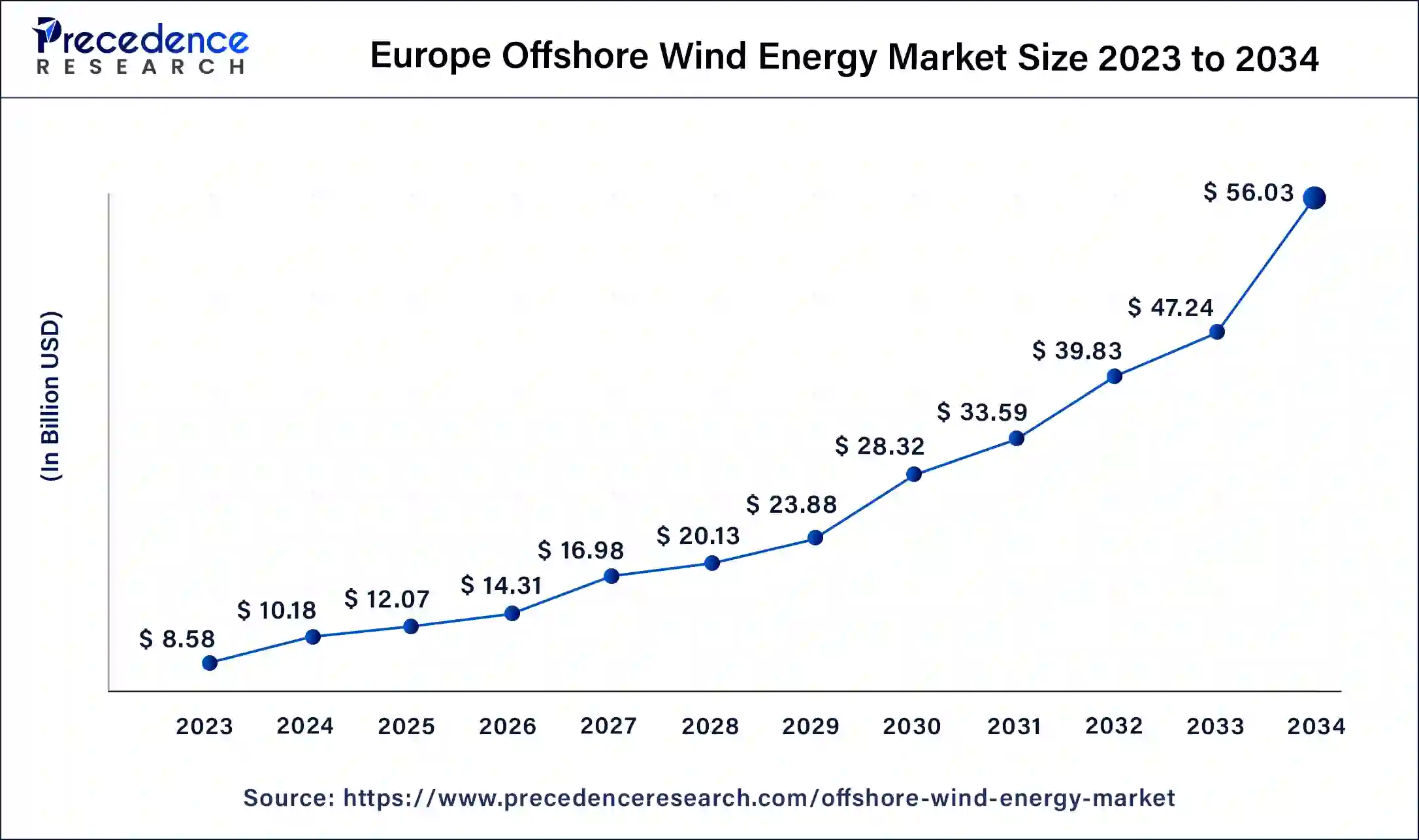
The European market is the largest market among all regions in 2025. It comprises of UK, Germany, Netherlands and the rest of the Europe. EWI (European wind initiative) which is a research and development program is concentrating on upgrading the infrastructure. To generate more power the governments are also promoting renewable energy sources.
Apart from the European market the leading players for the offshore wind market are electric wind power (China), Siemens gamesa (Spain) and General Electric (US). The American offshore wind market will generate 83000 jobs by 2032 and the investments in the market will give returns of $5.5 to 14.5 billion per year by 2025 and up to $ 25.4 billion until 2032 in terms of the economic output. US have vast stretch for energy generation. Their coastal area has the capacity to provide upto 2000GW for usage. This will draw major investments in USA companies have announced a good amount of port related investment which happens to be $307 million and $650 million in the infrastructure used for transmission. US signed a contract to develop new crew transfer vehicles which will w built by Blount Boats. The emerging markets in Africa and south America are providing a great opportunity ever increasing need for more and more electricity has made this option lucrative.
UK Offshore Wind Energy Market Trends
In Europe, UK led the market owing to the surge in energy security goals, government support, and technological advancements. The UK government also has fixed targets to substantially expand offshore wind capacity for 50GW by 2030 and 86GW overall. Also, floating foundations, larger turbines, and innovations in grid infrastructure are propelling efficiency and cost reductions.
What is Driving the Growth of the Wind Energy Market in Asia Pacific?
Asia Pacific is expected to grow at a notable CAGR over the forecast period. The growth of the region can be linked to the rising energy demands, supportive policies, and favourable wind conditions. Furthermore, the increasing adoption of floating wind energy projects in nations like Taiwan and Japan will contribute to the overall market growth soon.
China Market Trends
The Chinese market is driven by large-scale installations and strong government backing. Rapid industrialization, domestic manufacturing capabilities, and ambitious renewable energy targets significantly boosted offshore wind capacity.
How Did North America Drive Offshore Wind Energy Growth?
North America is expected to grow at a notable CAGR in the foreseeable future. The region experienced strong growth driven by rising investments in renewable energy and supportive government policies. Increasing focus on reducing carbon emissions and expanding offshore project pipelines supported market expansion. Technological advancements in turbine capacity and grid integration further enhanced deployment.
U.S. Offshore Wind Energy Market Trends
In North America, the US dominated the market by holding the largest market share due to the substantial investment in offshore wind infrastructure and projects. Increasing renewable energy targets and ongoing government initiatives are supporting positive market growth in the country. Offshore wind projects are anticipated to generate thousands of jobs to promote economic growth in coastal regions.
How is Latin America Growing in the Offshore Wind Energy Market?
Latin America is considered to be a significantly growing area, due to increasing focus on clean energy diversification. The region showed emerging growth potential supported by favourable wind resources, government initiatives, and international investments in early-stage offshore wind projects.
Brazil Market Trends
The Brazilian market is driven by its vast coastline and strong wind resources. Regulatory developments and rising foreign investments supported the advancement of offshore wind projects.
Will the Middle East and Africa Grow in the Offshore Wind Energy Market?
The Middle East and Africa region is expected to grow at a considerable CAGR in the upcoming period. The region witnessed gradual growth driven by diversification of energy sources and increasing focus on renewable energy. Government strategies to reduce dependence on fossil fuels supported offshore wind adoption.
UAE Market Trends
The UAE is considered to be a significantly growing area, due to strong renewable energy ambitions and investments in clean technologies. Strategic initiatives and partnerships supported the exploration of offshore wind opportunities.
What are the Government Initiatives in the Offshore Wind Energy Market?
- The U.S. Bureau of Ocean Energy Management extended offshore wind leasing programs, permitting large-scale development of offshore wind energy on the Atlantic Coast.
- The European Union launched renewable energy policies and grid plans that promote offshore wind energy infrastructure via floating platforms.
- China enhanced investments in offshore renewable energy resources, leveraging clean energy initiatives, local wind turbine production, and offshore grids.
- Brazil adopted legislation that permits the development of offshore wind farms, promoting marine renewable energy infrastructure investments.
Value Chain Analysis - Offshore Wind Energy Market
- Resource Extraction - Mining for steel, rare earth metals, and copper enables the manufacturing process of offshore turbines.
Key Players: Rio Tinto, Glencore - Power Generation - The offshore wind turbines use turbine technology to transform wind power to electricity.
Key Players: Siemens Gamesa, Vestas - Grid Management - Submarine cables and offshore substations transport electricity from the source.
Key Players: Prysmian Group, Nexans - Storage Systems - Battery storage systems are used to store renewable power from the energy sources.
Key Players: Tesla, Fluence Energy
Competitive Landscape
The offshore wind energy market is highly consolidated, with the presence of project developers, turbine manufacturers, specialized marine contractors, and grid specialists. A group of original equipment manufacturers (OEMs) like GE Vernova, Vestas Wind Systems, and Equinor, utility enterprises, and regional power companies hold the majority share of manufacturing, supply chain logistics, and large-scale project installations.
The market faces formidable challenges, including high building and repair costs, complex supply chains, and a lack of specialized installation ships. Despite these challenges, the market's future is driven by the growing demand for clean energy, floating foundations for deep water, and strong commitments in Europe and Asia. The sector is witnessing a scale-up in manufacturing toward gigantic 20MW+ turbines.
Company Profiles
EnBW
- HQ: Karlsruhe, Germany
- Founded: 1997
- Ownership: Public
- Business Overview: Energie Baden-Württemberg (EnbW) is one of the largest integrated energy companies in Germany and Europe that covers the entire value chain, including renewable and available generation, transmission and distribution grids, sales, and e-mobility. The company has around 5.5 million electricity and gas customers, with an aim to invest up to €50 billion by 2030.
- Geographic Presence: EnBW's core presence is in Germany, with a strategic operational and project footprint across select European and global markets.
- Revenue: The total revenue of EnBW in the first half of 2026 was €19,132 million, representing an increase of 9.3% from the same period in 2025. About 59 of the 64 wind turbines were installed by the end of 2026, supplying electricity to over 1.1 million households.
Recent Development: In February 2026, EnBW and Google signed a long-term power purchase agreement for 100 MW of offshore wind power, supporting the development of clean, reliable, and affordable energy systems. - Key Strategies: The company has started preparing for the next stage in the expansion of its offshore portfolio. As part of the EnBW 2030 strategy, it increases investment in the short and medium term along with the entire value chain in the growing and transitioning energy system.
Ørsted
- HQ: Fredericia, Denmark
- Founded: 2006
- Ownership: Public
- Business Overview: Ørsted is a global leader in developing, constructing, and operating offshore wind farms. It powers millions of homes and businesses with homegrown renewable energy, strengthening energy security and advancing the vision of a world that runs entirely on green energy.
- Geographic Presence: Ørsted operates across three continents, including Europe, North America, and Asia. It serves many countries in these regions, including Denmark, Germany, Malaysia, Poland, Taiwan, the Netherlands, the UK, and the U.S.
- Revenue: The EBITDA of Ørsted in the fourth quarter of 2025 was DKK 3.86 billion, while the total profit of 2025 was DKK 3.2 billion. Of these, offshore sites amounted to DKK 24.3 billion, representing an increase of approx. DKK 0.5 billion.
- Recent Development: In August 2026, Ørsted announced the development of a new offshore wind project in Taiwan, Dadu 2, with a proposed capacity of up to 2 GW.
Key Strategies: The company aims to maintain its position as the undisputed global leader in offshore wind, to be the leading workplace for talent in offshore wind, and to be recognized globally as a sustainable leader.
Siemens Gamesa Renewable Energy SA
- HQ: Biscay, Spain
- Founded: 2017
- Ownership: Siemens Energy (Parent Company)
- Business Overview: Siemens Gamesa is a global leader in wind energy, supporting companies to build resilient, affordable, and sustainable energy systems that accelerate the energy transition. It offers an extensive range of solutions and services for offshore power generation.
- Geographic Presence: The company operates in over 81 countries across various regions, including Africa and the Middle East, Asia-Pacific, Europe, and North America.
- Revenue: The total revenue of Siemens Energy in the fiscal year 2025 was €39.1 billion, representing an increase of 15.2%. The net income increased to €1.685 billion.
- Recent Development: In March 2025, Siemens Gamesa secured a contract to construct, finance, and operate a 500 MW wind farm in the Gulf of Suez region in Egypt.
Key Strategies: The company combines innovation, responsibility, and collaboration to accelerate the energy transition and make a meaningful impact on the world.
Vestas Wind Systems AS
- HQ: Aarhus N, Denmark
- Founded: 1945
- Ownership: Public (Nasdaq: NWS)
- Business Overview: Vestas is a global leader in sustainable energy solutions by designing, installing, and maintaining wind energy projects globally. It has over 30 years of experience in offshore wind, has installed more than 1500 wind turbines at sea, and has installed 12 GW of capacity across 58 projects.
Geographic Presence: Vestas has international offices worldwide to ensure a global presence with local knowledge of all markets. - Revenue: The revenue of Vestas in the second quarter of 2026 was EUR 4.72 billion, representing an increase of 26.1% from the second quarter of 2025. The quarterly intake of firm and unconditional wind turbine orders amounted to 3,349 MW.
- Recent Development: In August 2026, Vestas supplied 64 flagship 15 MW offshore wind turbines to the 960MW project of EnBW.
- Key Strategies: The four main goals of Vestas include: a science-based decarbonization without carbon offsets; producing zero-waste wind turbines by 2040; becoming the safest, most inclusive, and socially responsible company in the energy industry; leading the transition towards a world powered by sustainable energy.
GE Vernova
- HQ: Massachusetts, United States
- Founded: 2023
- Ownership: Public
- Business Overview: GE Vernova is an energy equipment manufacturing and services company with a relentless passion for innovation and a diverse portfolio of leading technologies. It helps reduce the carbon intensity of the world's power systems by reducing the CO2 per kWh produced.
- Geographic Presence: The company has a global presence across multiple regions, including Africa, Asia, Australia, Europe, the Middle East, America, and South America.
Revenue: The revenue generated in the second quarter of 2026 was $11.1 billion, representing an increase of 22% from the same period in 2025. - Recent Development: In December 2025, GE Vernova signed an agreement with Aula Energy to provide 42 6.1 MW–158m1 workhorse turbines for the Carmody's Hill Wind Farm in Australia.
Key Strategies: The company commits to building a more sustainable electric power system through its 5 ambitions, including electrify the world, help people thrive, decarbonize emissions, innovate more, use less, and operate fatality-free.
Offshore Wind Energy Market Companies
- Siemens Gamesa: Offers offshore wind turbines, as well as maintenance and digital solutions to offshore wind farms.
- Prysmian Group: Provides submarine power cables and connection grids to offshore wind transmission.
- Nexans: Provides high-voltage subsea cables and solutions to electrify offshore wind farms.
- Sumitomo Electric: Produces submarine power cables and power transmission systems for offshore wind power connections.
- General Electric: Designs Haliade-X offshore wind turbines for high-capacity renewable energy projects.
Other Major Key Players
- Southwire LLC
- IMPSA
- Enessere
- LS Cable & System
- Vestas
- Goldwind
- Nordex
- WEG
- Suzlon Energy
- Global Energy (Group)
- Senvion
- RTS Wind
- Vattenfall
- ENVISION Group
- NSW Cable
- Clipper Windpower
- Enercon
- JDR Cable
- Northland Power
- Bergey Windpower
- NKT A/S
- Zhejiang Windey
Recent Developments
- In February 2026, India and the United Kingdom launched the India–UK Offshore Wind Taskforce to boost cooperation under Vision 2035. Pralhad Joshi highlighted structured execution, while David Lammy and Lindy Cameron attended, emphasizing joint offshore wind development and strategic coordination. (Source: https://ddnews.gov.in )
- In April 2026, Dajin Heavy Industry announced the launch of the third vessel in its King series. Both King Two and the upcoming vessel were set to enter service within the year. Dajin Heavy Industry stated the vessels were part of its fleet expansion plan. (Source: https://www.offshorewind.biz )
- In June 2025, Brazilian state-owned oil and gas company Petrobras launched two tenders for an offshore wind pilot project off the coast of Rio de Janeiro state. One tender is for the acquisition and processing of geophysical data in ultra-shallow waters off São João da Barra.
(Source: https://splash247.com) - In May 2025, South Korea launches a new offshore wind tender. The country is aiming to install over 18.3GW of offshore wind capacity by 2030, recently passing legislation to boost deployment. The auction will focus on fixed-bottom projects, with 750MW offered through a general bidding market. (Source: https://www.rechargenews.com)
- In March 2025, Vestas secured a 495 MW order from Copenhagen Infrastructure Partners (CIP) for the Fengmiao I offshore wind project off the coast of Taichung, Taiwan. The order includes 33 V236-15.0 MW turbines as well as a long-term comprehensive service agreement designed to ensure the optimized performance of the assets. (Source: https://www.vestas.com)
Segments covered in the report
By Components
- Turbines
- ≤ 2 MW
- > 2 to ≤ 5 MW
- > 5 to ≤ 8 MW
- > 8 to ≤ 10 MW
- > 10 to ≤ 12 MW
- > 12 MW
- Floating
- Axis
- Component
- Fixed
- Axis
- Component
- Rating
- Installation
- Electrical infrastructure
- Wires & cables
- Substation
- Others
- Support Structure
- Monopile
- Jacket
- Substructure (steel)
- Foundation
- Others
By Location
- Shallow Water
- Transitional Water
- Deep Water
By Depth
- 0 to ≤ 30 m
- 30 to ≤ 50 m
- 50 m
By Capacity
- Up to 3MW
- 3MW to 5MW
- Above 5MW
By Geography
- North America
- Latin America
- Europe
- Asia-pacific
- Middle and East Africa
For inquiries regarding discounts, bulk purchases, or customization requests, please contact us at sales@precedenceresearch.com
Frequently Asked Questions
Tags





Ask For Sample
No cookie-cutter, only authentic analysis – take the 1st step to become a Precedence Research client
 Get a Sample




 sales@precedenceresearch.com
 Schedule a Meeting
