



Ball Bearing Market Size, Key Companies, Company Market Share, Equipment Production Volume, Sales Performance, Manufacturing Cost, Export & Import Trends, Competitive Positioning, and Market Analysis
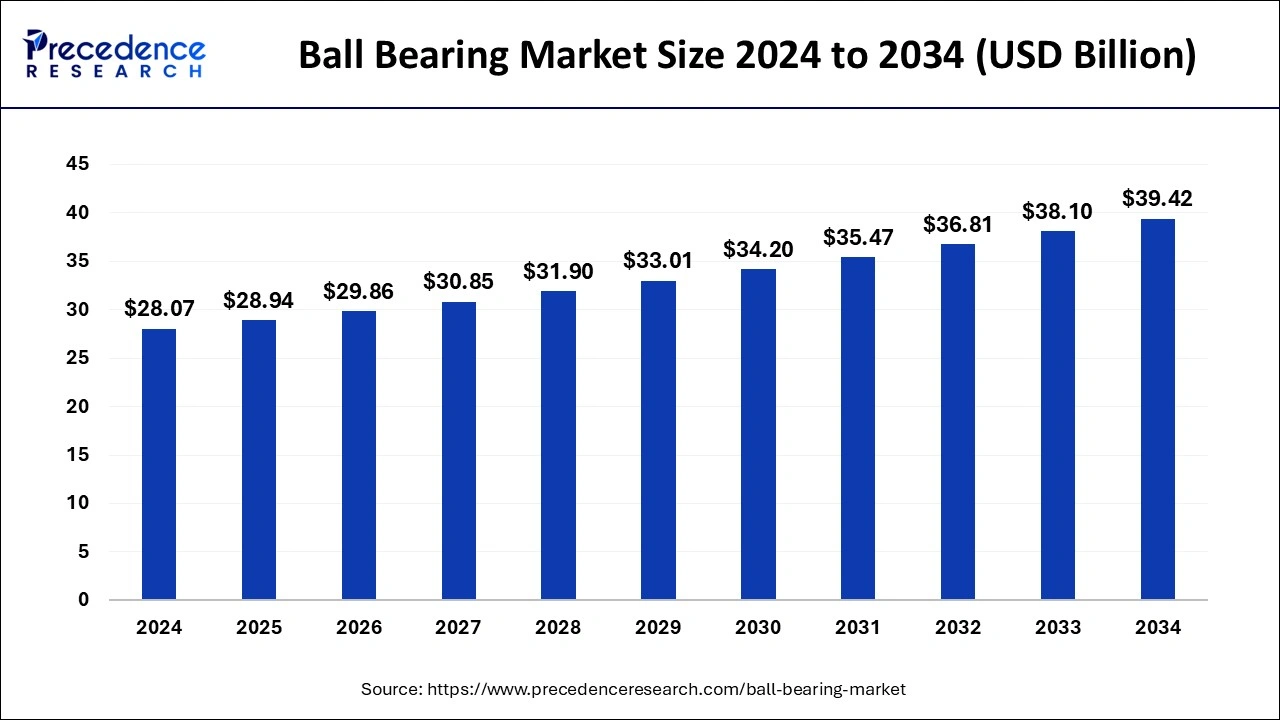
The global ball bearing market size is calculated at USD 29.86 billion in 2026 and is forecasted to reach around USD 39.42 billion by 2034, accelerating at a CAGR of 3.45% from 2026 to 2034. The Asia Pacific ball bearing market size surpassed USD 12.44 billion in 2025 and is expanding at a CAGR of 3.58% during the forecast period. The market sizing and forecasts are revenue-based (USD Million/Billion), with 2024 as the base year.
Source: https://www.precedenceresearch.com/ball-bearing-market
 Get a Sample
 Table Of Content


Ball Bearing Market Size and Forecast 2026 to 2034
The global ball bearing market size reached USD 29.86 billion in 2026 and is expected to be worth around USD 39.42 billion by the end of 2034, expanding at a compound annual growth rate (CAGR) of 3.45% during the forecast period from 2026 to 2034. The ball bearing market is driven by rising automotive production, industrial automation, and growing demand for high quality and reliable ball bearings.
Ball Bearing Market Key Takeaways
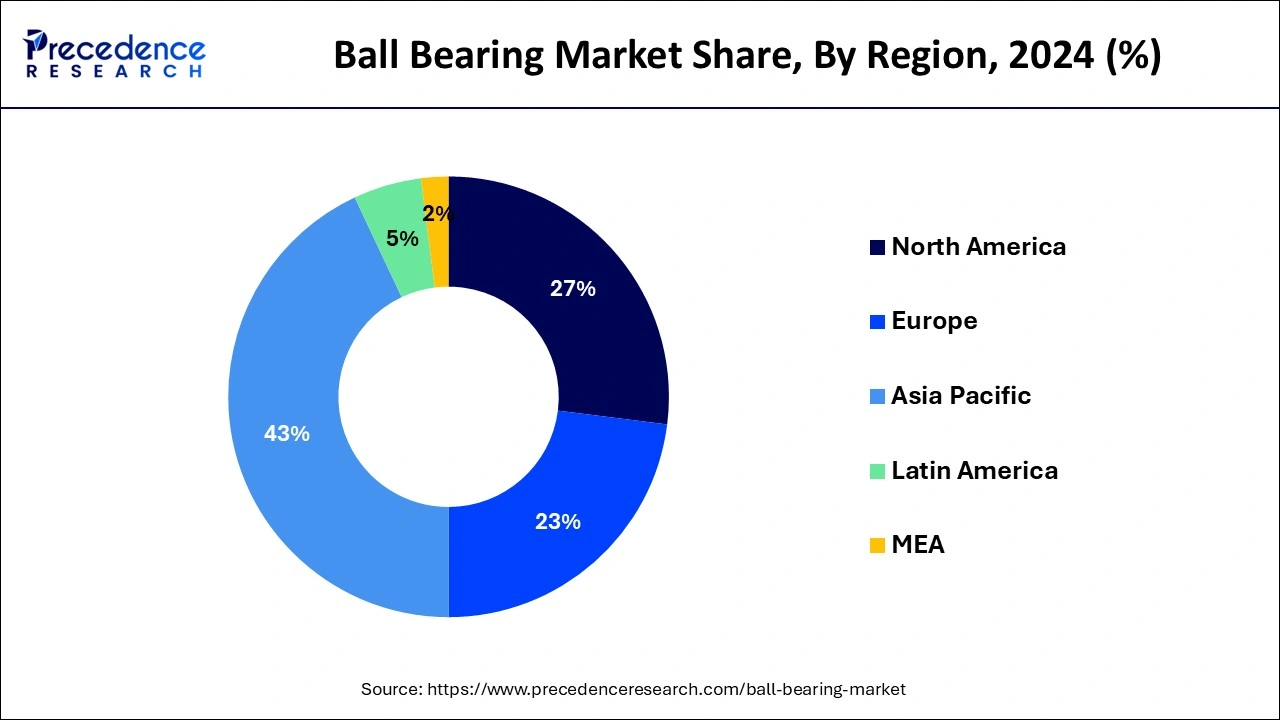
- Asia Pacific led the global market with the highest market share of 43% in 2024.
- North America region is estimated to expand the fastest CAGR between 2025 and 2034.
- By application, the automotive segment has held the largest market share of 53% in 2024.
Market Overview
Bearings are basically used in every kind of machine or equipment ranging from agricultural equipment, auto parts, and home machinery to aviation and safeguard equipment. Bearings are used in a number of automotive applications including interiors, wheel hubs, power trains, and engines. Continuously increasing vehicle production, growing demand from emerging countries, and growing demand for technology-enhancing solutions are enterprising the growth of the automotive industry bearings market worldwide. In recent years, there is an increasing demand for bearings with higher performance, less maintenance, and longer life. Ball bearings hold spherical rolling members and are used for smaller loads, while roller bearings have elliptical rolling elements and are used for big loads. Linear bearings are used to move linearly along the shaft and also rotate. Pre-assembled bearings are pre-assembled sets of bearings in racks that are attached to frames and other structures used to support shaft ends and other structures.
Ball Bearing Market Growth Factors
The requisition for electric vehicles will be driven mainly by the increase in car sales and the increase in the use of these vehicles. The average passenger car has 35 bearings, which varies considerably depending on the vehicle model and broadly used robotics. The most current technological elevation in dual-clutch automatic transmissions necessitates the induction of three more bearings, two main shafts from the second transmission, and one on the dual-clutch. In addition, the development of high-capacity bearings combined with transcending lubrication performance will drive the growth of the bearing market. Bearings are important in powering several rotating elements and maintaining the load characteristics of various mechanical devices. The elevated demand for a specialized system to meet specific industry needs such as airplane support systems, gas meters, and medical imaging equipment will significantly drive the market growth in the bearing industry.
Various industries are driving the ball bearing market growth interested in designing extremely low tolerance components, fixtures, and machines and stable over time under severe working conditions. Growing demand for ball bearing due to a spike in the usage of custom bearings is expected to drive market revenue growth. The rise of digitization and smart technologies embedded in bearings are driving the excrescence of the market Digitization is one of the key approaches to capture wireless options in the vertical. The bearing is digitized by moving its lubrication state and oscillation pattern. These measurements are dissected to take corrective action in the event of potential problems. The coalition of sensors with bearings has developed into smart bearings. For industrial operation, the sensor expedient the direction, temperature, speed, and vibration of these bearings. In addition, the advent of the Internet of Things (IoT) and Real-time Artificial Intelligence (AI) benefits end-users easily monitoring the form of their bearings at any time. In addition, the technological shift towards electric vehicles (EVs) is proving to be positive. Because ball-bearing electric vehicles are more technologically advanced than conventional vehicles using an internal combustion engine (IC).
Market Outlook
- Industry growth overview - The ball bearing market is expected to grow steadily, supported by rising automotive production, expanding manufacturing activities, and increasing demand for reliable high performance mechanical components.
- Major Investors - Investments are increasing from global bearing manufacturers, industrial equipment companies and automotive companies. Major investors in the market include
- Startup ecosystem - The startup economy in the market is focused on developing smart bearings with condition monitoring, advanced materials and suitable for smart manufacturing technologies.
Market Scope
| Report Coverage | Details |
| Market Size in 2026 | USD 29.86 Billion |
| Market Size by 2034 | USD 39.42 Billion |
| Growth Rate from 2026 to 2034 | CAGR of 3.45% |
| Largest Market | Asia Pacific |
| Base Year | 2025 |
| Forecast Period | 2026 to 2034 |
| Segments Covered | By Type, By Application, and Distribution Channel |
| Regions Covered | North America, Europe, Asia-Pacific, Latin America, and Middle East & Africa |
Market Dynamics
Drivers
Usage of advanced materials in manufacturing bearings - The market for precision mechanical bearings is growing in a variety of industries, where chromium steel is widely used in the bearing-making process. These chromium steel bearings improve the bearing's physical characteristics in terms of wear resistance, fatigue life hardness, stiffness, and other properties compared to traditional bearings. In addition, to meet industry-specific requirements for applications in harsh environments, bearing manufacturers are required to use tungsten carbide.
Rising demand for precision engineering - Various industries are driving the Ball bearing market growth interested in designing very low tolerance components, fixtures, and machines and stable over time under severe working conditions. Growing demand for ball bearing due to a spike in the usage of custom bearings will drive market revenue growth.
Development of precision bearings for power trains - The chromium steel bearings improve the bearing's physical properties in terms of hardness, wear resistance, stiffness, fatigue life, and other properties compared to traditional bearings. In addition, to meet industry-specific requirements for applications in harsh environments, bearing manufacturers are required to use tungsten carbide and ceramic materials.
Challenges
- Bearing failure occurrences - The growth of the global bearing market is hampered by bearing failure caused by electric vehicles, volatile raw material prices, rising electrification of vehicles, and high maintenance costs.
- COVID-19 disruptions - The COVID-19 pandemic had a significant impact on the market, with many manufacturing plants facing the negative effects of shutdowns in major economies such as Japan, and China, among others. The automotive industry has seen a significant decline in vehicle production, mainly due to supply chain disruptions and limited supply hampering the market for ball bearings.
- Geopolitical conflicts pose serious challenges to the market - Market restrictions have an impact on the market. Many countries have geopolitical conflicts among each other which affect the global supply chain and negatively impact the ball-bearing market.
Opportunities
- Increasing investment by key market players in product design - Manufacturers are constantly working to improve product designs to increase efficiency and energy effectiveness. They use a one-off material for the raceway, cage, and rolling member as well as a redesigned raceway profile. In addition, technological advances in sealing and lubrication technologies as well as the use of lightweight materials in high-performance products are opening up enormous opportunities for manufacturers.
- High-performance bearings - The growing demand for high-performance bearings has prompted manufacturers to incorporate advanced sensors into their products. The sensor supports digital monitoring of shaft movement, deceleration, acceleration, rotational speed, and load capacity of the product. In addition, the advent of the agricultural Internet of Things (IoT) has encouraged the adoption and ongoing monitoring of connected devices and machines. This trend will also offer lucrative growth opportunities for market growth.
- New product launches with compact design - Several major suppliers have begun offering hi-tech bearings, which can be continuously monitored to predict failures before they occur. The embracement of these products is still in its infancy. Several other major market players are likely to offer in their portfolios in the near future. Because smart bearings are easy to predict failures before they happen, they offer tremendous value by reducing the cost of unplanned downtime, which will increase the adoption of these products compared to forecast.
Segmental Insights
Application Insights
The automotive segment dominates the bearing market in 2025 and accounts for 53% of the revenue share. The demand for motor vehicles with advanced technological solutions is increasing, necessitating the rise of the vehicle manufacturing industry. The increasing demand for modern automobiles coupled with the vehicle's ability to innovate has elevated the demand for bearings in the automotive sector. The rail and aerospace segment is the fastest-growing bearing market segment in 2020.
This is attributed to the growing interest in business travel, and the need to replace aging fleets of trains. The growth of the floating market is proportional to the growth of the industrial and automotive sectors. Increasing the production of corporate vehicles is one of the pressing drivers of the bearing market. In addition, the growing construction activities globally are also driving the growth of the global bearing market.
Type Insights
Why Did the Deep Groove Ball Bearings Segment Dominate the Ball Bearing Market?
The deep groove ball bearing segment held the largest revenue share in the ball bearing market in 2025 because they offer excellent performance, simple design, low maintenance, and cost effective operations. They are widely used in electric motors, pumps, fans, automotive components and industrial machinery. Their ability to handle both radial and moderate axial loads makes them suitable for numerous applications in industries.
The angular contact ball bearing segment is expected to expand rapidly in the ball bearing market, with a CAGR over the forecast period. The angular contact ball bearings are widely used in applications requiring high speed performance and the ability to support combined radial and axial loads. Rising investments in industrial automation and advanced manufacturing technologies are driving growth of the segment in the market.
Regional Insoghts
Asia Pacific Ball Bearing Market Size and Forecast 2026 to 2034
The Asia Pacific ball bearing market size reached USD 12.84 billion in 2026 and is anticipated to be worth around USD 17.15 billion by 2034, poised to grow at a CAGR of 3.58% from 2026 to 2034.
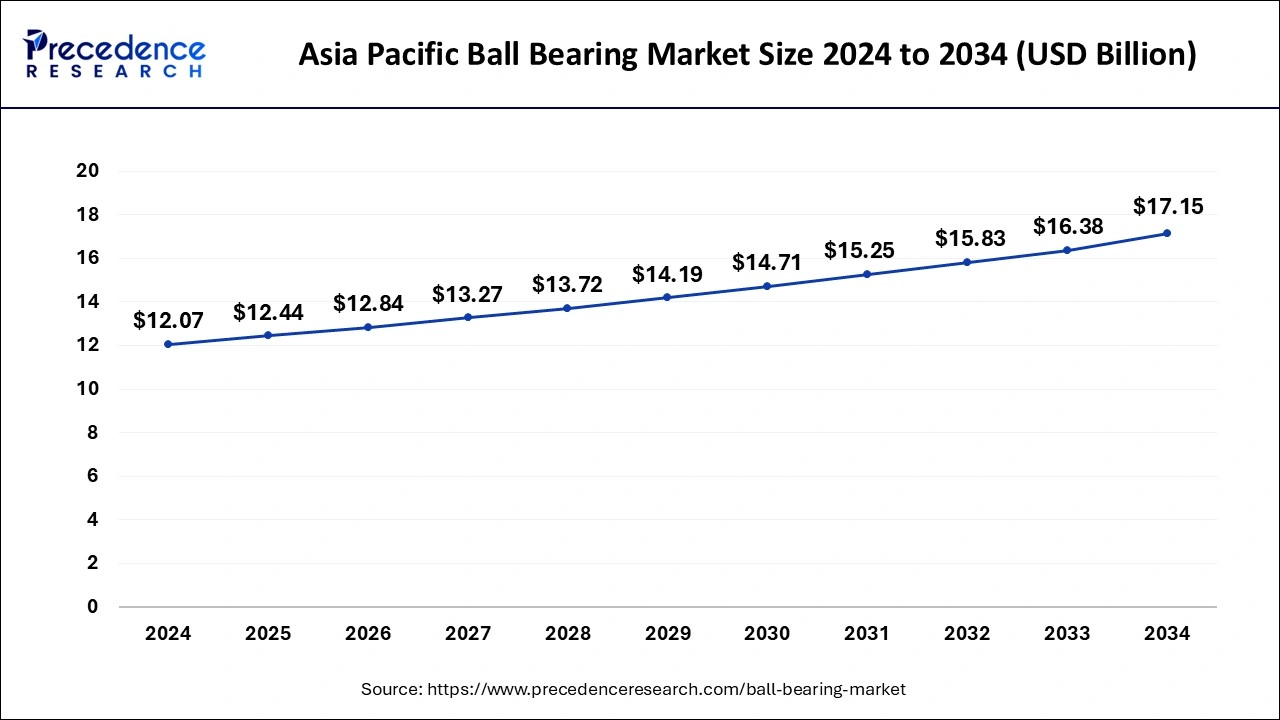
The Asia-Pacific region accounts for more than 43% of the revenue share by 2024. Countries such as China and Japan are driving the growth of the bearing market in Asia-Pacific, where sales numbers are expected to increase in the upcoming years due to robust expansion in automobile and machinery manufacturing, as well as an aftermarket for industrial equipment and auto repair. Sales of automotive bearings are expected to increase in Asia-Pacific countries, mainly in India, China, and Japan in the coming years. The growing demand for vehicles, especially passenger cars and two-wheelers by more than a third of the world's population concentrated in India and China, is supporting the sale of automotive bearings.
China Market Trends
China accounts for the largest share of the ball bearing market in Asia-Pacific in 2025. The growth is driven by its large scale manufacturing ecosystem and extensive industrial production. The rapid industrialization in the country, particularly in manufacturing, construction, and infrastructure development, is further fueling demand for ball bearings. Government support for advanced manufacturing and smart factories encourages greater use of precision bearings. Domestic companies are continuously investing in improving product quality and also expanding exports.
The ball bearings market is expected to witness steady growth of automotive bearings in the markets of Europe and North America. Emerging economies such as Brazil and South Africa are expected to record high growth rates during the forecast period. Europe is said to be experiencing favorable growth rates due to sustained economic growth and increased investment. The growth in the sales of electric vehicles, coupled with the growth and development of the automotive and automotive industries, is driving the bearing market growth in the European region.
In addition, demand in mature markets such as Western Europe, the United States, and Japan is expected to be driven by a recovery in motor vehicle production and a strong investment condition. Improved revenue from high-value bearings, including custom large-diameter bearings used in turbines and heavy machinery, is also expected to trigger market growth in North America.
What Factors Made the North America Region the Dominant Region in the Market?
North America dominated the ball bearing market in 2025, driven by a recovery in motor vehicle production and a strong investment climate. Manufacturers continue to invest in precision bearings that improve equipment efficiency and durability. The region also benefits from well established distribution networks and continuous product innovation. Improved revenue from high-value bearings, including custom large-diameter bearings used in turbines and heavy machinery, is also expected to trigger market growth in North America.
U.S. Market Trends
The United States represents the largest share of the ball bearing market in North America. The growth is driven by its extensive manufacturing base and advanced transportation sector. The technological advancements in industries such as robotics, automation, and aerospace further demands the high performance ball bearings. Growth in electric vehicles, warehouse automation, and renewable energy projects is also creating additional opportunities for market growth. The country is focused on technological innovation, with stringent quality standards supporting market growth.
Which Factors Made Europe a Significantly Growing Region in the Market?
Europe is expected to grow at a considerable CAGR in the ball bearing market in the coming period. The growth is supported by sustained economic growth and increased investment. Demand remains strong across automotive production, industrial machinery, aerospace, and renewable installations. Increasing investment in research and development is also supporting market growth. The growth in the sales of electric vehicles, coupled with the growth and development of the automotive and industrial machinery industries, is driving the ball bearing market growth in the European region.
Germany Market Trends
Germany leads the European ball bearing market in 2025 due to its globally recognized automotive, mechanical engineering, and industrial equipment sectors. High demand for precision bearings comes from premium vehicle production, automation systems, robotics, and advanced manufacturing technologies. The country's focus on reducing carbon emissions is also reshaping product offerings and market strategies. Strong export capabilities and continuous technological development further reinforce Germany's leadership in the regional market.
What are the Advancements in the Market in Latin America?
Latin America held a considerable share of the ball bearing market in 2025, supported by rapid industrialization and infrastructure development. Demand is increasing from automotive, assembly, mining, agriculture, construction equipment and manufacturing industries. Government are investing in transportation and industrial projects, also creating additional opportunities for market growth. The region is investing in improving local manufacturing capabilities to reduce imports and strengthen the regional supply chain. These factors are contributing to the market growth in Latin America.
Brazil Market Trends
Brazil accounts for the largest share of the Latin American ball bearing market in 2025, due to its large automotive industry, mining operations, and industrial manufacturing base. The country is expanding renewable energy projects, such as wind power, that require precision bearings. Offshore oil exploration in Brazil also requires equipment dependent on high quality bearings. Continuous investment in infrastructure and equipment modernization supports demand for reliable bearing solutions.
What are the Key Trends in the Market in the Middle East and Africa Region?
The Middle East & Africa held a notable share of the ball bearing market in 2025, driven by rising infrastructure investment and industrial diversification. Governments are promoting industrial development beyond traditional energy sectors, encouraging investment in modern machinery and automation. The market growth is further driven by industrial expansion in countries such as the UAE, Saudi Arabia, and South Africa. Strong demand is coming from oil and gas operations, mining and construction, and maintenance requirements are also supporting market growth.
Saudi Arabia Market Trends
Saudi Arabia represents the leading market within the Middle East and Africa ball bearing market in 2025, supported by industrial diversification and infrastructure expansion. Under Vision 2030, investment in manufacturing, logistics, renewable energy and smart industrial projects is increasing the need for high quality bearing solutions. The increasing vehicle imports, rising local assembly and expanding commercial transport sector create steady demand for high quality ball bearings in the automotive industry.
Supply Chain Analysis
- Raw Material Sourcing: Raw materials such as steel, ceramic materials, lubricants, and seals are sourced from reliable suppliers to ensure high-quality and durability. Raw material pricing and availability directly affect production cost.
- Key Players: Schaeffler AG, Nachi Fujikoshi Corp, and Koyo
- Component Fabrication and Machining: In this stage, raw materials are processed into bearing rings, balls, cages, and seals using forging, heat treatment, and precision machining. Precision machining is critical, as small deviations can affect insertion accuracy.
- Key Players: NTN Bearing Corporation, THB Bearings and ISB Industries 
- Testing and Certification : The finished bearings undergo quality inspections for hardness, dimensional accuracy, load performance, and durability. Certification ensures the product meets quality and safety standards as per industry standards before entering the global market.
- Key Players: Myonic GmbH, Luoyang Huigong Bearing Technology Co. Ltd. and NTN Bearing Corporation
- Maintenance and After-Sales Service: After installation, ongoing maintenance support plays a major role in customer service. Companies provide training, software updates, and technical assistance. Regular inspection and servicing help to extend bearing life span and improve machine performance.
- Key Players: Nachi Fujikoshi Corp, LYC Bearing Corporation and NTN Bearing Corporation
- Product Lifecycle Management : Manufacturers continuously monitor the complete lifecycle of ball bearings from design and production to field performance and recycling. Effective product lifecycle management ensures the product remains competitive and aligned with evolving industry standards.
Competitive Landscape
The ball bearing market is highly competitive, with established international manufacturers competing through product quality, pricing and technological innovation. The leading companies in the market include Nachi Fujikoshi Corp, Luoyang Huigong Bearing Technology Co. Ltd, The Timken Company, Alchemy Immersive, NSK Ltd, Myonic GmbH, LYC Bearing Corporation, NTN Bearing Corporation and SKF. Companies are strengthening their market position through continuous investment in research and development and advanced manufacturing processes. Strategic partnerships, collaborations, mergers and acquisitions remain common approaches for market growth.
For future growth in the ball bearing market, companies should focus on developing bearings for electric vehicles, robotics, and industrial automation. Companies should also expand their supply chain and increase investment in emerging markets to maintain a competitive landscape.
Top Companies in the Ball Bearing Market and Their Offerings (addition)
- SKF Group - A Swedish based and global supplier of bearings. Its key offerings include deep groove ball bearings, angular contact ball bearings, bearing lubrication systems and industrial maintenance services for automotive, aerospace and railways.
- Schaeffler Group - A German company and a global supplier of precision bearings and motion technologies; it offers ball bearings, roller bearings, high speed spindle bearings, and automotive bearing systems.
- NTN Corporation - A Japanese company recognized for its extensive range of bearings and drivetrain products. Its key offerings include ball bearings, wheel hub bearings, precision bearings, and linear motion products.
- NSK Ltd. - A Japanese company that offers deep groove ball bearings, angular contact ball bearings, and precision machine tool bearings.
Ball Bearing Market Companies
- Schaeffler AG (Germany)
- NSK Ltd. (Japan)
- Nachi Fujikoshi Corp (Japan)
- LYC Bearing Corporation (China)
- Myonic GmbH (Germany)
- Luoyang Huigong Bearing Technology Co. Ltd. (China)
- ISB Industries (Italy)
- Koyo (Japan)
- NTN Bearing Corporation (United States)
- The Timken Company (United States)
- SKF (Sweden)
- THB Bearings (China)
Recent Developments
- In February 2026, Dodge Industrial Inc., a leading provider of innovative industrial solutions, launched 300 Series mounted ball bearings. The bearings offer unmatched durability, quality and reliability, especially under heavy loads and high speed working.
- In May 2026, SKF India launched advanced industrial solutions at Tech Day 2026. The solutions addressed three pillars of modern industry - energy efficiency, maximum uptime, and resilience in extreme environments. They introduced AI monitoring tools and prioritised sustainability through bearing manufacturing, which reduced carbon emissions by 90%.
- March 2021 - NTN Corporation designed a bearing “Tenter clip bearing”. This bearing will be used especially in the packaging industry.
- March 2021 – SKF, a well-known company in the ball bearing industry, upgraded the application to provide faster information on precision bearings. Customers can scan the products and also get product information using this application.
Segments Covered in the Report
By Type
- Deep Groove Ball Bearings
- Angular Contact Ball Bearings
- Self-Aligning Ball Bearings
- Thrust Ball Bearings
- Others
By Application
- Automotive
- Industrial machinery
- Mining & Construction
- Medical
- Others
By Distribution Channel
- O.E.M
- Retail Distribution
By Geography
- North America
- Europe
- Asia-Pacific
- Latin America
- Middle East & Africa (MEA)
For inquiries regarding discounts, bulk purchases, or customization requests, please contact us at sales@precedenceresearch.com
Frequently Asked Questions
Tags





Ask For Sample
No cookie-cutter, only authentic analysis – take the 1st step to become a Precedence Research client
 Get a Sample




 sales@precedenceresearch.com
 Schedule a Meeting
