


Cervical Cancer Screening, Diagnostics and Pre-Cancerous Dysplasia Lesion Treatment Market Size, Key Companies, Company Product Portfolio, Hospital Procurement Trends, Manufacturing Capacity, Company Market Share, and Forecast
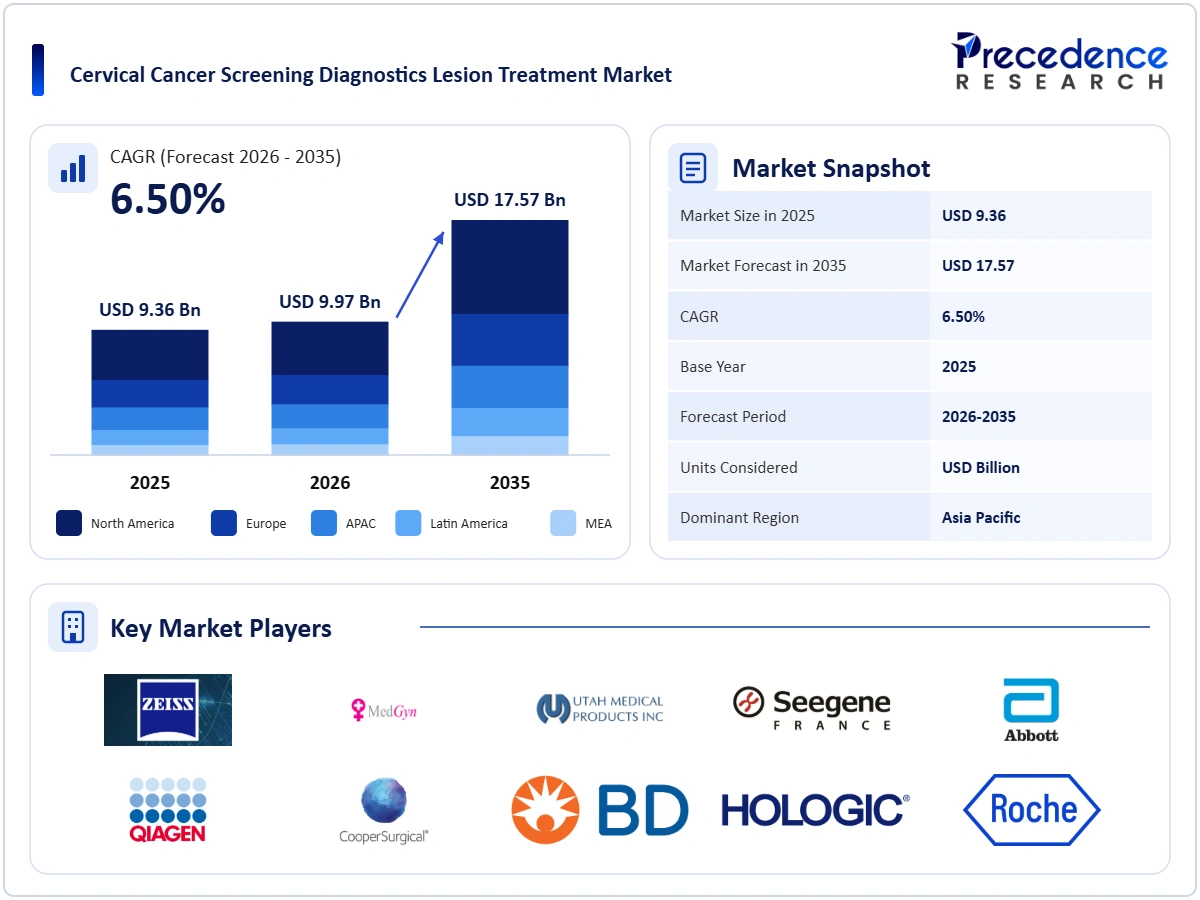
Payal Rabde, a Healthcare Industry Expert, highlights that the cervical cancer screening, diagnostics and pre-cancerous dysplasia lesion treatment market has reached USD 9.97 billion in 2026 and is on track to reach USD 17.57 billion by 2035, advancing at a CAGR of 6.50%. Key cervical cancer screening, diagnostics and pre-cancerous dysplasia lesion treatment market companies shaping the market include Roche Diagnostics, BD, CooperSurgical while major growth segments span type, technology, end user, region.
Source: https://www.precedenceresearch.com/cervical-cancer-screening-diagnostics-lesion-treatment-market
 Get a Sample
 Table Of Content


Cervical Cancer Screening Diagnostics Lesion Treatment Market Size, Share, Trends, and Growth Forecast 2035
The cervical cancer screening, diagnostics and pre-cancerous dysplasia lesion treatment market is forecasted to expand from USD 9.97 billion in 2026 to USD 17.57 billion by 2035, growing at a CAGR of 6.50% from 2026 to 2035.
Key Takeaways
Market Size & Growth Outlook
- Market size in 2025: USD 9.36 billion
- Estimated market size in 2026: USD 9.97 billion
- Projected market size by 2035: USD 17.57 billion
- CAGR (2026-2035): 6.50%
Regional Market Spotlight
- North America led the market with a 36.80% (USD 3.44 billion) share in 2025.
- Europe accounted for 27.40% (USD 2.56 billion) of the market in 2025.
- Asia Pacific accounted for 24.60% (USD 2.30 billion) of the market in 2025 and is projected to be the fastest-growing region, at a CAGR of 7.75% from 2025 to 2035.
Segmental Spotlight
- By type, Screening accounted for 58.60% (USD 5.48 billion) in 2025.
- By technology, HPV Testing accounted for 44.60% (USD 4.17 billion) in 2025.
- By end user, Hospitals accounted for 38.40% (USD 3.59 billion) in 2025.
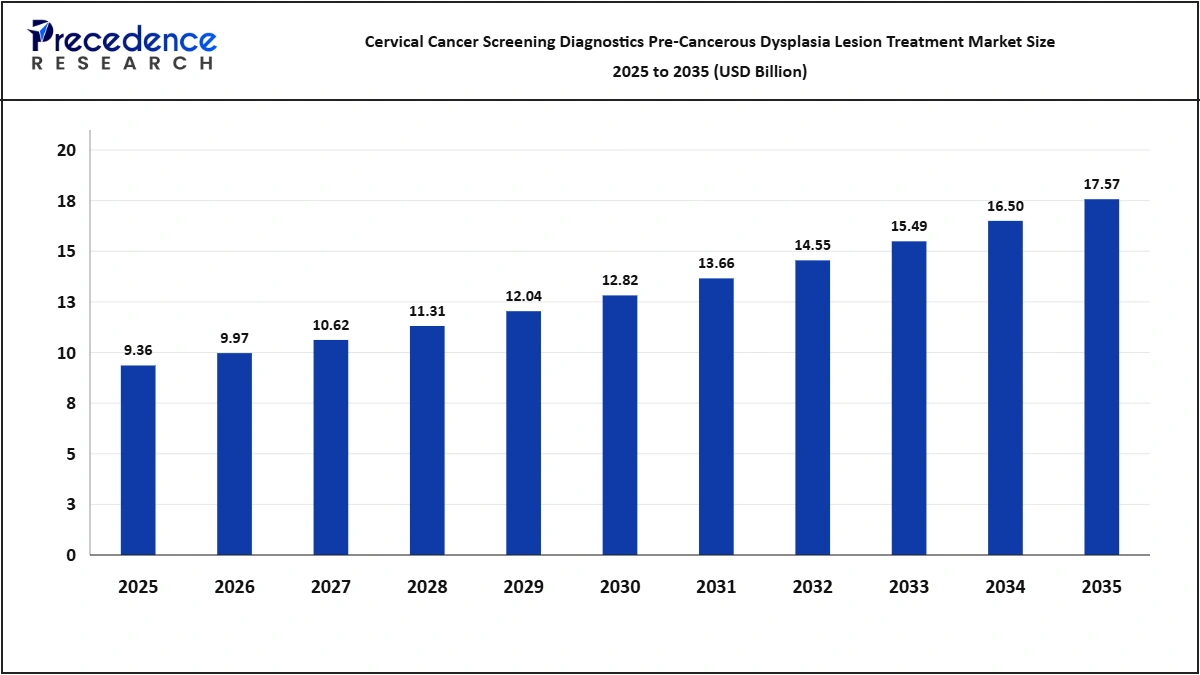
Cervical Cancer Screening Diagnostics Pre-Cancerous Dysplasia Lesion Treatment Market Size and Forecast, 2025-2035 (USD Billion)
Sources: Expert interviews, secondary sources, Precedence Research database and Precedence Research analysts.
The cervical cancer screening, diagnostics and pre-cancerous dysplasia lesion treatment market is projected to grow from USD 9.36 billion in 2025 to USD 17.57 billion by 2035 because health systems move to primary HPV testing and self-collection, which raises test value and reaches women who did not attend screening before. Positive results lead to colposcopy, biopsy and treatment of pre-cancerous lesions, which adds diagnostic and treatment revenue, lifting the market to USD 12.82 billion by 2030 and sustaining a CAGR of 6.50% from 2026 to 2035.
- Analyst View: We built the estimate from screened women by method and region, multiplied by test prices for HPV, cytology and co-testing, plus colposcopy, biopsy and lesion treatment volumes based on positive result and referral rates, and device and kit sales. Screening volumes reflect national program coverage and intervals, while follow-up volumes reflect HPV positivity and abnormal cytology rates. The total was cross-checked against the womens health and HPV testing revenue of leading diagnostics companies and against published estimates, which places our base year slightly above the comparable figures. The growth rate reflects wider HPV and self-collection screening and screen-and-treat programs, moderated by longer screening intervals with HPV testing.
Market Trends
- Primary HPV testing is replacing cytology-first screening.
- At-home and clinic self-collection are expanding screening reach.
- Extended HPV genotyping guides colposcopy referral.
- AI-assisted colposcopy and cytology are entering practice.
- Thermal ablation is conducive to screen and treat strategies in impoverished nations.
- Insurance for the follow-up helps in keeping away from the fall-out after a positive test result.
Drivers, Restraints and Opportunities
Driver
Guidelines and national programs are moving to primary HPV testing, which is more sensitive than cytology and carries a higher price per test. Self-collection in clinics and at home allows screening of women who avoid speculum exams or live far from clinics. The WHO global strategy to eliminate cervical cancer sets targets for screening and treatment coverage. Insurance and public funding for screening and follow-up care are expanding. These factors increase both screening attendance and the follow-up process.
Restraint:
Vaccination against HPV will decrease the incidence of cervical cancer over time, reducing follow-up procedures in younger women. Screening using HPV is done less frequently, thereby lowering testing per woman. Many low-income countries lack laboratory and treatment capacity. Volume is limited by loss to follow-up of patients who test positive. Tender price pressure reduces test income.
Opportunity
At-home self-collection and mail-in services can reach under-screened women. Low-cost point-of-care HPV tests linked to same-day thermal ablation can expand screen-and-treat programs. AI-assisted cytology and colposcopy can address shortages of specialists. Coverage mandates for follow-up care can increase colposcopy and treatment volumes. Funding international for elimination programs provides development in Africa and Asia.
Market Segmentation: 2025 Share and Value
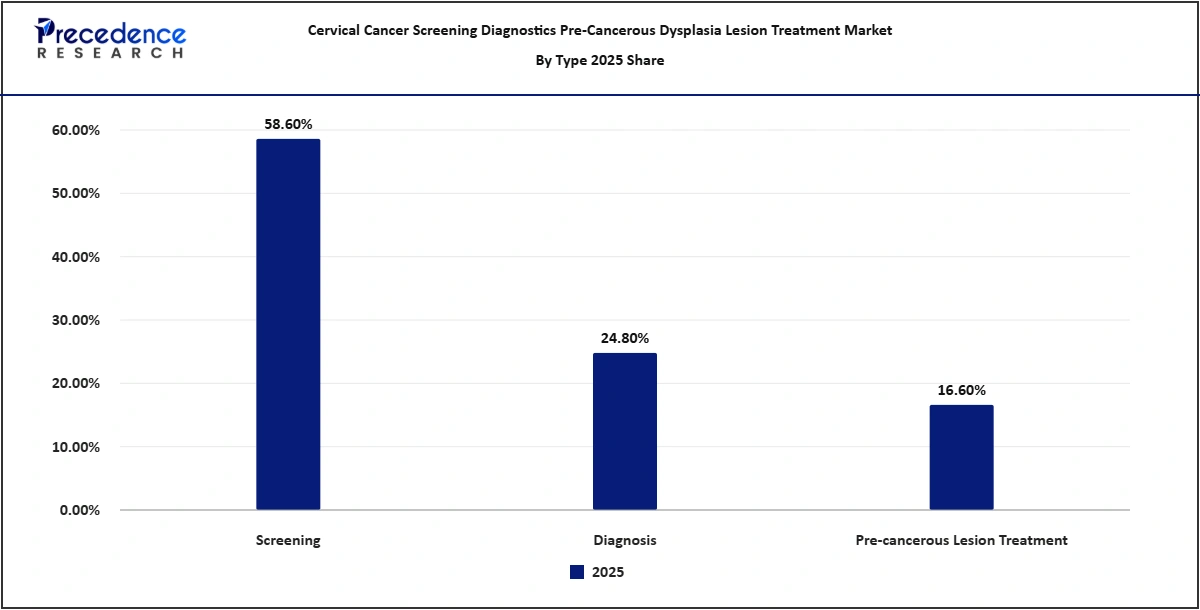
Cervical Cancer Screening Diagnostics Pre-Cancerous Dysplasia Lesion Treatment Market by Type 2025 Share & Size
Sources: Expert interviews, secondary sources, Precedence Research database and Precedence Research analysts.
Screening accounted for 58.60% (USD 5.48 billion) in 2025 because organized and opportunistic programs test large numbers of women every three to five years using HPV, cytology, or co-testing, together with collection devices and self-collection kits. Diagnosis, at 24.80% (USD 2.32 billion), covers colposcopy, biopsy, and HPV genotyping after a positive screen, including newer digital and AI-assisted colposcopes. Pre-cancerous lesion treatment accounts for 16.60% (USD 1.55 billion), including LEEP, cryotherapy and thermal ablation, and is the fastest-growing type as screen-and-treat programs expand in Africa, Asia, and Latin America.
Cervical Cancer Screening Diagnostics Pre-Cancerous Dysplasia Lesion Treatment Market by Technology 2025 Share & Size
| Segments | 2025 Share | 2025 Market Value |
| HPV Testing | 44.60% | USD 4.17 billion |
| Cytology (Pap & Liquid-Based) | 27.80% | USD 2.60 billion |
| Colposcopy & Biopsy | 15.20% | USD 1.42 billion |
| LEEP | 6.80% | USD 0.64 billion |
| Ablation (Cryotherapy & Thermal) | 5.60% | USD 0.52 billion |
Note: 2025 is the base year.
Sources: Expert interviews, secondary sources, Precedence Research database and Precedence Research analysts.
HPV testing accounted for 44.60% (USD 4.17 billion) in 2025 and is the fastest-growing technology because guidelines now prefer primary HPV screening and self-collected samples are approved for testing. Cytology, at 27.80% (USD 2.60 billion), remains widely used, especially for triage of HPV-positive women and in programs still based on Pap tests. Colposcopy and biopsies contribute 15.20% (USD 1.42 billion), LEEP 6.80% (USD 0.64 billion), and ablation via cryotherapy or thermotherapy 5.60% (USD 0.52 billion). Thermotherapy ablation is preferred in poor countries because it is portable and does not require any gases to be available.
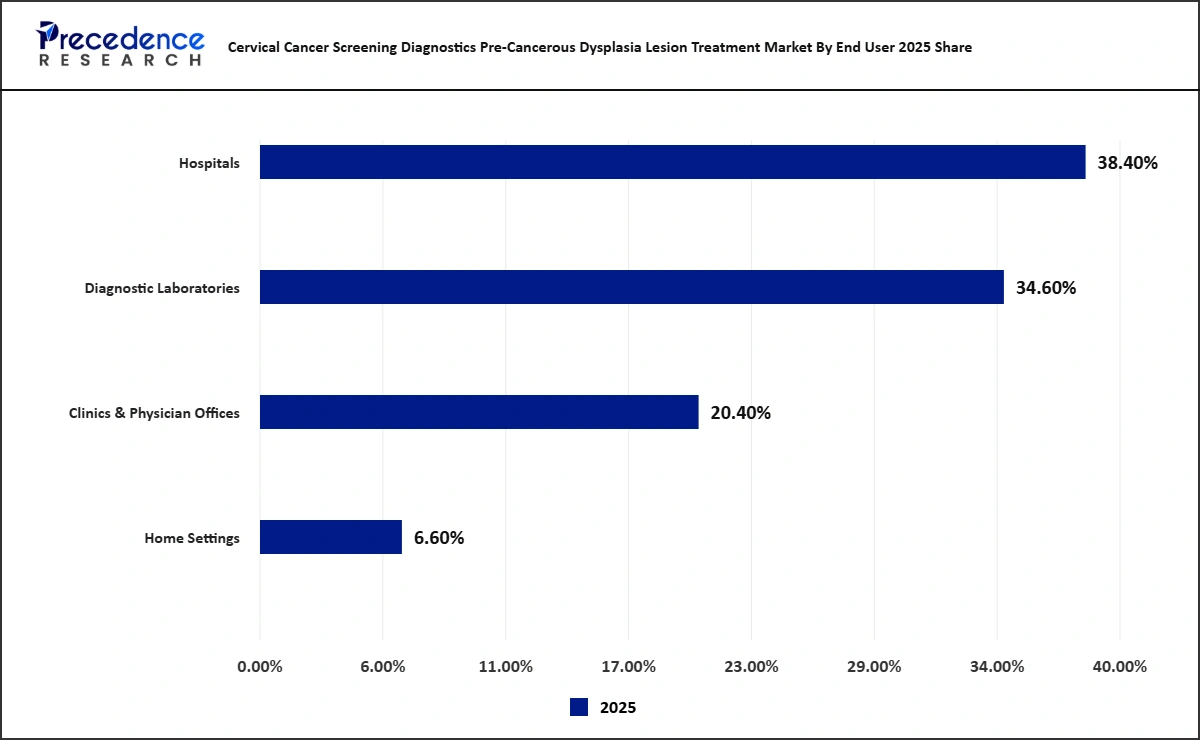
Cervical Cancer Screening Diagnostics Pre-Cancerous Dysplasia Lesion Treatment Market by End User 2025 Share & Size
Sources: Expert interviews, secondary sources, Precedence Research database and Precedence Research analysts.
Hospitals accounted for 38.40% (USD 3.59 billion) in 2025, covering colposcopy clinics, gynecology departments, and in-house laboratories. Diagnostic laboratories, at 34.60% (USD 3.24 billion), run most HPV and cytology tests; clinics and physician offices account for 20.40% (USD 1.91 billion) and perform sample collection and some lesion treatment; and home settings, at 6.60% (USD 0.62 billion), are the fastest-growing end user following approval of at-home self-collection kits.
- Analyst View: Segment values were allocated by matching screened women, positive result rates and follow-up procedures to screening, diagnostic, and treatment categories, using average test and procedure prices. Screening leads because of very large test volumes, and HPV testing leads within technologies as programs switch from cytology. We expect HPV testing, home self-collection, and lesion treatment in screen-and-treat programs to gain share.
Regional Analysis
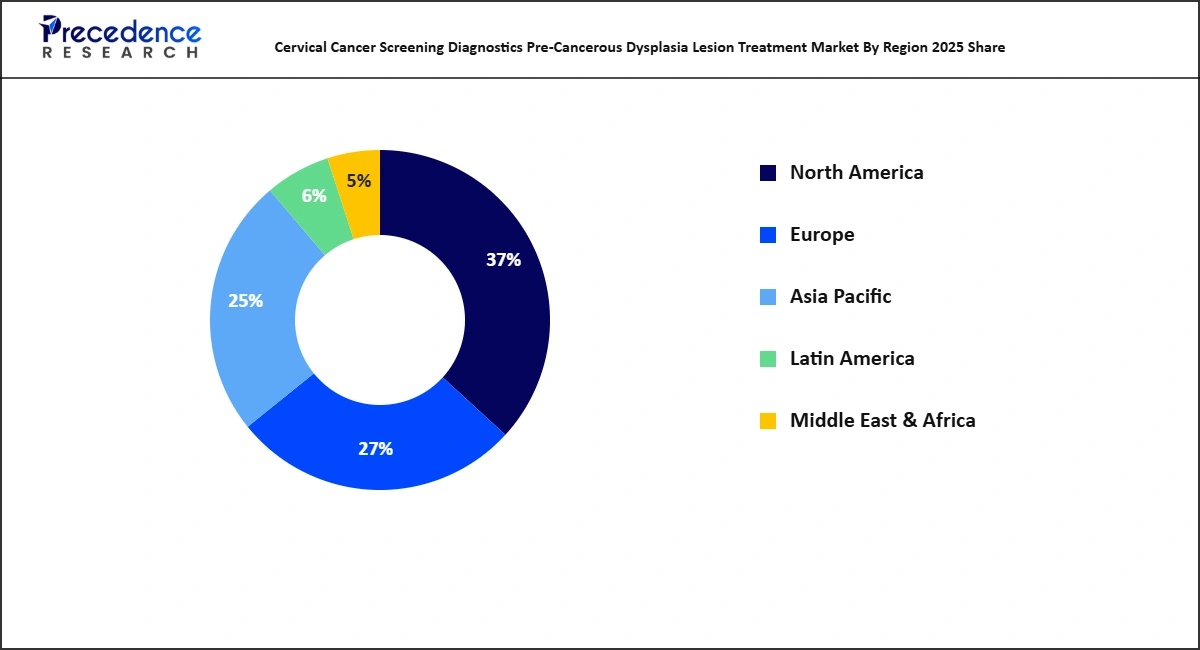
Cervical Cancer Screening Diagnostics Pre-Cancerous Dysplasia Lesion Treatment Market by Region 2025 Share & Size
Sources: Expert interviews, secondary sources, Precedence Research database and Precedence Research analysts.
North America accounted for 36.80% (USD 3.44 billion) in 2025, growing on established screening, high HPV test prices, and the 2024 to 2026 approvals and guidelines that added clinic and at-home self-collection. The new guidelines for private plans in the United States stipulate that there should be no copayments in 2027. Europe, at 27.40% (USD 2.56 billion), is supported by organized national programs, many of which have switched to primary HPV screening and offer self-sampling in the Netherlands, Sweden, the UK, and other countries. Asia Pacific, at 24.60% (USD 2.30 billion), is the fastest-growing region, supported by large screening programs in China and India, HPV testing expansion in Australia and Japan, and WHO elimination targets. Latin America, at 6.20% (USD 0.58 billion), and the Middle East and Africa, at 5.00% (USD 0.47 billion), have high cervical cancer burdens, and screen-and-treat programs with HPV testing and thermal ablation are expanding with international support.
North America accounted for 36.80% (USD 3.44 billion) in 2025. Primary HPV screening and self-collection are expanding. New guidelines for the United States include self-sampling and follow-up treatment. At-home kits add a new channel.
Europe accounted for 27.40% (USD 2.56 billion) in 2025. Many national programs use primary HPV screening. Self-sampling reaches women who do not attend clinics. Nordic countries and the Netherlands lead adoption.
Asia Pacific accounted for 24.60% (USD 2.30 billion) in 2025 and is the fastest-growing region. China and India run large screening programs. Australia leads in HPV-based screening and self-collection. Funding in the region is increased due to WHO elimination targets.
Latin America accounted for 6.20% (USD 0.58 billion) in 2025. High disease burden potentiates the demand for advanced diagnostics. HPV testing is replacing Pap tests in several countries.
The Middle East and Africa accounted for 5.00% (USD 0.47 billion) in 2025. Sub-Saharan Africa has the highest cervical cancer rates. Screen-and-treat programs with thermal ablation are expanding.
- Analyst View: Regional shares were built from screened women, follow-up procedures, and prices in each region. North America leads because of high test prices and broad coverage. We assign Asia Pacific the highest growth premium because large national programs are expanding HPV testing from a large unscreened population.
Top 10 Companies in the Cervical Cancer Screening Diagnostics Pre-Cancerous Dysplasia Lesion Treatment Market
| Rank | Company Name | Market-Specific Revenue (USD Billion) | 2025 Share | Key Products/Business | Headquarters |
| 1 | Roche Diagnostics | 1.32 | 14.10% | cobas HPV test, CINtec PLUS cytology and self-collection | Switzerland |
| 2 | Hologic | 1.18 | 12.61% | ThinPrep cytology and Aptima HPV assays | United States |
| 3 | BD | 0.62 | 6.62% | Onclarity HPV assay and SurePath cytology | United States |
| 4 | CooperSurgical | 0.30 | 3.21% | LEEP, colposcopy and cryotherapy devices | United States |
| 5 | QIAGEN | 0.24 | 2.56% | HPV testing products | Netherlands |
| 6 | Abbott | 0.22 | 2.35% | Alinity m HR HPV assay | United States |
| 7 | Seegene | 0.10 | 1.07% | HPV genotyping assays | South Korea |
| 8 | Carl Zeiss Meditec | 0.06 | 0.64% | Colposcopes | Germany |
| 9 | Utah Medical Products | 0.04 | 0.43% | LEEP electrosurgical systems | United States |
| 10 | MedGyn Products | 0.04 | 0.43% | Colposcopes and LEEP systems | United States |
Note: Company revenues and shares are 2025 estimates.
Sources: Company press releases, expert interviews, secondary sources, Precedence Research database and Precedence Research analysts.
Roche Diagnostics led the cervical cancer screening, diagnostics and pre-cancerous dysplasia lesion treatment market with an estimated 14.10% (USD 1.32 billion) of 2025 revenue, followed by Hologic at 12.61% (USD 1.18 billion) and BD at 6.62% (USD 0.62 billion). Roche leads with its cobas HPV test, which is approved for clinician and self-collected samples and is used by at-home collection services, along with CINtec PLUS triage cytology. Hologic holds a strong position through ThinPrep liquid-based cytology and Aptima HPV assays used by many laboratories. BD supplies the Onclarity HPV assay with extended genotyping and SurePath cytology, while QIAGEN, Abbott and Seegene offer additional HPV tests. CooperSurgical, Zeiss, Utah Medical and MedGyn lead in colposcopy and lesion treatment devices, and newer companies such as Teal Health are building at-home collection services.
The top 10 companies accounted for an estimated 44.02% (USD 4.12 billion) of 2025 revenue, while the remaining 55.98% (USD 5.24 billion) was shared among regional HPV test makers, colposcope and ablation device suppliers, cytology laboratories and self-collection start-ups. The cervical cancer screening, diagnostics and pre-cancerous dysplasia lesion treatment market is moderately concentrated in testing and fragmented in devices, and competition centers on HPV test performance and genotyping, self-collection approvals, laboratory automation and low-cost treatment devices. Low-cost HPV tests and portable thermal ablation devices are important for donor-funded programmes in low- and middle-income countries.
Recent Developments
- May 2025: The FDA approved Teal Health's Teal Wand, the first at-home self-collection device for cervical cancer screening, with samples tested using Roche's cobas HPV test.
- January 2026: HRSA updated U.S. women's preventive services guidelines to make HPV testing the preferred screening method and add self-collection, with coverage of screening and follow-up without cost-sharing from 2027.
Market Segments
By Type
- Screening
- Diagnosis
- Pre-cancerous Lesion Treatment
By Technology
- HPV Testing
- Cytology (Pap & Liquid-Based)
- Colposcopy & Biopsy
- LEEP
- Ablation (Cryotherapy & Thermal)
By End User
- Hospitals
- Diagnostic Laboratories
- Clinics & Physician Offices
- Home Settings
By Region
- North America (U.S., Canada, Mexico)
- Europe (Germany, U.K., France, Italy, Spain, Rest of Europe)
- Asia Pacific (China, Japan, India, South Korea, Taiwan, Rest of Asia Pacific)
- Latin America (Brazil, Argentina, Rest of Latin America)
- Middle East & Africa (GCC, South Africa, Rest of MEA)
Research Methodology
The cervical cancer screening, diagnostics and pre-cancerous dysplasia lesion treatment market refers to HPV tests, cytology, collection devices and self-collection kits, colposcopes and biopsy devices, and LEEP, cryotherapy, and thermal ablation treatments for pre-cancerous cervical lesions worldwide. The 2025 base year was built bottom-up from screened women by method, positive result and referral rates, follow-up procedure volumes and prices, and checked top-down against the women's health and HPV testing revenue of leading diagnostics and device companies. Segment, regional and company values were allocated from types, technologies, end users and regional screening programs. Key estimates were verified by cross-checking company disclosures, regulatory and industry data and published third-party estimates, and inputs that could not be reconciled were excluded. All segment, regional and company figures were reconciled to the same 2025 base year, and the 2026-2035 forecast, which applies a constant CAGR from the 2025 base, was recalculated and validated.
Analyst View Overall Market
The cervical cancer screening, diagnostics and pre-cancerous dysplasia lesion treatment market is shifting from cytology to HPV testing and from clinic collection to self-collection, which expands reach and adds value per test. The projection is tied to demand for screened females, positive tests, and follow-ups, thus being driven by program implementation and new guidelines. The biggest benefits come from self-sampling and screen-and-treat programs, while the drawbacks include extended intervals of screening and consequences of vaccination.
Sources and References
- ASCO Post. "FDA approves at-home self-collection device for cervical cancer screening". 2025-05-12. Teal Wand approval. https://ascopost.com/news/may-2025/fda-approves-at-home-self-collection-device-for-cervical-cancer-screening/
- Boston Globe. "FDA approves self-collection for screening virus that causes cervical cancer". 2024-05-15. BD Onclarity and Roche cobas self-collection. https://www.bostonglobe.com/2024/05/15/nation/fda-approves-self-collection-screening-virus-that-causes-cervical-cancer
- ASCP. "HHS updates cervical cancer screening guidelines". 2026-01-13. HRSA guideline update. https://www.ascp.org/news/news-details/2026/01/13/hhs-updates-cervical-cancer-screening-guidelines
For inquiries regarding discounts, bulk purchases, or customization requests, please contact us at sales@precedenceresearch.com
Frequently Asked Questions





Ask For Sample
No cookie-cutter, only authentic analysis – take the 1st step to become a Precedence Research client
 Get a Sample




 sales@precedenceresearch.com
 Schedule a Meeting