


Clostridium Diagnostics Market Size, Key Companies, Company Market Share, Patient Volume, Treatment Adoption Rates, Pricing Analysis, Regulatory Landscape, Competitive Positioning, and Demand Forecast
Payal Rabde, a Healthcare Industry Expert, highlights that the clostridium diagnostics market has reached USD 4.38 billion in 2026 and is on track to reach USD 8.60 billion by 2035, advancing at a CAGR of 7.80%. Key clostridium diagnostics market companies shaping the market include Cepheid, BD, bioMérieux, Abbott Agilent Technologies while major growth segments span species, technology, product type, end user, region.
Source: https://www.precedenceresearch.com/clostridium-diagnostics-market
 Get a Sample
 Table Of Content


Clostridium Diagnostics Market Trends, Growth, and Market Size Analysis 2035
The clostridium diagnostics market is forecasted to expand from USD 4.38 billion in 2026 to USD 8.60 billion by 2035, growing at a CAGR of 7.80% from 2026 to 2035.
Key Takeaways
Market Size & Growth Outlook
- Market size in 2025: USD 4.06 billion
- Estimated market size in 2026: USD 4.38 billion
- Projected market size by 2035: USD 8.60 billion
- CAGR (2026–2035): 7.80%
Regional Market Spotlight
- North America led the market with a 38.42% (USD 1.56 billion) share in 2025.
- Europe accounted for 27.60% (USD 1.12 billion) of the market in 2025.
- Asia Pacific accounted for 22.40% (USD 0.91 billion) of the market in 2025 and is projected to be the fastest-growing region, at a CAGR of 8.86% from 2025 to 2035.
Segmental Spotlight
- By species, C. difficile accounted for 57.48% (USD 2.33 billion) in 2025.
- By technology, Immunoassays accounted for 42.37% (USD 1.72 billion) in 2025.
- By product type, Reagents & Kits accounted for 52.40% (USD 2.13 billion) in 2025.
- By end user, Hospitals accounted for 58.27% (USD 2.37 billion) in 2025.
Clostridium Diagnostics Market Size and Forecast, 2025-2035 (USD Billion)
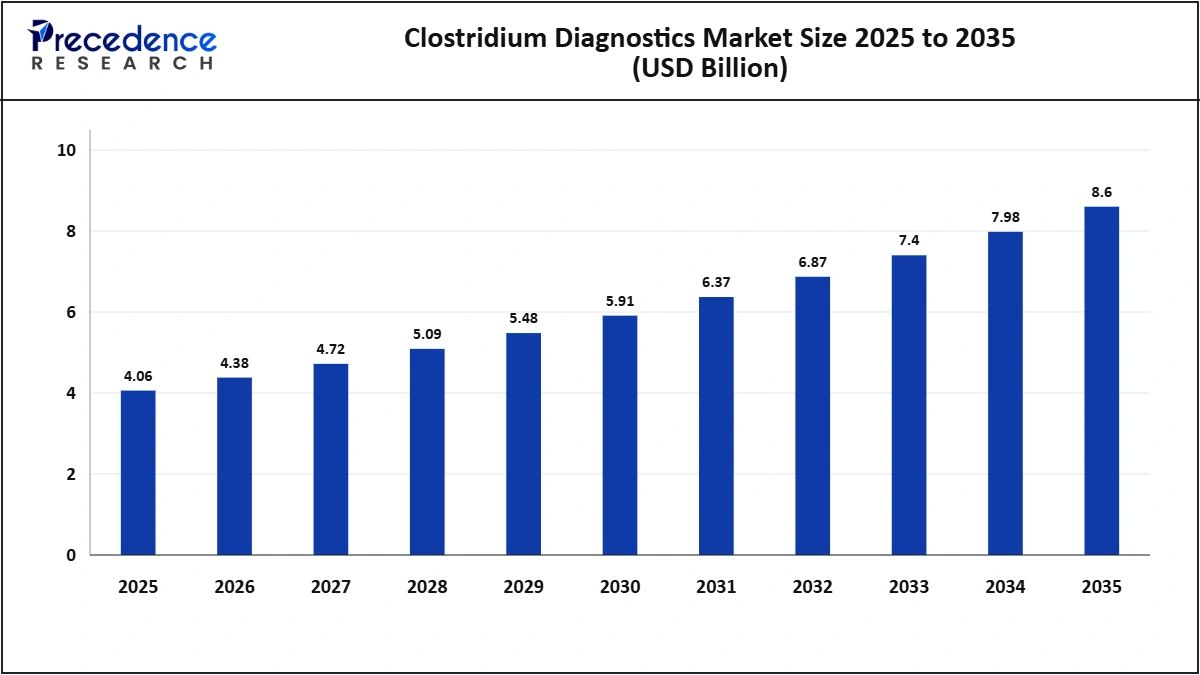
Note: 2025 is the base year; 2026–2035 values are forecasts.
Sources: Expert interviews, secondary sources, Precedence Research database and Precedence Research analysts.
The clostridium diagnostics market is projected to grow from USD 4.06 billion in 2025 to USD 8.60 billion by 2035 because hospitals test patients with diarrhea for C. difficile using combined immunoassay and molecular algorithms, and food and public health laboratories test for other clostridial toxins. New therapies for recurrent C. difficile and infection reporting rules keep testing volumes high, lifting the market to USD 5.91 billion by 2030 and sustaining a CAGR of 7.80% from 2026 to 2035.
- Analyst View: We built the estimate from clostridial test volumes by species, setting and region, based on hospital admissions, diarrhea testing rates, outbreak and food safety testing, multiplied by average prices for immunoassay, molecular, rapid, and culture tests, plus instrument and software sales. Volumes reflect national infection rates, testing algorithms that use two tests per sample, and surveillance programs. The total revenue was cross-checked against the infectious disease testing revenue of leading diagnostics companies and against published estimates, which places our base year slightly above the comparable figures. The growth rate reflects steady hospital testing and wider molecular adoption, moderated by stewardship efforts to avoid unnecessary testing.
Market Trends
- Multistep testing algorithms combine screening assays, toxin detection and/or molecular testing, depending on the laboratory protocol.
- Rapid PCR assays can detect C. difficile toxin genes and, where specifically validated, markers associated with epidemic ribotypes such as 027.
- Multiplex gastrointestinal panels include C. difficile targets.
- Diagnostic stewardship limits testing to patients with clinically appropriate symptoms.
- Microbiome-based therapies for recurrent C. difficile infection are increasing clinical attention to recurrence prevention and appropriate diagnosis.
- Food safety testing for clostridial toxins is expanding.
Drivers, Restraints and Opportunities
Driver
C. difficile remains a leading cause of healthcare-associated infection, and hospitals must test patients quickly to isolate and treat them. Guidelines recommend multi-step testing, which often uses two tests per sample. Molecular tests give fast, sensitive results and can identify hypervirulent strains. New microbiome therapies for recurrent infection make accurate diagnosis more important. Food safety and public health programs test for C. perfringens and C. botulinum.
Restraint
Molecular tests can detect colonization rather than active disease, which can lead to overdiagnosis and stewardship limits on testing. Infection control improvements have reduced hospital-onset rates in some countries. Price pressure from hospital procurement lowers test revenue. Access to molecular testing is limited in low-income regions. Testing algorithms vary between hospitals, complicating product adoption.
Opportunity
Ultrasensitive toxin assays can distinguish active infection from colonization. Multiplex panels can test several gastrointestinal pathogens at once. Point-of-care molecular tests can speed up decisions in smaller hospitals. Expanding hospital networks in Asia and Latin America offer new demand. Surveillance software and strain typing can support outbreak control.
Market Segmentation: 2025 Share and Value
Clostridium Diagnostics Market By Species 2025 Share & Size
| Segments | 2025 Share | 2025 Market Value |
| C. difficile | 57.48% | USD 2.33 billion |
| C. perfringens | 18.60% | USD 0.76 billion |
| C. botulinum | 10.40% | USD 0.42 billion |
| C. tetani | 7.20% | USD 0.29 billion |
| Others | 6.32% | USD 0.26 billion |
Note: 2025 is the base year.
Sources: Expert interviews, secondary sources, Precedence Research database and Precedence Research analysts.
C. difficile diagnostics accounted for 57.48% (USD 2.33 billion) in 2025 because C. difficile causes many hospital-acquired infections, and guidelines recommend testing patients with unexplained diarrhea using sensitive GDH or PCR tests followed by toxin tests. Recurrent symptoms may prompt clinical reassessment and testing when indicated; routine repeat testing during the same diarrheal episode and testing to confirm cure are generally not recommended. C. perfringens, at 18.60% (USD 0.76 billion), is tested in food poisoning outbreaks, food safety programs, and veterinary settings, while C. botulinum, at 10.40% (USD 0.42 billion), is the fastest-growing species segment, supported by food safety and public health preparedness. C. tetani accounts for 7.20% (USD 0.29 billion), and other species, including C. sordellii and C. septicum, account for 6.32% (USD 0.26 billion).
Clostridium Diagnostics Market By Technology 2025 Share & Size
| Segments | 2025 Share | 2025 Market Value |
| Immunoassays | 42.37% | USD 1.72 billion |
| Molecular Diagnostics | 38.60% | USD 1.57 billion |
| Rapid Tests | 11.40% | USD 0.46 billion |
| Others | 7.63% | USD 0.31 billion |
Note: 2025 is the base year.
Sources: Expert interviews, secondary sources, Precedence Research database and Precedence Research analysts.
Immunoassays accounted for 42.37% (USD 1.72 billion) in 2025 because GDH antigen and toxin A/B enzyme immunoassays are widely used as first and confirmatory steps in testing algorithms and are low-cost. Molecular diagnostics, at 38.60% (USD 1.57 billion), are the fastest-growing technology because PCR detects toxin genes quickly with high sensitivity, and some assays also identify hypervirulent strains such as ribotype 027. Rapid lateral flow tests account for 11.40% (USD 0.46 billion), and other methods, including culture and cell cytotoxicity assays, account for 7.63% (USD 0.31 billion), mainly in reference and research laboratories.
Clostridium Diagnostics Market By Product Type 2025 Share & Size
| Segments | 2025 Share | 2025 Market Value |
| Reagents & Kits | 52.40% | USD 2.13 billion |
| Instruments | 32.46% | USD 1.32 billion |
| Software & Services | 15.14% | USD 0.61 billion |
Note: 2025 is the base year.
Sources: Expert interviews, secondary sources, Precedence Research database and Precedence Research analysts.
Reagents and kits accounted for 52.4% (USD 2.13 billion) in 2025 because each test uses assay cartridges, reagents, or kits. Instruments, at 32.46% (USD 1.32 billion), include molecular systems and immunoassay analyzers placed in hospital laboratories, and software and services account for 15.14% (USD 0.61 billion), including connectivity and infection surveillance tools.
Clostridium Diagnostics Market By End User 2025 Share & Size
| Segments | 2025 Share | 2025 Market Value |
| Hospitals | 58.27% | USD 2.37 billion |
| Diagnostic Laboratories | 26.40% | USD 1.07 billion |
| Research Institutes | 8.60% | USD 0.35 billion |
| Others | 6.73% | USD 0.27 billion |
Note: 2025 is the base year.
Sources: Expert interviews, secondary sources, Precedence Research database and Precedence Research analysts.
Hospitals accounted for 58.27% (USD 2.37 billion) in 2025 because most C. difficile testing is performed in hospital laboratories to support rapid isolation and treatment. Diagnostic laboratories account for 26.40% (USD 1.07 billion), research institutes for 8.60% (USD 0.35 billion), and other users, including food safety and public health laboratories, account for 6.73% (USD 0.27 billion).
- Analyst View: Segment values were allocated by matching test volumes based on species and setting to technologies and product types, using average prices. C. difficile and immunoassays lead because hospital algorithms rely on low-cost antigen and toxin tests for large volumes. We expect molecular diagnostics and food safety testing for other species to gain share.
Regional Analysis
Clostridium Diagnostics Market By Region 2025 Share & Size
| Region | 2025 Share | 2025 Market Value |
| North America | 38.42% | USD 1.56 billion |
| Europe | 27.60% | USD 1.12 billion |
| Asia Pacific | 22.40% | USD 0.91 billion |
| Latin America | 6.20% | USD 0.25 billion |
| Middle East & Africa | 5.38% | USD 0.22 billion |
Note: 2025 is the base year.
Sources: Expert interviews, secondary sources, Precedence Research database and Precedence Research analysts.
North America accounted for 38.42% (USD 1.56 billion) in 2025, owing to high C. difficile infection rates, mandatory reporting of hospital-onset infections in the United States and widespread usage of molecular and two-step testing. Approval of microbiome-based treatments for recurrent infection adds attention to accurate diagnosis. Europe, at 27.60% (USD 1.12 billion), is supported by infection surveillance programs and guideline-based testing algorithms in the UK, Germany, France and Spain. Asia Pacific, at 22.40% (USD 0.91 billion), is the fastest-growing region, supported by expanding hospital capacity, rising awareness of healthcare-associated infections and food safety testing in China, Japan, India and South Korea. Latin America, at 6.20% (USD 0.25 billion), and the Middle East and Africa, at 5.38% (USD 0.22 billion), are smaller markets where hospital laboratories are adopting rapid and molecular tests.
North America accounted for 38.42% (USD 1.56 billion) in 2025. High infection rates and reporting rules drive testing. Molecular and two-step algorithms are widely used for diagnostics. Recurrent infection therapies keep the focus on diagnosis.
Europe accounted for 27.60% (USD 1.12 billion) in 2025. Surveillance programs and testing guidelines support demand. Hypervirulent strains are monitored across countries. Hospital laboratories use combined algorithms.
Asia Pacific accounted for 22.40% (USD 0.91 billion) in 2025 and is the fastest-growing region. Hospital expansion and infection control programs increase testing. Food safety testing for clostridial toxins is growing across the continent. Japan and China are leading adopters.
Latin America accounted for 6.2% (USD 0.25 billion) in 2025. Hospital laboratories in Brazil and Mexico are adopting rapid tests as awareness of C. difficile is rising.
The Middle East and Africa accounted for 5.38% (USD 0.22 billion) in 2025. Gulf hospitals invest in molecular testing. Testing access is limited in many African countries.
- Analyst View: Regional shares were built from test volumes, infection rates, and test prices in each region. North America leads because of high infection rates and molecular testing use. Asia Pacific has the highest growth premium because hospital capacity and infection control programs are expanding fastest there.
Top 10 Companies in the Clostridium Diagnostics Market
| Rank | Company Name | Market-Specific Revenue (USD Billion) | 2025 Share | Key Products / Business | Headquarters |
| 1 | Cepheid | 0.42 | 10.34% | Xpert C. difficile and C. difficile/Epi PCR tests | United States |
| 2 | BD | 0.30 | 7.39% | BD MAX Cdiff molecular assays | United States |
| 3 | bioMérieux | 0.28 | 6.90% | VIDAS C. difficile and BIOFIRE GI panels | France |
| 4 | Abbott | 0.26 | 6.40% | C. difficile rapid and immunoassay tests | United States |
| 5 | Roche Diagnostics | 0.24 | 5.91% | cobas Cdiff molecular test | Switzerland |
| 6 | Thermo Fisher Scientific | 0.18 | 4.43% | Microbiology culture media and assays | United States |
| 7 | Meridian Bioscience | 0.14 | 3.45% | ImmunoCard and molecular C. difficile tests | United States |
| 8 | QuidelOrtho | 0.12 | 2.96% | C. difficile immunoassays and molecular tests | United States |
| 9 | TECHLAB | 0.08 | 1.97% | C. DIFF QUIK CHEK COMPLETE GDH and toxin test | United States |
| 10 | Seegene | 0.08 | 1.97% | Multiplex gastrointestinal PCR panels | South Korea |
Note: Company revenues and shares are 2025 estimates.
Sources: Company press releases, expert interviews, secondary sources, Precedence Research database and Precedence Research analysts.
Cepheid led the clostridium diagnostics market with an estimated 10.34% (USD 0.42 billion) of 2025 revenue, followed by BD at 7.39% (USD 0.30 billion) and bioMérieux at 6.90% (USD 0.28 billion). Cepheid offers Xpert C. difficile molecular assays on its GeneXpert platform. The FDA determined the Xpert C. difficile/Epi assay to be substantially equivalent to a legally marketed predicate device on February 28, 2025. BD holds a strong position with BD MAX molecular assays in hospital laboratories, and bioMérieux combines VIDAS immunoassays with BIOFIRE gastrointestinal panels. Abbott, TECHLAB, Meridian and QuidelOrtho supply GDH and toxin immunoassays used in two-step algorithms, while Roche, Thermo Fisher Scientific and Seegene provide molecular tests, culture media and multiplex panels.
The top 10 companies accounted for an estimated 51.72% (USD 2.10 billion) of 2025 revenue, while the remaining 48.28% (USD 1.96 billion) was shared among regional test makers, food safety testing companies, culture media suppliers and veterinary diagnostics firms. The clostridium diagnostics market is moderately concentrated, and competition focuses on sensitivity and specificity, time to result, ability to detect toxins and hypervirulent strains, automation and fit with recommended testing algorithms. Diagnostic stewardship programs that limit unnecessary testing are pushing suppliers to emphasize test accuracy and clinical value rather than volume.
Recent Developments
- November 2022: The FDA approved Rebyota, the first fecal microbiota product to prevent recurrence of C. difficile infection, increasing focus on accurate diagnosis of recurrent cases.
- April 2023: The FDA approved Vowst, the first oral fecal microbiome therapy to prevent recurrent C. difficile infection.
- February 2025: Cepheid received FDA 510(k) clearance for its Xpert C. difficile/Epi test, which detects C. difficile toxin genes in stool specimens from symptomatic patients.
Clostridium Diagnostics Market Segments
By Species
- C. difficile
- C. perfringens
- C. botulinum
- C. tetani
- Others
By Technology
- Immunoassays
- Molecular Diagnostics
- Rapid Tests
- Others
By Product Type
- Reagents & Kits
- Instruments
- Software & Services
By End User
- Hospitals
- Diagnostic Laboratories
- Research Institutes
- Others
By Region
- North America (U.S., Canada, Mexico)
- Europe (Germany, U.K., France, Italy, Spain, Rest of Europe)
- Asia Pacific (China, Japan, India, South Korea, Taiwan, Rest of Asia Pacific)
- Latin America (Brazil, Argentina, Rest of Latin America)
- Middle East & Africa (GCC, South Africa, Rest of MEA)
Research Methodology
The clostridial diagnostics market is defined in this study as the estimated revenue from diagnostic tests and associated products used to detect Clostridioides difficile and other specified clostridial pathogens. The market scope should explicitly identify whether clinical diagnostics, food safety testing, veterinary diagnostics, instruments, software, and services are included.
The 2025 base-year estimate is modeled using estimated testing volumes by pathogen, technology, end user and region, together with assumed average selling prices and applicable instruments, consumables and software revenue. The resulting estimates are allocated across the defined market segments and reconciled to the total market value.
The 2026–2035 forecast applies the stated growth assumptions to the selected base-year values. Company-level revenue and market-share estimates require separate allocation of assumptions and should be supported by company disclosures, product-level evidence or documented analyst estimates. Secondary research and expert interviews may inform the assumptions, but the final publication should distinguish observed data from modeled estimates and disclose material limitations.
All segment, regional and company tables should use a consistent 2025 base year and clearly identify forecast years. Growth rates should be recalculated from unrounded figures, with rounding conventions disclosed. Where the underlying evidence is insufficient to establish a ranking or growth claim, the claim should be presented as a forecast assumption rather than a verified market fact.
Analyst View Overall Market
The clostridium diagnostics market is led by C. difficile testing in hospitals, with steady growth from molecular adoption and food safety testing. Our estimate links demand to test volumes, testing algorithms and prices by species and setting, so the forecast follows infection rates, guideline practices and technology shifts. The main upside comes from molecular and ultrasensitive toxin tests and growth in Asia, while the main risks are stewardship limits on testing and price pressure.
For inquiries regarding discounts, bulk purchases, or customization requests, please contact us at sales@precedenceresearch.com
Frequently Asked Questions





Ask For Sample
No cookie-cutter, only authentic analysis – take the 1st step to become a Precedence Research client
 Get a Sample




 sales@precedenceresearch.com
 Schedule a Meeting