



Commercial Telematics Market Size, Key Companies, Company Market Share, Vehicle Production Volume, Sales Performance, Export & Import Analysis, Technology Adoption, Competitive Positioning, and Demand Trends
Commercial Telematics Market (By Type: Aftermarket, OEM; By Application: Solution, Services; By System Type: Embedded, Tethered, Smartphone Integrated; By End user: Government Agencies, Media and Entertainment, Insurers, Vehicle Manufacturers/Dealers, Transportation & Logistics, Others) - Global Industry Analysis, Size, Trends, Leading Companies, Regional Outlook, and Forecast 2026 to 2035
Source: https://www.precedenceresearch.com/commercial-telematics-market
 Get a Sample
 Table Of Content


What is the Commercial Telematics Market Size?
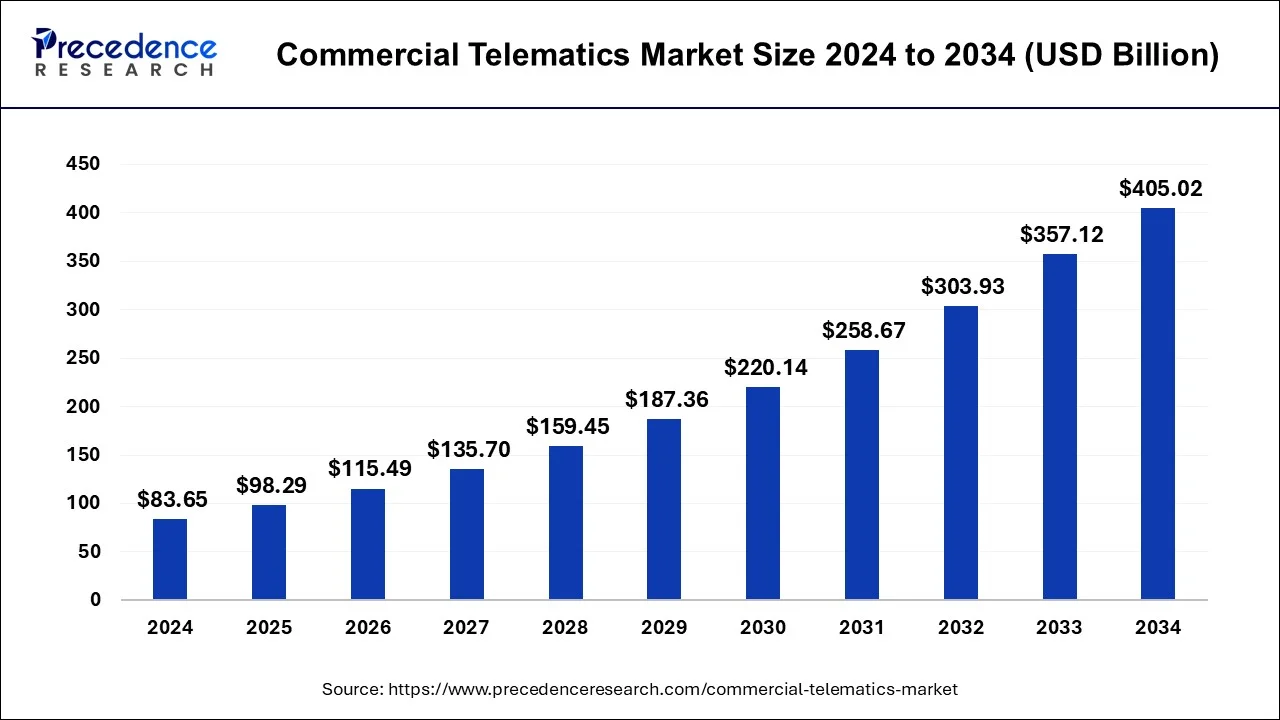
The global commercial telematics market size accounted for USD 115.49 billion in 2026 and is expected to exceed around USD 456.45 billion by 2035, growing at a CAGR of 16.60% from 2026 to 2035. Telematics technology is of key importance to commercial fleets due to its major role in improving fleet safety, reducing costs, and optimizing driver performance.
Commercial Telematics Market Key Takeaways
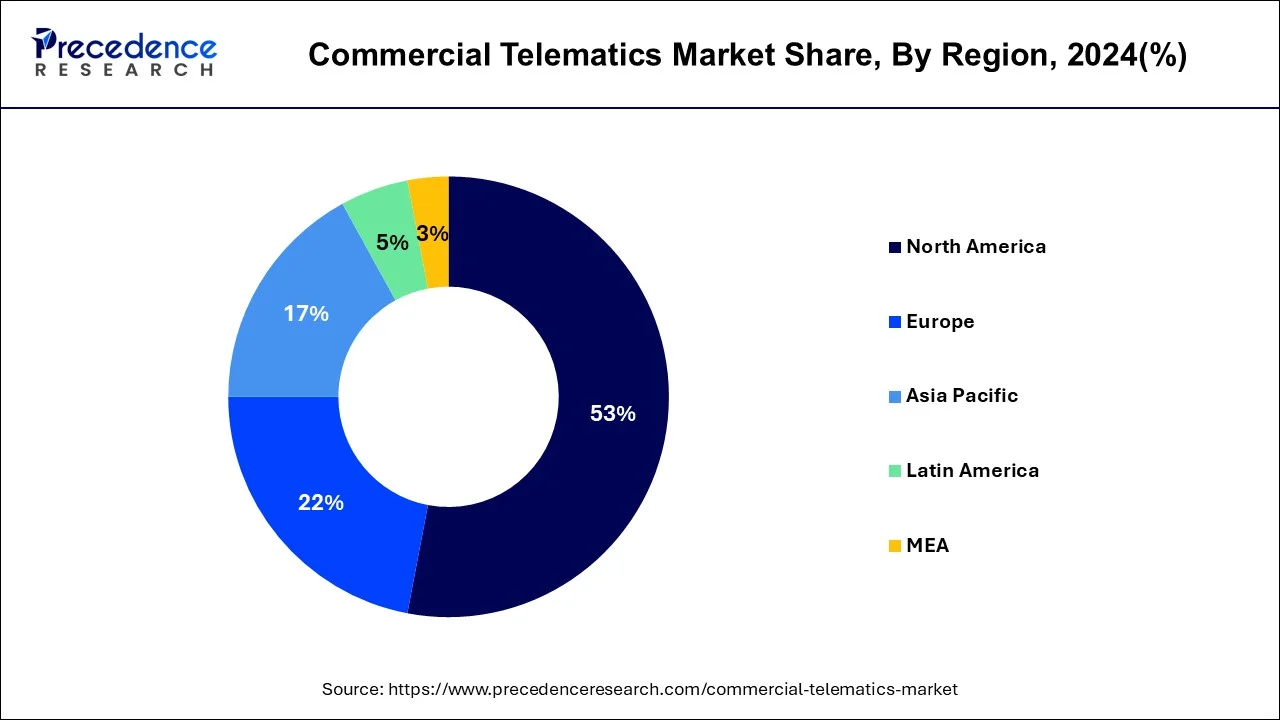
- North America represented the highest market share 52.14% in 2025.
- Asia Pacific is supposed to create at the speediest rate with a CAGR of 26.5% from 2026 to 2035.
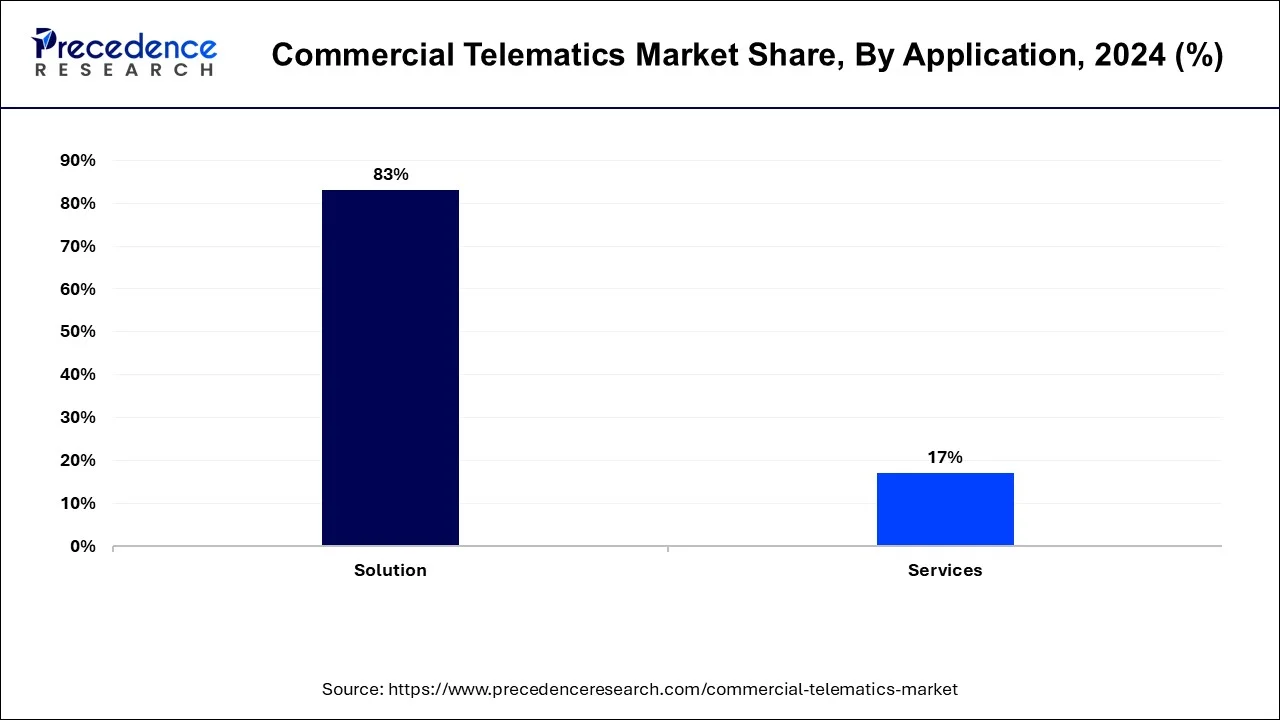
- By application, the solution segment accounted market share of around 83% in 2025.
- By end user, the transportation and operations segment accounted for 32% market share in 2025.
- The OEM segment is expected to grow at a CAGR of 15.2% over the forecast timeframe from 2026 to 2035.
- The services segment is expected to reach a CAGR of 15.3% from 2026 to 2035.
Market Overview
The ever-evolving expansion in CAGR is because of rising business sector interest and post-pandemic development. Commercial telematics permits business vehicles or transportation fragments to send ongoing functional information to focal workplaces or dispatch workplaces. A fixed armada correspondence framework and a mobile business vehicle are in many cases utilized in the framework.
These business trucks are furnished with telematics sensors and devices that trade continuous functional information with dispatch workplaces to guarantee proficient and safe freight conveyance. Reception of commercial telematics is rapidly expanding among armada proprietors, OEMs, and guarantors to gather constant data from the vehicle like area, speed, slowing down, motor temperature, fuel utilization, and others to improve armada effectiveness and driver execution. GPS trackers, sensors, versatile applications, motor analytic arrangements, dashcams, and other telematics gear are many times used in the area. These innovations connect to show how well the armada is performing. The expanded reception of telematics in arising economies all through the world is driving business sector extension at a remarkable rate.
Besides, government regulations administering armada the board and street wellbeing are projected to drive the commercial telematics industry before very long. The COVID-19 scourge is as yet affecting the auto area. Moreover, the inventory network has been interfered with by government-upheld rules and limitations. Market development has been hampered by store network disturbances and an extensive decrease in armada the board and transportation area interest. Notwithstanding, rising interest for utilization based protection during the pandemic has helped market development even with the COVID-19.
What is the Central Role of AI in the Commercial Telematics Market?
AI is reshaping the role of video telematics in fleet management. AI-driven systems are equipped with facial analysis, object recognition, and real-time behavior interpretation. AI-powered video telematics technologies assist owners in better understanding their organizations. AI helps in the identification of signs of fatigue, seatbelt use, eye movement, drowsiness, and distractions. Some systems offer real-time spoken feedback to assist in correcting risky behavior. AI platforms predict risky behaviors, including early warnings based on a combination of inputs.
Commercial Telematics Market Growth Factors
- Commercial telematics is altering the manner in which organizations and associations coordinate their armadas. Moreover, the absolute benefits of telematics gadgets are connected with their industry reception rate. Since cutting edge autos, like associated vehicles, are at present equipped with a few innovations and sensors that interface them to the web, cloud administrations, and their environmental elements, their reception in the transportation and armada business is projected to drive market development. Besides, their capacity to convey continuous data makes them ideal for telematics use.
- Developing mortality from business vehicle mishaps and transportation delays are pushing the reception of associated vehicles in the shipping business. As per the National Safety Council, there were 5,005 trucks engaged with lethal impacts in the United States in 2019, a 1.5% expansion from 2018. Subsequently, the public authority's accentuation on bringing down the rising number of passings brought about by truck mishaps is supposed to support market extension over the figure period.
- Moreover, rising gridlock and need for last-mile conveyance are probably going to drive interest for associated vehicles furnished with telemetry administrations. Consistently, around 1.35 million individuals are killed in street mishaps worldwide, as per the Association for the Safe International Road Travel. Subsequently, the requirement for safe street travel and traffic stream is supposed to drive market extension sooner rather than later.
Commercial Telematics Market Trends
- Evolution of Telematics Faster than Ever: The more connected and intelligent fleet operations are driving the future of telematics. Fleets help to manage more vehicles across expanded geographies. They are facing rising preferences for uptime, safety, and regulatory compliance.
- Wide Adoption of Telematics Solutions: The rising expectations of potential end-users are boosting the huge adoption of solutions like fleet fuel telematics that deliver predictive insights and visibility. On the other hand, vehicles are generating more data, and it is made easier to use by advances in connectivity and analytics. Modern telematics platforms are uniting driver, vehicle, and asset together.
- Advanced Connectivity: Stronger connectivity has expanded fleet visibility and transformed the way in which fleets measure and manage in real-time. Modern telematics devices support multiple communication paths. They also deliver more authentic data across diverse operating platforms, including time-sensitive operations, remote regions, and cross-border routes.
Commercial Telematics Market Outlook
- Industry Growth Overview: Commercial telematics is an increasingly growing market, with developments in fleet digitization; demand for real-time visibility of assets in transit; and a growing reliance on data to improve operational efficiency across logistics, construction, and transportation sectors.
- Sustainability Trends: Telematics adoption also supports sustainability - by optimizing a fleet's route, reducing fuel consumption, and lowering idle time, fleets can achieve their goals related to environmental stewardship (i.e., ESG) and comply with the stricter environmental regulations that are emerging around the world.
- Global Expansion: The continuing expansion of commercial telematics globally can be attributed to initiatives to build smart transportation systems, the rising prevalence of connected vehicles in the marketplace, and the need to have centralized fleet intelligence across different geographical regions as logistics networks expand globally.
Market Scope
| Report Coverage | Details |
| Growth Rate from 2026 to 2035 | CAGR of 16.60% |
| Market Size in 2026 | USD 115.49 Billion |
| Market Size by 2035 | USD 456.45 Billion |
| Base Year | 2025 |
| Forecast Period | 2026 to 2035 |
| Segments Covered | Type, Application, System Type, and End-User |
| Regions Covered | North America, Europe, Asia-Pacific, Latin America, and Middle East & Africa |
Segments Insights
Type Insights
Aftermarket selling telematics, as the name infers, is a telematics solution that is retrofitted by the vehicle proprietor fundamentally for vehicle following, fuel checking, driver observing, etc. Thus, it is done exclusively based on a certifiable need, as opposed to a capability that has been remembered for a vehicle. Secondary selling telematics acquired unmistakable quality in the mid 2000s when huge armada firms, for example, oil and mining partnerships, made vehicle following essential. Beforehand, it was simply used to safeguard traveler wellbeing and to uphold speed limitations on enormous grounds and in oil fields. Afterward, the item advanced and was tailor-made to meet the assorted requirements of specific clients and businesses. This made the way for the item to be considerably more broadly embraced by more modest Fleets. The development of industry has been fast to the point that the quantum of information gained from vehicles has advanced from essential areas and velocities to minute subtleties like motor determinations, eco-friendliness, and, surprisingly, the specific data about the merchandise being conveyed.
A unique hardware producer (OEM) makes frameworks or parts that are utilized in the eventual outcome of another firm. PC creators, for instance, much of the time pack or integrate OEM components into the arrangements they give, like CPUs and programming. OEMs might set aside cash and time. Outsider parts permit an organization to zero in on its essential business as opposed to fostering every optional thing or framework. A maker or affiliate can cut costs by helping out an OEM. Organizations are not expected to build fabricating offices or to oversee OEM creation in-house. They simply integrate OEM parts into their framework and sell them under their own image name. Due to economies of scale, OEM things can be more affordable. The OEM practices at making one item and one item just, and flourishes at building many thousands, on the off chance that not millions, of those things in a savvy, productive way.
End User Insights
What made Transportation & Logistics the Dominant Segment in the Commercial Telematics Market in 2025?
The transportation and logistics segment dominated the market in 2025, owing to the central role of telematics in on-road and logistics operations, enabling efficiency, visibility, and real-time connectivity across fleet management. Many businesses conduct reassessment of their telematics technology to ensure performance, continuity, and future readiness.
The insurers segment is estimated to grow at the fastest rate in the market during the predicted timeframe due to the key role of insurance telematics in improving customer satisfaction and driving more accurate and competitive pricing. The insurers are enabled to see people who are at risk, to look at scores, and see what factors impact them at risk.
Application Insights
The services segment is expected to grow at the fastest CAGR in the market during the forecast period due to the potential features of commercial telematics in the identification and correction of unsafe practices such as harsh braking and speeding. Telematics is of primary importance to fleet operators in reducing fuel consumption, optimizing route planning, improving driver performance, and enhancing vehicle maintenance.
System Type Insights
How did the Embedded Segment Dominate the Commercial Telematics Market in 2025?
The embedded segment dominated the market in 2025, owing to the wide importance of embedded systems in industrial automation and in speeding up production and controlling factory systems. Embedded systems have emerged as an essential component of several industries.
The smartphone integrated segment is anticipated to grow at the fastest rate in the market during the upcoming period due to the importance of smartphone telematics technology designed to collect driving data. Smartphone telematics technology works with the help of sensors like a GPS receiver, accelerometer, gyroscope, and magnetometer.
Regional Insights
What is the U.S. Commercial Telematics Market Size?
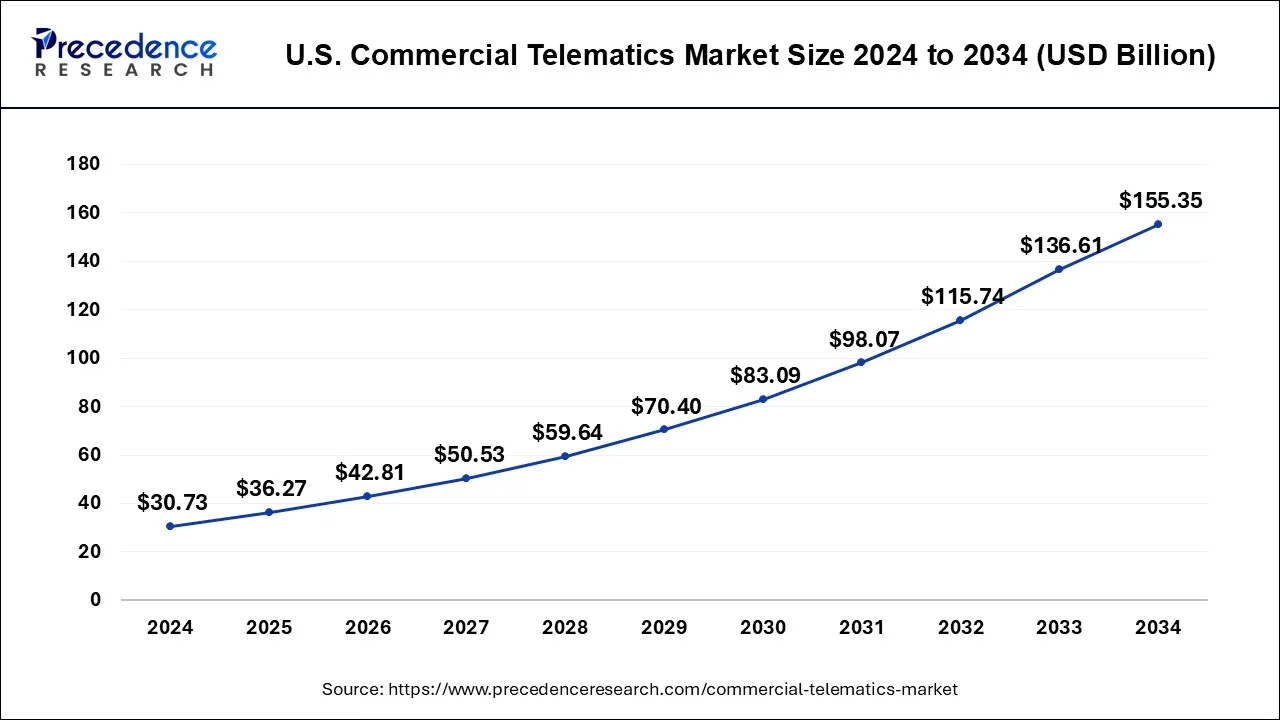
The U.S. commercial telematics market size was evaluated at USD 42.81 billion in 2026 and is projected to be worth around USD 175.51 billion by 2035, growing at a CAGR of 17.59% from 2026 to 2035.
In contrast with different regions, North America has the biggest market entrance. The North American market is as of now experienced. Moreover, the presence of deep rooted telematics arrangement suppliers in the business, like Verizon Connect, Omnitracs, and others, is a strong component for the market. Besides, the rising reception pace of associated business vehicles and electromobility animates market development.
How can the Commercial Telematics Market Contribute to the Growth of the U.S.?
The U.S. industry is advancing due to strict regulatory compliance mandates, the shift to agentic and predictive AI, and accelerated 5G infrastructure. The U.S. government initiatives aim to tighten oversight, modernize freight infrastructure, and boost vehicle-to-everything (V2X) integration.
Asia Pacific Commercial Telematics Market Trends
Asia Pacific region is expected to grow at a faster CAGR during the projection time frame. Developing telematics entrance in developing business sectors like Japan, India, South Korea and China is supposed to drive local market improvement. The accessibility of a hearty car and transportation industry, alongside expanded telematics use, is supposed to help market extension. Rising import-trade action drives need for compelling armada the board, driving in the market's fast extension. In 2020, Europe had the second-biggest piece of the pie. The significant presence of telematics in key countries, for example, the United Kingdom and Italy powers industry extension. Moreover, notable makers like as MAN, BMW Group, Daimler, and others add to advertise development. Expanding need for safe transportation, vehicle diagnostics, route, and viable armada the executives administrations is supposed to drive the market before long. Germany is anticipated to increment at a great rate all through the projection period.
How is the Expansive Reach of the Commercial Telematics Market in India?
India is advancing in the market through government regulations and safety mandates, booming e-commerce and next-gen logistics, and rapid commercial fleet electrification. The Indian industry is rapidly expanding due to smart infrastructure rollouts, digital enforcement frameworks, and strict federal regulations.
Europe: Regulation-Driven Telematics Adoption
Telematics adoption across the European market for commercial fleets is being driven by the introduction of stringent safety regulations as well as carbon reduction mandates. Furthermore, the increased use of digitalization within fleets has allowed logistics and public transportation to embrace telematics integration with Smart Mobility infrastructures. Germany ranks as the fastest-growing country within the European market, due to its strong logistics infrastructure and focus on compliance-based monitoring of fleet operations.
What is the Key Role of the Commercial Telematics Market in Germany?
Germany is growing and expanding in the market due to stringent government and EU mandates, sustainable fleet management and EV adoption, operational cost control, and AI integration. Government policies are encouraging fleet operators to transition from optional operational software to data-driven compliance ecosystems.
Latin America: Fleet Security and Cost Optimization Focus
In Latin America, there has been a national movement toward greater telematics adoption across all markets to minimize fuel theft, cargo theft, and improve operational efficiencies among large commercial fleets. Increasingly cost-effective solutions have continued to gain popularity among small and medium-sized enterprises (SMEs).
How can the Commercial Telematics Market Expand in Brazil?
Brazil is transitioning toward fuel cost optimization, operational efficiency, technological infrastructure, OEM partnerships, e-commerce, and last-mile delivery. The government frameworks are focusing on logistics optimization, decarbonization, and open-data digital governance. The federal government also boosts green mobility across the automotive supply chain.
Middle East & Africa: Smart Fleet Transformation Momentum
In the Middle East and Africa (MEA), the telematics market is growing steadily as a result of increased investment into infrastructure, smart city initiatives, and the growing need for visibility to fleet operations within the oil and gas and logistics industries. The adoption of cloud-based telematics continues to grow. The United Arab Emirates stands out as the fastest-growing country within MEA due to the implementation of advanced smart mobility programs as well as the rapid digitalization of commercial transportation.
What is the Major Footprint of Saudi Arabia in the Commercial Telematics Market?
Saudi Arabia is transforming due to Saudi Vision 2030 and giga-projects, SME fleet modernization, and AI and IoT tech integration. The government provides funding for smart cities and high-definition infrastructure. It also supports autonomous vehicle legal frameworks and the national HD mapping project.
Value Chain Analysis of the Commercial Telematics Market
- Telematics Hardware Manufacturing & Sensor Integration: This is the development and manufacturing of diagnostic instruments such as odometers, GPS navigation modules, vehicle sensors, cameras, and other connectivity devices that are installed in vehicles.
Key Players: Bosch, Continental, and CalAmp. - Software Platforms, Cloud Infrastructure & Data Analytics: This category is the transformation of raw data from vehicles into usable information through the use of fleet management dashboards, AI-based analytics, predictive maintenance tools, and driver behavior monitoring tools.
Key Players: Verizon Connect, Trimble, and Geotab. - System Integration, Deployment, and Post-Sale Support: Telematics solution integration partners provide solutions to diverse fleets' needs by offering installation, custom application development, configuration for compliance purposes, training, and continuing technical support.
Key Players: TomTom Telematics, Omnitracs, and Samsara.
Competitive Landscape
The commercial telematics market is dominated by top companies like Geotab, Samsara, Powerfleet, and Verizon Connect. The other dominant players and market specialists are Lytx, Trimble, ORBCOMM, Continental AG, and Robert Bosch. The industry is defined by the shift from simple GPS tracking to mixed-fleet EV management, AI-driven ecosystem integration, and unified video safety. The major product offerings are EV charge monitoring, sustainability overview, model context protocol connector, Geotab GO devices, video safety platform, AI in-cab coaching, connected operations cloud, etc. The strategic R&D focus areas are operational and agentic AI, advanced video telematics, and unified software ecosystems.
Top Companies in the Commercial Telematics Market and Their Offerings
- Zonar Systems, Inc.: Core telematics platforms like Zonar Ignition and Ground Traffic Control, hardware and in-cab devices, AI safety and compliance solutions, and specialized ecosystem add-ons.
- Trimble Inc.: Integration and communication hubs, next-generation transportation management systems, in-cab telematics, etc.
- Verizon Telematics, Inc.: Core fleet tracking and management software, safety, video intelligence, and hardware, etc.
- Omnitracs LLC: Unified fleet intelligence platforms, fleet tracking and IoT telematics, video safety and risk management, etc.
- Inseego Corporation: Hardware and telematics tracking devices, telematics SaaS platforms, and enterprise fixed and mobile routing.
Commercial Telematics Market Other Companies
- Zonar Systems, Inc.
- Trimble Inc.
- Verizon Telematics, Inc.
- Omnitracs LLC
- Inseego Corporation
Recent Developments
- In May 2026, Geotab announced that it has integrated Polestar vehicles into its OEM telematics network. It aims to give commercial fleets in Europe, North America, and Asia Pacific direct access to Polestar data through MyGeotab with no need for aftermarket hardware. (Source: https://theevreport.com)
- In May 2026, the National Truck Equipment Association (NTEA) and the Work Truck Association launched the commercial vehicle data exchange and reception during Work Truck Week in March. It will cover using analytics, data, and telematics for better decision-making. (Source: https://www.worktruckonline.com)
Segments covered in the report
By Type
- Aftermarket
- OEM
By Application
- Solution
- Fleet Tracking and Monitoring
- Driver Management
- Insurance Telematics
- Safety and Compliance
- V2X Solutions
- Others
- Services
- Professional services
- Managed services
By System Type
- Embedded
- Tethered
- Smartphone Integrated
By End user
- Government Agencies.
- Media and Entertainment
- Insurers
- Vehicle Manufacturers/Dealers
- Transportation & Logistics
- Others
By Geography
- North America
- U.S.
- Canada
- Europe
- U.K.
- Germany
- France
- Asia-Pacific
- China
- India
- Japan
- South Korea
- Malaysia
- Philippines
- Latin America
- Brazil
- Rest of Latin America
- Middle East & Africa (MEA)
- GCC
- North Africa
- South Africa
- Rest of the Middle East & Africa
For inquiries regarding discounts, bulk purchases, or customization requests, please contact us at sales@precedenceresearch.com
Frequently Asked Questions





Ask For Sample
No cookie-cutter, only authentic analysis – take the 1st step to become a Precedence Research client
 Get a Sample




 sales@precedenceresearch.com
 Schedule a Meeting
