



Curling Irons Market Size, Key Companies, Company Market Share, Sales Volume, Consumer Demand, Pricing Trends, Distribution Performance, Competitive Positioning, and Growth Forecast
The curling irons market is driven by rising need for at-home hairstyling, increasing beauty consciousness, and growing adoption of professional hair-styling tools among consumers. Key trends include ceramic, tourmaline, and titanium curling irons; adjustable temperature controls; automatic curling technology; and multi-functional styling devices. Growing need for heat-protective features, premium hair appliances, convenient styling solutions, and products suited to different hair types is creating opportunities for manufacturers to expand their product portfolios and strengthen their presence across online and offline retail channels through 2036.
Source: https://www.precedenceresearch.com/curling-irons-market
 Get a Sample
 Report Description


Curling Irons Market Size, Share, Trends, and Forecast Analysis 2036
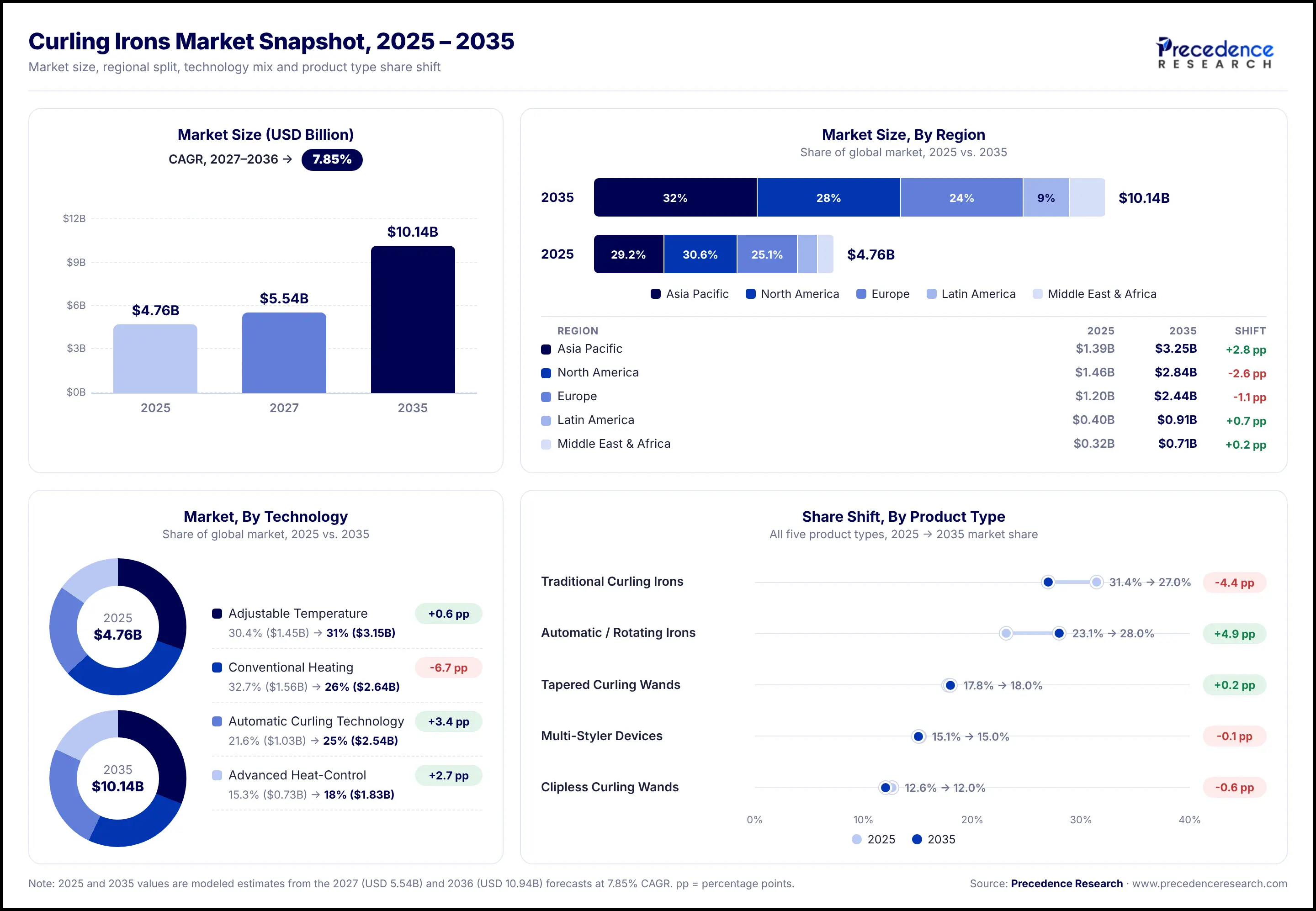
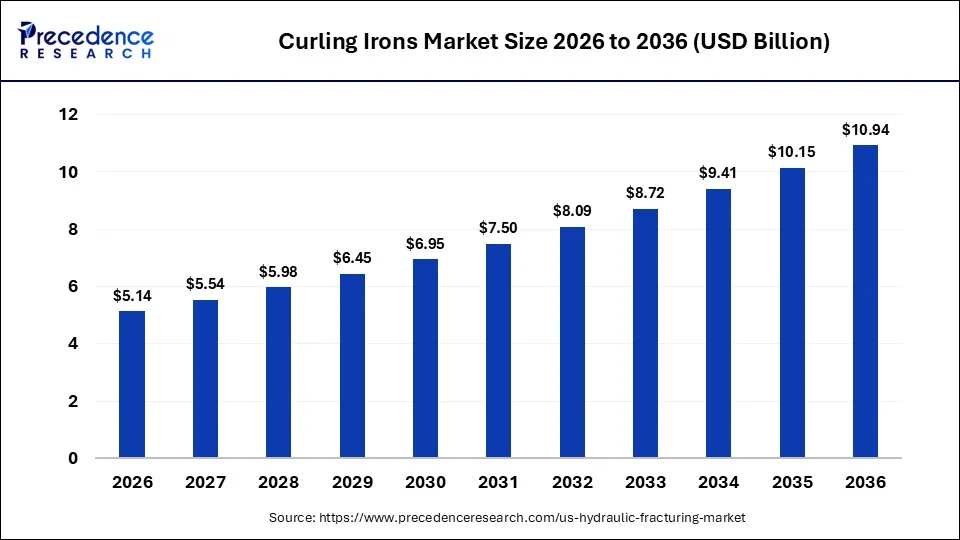
The global curling irons market is forecasted to expand from USD 5.54 billion in 2027 to USD 10.94 billion by 2036, growing at a CAGR of 7.85% from 2027 to 2036.
Key Takeaways
Market Size & Growth Outlook
- Market size in 2026: USD 5.14 billion
- Estimated market size in 2027: USD 5.54 billion
- Projected market size by 2036: USD 10.94 billion
- CAGR (2027–2036): 7.85%
Regional Market Spotlight
- North America share in 2026: 30.60%
- Asia-Pacific share in 2026: 29.20%
- Europe share in 2026: 25.10%
Segmental Spotlight
- Traditional curling irons share in 2026: 31.40%
- 1–1.25-inch barrel size segment share in 2026: 35.60%
- Ceramic barrel material segment share in 2026: 43.20%
Curling Irons Market Size 2026 to 2036
The curling irons industry is experiencing steady growth due to increasing demand for at-home hairstyling and advanced hair-styling appliances. Rising consumer preference for adjustable temperature settings, ceramic barrels, and convenient styling technologies is expected to support industry expansion throughout the forecast period.
At-Home Styling and Premium Heat Technology are Reshaping Curling Iron Demand
Curling irons are electric hair-styling appliances programmed to create curls, waves, and defined hairstyles through controlled heat. The market includes clamp-style curling tongs, clamp-free curling wands, automatic curling devices, and even selected cordless products specifically designed for curling. Demand comes from household consumers, professional salons, beauty studios, and hospitality businesses.
The global curling irons market is estimated at approximately USD 3.3–4.9 billion in 2026 across available market estimates. Forecasts vary considerably, with reported growth rates ranging from approximately 4.5% to 7.9% across different forecast periods. This spread reflects differences in product scope, market definitions, and forecasting assumptions rather than a single universally accepted market baseline. For commercial planning, the report distinguishes core curling appliances from broader multi-styling systems to avoid overstating the addressable market.
North America remains a leading regional market, supported by established beauty-appliance distribution, professional hairstyling culture, and consumer willingness to pay for differentiated features. Asia-Pacific offers an important expansion opportunity as urban consumers gain access to online beauty retail, affordable styling appliances, and internationally influenced hair trends. The competitive opportunity lies in serving several distinct needs: affordable everyday styling, professional performance, hair-type-specific products, travel convenience, and premium devices that offer greater control over heat exposure.
The market is also changing in how consumers evaluate products. Price and basic heating performance remain important, but adjustable temperature settings, ceramic or tourmaline coatings, barrel size, heat-up time, automatic shut-off, and ease of handling influence purchase decisions. Premium products compete on convenience and styling consistency, while entry-level products rely more heavily on affordability, availability, and broad consumer appeal.
Key Coverage
- Global market value, historical development, forecast scenarios, and regional growth.
- Product segmentation by curling tongs, curling wands, automatic curlers, and cordless devices.
- Revenue contribution by price tier, barrel material, barrel diameter, and end use.
- Consumer purchasing behaviour, online discovery, brand positioning, and replacement demand.
- Product-level pricing, retail economics, and premiumization opportunities.
- Competitive positioning, product portfolio comparisons, and company-level strategic analysis.
Premiumization Matters as Much as Unit Growth
The report establishes a consistent market boundary and applies the same definition across the historical period, base year, and forecast years. It separates revenue growth attributable to higher unit sales from growth generated by premium product mix, price increases, and the adoption of advanced styling features.
This distinction is important because the curling irons market is a replacement-oriented consumer appliance category. A household purchasing its first curling iron creates a different revenue opportunity from an existing customer upgrading to a faster-heating, adjustable-temperature, or automatic device. Similarly, a salon purchasing several professional tools differs economically from an individual purchasing a single entry-level product.
The forecast framework evaluates three scenarios. The base case assumes continued demand for personal grooming products and gradual adoption of improved styling technology. The upside case considers faster premium adoption, stronger online conversion, and successful launches of differentiated products. The downside case accounts for discretionary-spending pressure, longer replacement cycles, discounting, and competition from alternative styling appliances.
Key Coverage
- CAGR and absolute revenue growth under base, upside, and downside scenarios.
- Unit shipment and average selling price trends, where data is available.
- Regional and product-level contributions to market growth.
- Replacement demand versus first-time purchasing.
- Sensitivity to discounting, premiumization, and changing product mix.
Curling Irons Market Segments Analysis
Curling Irons Market by Product Type 2026 Share & Size
| Segments | 2026 Share | 2026 Market Value (USD Billion) |
| Traditional curling irons | 31.40% | 1.614 |
| Tapered curling wands | 17.80% | 0.915 |
| Clipless curling wands | 12.60% | 0.648 |
| Automatic/rotating curling irons | 23.10% | 1.187 |
| Multi-styler curling devices | 15.10% | 0.776 |
Traditional curling irons are estimated to lead the market due to their familiarity, versatility and broad price availability. Automatic curlers and multi-styler devices also attract consumers seeking convenient styling and multiple styling options.
Curling Irons Market by Barrel Size 2026 Share & Size
| Segments | 2026 Share | 2026 Market Value (USD Billion) |
| Below 1 inch | 24.70% | 1.27 |
| 1–1.25 inches | 35.60% | 1.83 |
| 1.25–1.5 inches | 25.20% | 1.295 |
| Above 1.5 inches | 14.50% | 0.745 |
The 1–1.25-inch barrel category is estimated to lead because it accommodates a broad range of curl styles and hair lengths. Smaller barrels are commonly suited to tighter curls, while larger barrels support loose waves and voluminous styles.
Curling Irons Market by Barrel Material 2026 Share & Size
| Segments | 2026 Share | 2026 Market Value (USD Billion) |
| Ceramic | 43.20% | 2.22 |
| Tourmaline | 22.40% | 1.151 |
| Titanium | 25.10% | 1.29 |
| Other coatings and materials | 9.30% | 0.478 |
Ceramic barrels are estimated to account for the largest share because of their widespread use and even heat distribution. Titanium remains important in professional styling tools, while tourmaline coatings appeal to consumers seeking smooth styling performance.
Curling Irons Market by Technology 2026 Share & Size
| Segments | 2026 Share | 2026 Market Value (USD Billion) |
| Conventional heating | 32.70% | 1.68 |
| Adjustable-temperature systems | 30.40% | 1.562 |
| Automatic curling technology | 21.60% | 1.11 |
| Advanced heat-control technology | 15.30% | 0.786 |
Conventional heating remains a major category due to the availability of established, affordable products. Adjustable-temperature systems and advanced heat-control features are gaining importance as consumers seek greater styling control and reduced exposure to excessive heat.
Curling Irons Market by Price Range 2026 Share & Size
| Segments | 2026 Share | 2026 Market Value (USD Billion) |
| Economy | 22.80% | 1.172 |
| Mid-range | 39.60% | 2.035 |
| Premium | 26.10% | 1.341 |
| Professional/high-end | 11.50% | 0.591 |
Mid-range products are estimated to lead by balancing affordability, performance and useful styling features. Premium and professional products serve consumers and hairstylists seeking advanced temperature controls, durable materials and specialized functionality.
Curling Irons Market by End User 2026 Share & Size
| Segments | 2026 Share | 2026 Market Value (USD Billion) |
| Individual consumers | 76.80% | 3.948 |
| Professional hairstylists and salons | 23.20% | 1.192 |
Individual consumers are estimated to dominate the market as at-home hairstyling remains a key purchasing use case. Professional hairstylists and salons contribute through demand for durable appliances, consistent performance and tools suited to frequent use.
Curling Irons Market by Distribution Channel 2026 Share & Size
| Segments | 2026 Share | 2026 Market Value (USD Billion) |
| Online retail | 29.40% | 1.511 |
| Brand-owned websites | 13.80% | 0.709 |
| Specialty beauty stores | 18.20% | 0.935 |
| Department stores | 12.10% | 0.622 |
| Supermarkets and hypermarkets | 10.40% | 0.535 |
| Professional beauty supply stores | 16.10% | 0.827 |
Online retail is estimated to lead distribution due to product variety, price comparison and convenient purchasing. Specialty beauty stores and professional supply stores remain important for product demonstrations, expert advice and salon-oriented tools.
Curling Irons Market by Application 2026 Share & Size
| Segments | 2026 Share | 2026 Market Value (USD Billion) |
| Everyday hairstyling | 43.60% | 2.241 |
| Special occasions and events | 25.30% | 1.3 |
| Professional salon styling | 21.40% | 1.1 |
| Travel and on-the-go styling | 9.70% | 0.499 |
Everyday hairstyling is estimated to represent the largest application, reflecting regular personal grooming and at-home styling routines. Special-event and professional salon styling also contribute substantially, while compact and portable products support travel-related use.
Curling Irons Market by Region 2026 Share & Size
| Segments | 2026 Share | 2026 Market Value (USD Billion) |
| North America | 30.60% | 1.573 |
| Europe | 25.10% | 1.29 |
| Asia-Pacific | 29.20% | 1.501 |
| Latin America | 8.30% | 0.427 |
| Middle East and Africa | 6.80% | 0.349 |
North America is estimated to hold the largest regional share, supported by established beauty appliance markets and consumer spending on personal grooming. Asia-Pacific represents another major market, with demand supported by expanding beauty retail access and growing interest in hairstyling products.
Market Dynamics - Convenience Supports Demand, but Heat-Damage Concerns Limit Adoption
Personal grooming habits, social media styling content, beauty tutorials, and the desire to reproduce salon-inspired hairstyles at home support demand. Curling irons are relatively accessible purchases compared with recurring salon appointments, making them attractive to consumers who style their hair regularly.
The main growth drivers include rising interest in personal appearance, a broad range of affordable products, product innovation, and e-commerce accessibility. Premiumization provides another source of revenue growth as consumers consider adjustable temperature, improved ergonomics, faster styling, and additional safety features.
However, heat exposure remains a concern. Consumers with damaged, colour-treated, fine, or textured hair may be cautious about frequent use. Products that communicate clear temperature settings, safe handling, and appropriate usage guidance can address these concerns, although no styling tool can eliminate the risk of heat damage.
Other restraints include competition from straighteners and multi-stylers, low-cost alternatives, product imitation, and a relatively long replacement cycle for durable appliances. Online price comparison also makes it difficult to sustain premium pricing without a recognisable product advantage.
Key Coverage
- Demand drivers and their influence on unit sales and premiumisation.
- Consumer concerns about heat damage and product safety.
- Substitution by straighteners, multi-stylers, and salon services.
- The effects of online reviews, tutorials, and influencer-led discovery.
- Product differentiation, repeat purchasing, and brand switching.
- Risks from discounting, imitation, and low-cost competition.
Leading Companies in the Curling Irons Market
| Company | Headquarters | Market Position and Core Strength |
| Conair Corporation | Stamford, United States | Broad consumer hair-appliance portfolio |
| BaBylissPRO | France / international operations | Professional styling tools |
| Helen of Troy Limited | Hamilton, Bermuda | Consumer beauty and personal-care products |
| Spectrum Brands | Middleton, United States | Consumer appliances and grooming products |
| Revlon | New York, United States | Mass-market beauty appliances and brand recognition |
| Dyson | Singapore / United Kingdom operations | Premium styling technology |
| ghd | London, United Kingdom | Premium salon-inspired styling |
| T3 Micro | United States | Premium styling appliances |
| Lunata Beauty | Canada | Cordless and portable styling tools |
| FHI Heat | United States | Professional hair tools |
| Hot Tools Professional | United States | Salon-oriented curling appliances |
| Bio Ionic | United States | Specialty styling tools |
| Farouk Systems | Houston, United States | Professional hair-care and styling products |
| Drybar | United States | Salon-inspired styling tools |
| The Beachwaver Co. | United States | Rotating curling technology |
| L'ange Hair | United States | Direct-to-consumer styling products |
| NuMe | United States | Consumer styling tools |
| Remington | United States / international operations | Accessible personal-care appliances |
| Koninklijke Philips N.V. | Amsterdam, Netherlands | Global personal-care appliances |
| Panasonic Corporation | Osaka, Japan | Consumer electronics and personal-care devices |
| TESCOM | Japan | Hair-care electrical appliances |
| Havells India | Noida, India | Consumer electrical appliances |
| Ikonic World | India | Professional beauty equipment |
| Syska | India | Accessible personal-care appliances |
| KISS Products | Port Washington, United States | Beauty products and styling accessories |
How is Market Share Distributed Across Key Competitors and Which Factors Determine Competitive Advantage?
Market concentration, competitor market shares, product differentiation, pricing strategies, distribution reach, and technological capabilities collectively determine competitive positioning. However, without market-specific data on company revenues, sales volumes, or market shares, the degree of concentration and the relative strength of individual competitors cannot be quantified reliably.
Our analysis indicates that competitive advantage depends not only on a company's current market share but also on its ability to sustain differentiation, maintain pricing competitiveness, expand distribution, and respond to changing customer requirements. Our assessment is that the distinction between market leaders and emerging challengers becomes clearer when market share is evaluated alongside revenue performance, product portfolios, geographic presence, and operational capabilities. These indicators help distinguish established competitive strength from short-term gains in sales or demand.
In our view, the most significant strategic consideration is whether leading competitors can defend their positions while smaller players identify underserved customer segments, differentiated product opportunities, or gaps in regional coverage. The full report examines competitive positioning, market-share distribution, key company capabilities, product and portfolio differentiation, and emerging areas of competitive intensity to identify potential opportunities and risks for market participants.
Which Demand Drivers, Market Restraints, and Emerging Opportunities Will Shape Market Growth?
Market dynamics are shaped by the interaction of demand drivers, adoption barriers, pricing pressures, regulatory requirements, technological developments, and shifts in customer purchasing behavior. The relative influence of these factors determines market expansion, competitive intensity, and the pace at which new opportunities translate into commercial demand. Without market-specific quantitative inputs, the contribution of individual drivers and restraints cannot be reliably quantified.
Our analysis indicates that the most important market dynamics are those that directly influence purchasing decisions, adoption rates, operating costs, and investment priorities. Our assessment is that distinguishing structural growth drivers from temporary demand fluctuations is essential to understanding the market's underlying potential. Similarly, constraints such as affordability, supply limitations, regulatory hurdles, or implementation complexity may slow adoption even when customer demand is increasing.
In our view, the strongest opportunities are likely to emerge where sustained demand growth intersects with identifiable gaps in product availability, technology, pricing, or customer access. Businesses that understand these interdependencies can prioritize investment more effectively, anticipate potential risks, and align product development and market-entry strategies with evolving demand conditions. The full report evaluates the principal growth drivers, restraints, challenges, and opportunities, examining their relative influence on market performance, demand development, and future commercial prospects.
Where Do Unmet Customer Needs and Competitive Gaps Create the Strongest Market Opportunities?
Market opportunities emerge where customer demand remains underserved, existing products fall short of performance or affordability expectations, distribution is limited, or emerging applications create new requirements. The commercial significance of these gaps depends on factors such as segment-level demand, willingness to pay, competitive intensity, adoption barriers, and the availability of suitable solutions. Without market-specific data on segment size, customer demand, and competitor coverage, the scale of individual white-space opportunities cannot be quantified reliably.
Our analysis indicates that the most attractive opportunities are not necessarily found in the largest market segments, but in areas where unmet demand aligns with a viable route to commercialization. Our assessment is that underserved customer groups, specialized applications, regional supply gaps, and differentiated price-performance requirements can offer entry points for businesses seeking growth beyond established segments. Evaluating these opportunities against market size, expected adoption, competitive presence, and execution requirements helps distinguish commercially actionable gaps from theoretical demand.
In our view, companies should prioritize white-space opportunities based on their addressable demand, competitive accessibility, revenue potential, and ability to leverage existing capabilities. Opportunities with clear customer needs and limited effective competition may support differentiation, while segments with substantial unmet demand but high regulatory, technical, or distribution barriers may require longer investment horizons. The full report evaluates opportunity areas across relevant applications, customer segments, product categories, and geographies, highlighting potential growth pockets, entry barriers, and strategic priorities for market participants.
Key Strategic Questions Addressed
- What is the consistently defined global curling irons market size in 2026?
- Which product types account for the largest revenue contribution?
- Which price tiers offer the strongest growth potential?
- How do barrel material, diameter, and temperature controls affect purchasing decisions?
- How much demand comes from households compared with professional users?
- How are online marketplaces changing product discovery and competitive pricing?
- Which technologies offer meaningful differentiation beyond marketing claims?
- How do manufacturing costs, channel margins, and discounting affect profitability?
- Which companies have the strongest relevant product portfolios and distribution reach?
- What proportion of the market is held by leading brands versus smaller competitors?
- Which regional markets offer the most attractive expansion opportunities?
- How do electrical safety and sustainability requirements influence product development?
- Which product and customer segments remain underserved?
- What competitive and technological developments are most likely to shape the market through 2035?
Curling Irons Market Segments
By Product Type
- Traditional curling irons
- Tapered curling wands
- Clipless curling wands
- Automatic/rotating curling irons
- Multi-styler curling devices
By Barrel Size
- Below 1 inch
- 1-1.25 inches
- 1.25-1.5 inches
- Above 1.5 inches
By Barrel Material
- Ceramic
- Tourmaline
- Titanium
- Other coatings and materials
By Technology
- Conventional heating
- Adjustable-temperature systems
- Automatic curling technology
- Advanced heat-control technology
By Price Range
- Economy
- Mid-range
- Premium
- Professional/high-end
By End User
- Individual consumers
- Professional hairstylists and salons
By Distribution Channel
- Online retail
- Brand-owned websites
- Specialty beauty stores
- Department stores
- Supermarkets and hypermarkets
- Professional beauty supply stores
By Application
- Everyday hairstyling
- Special occasions and events
- Professional salon styling
- Travel and on-the-go styling
By Region
- North America
- Europe
- Asia-Pacific
- Latin America
- Middle East and Africa
For inquiries regarding discounts, bulk purchases, or customization requests, please contact us at sales@precedenceresearch.com
Frequently Asked Questions





Ask For Sample
No cookie-cutter, only authentic analysis – take the 1st step to become a Precedence Research client
 Get a Sample




 sales@precedenceresearch.com
 Schedule a Meeting
