



North America Alopecia Market Size is USD 4.27 Billion in 2026
North America Alopecia market (By Treatment: Pharmaceutical, Devices; By Disease Type: Alopecia Areata, Cicatricial Alopecia, Traction Alopecia, Alopecia Totalis, Alopecia Universalis, Androgenetic Alopecia, Others; By End-use: Homecare Settings, Dermatology Clinics; By Sales Channel: Prescriptions, OTC; By Gender: Male, Female) Industry Size, Share, Growth, Trends 2026 to 2035.


The North America alopecia market size was estimated at USD 3.97 billion in 2025 and is predicted to increase from USD XX billion in 2026 to approximately USD 8.26 billion by 2035, expanding at a CAGR of 7.60% from 2026 to 2035. The rising prevalence of alopecia and chronic disorders that lead to hair loss is significantly driving the North American alopecia market.
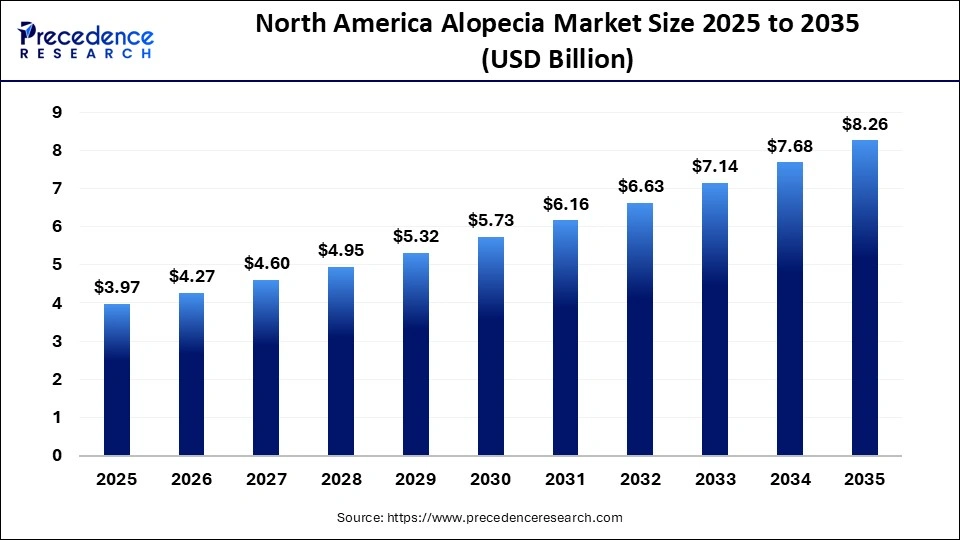
North America Alopecia Market Statical Scope
| Reports Attributes | Statistics |
| Market Size in 2025 | USD 3.97 Billion |
| Market Size in 2026 | USD 4.27 Billion |
| Market Size by 2035 | USD 8.26 Billion |
| CAGR 2026 to 2035 | 7.60% |
| Base Year | 2025 |
| Forecast Period | 2026 to 2035 |
Alopecia is a medical condition characterized by rapid and severe hair loss on the scalp, often occurring in circular patches. Alopecia areata is a well-known autoimmune disorder that causes baldness and can lead to partial or complete hair loss. The market for alopecia is likely to grow due to advancements in therapies and an increase in the prevalence of conditions related to hair loss.
In North America, the market is experiencing accelerated growth driven by both medical and cosmetics needs. While hereditary hair loss is the most common form affecting over 50 million men and 30 million women in the U.S., other types, such as alopecia areata, are receiving medical attention, particularly with FDA-approved treatments now available. Additionally, conditions like traction alopecia are being discussed concerning cultural practices and personal grooming habits, which add socio-medical relevance to the market.
Moreover, the U.S. sees an increase in obesity and high stress levels, alongside a high disposable income and growing consumer spending on grooming products. These factors, combined with increased awareness about alopecia, are expected to fuel demand during the forecast period.
The rising patient population is actively seeking solutions for various forms of alopecia, including conditions such as alopecia totalis and universalis. Innovations in treatment options and a focus on aesthetic appearance are driving market growth. Non-invasive, at-home hair regrowth stimulation options such as Low-Level Laser Therapy using laser helmets, caps, and combs are particularly appealing due to their convenience.
North America Alopecia Market Share, By Treatment, 2025 (%)
| Segments | Shares (%) |
| Pharmaceuticals | 99% |
| Devices | 1% |
- Pharmaceuticals - High reliance on drug-based treatments for hair loss management, with a 99% share, establishes pharmaceuticals as the leading treatment segment.
- Devices - Limited adoption and niche use, with a 1% share, restrict overall market contribution.
North America Alopecia Market Share, By Disease Type, 2025 (%)
| Segments | Shares (%) |
| Alopecia Areata | 42% |
| Androgenetic Alopecia | 25% |
| Cicatricial Alopecia | 10% |
| Traction Alopecia | 8% |
| Alopecia Totalis | 6% |
| Alopecia Universali | 5% |
| Others | 4% |
- Alopecia Areata - High prevalence and strong treatment demand, with a 42% share, establish it as the leading disease segment.
- Androgenetic Alopecia - Common condition with significant demand, with a 25% share, supports the market but remains below alopecia areata.
- Cicatricial Alopecia - Less common but severe condition, with a 10% share, contributes but does not lead.
- Traction Alopecia - Condition linked to lifestyle factors, with a 8% share, limits broader dominance.
- Alopecia Totalis - Rare but severe form, with a 6% share, results in smaller contribution.
- Alopecia Universalis - Very rare condition, with a 5% share, restricts overall market presence.
- Others - Diverse minor conditions, with a 4% share, result in minimal impact.
North America Alopecia Market Share, By End-Use, 2025 (%)
| Segments | Shares (%) |
| Dermatology Clinics | 58% |
| Homecare Settings | 42% |
- Dermatology Clinics - Specialized treatment and professional care availability, with a 58% share, establish clinics as the leading end-use segment.
- Homecare Settings - Convenience and self-treatment options, with a 42% share, support demand but remain below clinical settings.
North America Alopecia Market Share, By Sales Channel, 2025 (%)
| Segments | Shares (%) |
| Prescriptions | 66% |
| OTC | 34% |
- Prescriptions - High dependence on medically approved treatments, with a 66% share, establish prescriptions as the leading sales channel.
- OTC - Availability of over-the-counter solutions, with a 34% share, contributes but does not surpass prescription dominance.
North America Alopecia Market Share, By Gender, 2025 (%)
| Segments | Shares (%) |
| Male | 55% |
| Female | 45% |
- Male - Higher prevalence of hair loss conditions among men, with a 55% share, establish males as the leading gender segment.
- Female - Growing awareness and treatment adoption, with a 45% share, support the market but remain below male dominance.
Top Companies of North America Alopecia Market
- Cipla Inc.
- Sun Pharmaceuticals Industries Ltd
- Johnson & Johnson Services, Inc
- Merck & Co., Inc.
- Lexington Intl., LLC
- Cirrus Hair Centers
- Vita-Cos-Med Klett-Loch GmbH
- Transitions Hair
- PureTech Health
- Curallux, LLC
- Dr. Reddy's Laboratories Ltd
- GSK plc
- Aurobindo Pharma
- Mylan N.V. (Viatris, Inc.)
- Freedom Laser Therapy, Inc.
- Apira Science, Inc. (iGrow Laser.)
- Revian, Inc
- Theradome
- LUTRONIC
- WON TECH Co., Ltd
- LifeMD
- LG Electronics
Segments Covered in the Report
By Treatment
- Pharmaceuticals
- Devices
By Disease Type
- Cicatricial Alopecia
- Traction Alopecia
- Alopecia Totalis
- Alopecia Universalis
- Androgenetic Alopecia
- Others
By End-use
- Homecare Settings
- Dermatology Clinics
By Sales Channel
- OTC
- Prescriptions
By Gender
- Male
- Female
| Treatment | 2025 | 2026 | 2027 | 2028 | 2029 | 2030 | 2031 | 2032 | 2033 | 2034 | 2035 |
|---|---|---|---|---|---|---|---|---|---|---|---|
| Pharmaceuticals | 3.87 | 4.15 | 4.46 | 4.79 | 5.13 | 5.49 | 5.88 | 6.30 | 6.75 | 7.22 | 7.74 |
| Devices | 0.10 | 0.12 | 0.14 | 0.16 | 0.20 | 0.24 | 0.29 | 0.34 | 0.40 | 0.47 | 0.49 |
| Gender | 2025 | 2026 | 2027 | 2028 | 2029 | 2030 | 2031 | 2032 | 2033 | 2034 | 2035 |
|---|---|---|---|---|---|---|---|---|---|---|---|
| Male | 2.14 | 2.29 | 2.46 | 2.63 | 2.81 | 3.00 | 3.20 | 3.42 | 3.65 | 3.88 | 4.20 |
| Female | 1.83 | 1.98 | 2.14 | 2.32 | 2.52 | 2.73 | 2.97 | 3.22 | 3.50 | 3.81 | 4.03 |
Research Methodology
Related Databooks
March 2026
March 2026
March 2026
March 2026


 sales@precedenceresearch.com
 +1 804-441-9344
 Download Databook
 Schedule a Meeting