



U.S. Bioplastics Market Size is USD 5.15 Billion in 2026
U.S. Bioplastics Market (By Product: Biodegradable, Non-biodegradable; By Application: Packaging, Agriculture, Consumer Goods, Textile, Automotive & Transportation, Building & Construction, Others) Industry Size, Share, Growth, Trends 2026 to 2035.


The U.S. bioplastics market size was estimated at USD 4.31 billion in 2025 and is predicted to increase from USD 5.15 billion in 2026 to approximately USD 25.38 billion by 2035, expanding at A CAGR of 19.4% from 2026 to 2035. It is mainly driven by strict environmental rules regarding single-use plastics, increasing consumer demand for eco-friendly packaging, and corporate sustainability efforts.
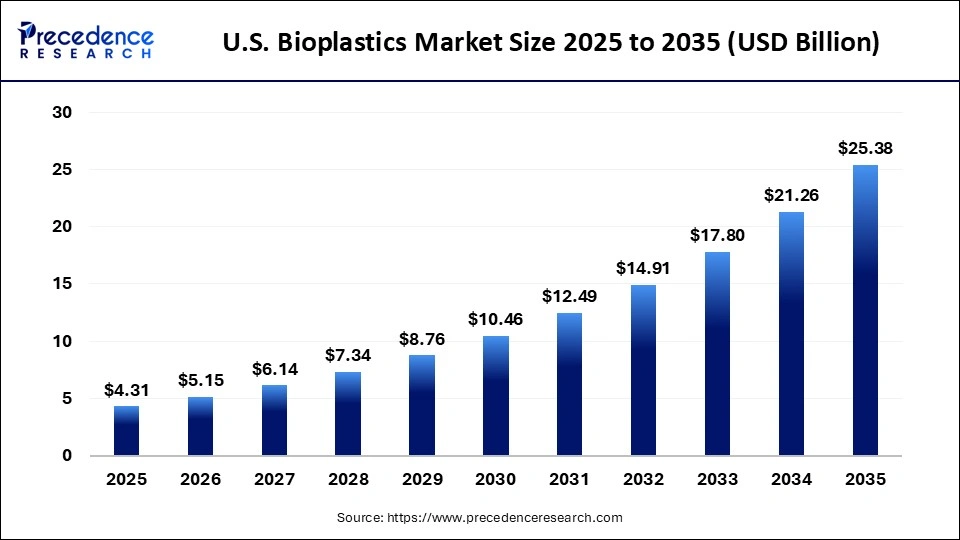
U.S. Bioplastics Market Statical Scope
| Reports Attributes | Statistics |
| Market Size in 2025 | USD 4.31 Billion |
| Market Size in 2026 | USD 5.15 Billion |
| Market Size by 2035 | USD 25.38 Billion |
| CAGR 2026 to 2035 | 19.4% |
| Base Year | 2025 |
| Forecast Period | 2026 to 2035 |
The U.S. bioplastics market plays a vital role in moving away from reliance on petroleum, fueled by the need for sustainable packaging and regulatory demands. This market is essential for lowering carbon footprints, enhancing the bioeconomy, and fostering sustainable advancements in the automotive, agricultural, and medical fields. Bioplastics provide a smaller carbon footprint and help decrease environmental harm, with biodegradable options addressing plastic waste.
Government programs, like the USDA's BioPreferred Program, promote the use of bio-based products to lessen dependence on foreign fossil fuels. In addition to packaging, bioplastics are being used more in automotive parts (for weight reduction), agricultural supplies, and medical equipment, spurring innovation in material science. Growing awareness of plastic pollution is leading consumers to seek eco-friendly options, encouraging companies to use sustainable, bio-based materials to align with consumer demands.
U.S. Bioplastics Market, By Product, 2025 (%)
| Segments | Shares (%) |
| Biodegradable | 55% |
| Non-biodegradable | 45% |
- Biodegradable - The biodegradable segment, with a share of 55%, plays a vital role in the market as it provides a sustainable solution to plastic pollution. Major factors include increasing consumer interest in eco-friendly products, strict environmental laws against single-use plastics, and the necessity for a circular economy.
- Non-biodegradable - The non-biodegradable segment, with a share of 45%, is important in the market because it combines the durability, strength, and performance of conventional plastics with renewable resources. Materials like Bio-PET and Bio-PE offer a seamless solution for long-lasting uses in automotive, electronics, and rigid packaging.
U.S. Bioplastics Market, By Application, 2025 (%)
| Segments | Shares (%) |
| Packaging | 61% |
| Automotive & Transportation | 10% |
| Agriculture | 9% |
| Consumer Goods | 20% |
- Packaging - The packaging segment, with a share of 61%, leads the market, being essential due to the high demand for sustainable materials in the food and beverage sectors, regulatory bans on single-use plastics, and consumer interest in compostable packaging, which boosts growth in both rigid and flexible formats.
- Automotive & Transportation - The automotive & transportation segment, with a share of 10%, is essential to the market as it creates significant demand for lightweight materials that help lower vehicle emissions and enhance fuel efficiency. It provides a sustainable, recyclable option compared to traditional plastic for interior trim, dashboard panels, and under-the-hood components.
- Agriculture - The agriculture segment, with a share of 9%, is key to the U.S. bioplastics market as it acts as a primary driver for sustainable, biodegradable products like mulch films and serves as a major source of renewable feedstock, such as corn and starch, for creating PLA and other polymers.
- Consumer Goods - The consumer goods segment, with a share of 20%, is vital to the market as it meets the rising demand for sustainable, biodegradable alternatives to traditional plastics, fueled by consumer environmental awareness and corporate sustainability objectives. There is a high demand in this area, especially for packaging, single-use products, and durable household items.
Top Companies in the U.S. Bioplastics Market
- NatureWorks LLC
- Trinseo
- Danimer Scientific
- Dow Inc.
- Hallstar Industrial
- Genomatica
- Amcor Rigid Plastics USA, LLC
- Glycosbio
- Lanzatech
- Myriant
Segments Covered in the Report
By Product
- Biodegradable
- Polylactic Acid
- Starch Blends
- Polybutylene Adipate Terephthalate (PBAT)
- Polybutylene Succinate (PBS)
- Others
- Non-biodegradable
- Polyethylene
- Polyethylene Terephthalate
- Polyamide
- Polytrimethylene Terephthalate
- Others
By Application
- Packaging
- Agriculture
- Consumer Goods
- Textile
- Automotive & Transportation
- Building & Construction
- Others
| Product | 2025 | 2026 | 2027 | 2028 | 2029 | 2030 | 2031 | 2032 | 2033 | 2034 | 2035 |
|---|---|---|---|---|---|---|---|---|---|---|---|
| Biodegradable | 2.24 | 2.70 | 3.25 | 3.93 | 4.73 | 5.70 | 6.87 | 8.28 | 9.97 | 12.22 | 15.23 |
| Non-biodegradable | 2.07 | 2.45 | 2.89 | 3.41 | 4.03 | 4.76 | 5.62 | 6.63 | 7.83 | 9.04 | 10.15 |
| Application | 2025 | 2026 | 2027 | 2028 | 2029 | 2030 | 2031 | 2032 | 2033 | 2034 | 2035 |
|---|---|---|---|---|---|---|---|---|---|---|---|
| Packaging | 1.55 | 1.88 | 2.27 | 2.75 | 3.33 | 4.03 | 4.87 | 5.89 | 7.12 | 8.61 | 10.41 |
| Agriculture | 0.52 | 0.62 | 0.75 | 0.90 | 1.09 | 1.31 | 1.57 | 1.89 | 2.28 | 2.74 | 3.30 |
| Consumer Goods | 0.60 | 0.73 | 0.88 | 1.07 | 1.30 | 1.57 | 1.90 | 2.30 | 2.78 | 3.36 | 4.06 |
| Textile | 0.43 | 0.52 | 0.63 | 0.76 | 0.91 | 1.10 | 1.32 | 1.60 | 1.92 | 2.32 | 2.79 |
| Automotive & Transportation | 0.47 | 0.56 | 0.66 | 0.79 | 0.93 | 1.10 | 1.30 | 1.54 | 1.82 | 2.15 | 2.54 |
| Building & Construction | 0.39 | 0.46 | 0.54 | 0.64 | 0.75 | 0.89 | 1.05 | 1.24 | 1.46 | 1.72 | 2.03 |
| Others | 0.34 | 0.38 | 0.41 | 0.43 | 0.46 | 0.47 | 0.47 | 0.46 | 0.43 | 0.36 | 0.25 |


 sales@precedenceresearch.com
 +1 804-441-9344
 Download Databook
 Schedule a Meeting