



Flight Tracking System Market Trends, Companies, Contract Wins / Project Pipeline, Defense Contracts, Procurement Volume, Government Spending, Production Capacity, Competitive Positioning, and Growth Outlook
Flight Tracking System Market (By System Type: ADS-B, ACARS, FANS; By End Use: General Aviation, Civil Aviation, Military Aircraft) - Global Industry Analysis, Size, Trends, Leading Companies, Regional Outlook, and Forecast 2026 to 2035
Source: https://www.precedenceresearch.com/flight-tracking-system-market
 Get a Sample
 Table Of Content


What is the Flight Tracking System Market Size?
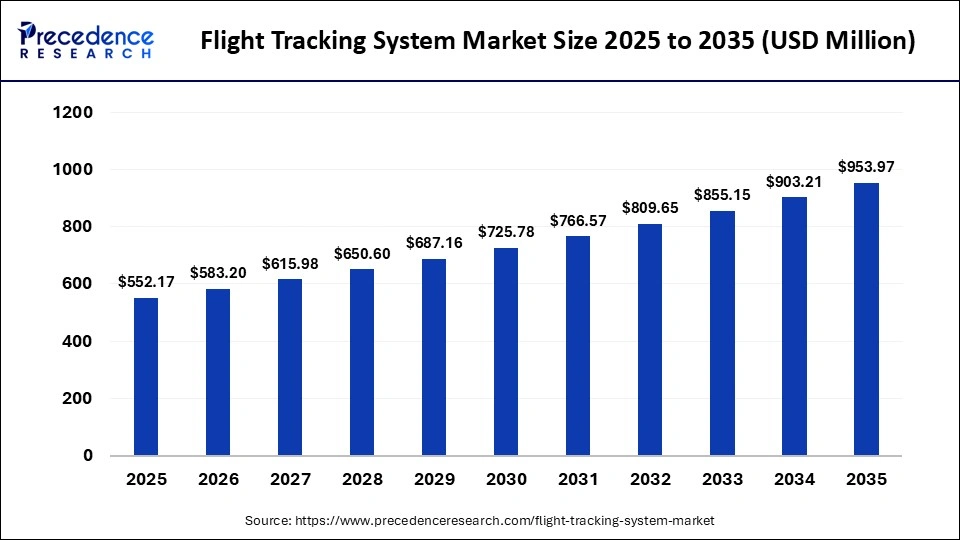
The global flight tracking system market size was calculated at USD 552.17 million in 2025 and is predicted to increase from USD 583.2 million in 2026 to approximately USD 953.97 million by 2035, expanding at a CAGR of 5.62% from 2026 to 2035.The global flight tracking system market is witnessing robust growth, driven by rising technological innovation and the growing need for real-time information about flights.
Market Highlights
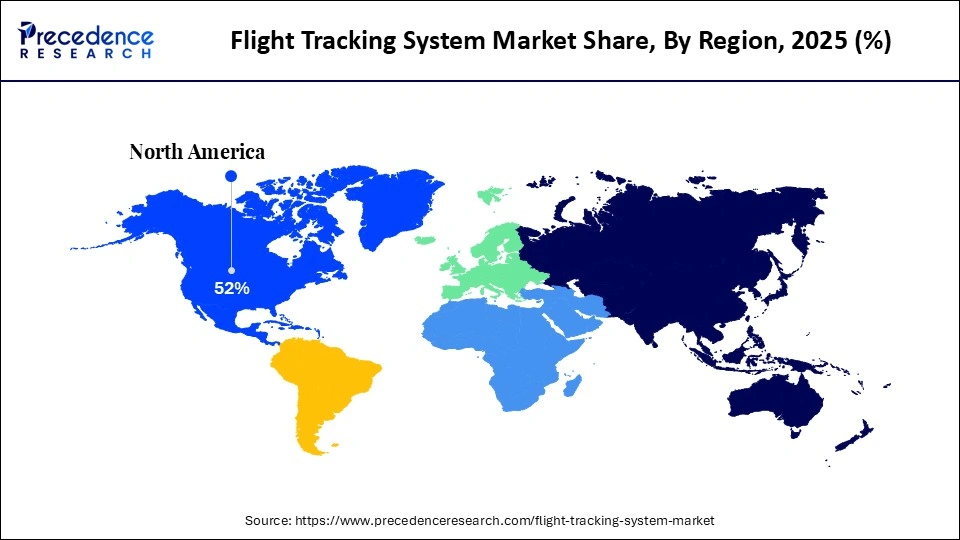
- North America dominated the global flight tracking system market with the highest market share of 52% in 2025.
- Asia Pacific is expected to grow at the fastest CAGR in the market during the forecast period.
- By system type, the ADS-B segment held the largest market share in 2025.
- By system type, the ACARS segment is expected to grow at a remarkable CAGR between 2026 and 2035.
- By end use, the civil aviation segment contributed the biggest market share in 2025.
- By end use, the military aircraft segment is expected to grow at a significant CAGR between 2026 and 2035.
Market Overview
The flight tracking system has become a crucial part of modern air travel. A flight tracking system monitors the movement of aircraft as they travel from one destination to another. Flight tracking systems provide real-time monitoring of aircraft worldwide, offering precise details on their altitude, location, speed, and other relevant information. Integrating ground-based and satellite technologies, the flight tracking system provides comprehensive global coverage. This system assists airports, airlines, and passengers in accessing real-time data. Leveraging radar, satellite communication, and ADS-B allows airlines, airports, and air traffic control to manage air traffic and improve safety.
How are AI-driven Innovations Reshaping the Growth of the Flight Tracking System Market?
In the era of a rapidly evolving technological landscape, the integration of Artificial Intelligence (AI) is driving innovation and accelerating the growth of the flight tracking system market by enabling predictive analytics, real-time route optimization, and enhancing safety. AI integration in flight-tracking technology has been revolutionizing the aviation industry. AI enhances flight tracking accuracy by utilizing historical data and real-time analytics to provide more precise predictions about flight paths.
AI-driven flight tracking technology can assess countless variables which often leading to make informed decisions by airline operations and air traffic controllers. AI enables predictive maintenance for aircraft, detecting any potential mechanical issues before they occur. This reduces maintenance and increases operational uptime, making flight tracking systems critical for proactive maintenance. AI algorithms can detect anomalies in flight behavior, such as deviations from assigned routes or unexpected altitude changes, ensuring safety of air travel.
What are the Emerging Trends in the Flight Tracking System Market?
- The rising safety concerns and increasing focus on enhancing safety are expected to promote the growth of the flight tracking system market in the coming years. Flight tracking technology monitors aircraft to track missing planes, avoid mid-air collisions, and reduce potential accidents.
- The stringent regulatory mandates are expected to contribute to the overall growth of the flight tracking system market. The mandated standards implemented by the International Civil Aviation Organization (ICAO) require precise real-time monitoring systems to track aircraft, particularly in areas with limited radar coverage.
- The rise in traffic has led to the creation of significant demand for efficient, reliable, and scalable air traffic management solutions, accelerating the growth of the flight tracking system market during the forecast period.
- The increasing adoption of Automatic Dependent Surveillance-Broadcast (ADS-B) is anticipated to boost the growth in the flight tracking system market. ADS-B is a widely used technology that allows aircraft to determine their position using GPS and transmit this data on 1090 MHz to ground stations, then send it to central servers.
- The rising need of airlines to provide real-time status updates to passengers to reduce delays and enhance satisfaction is anticipated to fuel the expansion of the flight tracking system market in the coming years.
Market Scope
| Report Coverage | Details |
| Market Size in 2025 | USD 552.17 Million |
| Market Size in 2026 | USD 583.2 Million |
| Market Size by 2035 | USD 953.97 Million |
| Market Growth Rate from 2026 to 2035 | CAGR of 5.62% |
| Dominating Region | North America |
| Fastest Growing Region | Asia Pacific |
| Base Year | 2025 |
| Forecast Period | 2026 to 2035 |
| Segments Covered | System Type, End Use, and Region |
| Regions Covered | North America, Europe, Asia-Pacific, Latin America, and Middle East & Africa |
Segmental Insights
System Type Insights
What Caused the ADS-B Segment to Dominate the Flight Tracking System Market?
Automatic Dependent Surveillance-Broadcast (ADS-B)
The Automatic Dependent Surveillance-Broadcast (ADS-B) segment held the largest market share in the flight tracking system market. ADS-B is an integral technology in real-time flight tracking solutions. It operates on the principle of aircraft autonomously transmitting their GPS-derived information, such as position, altitude, and speed, to ground stations and other aircraft. It provides much higher accuracy compared to traditional radar, enhancing safety and reducing separation, which assists in direct and fuel-efficient routing.
By utilizing ADS-B technology, stakeholders in the aviation industry can optimize airspace utilization and monitor real-time aircraft movements, which ensures safer and streamlined air travel operations globally. In addition, the strict regulatory mandates from agencies like the FAA and EASA for real-time monitoring through Automatic Dependent Surveillance-Broadcast (ADS-B) are anticipated to bolster the segment's growth during the forecast period.
Aircraft Communications Addressing and Reporting System (ACARS)
The Aircraft Communications Addressing and Reporting System (ACARS) segment is expected to grow at a remarkable CAGR between 2026 and 2035. ACARS provides a crucial layer of situational awareness by efficiently transmitting messages directly from the aircraft's onboard systems. ACARS uses numerous communication channels such as HF, VHF, and satellite. ACARS has the ability to continue operating even when other tracking feeds go offline. Integrated with systems like OpsControl, ACARS data complements radar, and ADS-B feeds to create a layered tracking setup. Aircraft Communications Addressing and Reporting System (ACARS) provides reliable tracking, especially in oceanic or remote areas, by leveraging satellite links. This technology automates data transmission, which reduces the risk of human error and provides instant & accurate information to maintenance crews.
End Use Insights
What has Led the Civil Aviation Segment to Dominate the Flight Tracking System Market?
Civil Aviation
The civil aviation segment dominated the flight tracking system market, holding the highest market share in 2025. The growth of the segment is primarily driven by the high volume of commercial flights, increasing emphasis on passenger safety, strict regulatory mandates from bodies like ICAO and FAA, and rising focus to optimize operational efficiency. The increasing integration of sophisticated technologies like Satellite-based tracking and ADS-B allows for real-time monitoring, which enhances safety, operational efficiency, and predictive maintenance.
Military Aircraft
The military aircraft segment is the fastest-growing in the flight tracking system market. The segment's fastest growth is supported by the rise in defense expenditures, increasing investments in the advanced real-time tracking system, and the growing need for advanced surveillance. Flight tracking systems has widespread used in military aircraft, such as Mode S transponders, Aircraft Communications Addressing and Reporting System (ACARS), and satellite tracking, for real-time situational awareness, safety, and mission planning. The rise in geopolitical tensions significantly increased the demand for surveillance and reconnaissance aircraft to monitor borders and enhance situational awareness.
Regional Insights
How Big is the North America Flight Tracking System Market Size?
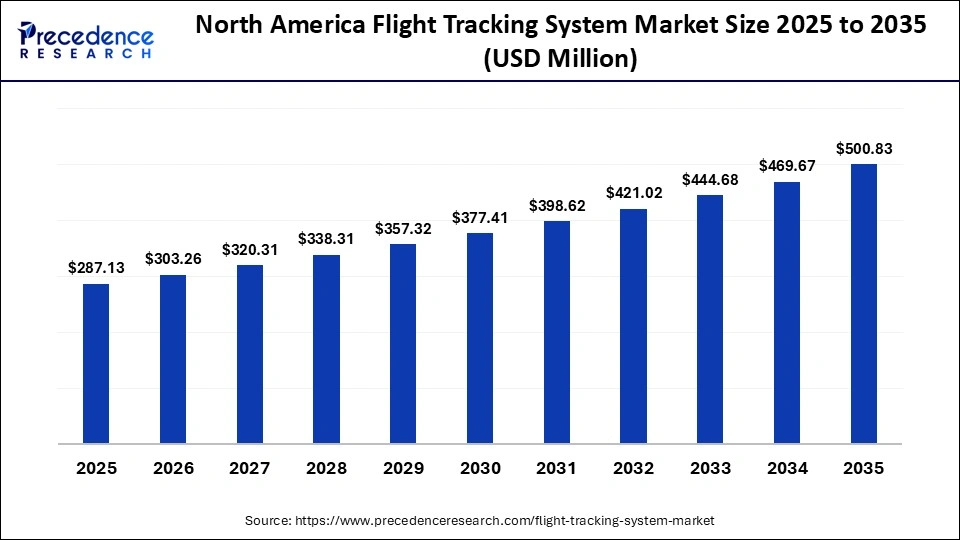
The North America flight tracking system market size is estimated at USD 287.13 billion in 2025 and is projected to reach approximately USD 500.83 billion by 2035, with a 5.72% CAGR from 2026 to 2035.
North America Flight Tracking System Market Analysis
North America dominated the flight tracking system market, holding the largest share in 2025. The region benefits from advanced aviation infrastructure and a strong presence of key market players. The regional leadership position is characterized by the increasing investments in next-generation tracking technology by military aircraft and civil aviation, growing emphasis on passenger safety, and increasing adoption of space-based ADS-B for oceanic tracking and API-driven analytics. The stringent regulatory mandates from the Federal Aviation Administration (FAA) enforce safety protocols that push airlines to adopt advanced flight tracking systems. Such factors significantly contribute to the growth of the flight tracking system market during the forecast period.
What is the Size of the U.S. Flight Tracking System Market?
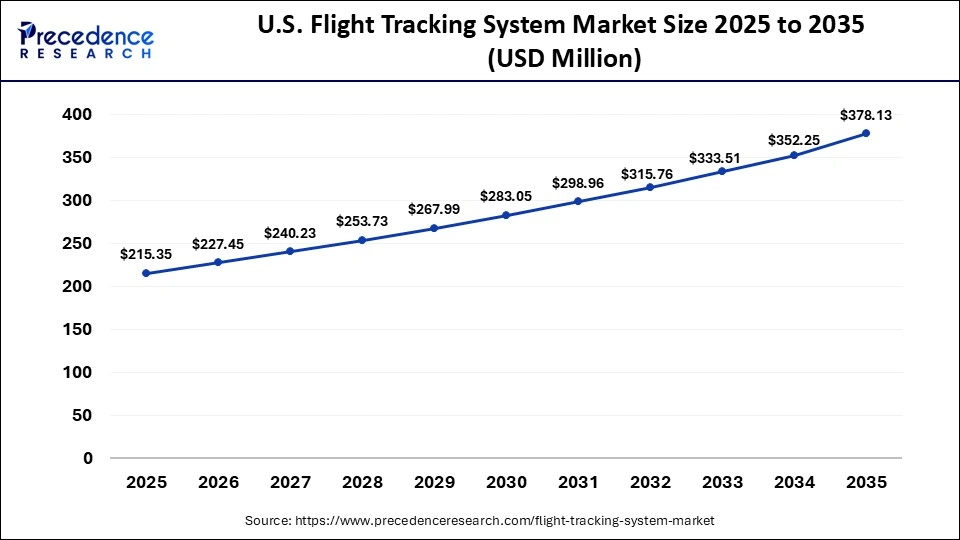
The U.S. flight tracking system market size is calculated at USD 215.35 billion in 2025 and is expected to reach nearly USD 378.13 billion in 2035, accelerating at a strong CAGR of 5.79% between 2026 and 2035.
United States Flight Tracking System Market Analysis
The United States leads the flight tracking system market. The United States is a major contributor to the flight tracking system market. The country operates the largest aviation networks, which creates substantial demand for advanced real-time flight tracking systems for both operational efficiency and passenger safety. The country is home to the leading market players such as Honeywell International Inc., RTX Corporation, Garmin Ltd., ACR Electronics Inc., AirNav Systems LLC, Collins Aerospace, Airbus SAS, Aireon LLC, FLYHT Aerospace Solutions Ltd., Sabre Corporation, and others.
The country's growth is driven by the strong presence of the world's largest commercial airline fleets, high aircraft fleet volume, growing demand for real-time monitoring, growing demand for satellite-based flight tracking systems, and stringent safety regulations (FAA mandates). The rapid expansion of the commercial aviation sector in the country increases the demand for a flight tracking system to enhance safety and operational efficiency. The rapid adoption of cloud-based tracking and space-based ADS-B for global coverage strengthens the country's position in the North America region.
Asia Pacific Flight Tracking System Market Analysis
Asia Pacific is the fastest-growing region in the flight tracking system market. The region's growth is primarily driven by the rising presence of major aerospace manufacturers and technology providers, increasing investment in advanced aviation infrastructure, rising focus on aviation safety, strict safety regulations mandated by the government, rising air passenger traffic, and increasing integration of ADS-B technology in modern aircraft. The rising expenditure of military and defense budget are enhancing demand for real-time flight tracking systems.
The modernization of aging military fleets is pushing governments to invest in high-precision surveillance and satellite-based systems. Several countries in the Asia Pacific region, particularly China, Japan, South Korea, and India, are increasingly investing in new aircraft equipped with tracking and surveillance technologies. These collective factors are expected to boost the growth of the flight tracking system market during the forecast period.
- In September 2025, Korean Air announced a partnership with Swedish flight tracking company Wingbits to enhance research in sustainable air travel, autonomous aviation, and Advanced Air Mobility (AAM). Through its R&D Center, the Seoul-based carrier will gain access to real-time flight-tracking data spanning three continents. The partnership will allow Korean Air to integrate Wingbits' data into its R&D activities. The airline will leverage Wingbits' incentive-based network that tracks 150,000 daily flights using over 4,500 global contributors.
China's Flight Tracking System Market Analysis
India's flight tracking system market is experiencing growth. The country's growth is supported by the rapidly expanding aviation sector, increasing emphasis on passenger safety, rising investment in fleet modernization, and increasing push into advanced AI-driven & satellite-based systems. China is accelerating the adoption of satellite-based (ADS-B) for enhanced tracking in non-radar airspace and improving real-time surveillance.
The country invests heavily in aviation surveillance, employing both ground-based and space-based technologies to modernize its airspace management. Moreover, the country is experiencing a significant rise in air travel, which necessitates real-time and high-performance flight tracking systems to manage busy airspace. These combined factors are expected to drive the growth of the flight tracking system market in the country during the forecast period.
Who are the Major Players in the Global Flight Tracking System Market?
The major players in the flight tracking system market include Honeywell International Inc., Raytheon Technologies Corporation, Garmin Ltd., ACR Electronics Inc., AirNav Systems LLC, Collins Aerospace, Airbus SAS, Aireon, Blue Sky Network, FLYHT Aerospace Solutions Ltd, SITA, IBM Corporation, Spider Tracks Limited, Sabre, Lufthansa Systems.
Recent Developments
- In December 2025, Flightradar24, the world's leading flight tracking service, signed an agreement to provide flight data services to Boeing. Under the agreement, Boeing will gain access to both live and historical flight data supported by Flightradar24's network of more than 55,000 global ADS-B receivers.
- In June 2025, VASystemsc announced a new flight tracker device. VASystems' sister company, VA Hardware. This is a device that tracks any real-world flight in real time. The team stated that although other devices, like mobile phones, are already very capable of doing this, this device is “designed to do just one thing, but very well.
- In October 2025, Cambridge Pixel announced the success of its five-year collaboration with BAE Systems, providing advanced tracking technology to support aircraft telemetry during live flight trials. The company's SPx Fusion Server and ASD-100 display software have become central to BAE Systems' test and evaluation processes for airborne systems.
Segments Covered in the Report
By System Type
- ADS-B
- ACARS
- FANS
By End Use
- General Aviation
- Civil Aviation
- Military Aircraft
By Region
- North America
- Europe
- Asia-Pacific
- Latin America
- Middle East & Africa
For inquiries regarding discounts, bulk purchases, or customization requests, please contact us at sales@precedenceresearch.com
Frequently Asked Questions





Ask For Sample
No cookie-cutter, only authentic analysis – take the 1st step to become a Precedence Research client
 Get a Sample




 sales@precedenceresearch.com
 Schedule a Meeting
