



Gas Sensors Market Size, Key Companies, Company Market Share, Chip Production Volume, Wafer Capacity, Technology Adoption, Pricing Trends, Competitive Positioning, and Demand Analysis
Gas Sensors Market (By Type: Wireless, Wired; By Product: Oxygen/Lambda Sensor, Carbon Dioxide Sensor, Carbon Monoxide Sensor, NOx Sensor, Methyl Mercaptan Sensor, Others (Hydrogen, Ammonia, Hydrogen Sulfide); By Technology: Electrochemical, Semiconductor, Catalytic, Infrared (IR), Solid State/MOS, Photo-ionization Detector (PID); By Output Type: Analog, Digital; By End User: Medical, Building Automation & Domestic Appliances, Environmental, Industrial, Agriculture, Petrochemical, Automotive, Others) - Global Industry Analysis, Size, Trends, Leading Companies, Regional Outlook, and Forecast 2026 to 2035
Source: https://www.precedenceresearch.com/gas-sensor-market
 Get a Sample
 Table Of Content


What is the Gas Sensors Market Size?
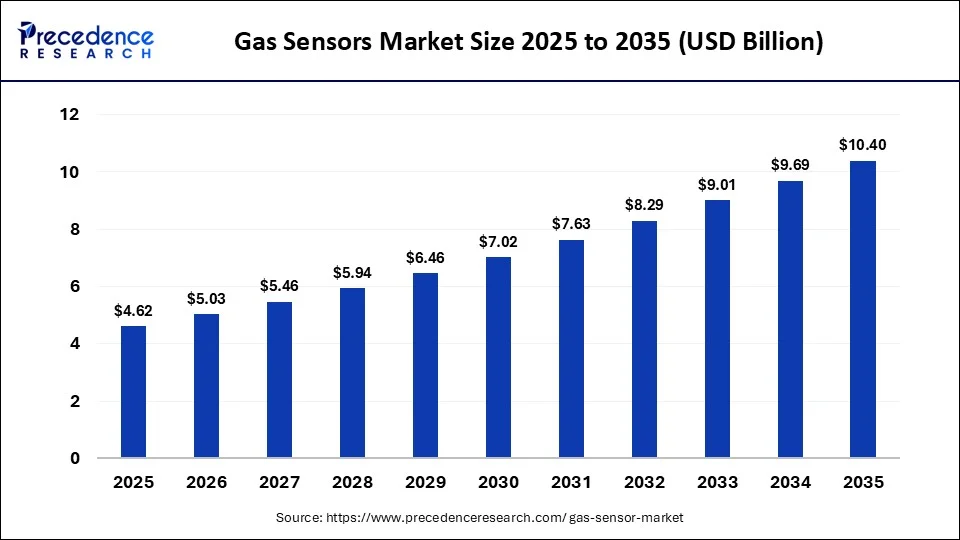
The global gas sensors market size is calculated at USD 4.62 billion in 2025 and is predicted to increase from USD 5.03 billion in 2026 to approximately USD 10.40 billion by 2035, expanding at a CAGR of 8.45% from 2026 to 2035. The gas sensors market is driven by rising environmental monitoring requirements and increasing smart manufacturing technologies
Gas Sensors Market Key Takeaways
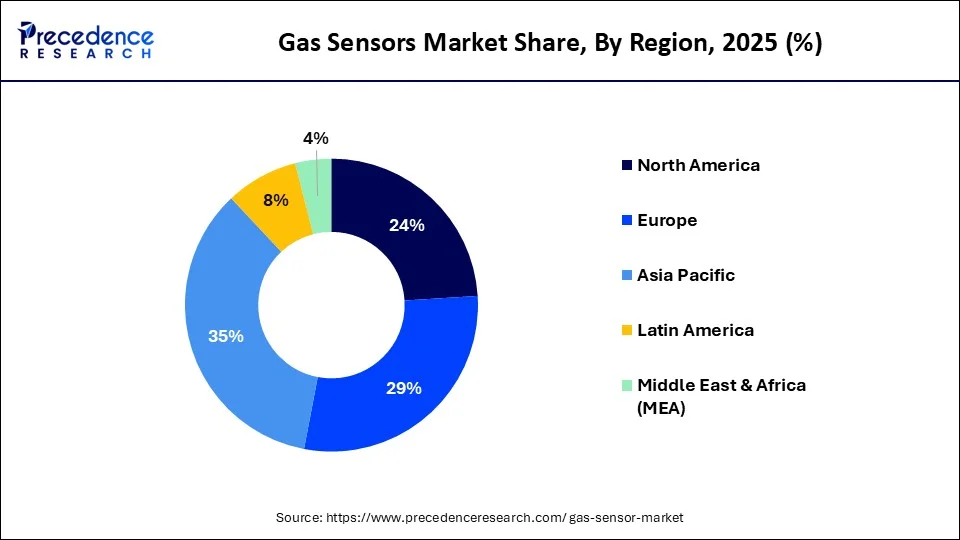
- Asia Pacific dominated the global gas sensor market and contributed the largest market share of 35% in 2025.
- North America is expected to expand at a solid CAGR during the forecast period.
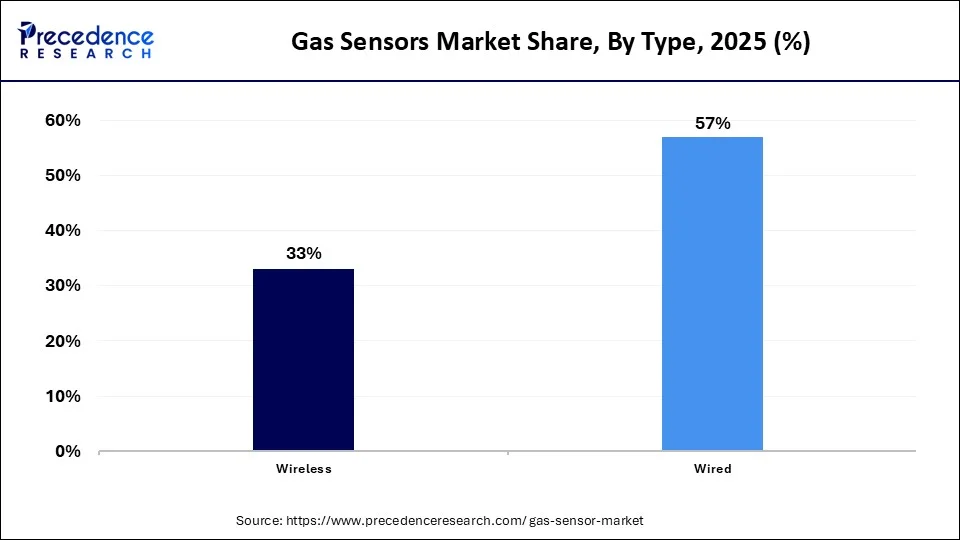
- By type, the wired segment has held the highest market share of 57% in 2025.
- By product, the carbon dioxide segment generated the biggest market share of 34% in 2025.
- By technology, the electrochemical segment accounted for the major market share of 24% in 2025.
- By end user, the industrial segment captured the biggest market share of 22% in 2025.
Market Overview
These are devices that help to detect the emissions of toxic gaseous substances into the atmosphere by the various gas producers such as industries, manufacturers, transport sector and the household sector. State government guidelines have been implemented regarding the release of toxic gases from the vehicles and the industries which prove to be a major factor for the global climate change and pollution full stop various harmful toxic gases are also release from the agricultural activities which results in climate change and pollution. Various types of gas sensors have been introduced into the market by the leading market players in order to reach the difficult sites where human being does not have access.
The size of the gas sensors is very small can be consorted and go narrow spaces which are out of human reach. The advance technology is which are used in the sensors help to detect toxic gas emissions from a far away distance without endangering the life of the operator. Wireless technology that are being used in the modern gas sensors helps to obtain relevant data and information regarding the toxic emissions from a safe distance without coming in contact with the handler. Segregation of the various toxic gases emitted is also important in order to put them to proper use and obtain maximum productivity. New technology is need to be developed in order to make secondary use of the toxic gases emitted so that the recycling process keeps continuing and the waste material that is emitted into the environment is minimum.
The harmful gases emitted by the transport sector have also been kept under check by the government by imposing various rules and guidelines regarding the use of the vehicles. Main toxic gases which are released into the atmosphere prove to be a great risk for the birds and other aerial animals. This creates and ecological imbalance in the environment, thus endangering the global ecosystem and climate.
The occurrence of the pandemic had a significant impact over the gas sensors market. As a result of the constants and restricted movement which were imposed by the government worldwide, the amount of toxic gases released by the transport sector was negligible which helped to maintain bycological balance of the environment. The functioning of the industries and factories over also restricted in order to control the spread of infection and diseases which help to reduce the amount of gases released into the atmosphere. This had a negative impact on the gas sensors market as the demand had reduced due to the restricted functioning of the factories. Or number of small scale industries had to be shut down temporarily in order to avoid monetary losses which had a negative impact on the gas sensors market.
On the other hand, the toxic gases emitted from the hotel industry and the household sector was on a rise due to the constant combustion of fossil fuels and petroleum products in these departments. During the post lock down phase the movement of the people increased rapidly in order to deal with anxiety which was created due to the restricted movements. This had a negative impact on the environmental but proves to be a growing factor for the gas sensors market.
Market Outlook
- Industry growth overview - The gas sensors market is growing due to rising industrial automation and stricter safety regulations worldwide. Gas sensors are majorly used across automotive, healthcare, manufacturing, mining and smart infrastructure applications.
- Sustainability trends - Industries are increasingly deploying gas sensors to reduce emissions, monitor air quality and comply with sustainability goals.
- Major Investors - Global electronic companies, industrial technology firms and private groups are investing in sensor innovation and research and development of products. Major investors in the market include Honeywell International Inc., Robert Bosch GmbH, and Siemens AG.
- Startup ecosystem - The startup economy in the market is focused on introducing artificial intelligence powered and IoT connected gas sensors which can improve operational efficiency and workplace safety. 
Impact of AI on the Gas Sensors Market
Integration of AI is enhancing the capabilities of gas sensors. AI has the ability to analyze and process sensor data effectively, which improves the accuracy of gas detection. It also identifies anomalies in gas sensors' data, helping detect possible faults. AI-powered gas sensors are crucial in weather monitoring. They can also enhance indoor air quality by monitoring and controlling pollution and humidity levels.
Gas Sensors Market Growth Factors
The development of wireless capabilities and miniaturization has proved to be a major driving factor for the growth of the market during the focus period. The advancements made in the communication technology which has been integrated with the modern devices and equipments in order to detect the toxic emissions help to promote the market to a great extent. This detection technique can be carried out from a safe distance without risking the life of the employee. Since it has wireless capabilities human intervention is minimum and the use of machines and technology has been considered to manage the entire process of detecting the toxic emissions. The miniature size of the devices helps them to penetrate into narrow spaces where the human body cannot reach and perform their actions. This enables the devices to perform the task with efficacy and precision. These devices are mainly put into use in order to detect the gas emissions from the industrial sectors and to keep a constant control over their toxic gas production.
The intensity at which the gas emissions take place or constantly monitor with the help of these devices. Industrial as well as domestic sectors are taken into consideration by this market. Rising demand for controlling in the climate change and pollution as a result of the emissions from the industrial sector has helped to show a considerable growth in the market. Smart devices are being developed by the manufacturers which sense gas emissions easily without errors. The constant research and development which are being carried out by the key market players helps to develop new advanced technologies in the market that support the objective of reducing the emissions of harmful gases into the environment.
Numerous companies are introducing drone based devices in order to detect the gas leaks from their industries in order to ensure better safety of their employees and also the handler of the pipelines. The strict rules and regulations laid down by the government regarding the toxic gas emissions from the industries and the gas emissions from the transport sector has helped to propel the demand for the gas sensors during the forecast period. The numerous gas emissions that have crowded that atmosphere prove to be a matter of concern for the environment. Use of methane which is greenhouse gas is highly toxic and inflammable. These guys can be explosive in the air if not controlled properly the gases such as carbon monoxide and carbon dioxide let out into atmosphere as waste materials which adversely alter the human health. Mithun gas is made use of in the power generation companies which helps to boost the market for the gas detection devices.
Specific gas detectors are developed by the leading market players in order to make the work easier. The use of modern technology to check the harmful gas emissions has boosted the demand for gas sensors technology. The development of the sensors in order to fulfill the rising demand from ventilator developers has helped to boost the supply for the gas sensors. A rapid growth in the industrialization in the developing countries has propelled the amount of toxic gas emissions in the atmosphere which has in-turn boosted the demand for the gas sensors in order to keep the emissions under control. These multiple reasons prove to be the growth factors for the gas sensors technology.
Market Scope
| Report Coverage | Details |
| Market Size in 2025 | USD 4.62 Billion |
| Market Size in 2026 | USD 5.03 Billion |
| Market Size by 2035 | USD 10.40 Billion |
| Growth Rate from 2026 to 2035 | CAGR of 8.45% |
| Largest Market | Asia Pacific |
| Base Year | 2025 |
| Forecast Period | 2026 to 2035 |
| Segments Covered | By Type, By Product, By Technology, By Output Type, and By End User |
| Regions Covered | North America, Europe, Asia-Pacific, Latin America, and Middle East & Africa |
Market Dynamics
Driver
Increasing Industrial Safety Regulations
Governments and regulatory bodies worldwide are strengthening workplace safety standards across industries such as oil and gas, chemicals, manufacturing, mining and power generation. Due to stringent guidelines, there is increased adoption of gas sensors for monitoring hazardous gases such as carbon monoxide, methane and ammonia to prevent accidents. The increasing investment in smart manufacturing integrates advanced gas detection systems to improve operational safety and regulatory compliance.
Restraint
High Calibration and Maintenance Requirements
Gas sensors require regular calibration, testing and maintenance to maintain measurement accuracy and ensure reliable performance over time. These ongoing requirements increase cost. The gas sensors are used in industries such as automotive, mining, oil and gas, which undergo harsh environmental conditions that also affect the life span of the gas sensors. The advanced gas sensors are expensive and may require supported infrastructure to deploy. These financial constraints may limit the adoption and implementation of gas sensors, particularly in small to medium sized enterprises.
Opportunity
Rising Demand for Smart and IoT Enabled Gas Sensors
The growing adoption of Industrial Internet of Things (IIOT) technologies is creating a strong opportunity for the gas sensor market. Industries are increasingly demanding smart gas sensors such as AI enabled, wireless, cloud connected gas monitoring systems that provide real time alerts and remote management. The growing smart manufacturing and smart city initiatives are accelerating demand for connected sensing solutions.
Segment Insights
Type Insights
The wired segment has held the highest market share of 57% in 2025. Various type of benefits were offered by the biot type of sensors such as loan maintenance cost which helps the small scale industries to generate a better revenue return. The reliability of the wire sensor system is better as compared to the wireless ones. The compact size of the devices helps to function better. The cost of the wire type of devices was quite low as compared to the wireless ones. The accuracy and precision which was offered by the wire devices and sensors were also a beneficial factor for the industries. Loss of connectivity and signal becomes a great challenge where the wireless devices suffer the most.
On the other hand, the wired glass sensors prove to be up great help when connectivity is concern. Disadvantage is a great use in receiving data and information from the mines and nuclear power plants. Whereas, the benefits obtained by the wireless devices were unavoidable. High flexibility and scalability were the key features of the wireless devices. These wireless gas sensors are highly portable which make them easily accessible even in narrow spaces.
Technology Insights
The electrochemical segment accounted for the major market share of 24% in 2025. This technology consumers less power as compared to the others and has safer operations for a particular targeted type of gas. The method of oxidation is made use of in order to target a specific type of gas which helps them to provide accurate results. The electrodes that are used in the electrochemical technology help to detect the target gas.
The mining sector makes use of this technology to operate extend in order to protect the workers from being exposed to a harmful variety of toxic gas. Infrared technology is very efficient for protection of a particular variety of gas. The infrared variety of technology has been considered to deliver the fastest growth on account of its flexibility and variability.
End User Insights
The industrial segment captured the biggest market share of 22% in 2025. The huge amount of various types of gases which are emitted by the industries creates an alarming situation which is kept under check with the help of gas sensors. A number of manufacturers are completing in the market in order to develop a miniature gas sensor for the industrial sector. Small sized gas sensors with high performance considered which are reliable as much as the bigger machines.
The petrochemical sector is projected to show a substantial growth as a result of its high demand in the market. The gases released by the sector need to be kept under check conceptually during the production transportation and storage processes. A great emphasis has been made regarding the security and safety regulations for this particular sector owing to its high inflammable properties.
Product Insights
Why has the Oxygen/Lambda Sensor Segment dominated the Gas sensors Market?
The oxygen/Lambda sensor segment held a dominant position in the gas sensors market in 2025, due to their essential role in monitoring oxygen levels and optimising combustion efficiency. They are widely used in automotive exhaust systems, industrial boilers, power plants, and emission control equipment. The growing emission regulations and increasing production of fuel efficient vehicles continue to support demand for oxygen/Lambda sensors. The segment is further driven due to its faster response time and compatibility with hybrid and alternative fuel engines.
The nitrogen oxide sensor (NOx) segment is expected to grow at the fastest CAGR during the studied period in the gas sensors market. The segment is growing as governments enforce stricter emission standards for vehicles and industrial facilities. The strict regulatory standards have led automakers to implement advanced exhaust after treatment technologies. These sensors accurately detect NOx concentrations, helping reduce harmful emissions while improving engine performance and environmental compliance. The growing use of diesel in commercial trucks and off road machinery further demands precise NOx sensors.
Regional Insights
What is the Asia Pacific Gas Sensors Market Size?
The Asia Pacific gas sensors market size was estimated at USD 1.78 billion in 2026 and is anticipated to be surpass around USD 3.82 billion by 2035, rising at a CAGR of 8.89% from 2026 to 2035.
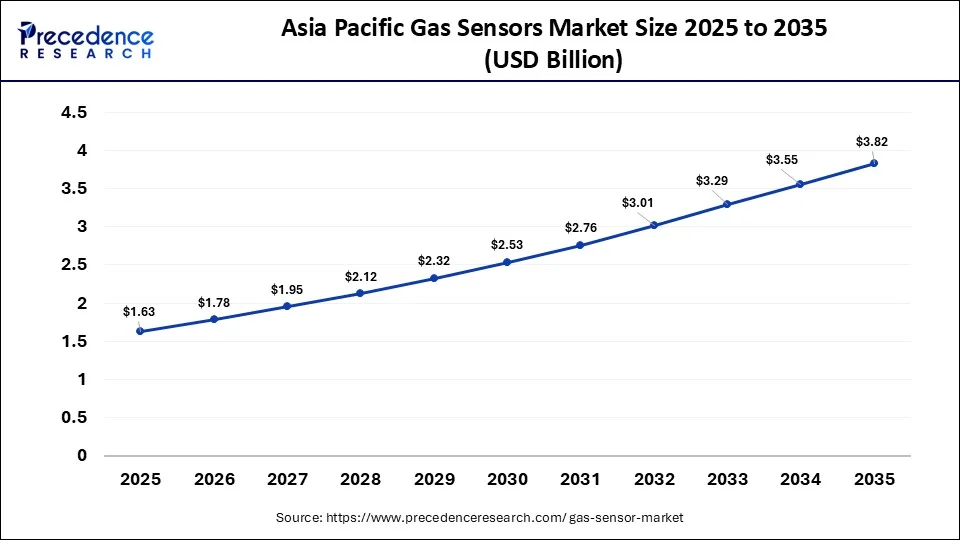
Asia Pacific region has dominated the segment as a result of its rapid urbanization and industrialization. The development of this region which is on a rise has increased the production of toxic gases in the environment. Growing demand for the air cleaners will also drive the growth of the Asia Pacific region for the gas sensors during the forecast period.
Asia pacific
- In Dec 2024, the Electronics City Industries Association and India Electronics & Semiconductor Association (IESA) entered into a collaboration to expand sensor product development and manufacturing in India. The aim of the collaboration is to establish a center of excellence completely dedicated to sensor technologies to fulfill the growing demand for sensor modules in India to minimize dependency on sensor imports.
North America is expected to expand at a solid CAGR during the forecast period.
China Market Trends
China accounts for the largest share of the gas sensors market in Asia-Pacific in 2025. The growth is driven by rapid industrialization, expanding electronics manufacturing and smart manufacturing. The country's increasing production of electric vehicles and smart factories has significantly boosted sensor demand. The government in the country is promoting strong initiatives for workplace safety and environmental monitoring. The rising investment in industrial automation and smart city infrastructure further supports the market growth.
Air Quality Monitoring and Emission Regulations Boosting Adoption in North America
North America is the fastest-growing market during the forecast period. This is due to stringent, expanding government enforcement, like the EPA or Canada, growing public health concerns regarding pollution-associated illnesses, and the urgent demand to track industrial emissions for ESG Environmental, Social, and Governance compliance.
U.S. Market Trends
The United States represents the largest share of the gas sensors market in North America. The growth is driven by strong demand from industrial safety, automotive, oil and gas and healthcare sectors. The country has stringent environmental regulations imposed by the U.S. Environmental Protection Agency (EPA) that encourage widespread adoption of gas sensors. The increasing investment in smart manufacturing technologies and growing use of connected devices further increase demand for advanced gas detection technologies.
Smart City Initiatives Fueling Gas Sensor Demand in Europe
Europe shows a significant growth during the forecast period. Smart cities are now moving away from having one large, expensive monitoring station per city to deploying hundreds of low-cost, connected sensors along with small sensors on lampposts, traffic lights, and public transport. As Europe shifts toward electric vehicles as well as hydrogen fuel cells, there is a rising need for sensors that detect gas leaks and monitor cabin air quality.
Germany Market Trends
Germany leads the European gas sensors market in 2025 due to its advanced automotive, chemical, and manufacturing sectors. The companies in the country, such as Siemens and Drager, are deploying gas detection systems to comply with strict safety and environmental regulations. The country's strong Industry 4,0 and industrial automation support rising demand for intelligent sensing technologies. The hydrogen infrastructure development in the country supports demand for specialized gas detection sensors. The ongoing innovation supports market growth.
What are the Advancements in the Market in Latin America?
Latin America held a considerable share of the gas sensors market in 2025, as industries strengthen workplace safety practices and modernize industrial operations. Mining, oil and gas and manufacturing remain key application sectors across the region. Governments in the region are introducing stricter environmental and occupational safety standards, which encourages wider adoption of gas monitoring systems. The growing adoption of connected devices and increasing industrial investment further supports the market expansion.
Brazil Market Trends
Brazil accounts for the largest share of the Latin American gas sensors market in 2025, due to its extensive oil and gas, mining, chemical, and manufacturing industries. Companies are investing in advanced gas detection technologies to comply with safety and environmental regulations. The region is focusing on infrastructure development, and ongoing technological advancement further supports the market growth. The increasing adoption of connected monitoring systems demands advanced gas sensors across the country.
What are the Key Trends in the Market in the Middle East and Africa Region?
The Middle East & Africa held a notable share of the gas sensors market in 2025, driven by increasing investment in oil and gas, petrochemicals, and infrastructure development. Industrial facilities are adopting advanced gas sensors to improve operational safety and meet environmental regulations. The region has well established mining and oil and gas sectors, which pose a risk of gas leaks that requires a mandatory gas monitoring system in the field. Increasing urbanization in the region and smart infrastructure initiatives are further creating demand for advanced gas sensors.
UAE Market Trends
UAE represents the leading market within the Middle East and Africa gas sensors market in 2025, supported by its large oil and gas industry and smart city initiatives. Businesses are investing in advanced gas monitoring systems to improve workplace safety, operational efficiency and environmental compliance. The country has stringent safety guidelines that encourage the adoption of smart gas monitoring systems. The government in the country is supporting digital transformation programs, which further support market expansion.
Value Chain Analysis for the Gas Sensors Market
- Raw Material Procurement: It is a vital, strategic function that directly impacts manufacturing success, product quality, and profitability. It includes securing key materials, like metal oxides, silver, copper, and aluminum, demanded to build sensitive, stable, and thus, reliable sensors.
Key Players: Robert Bosch GmbH, Sensirion AG, AlphaSense Inc. - Wafer Fabrication: By using silicon-based technologies and even MEMS (Micro-Electro-Mechanical Systems) techniques, producers can produce thousands of high-performance sensor chips in a single batch on a single wafer.
Key Players: ROHM Semiconductor, Okmetic Oy, Siltronic AG - Photolithography and Etching: They have transformed the gas sensors market by allowing the transition from bulky, manual manufacturing to mass-produced, high-performance, and miniaturized devices.
Key Players: ASML Holding N.V., SUSS MicroTec SE, Applied Materials, Inc., Nikon Corporation & Canon Inc.
Competitive Landscape
The gas sensors market is highly competitive, with global companies competing through technological innovation, product accuracy and reliability. The major companies in the market include Alphasense (AMETEK, Inc.), MEMBRAPOR AG, GfG Gesellschaft für Gerätebau mbH, Process Sensing Technologies, Honeywell International Inc. and Figaro Engineering Inc. The companies are expanding their portfolio with electrochemical, infrared catalytic and MEMS based gas sensors. The companies are strengthening their market position through strategic partnerships, acquisitions and investment in research and development.
To achieve sustainable growth in the gas sensors market, companies should prioritise artificial intelligence enabled sensing, enhance sensor accuracy and invest in sustainable technologies. Expanding presence in emerging markets will also help in long term market presence.
Gas Sensors Market Companies
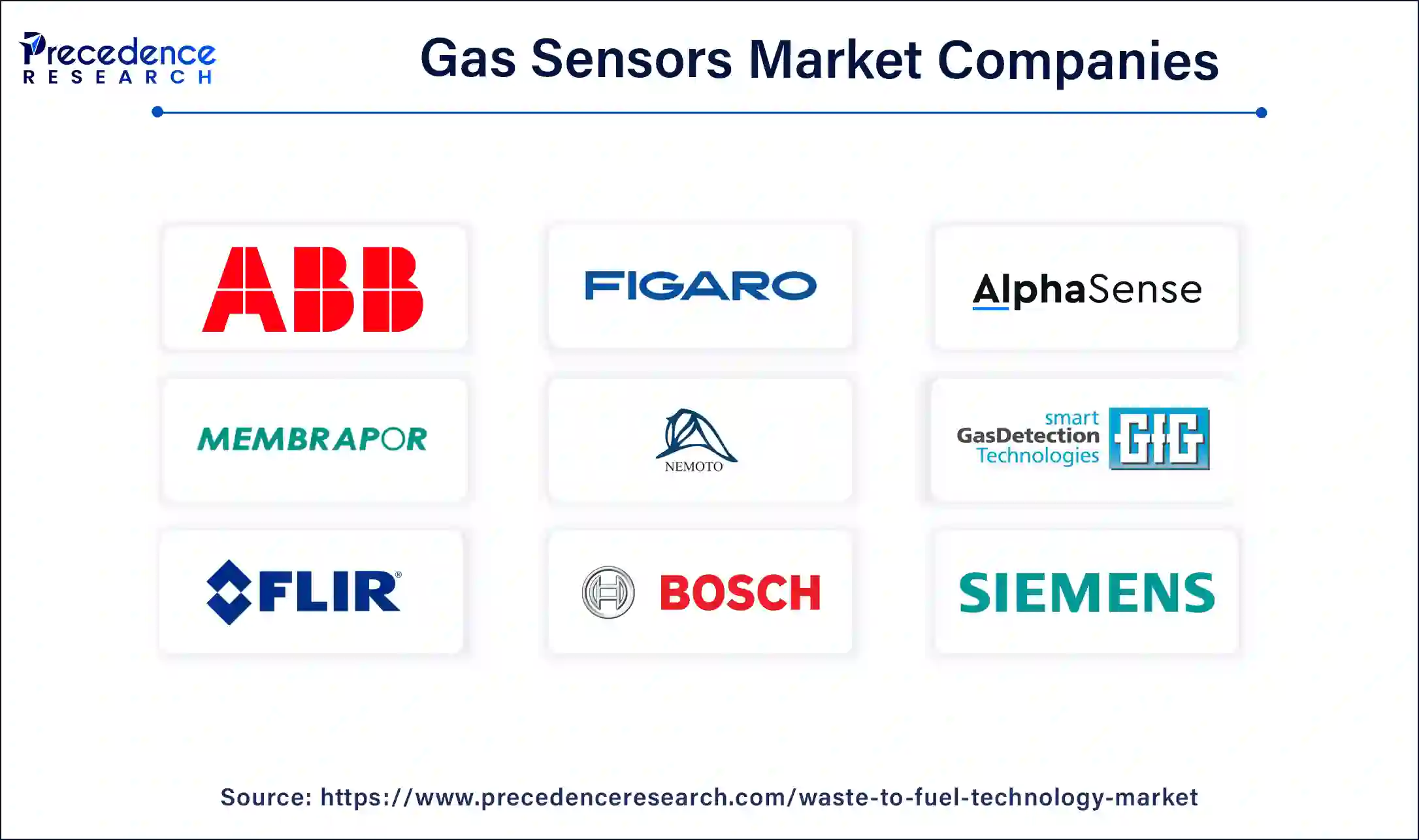
- Figaro Engineering Inc.: Figaro Engineering Inc. provides a comprehensive portfolio of high-durability gas sensors and modules, customizing in metal oxide semiconductor (MOS), electrochemical, and catalytic, along with infrared technologies for detecting combustible, toxic, and air quality gases.
- AlphaSense Inc.: AlphaSense Inc. is a prominent producer of high-quality gas and particulate sensors, catering to industrial safety, environmental monitoring, and air quality applications. They are recognized for offering reliable sensor technologies to global OEMs for both portable and fixed detection systems.
- City Technology Ltd.: City Technology Ltd provides a portfolio of over 300 products that detect 28 different gases. They cater to industrial safety, environmental monitoring, and specialized sectors such as semiconductors.
- Membrapor: Membrapor AG produces a broad range of specialized electrochemical gas sensors in Switzerland, aiming for high-performance, long-lasting, and even sensitive detectors for oxygen, toxic gases, and VOCs.
Other Major Key Players
Recent Developments
- In May 2026, Honeywell launched its advanced 4 – Series NDIR Hydrocarbon Gas Sensor to enhance industrial safety and hazardous gas detection capabilities. The sensor employs optical non dispersive infrared (NDIR) technology to precisely detect flammable gases in high risk industrial settings such as mining and oil and gas facilities. These sensors offer increased protection against contamination and chemical poisoning. This enhances long term dependability and minimise maintenance needs.
- In January 2025, researchers launched an innovative sensor that detects ammonia leaks in industrial settings. This sensor is made up of polyalanine coated laser-induced graphene to attain increased sensitivity and selectivity.
- In December 2024, a team of scientists from UNSW Sydney developed a highly sensitive miniature sensor that is able to predict even a smaller level of hazardous gas like nitrogen oxide. This flexible and tiny sensor can recognize the harmful gas in real time without requiring external energy source.
Segments covered in the report
By Type
- Wireless
- Wired
By Product
- Oxygen/Lambda Sensor
- Carbon Dioxide Sensor
- Carbon Monoxide Sensor
- NOx Sensor
- Methyl Mercaptan Sensor
- Others (Hydrogen, Ammonia, Hydrogen Sulfide)
By Technology
- Electrochemical
- Semiconductor
- Catalytic
- Infrared (IR)
- Solid State/MOS
- Photo-ionization Detector (PID)
By Output Type
- Analog
- Digital
By End User
- Medical
- Building Automation & Domestic Appliances
- Environmental
- Industrial
- Agriculture
- Petrochemical
- Automotive
- Others
By Geography
- North America
- U.S.
- Canada
- Europe
- U.K.
- Germany
- France
- Asia-Pacific
- China
- India
- Japan
- South Korea
- Malaysia
- Philippines
- Latin America
- Brazil
- Rest of Latin America
- Middle East & Africa (MEA)
- GCC
- North Africa
- South Africa
- Rest of the Middle East & Africa
For inquiries regarding discounts, bulk purchases, or customization requests, please contact us at sales@precedenceresearch.com
Frequently Asked Questions
Tags





Ask For Sample
No cookie-cutter, only authentic analysis – take the 1st step to become a Precedence Research client
 Get a Sample




 sales@precedenceresearch.com
 Schedule a Meeting
