



Generative AI In Travel Market Size, Key Companies, Company Market Share, User Adoption, Technology Deployment, Revenue Growth, Competitive Positioning, and Demand Forecast
Generative AI In Travel Market (By Type: Air Travel, Rail Travel, Cruise Travel; By Service Type: Accommodation Services, Transportation Services; By Deployment: Cloud-Based Model, On-Premises, Hybrid Model) - Global Industry Analysis, Size, Trends, Leading Companies, Regional Outlook, and Forecast 2026 to 2035
Source: https://www.precedenceresearch.com/generative-ai-in-travel-market
 Get a Sample
 Table Of Content


What is the Generative AI in Travel Market Size?
The global generative AI in travel market size is worth around USD 1063.71 million in 2025 and is predicted to increase from USD 1,265.18 million in 2026 to approximately USD 5,788.55 million by 2035, growing at a CAGR of 18.64% over the forecast period from 2026 to 2035.
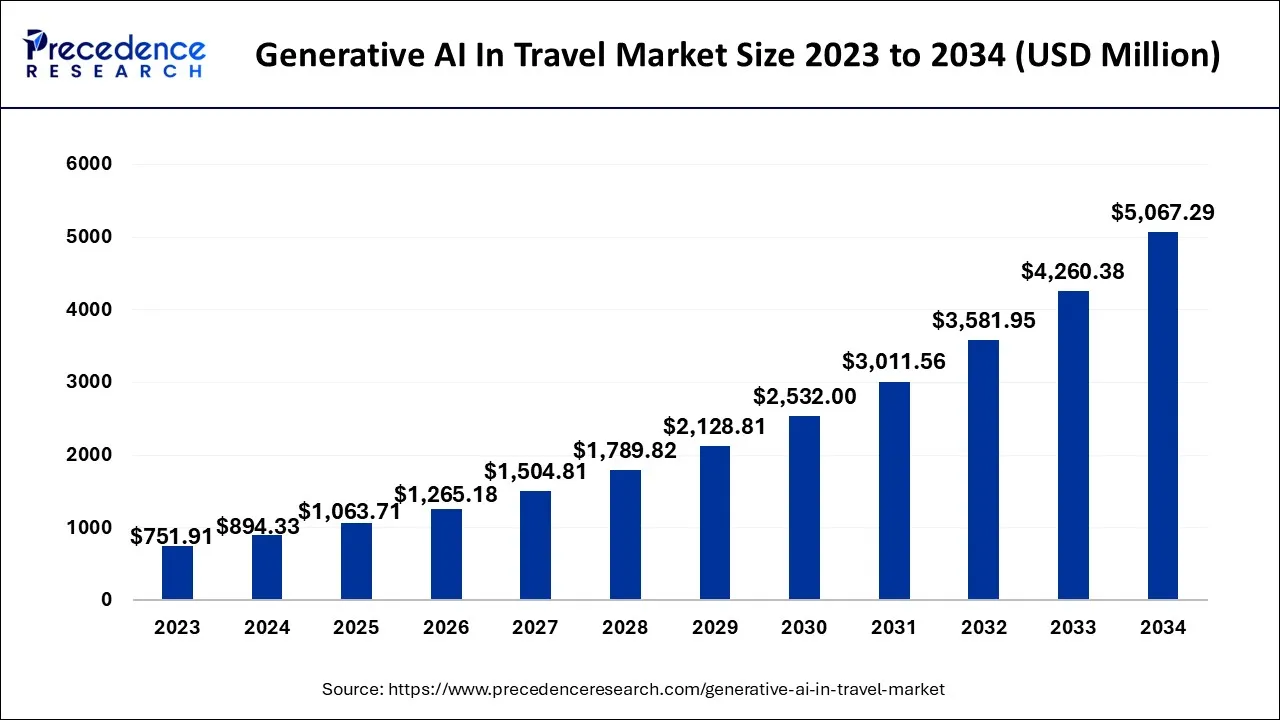
Generative AI In Travel Market Key Takeaways
- North America dominated the market with the highest market share in 2025.
- Asia Pacific is expected to hold a significant market share during the anticipated period.
- By type, the air travel segment dominated the market with the largest market share in 2023. Additionally, the rail travel segment is expected to grow at a significant rate during the forecast period.
- By service type, the accommodation services segment dominated the market with the largest market share in 2025. Additionally, the transportation accommodation segment is expected to grow at a noticeable rate during the forecast period.
- By deployment, the cloud-based segment dominated the market with the highest market share in 2025. While on-premises deployment is expected to hold a lucrative market share during the predicted timeframe.
Strategic Overview of the Global Generative AI in Travel Industry
Generative AI is the latest technology, which is involved in almost every other industry. The travel industry is one of the major industries which enhances its productivity through the use of generative AI in the workflow of the industry. Generative AI is capable of improving the travel industry by making the services easily approachable for consumers. Generative AI gives predictive analytics to provide personalized services to consumers. Moreover, the algorithms of generative AI systems can generate content that offers recommendations for flights, hotels, and other services.
Generative AI provides the most relevant result to consumers from the vast number of options in less time and reduced effort. The use of generative AI in the travel industry would be beneficial for companies as well as consumers. Many travel companies use generative AI to predict the best results or options for fares/tickets, expenses and hotels to the consumer by analyzing the enormous amount of data and current trends. Global generative AI in travel market is expected to be accelerated by the expansion of the tourism industry across the globe.
- Created by Mathew Rosenberg and featured in May 2023, Tripnotes AI is one of the fastest-growing AI platforms that generate accurate and precise data for trip planning, stays, expenses, availability of flights and accommodation along with a basic itinerary for the trip. The platform generated 40,000 itineraries on the first day of launch.
Generative AI In Travel Market Growth Factors
Generative AI is a revolutionary technology that is used by many industries for better productivity and efficient workflow. The travel industry is one of the most emerging industries across the globe. Increasing disposable incomes, especially in urban areas and rising interest in traveling fuel the growth of the overall tourism sector, this growth is expected to boost the adoption of generative solutions in the industry to enhance the efficacy of operations. Generative AI is the most promising technology which offers the most precise and accountable insights for the consumer effectively.
Generative AI gives the best options for travel mediums such as air travel, rail travel, or other sources of travel along with the accommodation services according to the requirement of the consumers. Generative AI analyzes the vast amount of historical and current trend data of the travel industry in order to offer insights to consumers.
Generative AI utilizes chatbots for generating reliable content. Chatbots help consumers enormously by providing them with relevant information by just asking or writing a query in it. In recent times the most established market players in the travel industry are turning towards generative AI to create better client services with chat solutions, and 24x7 customer support for the problem-solving purpose, these elements act as growth factors for the market while highlighting the importance of consumer satisfaction in the travel industry.
Market Outlook
- Market Growth Overview: The generative AI in travel market is expected to grow significantly between 2025 and 2034, driven by the enhanced customer experience, rising operational efficiency, and technological advancements.
- Sustainability Trends: Sustainability trends involve personalized eco-recommendations, resource optimization, and over-tourism management.
- Major Investors: Major investors in the market include Costanoa, Goodwater Capital, Stellaris, Thayer, Antler, Microsoft, Google, Amadeus, and Booking Holdings.
- Startup Economy: The startup economy is focused on hyper-personalized itinerary generation, and content and marketing automation.
Market Scope
| Report Coverage | Details |
| Market Size in 2025 | USD 1063.71 Million |
| Market Size in 2026 | USD 1,265.18 Million |
| Market Size by 2035 | USD 5,788.55 Million |
| Growth Rate from 2026 to 2035 | CAGR of 18.64% |
| Largest Market | North America |
| Base Year | 2025 |
| Forecast Period | 2026 to 2035 |
| Segments Covered | By Type, By Service Type, and By Deployment |
| Regions Covered | North America, Europe, Asia-Pacific, Latin America, and Middle East & Africa |
Market Dynamics
Driver
Rising emphasis on personalized solutions for travelers
Travel agencies or business operators are now capable of offering personalized or customized suggestions and tailored experiences with the use of generative AI. Generative AI is also capable of personalizing digital marketing materials like social media postings and reviews answers. There are existing technologies based on AI that can make sure visitors are promptly noticed and heard. With the rapid deployment of generative AI solutions, travel agencies will be able to provide distinctive, tailored journeys based on chatbot dialogues, much like the responses you give to a travel agent, thanks to generative AI. Before this innovation, the online chatbot interface only attempted to respond to the most basic questions. With the chatbots offered by generative AI platforms, customers can get sophisticated material for current and future travel references. Considering the importance of customer satisfaction, the deployment of generative AI tools in the travel industry is expected to grow; this element is expected to act as a major driver for the market's growth.
Restraint
Poor data quality
Large volumes of precise and pertinent data are needed to train and provide insights from AI algorithms. However, travel companies may struggle to compile and organize information from diverse sources, which might result in errors and inconsistencies. Poor quality data sometimes lead to pseudo or inaccurate outcomes for the users. In some cases, creation of fake content is observed to hamper the use of AI platforms for precise trip planning. The accuracy of AI-generated insights can be impacted by poor data quality, which can result in poor judgments and missed opportunities. These factors are likely to prevent the market from expanding by acting as a major restraint for the market's growth.
Opportunity
Demand for predictive analysis
Predictive analysis, which uses generative AI algorithms to analyze data and find patterns, trends, and insights, can provide tour operators the potential to enhance their operations using generative AI. Predictive analysis may help tour operators streamline their operations and make informed decisions. Predictive analytics may be used, for instance, to estimate demand for tours and activities, enabling businesses to modify personnel numbers and supplies as necessary. Additionally, by using predictive analytics, travel agencies may see prospective problems, such as tour cancellations or delays, before they happen. This enables them to take preventative action before the problem has a negative influence on client satisfaction. In case of negative outputs for travelers, travel companies are required to put in additional efforts and cost. To address such issues, travel agencies and operators are observed to boost the deployment of generative AI solutions, which is expected to offer a plethora of opportunities for the market.
Segmant Insights
Type Insights
The air travel segment dominated the market with the largest market share in 2023; the segment will continue to grow significantly during the forecast period. The segment's growth is increased due to the rising use of generative AI technology by the airline industry for the rise in the revenue share in the market. Generative AI improves the air travel experience for travelers and the airline industry through various approaches like data management, improved operations, and revenue stream.
In recent times, major airline operators have actively participated in the adoption of generative AI for better workflow and to provide better services to customers. Generative AI helps to increase customer satisfaction and avoid costly mistakes. Generative AI makes air travel easy due to predictive maintenance and increased efficiencies. Generative AI also helps in critical tasks like traffic management. Thus, generative AI positively influences the growth of the segment.
Service Type Insights
The accommodation services segment is expected to acquire a significant market share while sustaining its position in the market. Generative AI can be helpful to the hotel or hospitality sector by providing them the personalized data by analyzing the data for the guests, like the guests' behavior, purchase history, and preferences; all this customized information gives insights for the recommendation of restaurants and other services or accommodations. Generative AI can automate various time-consuming tasks.
The time consumed in the accommodation services by human agents revolves around the process of booking and check-ins. Algorithms of generative AI can ease the process of booking rooms and check-ins. Such models are also helpful in deciding the price of hotels or accommodations per real-time demand, local events, and seasonal trends. All these advantages of generative AI for accommodation services collectively propel the segment's growth.
Deployment Insights
The cloud-based segment dominated the market with the largest market revenue in 2023. Cloud-based technology is mostly used for data storage for several industries. Cloud technology gives remote access to travel companies. Travel executives and their workers may access their accounts, goods, and payment platform from any location with an internet connection thanks to cloud-based travel ERP software.
The cloud computing deployment option eliminates the requirement for on-site technological infrastructure and the associated costs. By encouraging more cooperation through a single central web page that is available to and visible to all employees, even those spread across various locations, cloud technology helps businesses remove obstacles. A single online file containing all trip paperwork, passenger information, supplier information, including business regulations and procedures, and corporate and travel agency data can be created by travel agencies and tour operators with the cloud-based deployment model.
Regional Insights
North America dominated the market with the largest market share in 2023. The growth of the market across the region is attributed to the presence of major travel companies in the North American countries. The United States holds the largest contributing share in the market. The faster technological adoption in several industries in the region is observed to supplement the growth of the market in this region. The rising tour and travel industry across the region will likely boost the demand for better management. Generative AI helps to manage and improve the services which are provided by the travel industry to consumers.
U.S. Generative AI in Travel Market Trends
The U.S. region's market growth is driven by more adoption and satisfaction. AI enables concierge-level experiences, from tailored marketing to booking flights/hotels and suggesting upgrades, and rising operational efficiency.
Asia Pacific is expected to register the fastest rate of growth during the forecast period. The growing tourism industry along with the supportive government policies to boost the tourism business in countries of Asia Pacific highlight the growth of the market for the upcoming period. Recently Asia Pacific has emerged as one of the major attractions for tourists owing to its historic heritage and tourism industrial development, this element is observed to force travel agencies and operators to adopt advanced and generative solutions to ease the operation in a cost-effective way.
China Generative AI in Travel Market Trends
China's integration of immersive AI assistants, such as digital historical figures, enhances on-site experiences, while platforms like Xiaohongshu and Douyin have become AI-centric hubs for discovery and seamless booking. Generative AI further accelerates the industry through automated content creation and sophisticated data analytics, allowing providers to optimize pricing and services in real time.
In May 2023, a leading service provider platform for tours and travels in India, MakeMyTrip announced that the company will be utilizing generative AI models to offer personalized solutions, recommend precise travel plans and information about the accommodation.
How Did Europe Notably Grow in the Generative AI in Travel Market?
European hyper-personalized itineraries and dynamic pricing models. While tech giants like Amadeus and Sabre embed AI into core reservation systems, European tourism organizations are focusing on strategic innovation in niche markets and automated marketing rather than foundational model development.
Germany Generative AI in Travel Market Trends
Germaine's AI quickly generates travel guides, itineraries, and marketing materials, reducing cost and speeding up campaigns, and it provides support in digital assistance, such as booking, navigation, and in-destination queries, enhancing customer experience.
Generative AI in Travel Market Companies
- Amadeus IT Group: This company uses generative AI for conversational search and internal data analysis to help travel sellers. They aim to connect industry players to access dynamic content efficiently.
- Google LLC: Google uses its Gemini models and AI Overviews to create personalized itineraries and travel recommendations. They also use AI for Flight Search and hotel price tracking.
- Airbnb Inc.: Airbnb uses generative AI to enhance customer service and provide personalized guest recommendations. They also develop AI-powered tools for dynamic pricing.
- Expedia Group Inc.: Expedia has an AI-powered trip planner and a "Trip Matching" feature. Their AI agent handles millions of customer conversations.
- Skyscanner Ltd.: Skyscanner uses generative AI to improve search capabilities and offer personalized options. They focus on using AI to provide tailored suggestions.
- Kayak Software Corporation: Kayak uses generative AI for real-time recommendations and to streamline the search process. They use AI to understand user preferences.
- Sabre Corporation: Sabre, with Google, launched an AI-powered platform to personalize the shopping experience. This platform helps with airline retailing and operational efficiency.
- Booking Holding Inc.: Booking is using generative AI with partners like OpenAI to provide personalized assistance. They aim to use AI to improve the customer experience.
Recent Developments
- In December 2025, Siyanda South African tourism launched Africa's first dedicated GuideGeek AI assistant to provide real-time, destination-specific insights for North American travelers. The personalized answers round was performed. (Source: https://www.travelweekly.com/ )
- In June 2023, Bookings.com announced the capabilities of ChatGPT's advanced language model to conduct a trail trip planner. The new launch will be featured on Bookings.com's current machine-learning model to offer a variety of accommodation and destination choices.
- In June 2023, the generative AI-powered contextual language and SGI (semantic graph index) were the latest two new technologies have been announced by Google. The launches would significantly impact the hospitality industry and change the experience of searching for information.
- In June 2023, a web3-based hotel booking platform “Sleap.io,” was launched to transform the hotel industry with the release of revolutionary technologies. The launch will give users access to the hotel booking platform that submerges artificial intelligence and blockchain technologies.
- In July 2023, a leading communication solutions provider, Alendei Platforms Pvt Ltd., announced the launch of its revolutionary product, ‘Multi-Channel and Omni-Channel Chatbot.' The launch showcases the Alendei Platforms' commitment to industry expertise and technological advancement. The launch was designed to give the improved experience of enterprise consumers' engagement and communication.
Segments Covered in the Report
By Type
- Air Travel
- Rail Travel
- Cruise Travel
By Service Type
- Accommodation Services
- Transportation Services
By Deployment
- Cloud-Based Model
- On-Premises
- Hybrid Model
By Geography
- North America
- Europe
- Asia-Pacific
- Latin America
- Middle East and Africa
For inquiries regarding discounts, bulk purchases, or customization requests, please contact us at sales@precedenceresearch.com
Frequently Asked Questions





Ask For Sample
No cookie-cutter, only authentic analysis – take the 1st step to become a Precedence Research client
 Get a Sample




 sales@precedenceresearch.com
 Schedule a Meeting
