


Grease Market Revenue, Leading Companies, Company Product Portfolio, Production Output, Material Consumption, Sales Performance, Pricing Trends, Distribution Analysis, Company Market Share, and Forecast
Vidyesh Swar, a Chemical and Materials Industry Expert, estimates the grease market at USD 5.42 billion in 2026, with the market projected to reach USD 6.41 billion by 2035 at a CAGR of 3.40%. Major grease marketcompanies such as Shell, ExxonMobil, FUCHS are competing across key material and application segments, including thickener type, base oil, end use, region.
Source: https://www.precedenceresearch.com/grease-market
 Get a Sample
 Table Of Content


Grease Market Size, Demand, and Trends Analysis 2035
The grease market is forecasted to expand from USD 5.42 billion in 2026 to USD 6.41 billion by 2035, growing at a CAGR of 3.40% from 2026 to 2035.
Key Takeaways
Market Size & Growth Outlook
- Market size in 2025: USD 5.42 billion
- Estimated market size in 2026: USD 5.60 billion
- Projected market size by 2035: USD 7.57 billion
- CAGR (2026–2035): 3.40%
Regional Market Spotlight
- Asia Pacific led the market in 2025 with a 41.60% share, worth USD 2.25 billion. It is also expected to be the fastest-growing region, with a CAGR of 4.08% from 2025 to 2035.
- Europe accounted for 23.80% of the market in 2025, worth USD 1.29 billion.
- North America accounted for 22.20% of the market in 2025, worth USD 1.20 billion.
Segmental Spotlight
- By thickener type, Metallic Soap held a 64.40% share in 2025, worth USD 3.49 billion.
- By base oil, Mineral Oil led the market in 2025 with a 68.60% share, worth USD 3.72 billion.
- By end use, Automotive held the largest share in 2025 at 34.60%, worth USD 1.88 billion.
Grease Market Size and Forecast, 2025-2035 (USD Billion)
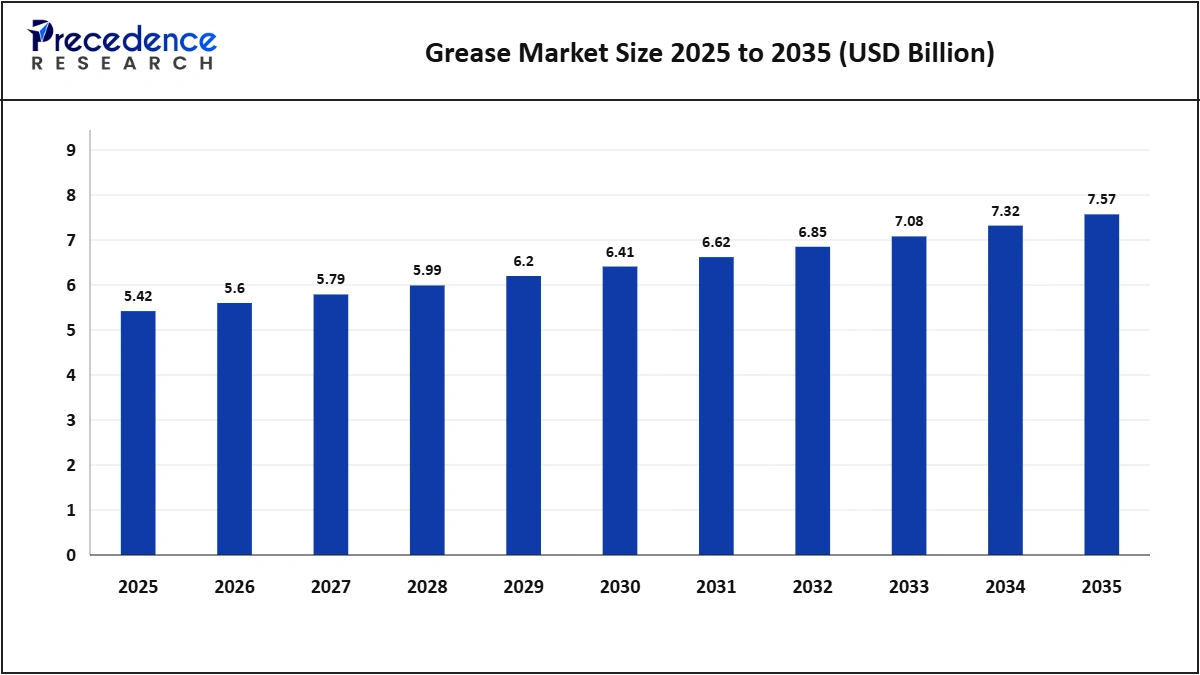
Note: 2025 is the base year, while figures from 2026 to 2035 are forecasts.
Sources: Expert interviews, secondary sources, Precedence Research database and Precedence Research analysts.
The grease market is expected to grow from USD 5.42 billion in 2025 to USD 7.57 billion by 2035. This is because vehicles, machines and industrial bearings regularly need grease to reduce friction and wear. Grease also needs to be replaced or reapplied over time, creating steady demand from the automotive and industrial sectors.
High-performance and specialised greases are also becoming more popular. These products often sell at higher prices, helping the market reach USD 6.41 billion by 2030 and maintain a CAGR of 3.40% from 2026 to 2035.
- Analyst View: We estimated the market by looking at global grease production and consumption across different thickener types, base oils, end uses and regions. We then used average selling prices for standard and high-performance greases to estimate the total market value.
Our estimates also consider vehicle production and fleet sizes, the use of industrial and mining equipment, and construction activity. We compared the results with revenue from major lubricant companies, industry production statistics and published market estimates.
Our base-year estimate is higher than some comparable estimates because those figures may not fully account for the higher prices of specialised greases. We expect steady growth as demand increases in Asia and more customers choose premium products. However, longer periods between grease applications may limit growth in the volume of grease sold.
Market Trends
- Polyurea greases are becoming more common in sealed bearings and electric vehicles.
- Calcium sulphonate greases are seeing greater use in mining and steel industries.
- Bio-based greases are gaining attention in environmentally sensitive applications.
- Wind turbines are creating more demand for specialised bearing greases.
- New grease production plants are opening in Asia.
- Longer periods between grease applications are encouraging the use of premium greases.
Drivers, Restraints and Opportunities
Driver
Industrial production, construction and mining activities need grease to protect bearings, gears and other moving parts. Growing vehicle fleets in Asia are also increasing demand for automotive grease. High-performance greases can last longer, reduce maintenance needs and help prevent equipment downtime. This makes them attractive to customers who want to lower maintenance costs. Electric vehicles and wind turbines are creating demand for specialised grease products. Infrastructure investment in developing markets is also supporting the use of heavy-duty greases.
Restraint
Changes in lithium prices can increase the cost of producing lithium-based greases. Longer-lasting greases and sealed-for-life bearings reduce the need for frequent grease replacement. Electric vehicles also need less grease in some drivetrain components. Changes in raw material and base oil prices can put pressure on manufacturers' profit margins. Competition from low-cost regional producers can also make it harder for companies to increase prices.
Opportunity
Electric vehicle bearings and components need greases that operate quietly and work well with electrical systems. The growth of wind energy is increasing demand for specialised greases. Environmental regulations may create more opportunities for bio-based products. Calcium sulphonate and polyurea greases can replace lithium-based greases in some demanding applications. Automated lubrication systems used in factories and industrial facilities can also increase sales of premium grease products.
Market Segmentation: 2025 Share and Value
Grease Market By Thickener Type 2025 Share & Size
| Segments | 2025 Share | 2025 Market Value |
| Metallic Soap | 64.40% | USD 3.49 billion |
| Non-Soap (Polyurea & Others) | 19.20% | USD 1.04 billion |
| Inorganic (Clay & Silica) | 10.20% | USD 0.55 billion |
| Others | 6.20% | USD 0.34 billion |
Note: 2025 is the base year.
Sources: Expert interviews, secondary sources, Precedence Research database and Precedence Research analysts.
Metallic soap greases held 64.40% of the market in 2025, with a value of USD 3.49 billion. This is mainly because lithium and lithium complex greases can be used in many applications, including wheel bearings, vehicle chassis parts, electric motors and general industrial bearings. They offer good temperature and water resistance at a reasonable cost.
Calcium sulphonate and aluminium complex greases are also becoming more popular in steel, mining and marine applications.
Non-soap greases accounted for 19.20% of the market, worth USD 1.04 billion. This is the fastest-growing thickener category because polyurea greases can last a long time in sealed bearings, electric motors and electric vehicle components.
Inorganic greases accounted for 10.20% of the market, worth USD 0.55 billion. Other types accounted for the remaining 6.20%, worth USD 0.34 billion.
Grease Market By Base Oil 2025 Share & Size
| Segments | 2025 Share | 2025 Market Value |
| Mineral Oil | 68.60% | USD 3.72 billion |
| Synthetic Oil | 22.40% | USD 1.21 billion |
| Bio-Based Oil | 9.00% | USD 0.49 billion |
Note: 2025 is the base year.
Sources: Expert interviews, secondary sources, Precedence Research database and Precedence Research analysts.
Mineral oil held the largest share in 2025 at 68.60%, worth USD 3.72 billion. It is widely used because it is an affordable choice for making general-purpose greases.
Synthetic oil accounted for 22.40% of the market, worth USD 1.21 billion. It is used when grease needs to work in very high or low temperatures, at high speeds or for longer periods.
Bio-based oil accounted for 9.00% of the market, worth USD 0.49 billion. It is the fastest-growing base oil type, supported by environmental rules and requirements in marine, forestry and agricultural applications.
Grease Market By End Use 2025 Share & Size
| Segments | 2025 Share | 2025 Market Value |
| Automotive | 34.60% | USD 1.88 billion |
| General Manufacturing | 18.40% | USD 1.00 billion |
| Mining & Construction | 15.80% | USD 0.86 billion |
| Steel & Metals | 9.20% | USD 0.50 billion |
| Energy & Power Generation | 8.40% | USD 0.46 billion |
| Marine & Others | 13.60% | USD 0.74 billion |
Note: 2025 is the base year.
Sources: Expert interviews, secondary sources, Precedence Research database and Precedence Research analysts.
Automotive was the largest end-use segment in 2025, accounting for 34.60% of the market, worth USD 1.88 billion. Vehicles use grease in wheel bearings, constant velocity joints, chassis parts and electrical components. Grease is needed during vehicle manufacturing as well as for regular maintenance and repairs.
General manufacturing accounted for 18.40% of the market, worth USD 1.00 billion. Mining and construction accounted for 15.80%, worth USD 0.86 billion. Steel and metals made up 9.20%, worth USD 0.50 billion. Energy and power generation accounted for 8.40%, worth USD 0.46 billion, while marine and other applications together held 13.60%, worth USD 0.74 billion.
Energy and power generation, including wind turbines, is expected to be the fastest-growing end-use segment.
- Analyst View: We estimated the value of each segment by matching grease consumption and prices with the relevant thickener types, base oils and end uses. We also used industry production statistics and supplier revenue information to check the estimates.
Metallic soap greases lead the market because lithium-based products are suitable for many different applications. Automotive is the largest end-use segment because of the large number of vehicles in use. We expect polyurea, synthetic and bio-based greases, along with demand from wind energy, to account for a growing share of the market.
Regional Analysis
Grease Market By Region 2025 Share & Size
| Region | 2025 Share | 2025 Market Value |
| Asia Pacific | 41.60% | USD 2.25 billion |
| Europe | 23.80% | USD 1.29 billion |
| North America | 22.20% | USD 1.20 billion |
| Latin America | 7.00% | USD 0.38 billion |
| Middle East & Africa | 5.40% | USD 0.29 billion |
Note: 2025 is the base year.
Sources: Expert interviews, secondary sources, Precedence Research database and Precedence Research analysts.
Asia Pacific held the largest market share in 2025 at 41.60%, worth USD 2.25 billion. It is also expected to be the fastest-growing region. The main reasons are high vehicle production and large vehicle fleets in China, India and Southeast Asia, along with strong manufacturing, construction and mining activity. Mining in Australia and Indonesia and the opening of new grease plants also support demand.
Europe accounted for 23.80% of the market, worth USD 1.29 billion. Its market is supported by automotive and machinery manufacturing, wind energy projects, and demand for high-performance and bio-based greases.
North America held 22.20% of the market, worth USD 1.20 billion. Demand comes from its large vehicle fleet, heavy-duty trucking, mining, oil and gas, and agriculture industries.
Latin America accounted for 7.00% of the market, worth USD 0.38 billion. The Middle East and Africa held 5.40%, worth USD 0.29 billion. Mining, construction and vehicle markets support demand in both regions.
Asia Pacific accounted for 41.60% of the market in 2025, worth USD 2.25 billion, making it the largest and fastest-growing region. China is the world's largest grease producer and consumer. Shell started production at a grease plant in Indonesia in 2026, with an annual capacity of 12,000 tonnes. FUCHS also opened a grease plant in China in 2024. Mining and construction activities in Australia, Indonesia and India add to regional demand.
Europe accounted for 23.80% of the market in 2025, worth USD 1.29 billion. Automotive and machinery manufacturers need high-performance greases for their equipment and products. Wind turbines also require specialised grease for main and pitch bearings. Environmental rules are helping support demand for bio-based greases.
North America held 22.20% of the market in 2025, worth USD 1.20 billion. Its large vehicle fleet and heavy-duty trucking industry support grease demand. Mining, agriculture, oil and gas activities also use heavy-duty greases. Calcium sulphonate greases are gaining use in industrial applications.
Latin America accounted for 7.00% of the market in 2025, worth USD 0.38 billion. Mining in Chile, Peru and Brazil creates strong demand for heavy-duty greases. Vehicle markets in Brazil and Mexico also support regional sales.
The Middle East and Africa accounted for 5.40% of the market in 2025, worth USD 0.29 billion. Mining in South Africa uses specialised products, including calcium sulphonate complex greases. Construction and oil and gas activities also support demand in Gulf countries.
Analyst View: We estimated regional market shares using grease consumption, product types and prices in each region. Asia Pacific leads because it has a large manufacturing base and a high number of vehicles in use. We expect the region to grow faster than others because industrial activity, vehicle demand and grease production capacity are expanding quickly.
Top 10 Companies in the Grease Market
| Rank | Company Name | Market-Specific Revenue (USD Billion) | 2025 Share | Key Products / Business | Headquarters |
| 1 | Shell | 0.62 | 11.44% | Gadus greases | United Kingdom |
| 2 | ExxonMobil | 0.52 | 9.59% | Mobilgrease and Mobil SHC greases | United States |
| 3 | FUCHS | 0.48 | 8.86% | RENOLIT greases | Germany |
| 4 | TotalEnergies | 0.36 | 6.64% | Multis and Ceran greases | France |
| 5 | Klüber Lubrication | 0.34 | 6.27% | Specialty greases | Germany |
| 6 | Chevron | 0.30 | 5.54% | Delo and Ultra-Duty greases | United States |
| 7 | Sinopec Lubricant | 0.28 | 5.17% | Great Wall greases | China |
| 8 | BP Castrol | 0.22 | 4.06% | Castrol greases | United Kingdom |
| 9 | SKF | 0.12 | 2.21% | LGxx bearing greases | Sweden |
| 10 | Idemitsu Kosan | 0.12 | 2.21% | Daphne greases | Japan |
Note: Company revenues and shares are 2025 estimates.
Sources: Company press releases, expert interviews, secondary sources, Precedence Research database and Precedence Research analysts.
Shell led the grease market in 2025, with an estimated 11.44% share and revenue of USD 0.62 billion. ExxonMobil ranked second with a 9.59% share and USD 0.52 billion in revenue. FUCHS ranked third with an 8.86% share and USD 0.48 billion in revenue.
Shell sells its Gadus greases to automotive, industrial and mining customers around the world. The company is also expanding its production capacity. This includes a new plant in Indonesia that started production in 2026 and can produce up to 12,000 tonnes of grease per year.
ExxonMobil supplies Mobilgrease and synthetic Mobil SHC greases. Its products are widely used in industrial and heavy-duty applications. FUCHS is a major independent lubricant manufacturer that sells RENOLIT greases. It has also expanded its production facilities in China and Germany.
Other major companies include TotalEnergies, Klüber Lubrication, Chevron, Sinopec, Castrol, SKF and Idemitsu. These companies compete in automotive, industrial and specialised grease markets.
The top 10 companies accounted for an estimated 61.99% of the market in 2025, with combined revenue of USD 3.36 billion. The remaining 38.01%, worth USD 2.06 billion, was shared by regional grease producers, lubricant businesses owned by national oil companies and specialised grease manufacturers.
The market is moderately concentrated among major lubricant companies, although many regional manufacturers also compete in the standard grease segment. Companies mainly compete on product performance, including temperature resistance, load handling and water resistance. Customer approvals, technical support, distribution networks and prices are also important. Specialised greases for electric vehicles, wind turbines and mining can often sell at higher prices.
Recent Developments
- September 2026: Shell started production at its new grease plant in Marunda, Bekasi, Indonesia. The plant can produce up to 12,000 tonnes of Shell Gadus grease per year.(Source: shell.com)
Grease Market Segments
By Thickener Type
- Metallic Soap
- Non-Soap (Polyurea & Others)
- Inorganic (Clay & Silica)
- Others
By Base Oil
- Mineral Oil
- Synthetic Oil
- Bio-Based Oil
By End Use
- Automotive
- General Manufacturing
- Mining & Construction
- Steel & Metals
- Energy & Power Generation
- Marine & Others
By Region
- North America (U.S., Canada, Mexico)
- Europe (Germany, U.K., France, Italy, Spain, Rest of Europe)
- Asia Pacific (China, Japan, India, South Korea, Taiwan, Rest of Asia Pacific)
- Latin America (Brazil, Argentina, Rest of Latin America)
- Middle East & Africa (GCC, South Africa, Rest of MEA)
Research Methodology
This report covers the global grease market by thickener type, base oil, end use and region.
We used 2025 as the base year. To estimate the market size, we started with grease consumption volumes across different thickener types, base oils, end uses and regions. We then applied average selling prices to calculate the market value.
We checked these estimates against revenue from major lubricant companies and industry production statistics. We also divided the market into segments and regions based on the types of grease used, the base oils involved, end-use demand and regional market conditions.
Key estimates were checked against company disclosures, regulatory information, industry data and published third-party estimates. Information that could not be matched or confirmed through these checks was excluded.
All segment, regional and company estimates were aligned with the same 2025 base year. The forecast for 2026–2035 was then calculated using a constant CAGR from the 2025 base and checked for consistency.
Analyst View: Overall Market
The grease market is well established and is expected to grow steadily. Most of the growth is likely to come from Asia and from demand for high-performance products.
Our estimate connects market demand with grease consumption, product mix and prices. This means the forecast reflects changes in industrial activity, vehicle fleets and demand for premium products.
Electric vehicles, wind turbines and specialised grease applications offer opportunities for future growth. However, changes in raw material prices and longer periods between grease applications could limit market growth.
Sources and References
- Hydrocarbon Engineering. "Shell starts production at its grease manufacturing plant in Indonesia". 2026-09-15. Shell Indonesia grease plant. (Source: hydrocarbonengineering.com)
- FUCHS. "FUCHS opens a new production plant for polyurea lubricating greases at its Kaiserslautern site". Undated. FUCHS polyurea plant. (Source: fuchs.com)
For inquiries regarding discounts, bulk purchases, or customization requests, please contact us at sales@precedenceresearch.com
Frequently Asked Questions
Tags





Ask For Sample
No cookie-cutter, only authentic analysis – take the 1st step to become a Precedence Research client
 Get a Sample




 sales@precedenceresearch.com
 Schedule a Meeting