



Hydraulic Fluid Market Trends, Leading Companies, Company Revenue / Sales Performance, Plant Utilization, Production Volume, Pricing Dynamics, Supply Chain Performance, Competitive Landscape, and Industry Growth
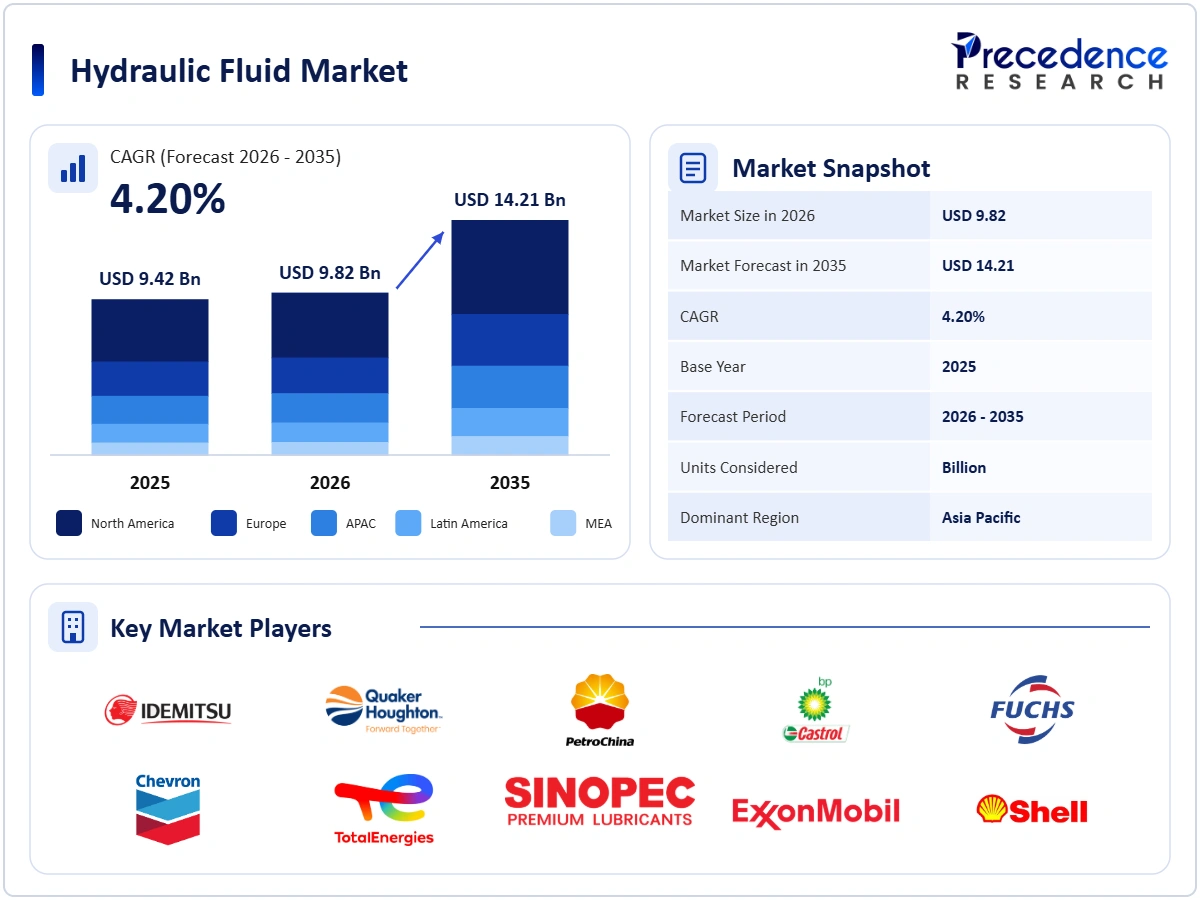
Vidyesh Swar, a Chemical and Materials Industry Expert, estimates the hydraulic fluid market at USD 9.82 billion in 2026 to USD 14.21 billion by 2035, growing at a CAGR of 4.20%. Major hydraulic fluid market companies such as Shell, ExxonMobil, Sinopec Lubricant are competing across key material and application segments, including Type, distribution channel, end use, region.
Source: https://www.precedenceresearch.com/hydraulic-fluid-market
 Get a Sample
 Report Description


Hydraulic Fluid Market Size, Share, Trends, and Growth Forecast 2035
The hydraulic fluid market is forecasted to expand from USD 9.82 billion in 2026 to USD 14.21 billion by 2035, growing at a CAGR of 4.20% from 2026 to 2035.
Key Takeaways
Market Size & Growth Outlook
- Market size in 2025: USD 9.42 billion
- Estimated market size in 2026: USD 9.82 billion
- Projected market size by 2035: USD 14.21 billion
- CAGR (2026-2035): 4.20%
Regional Market Spotlight
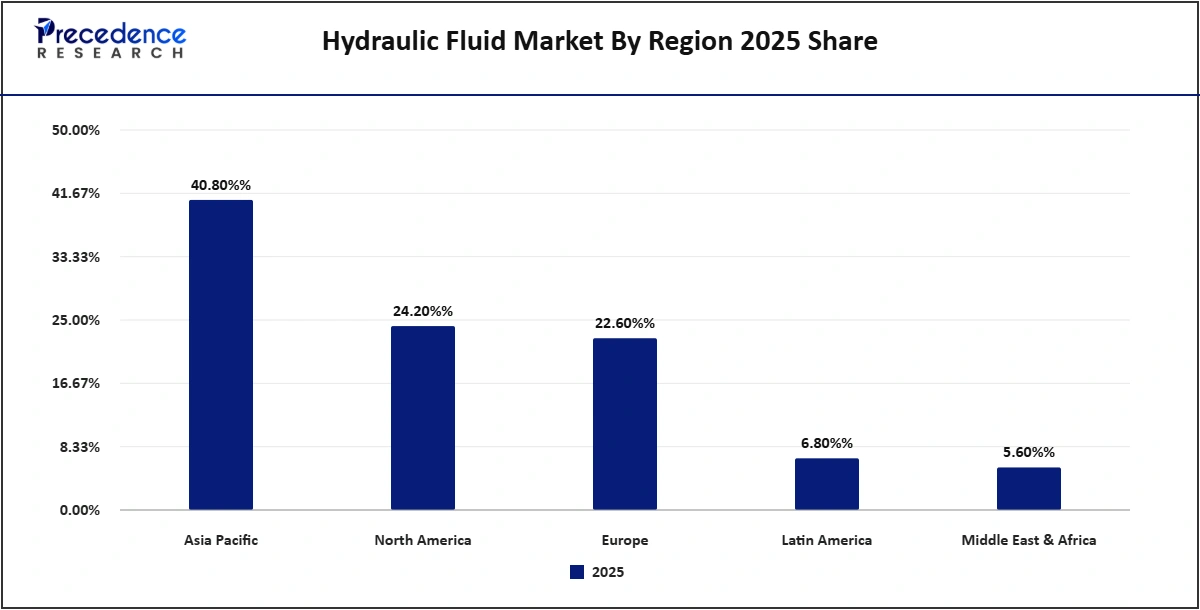
- Asia Pacific held the largest market share in 2025, at 40.80% (USD 3.84 billion). It is also expected to be the fastest-growing region, with a CAGR of 4.89% from 2025 to 2035.
- North America accounted for 24.20% (USD 2.28 billion) of the market in 2025.
- Europe accounted for 22.60% (USD 2.13 billion) of the market in 2025.
Segmental Spotlight
- By type, Mineral Oil held the largest share in 2025, at 71.40% (USD 6.73 billion).
- By distribution channel, Aftermarket held a 64.20% share (USD 6.05 billion) in 2025.
- By end use, Construction & Mining held the largest share in 2025, at 32.40% (USD 3.05 billion).
Hydraulic Fluid Market Size and Forecast, 2025-2035 (USD Billion)
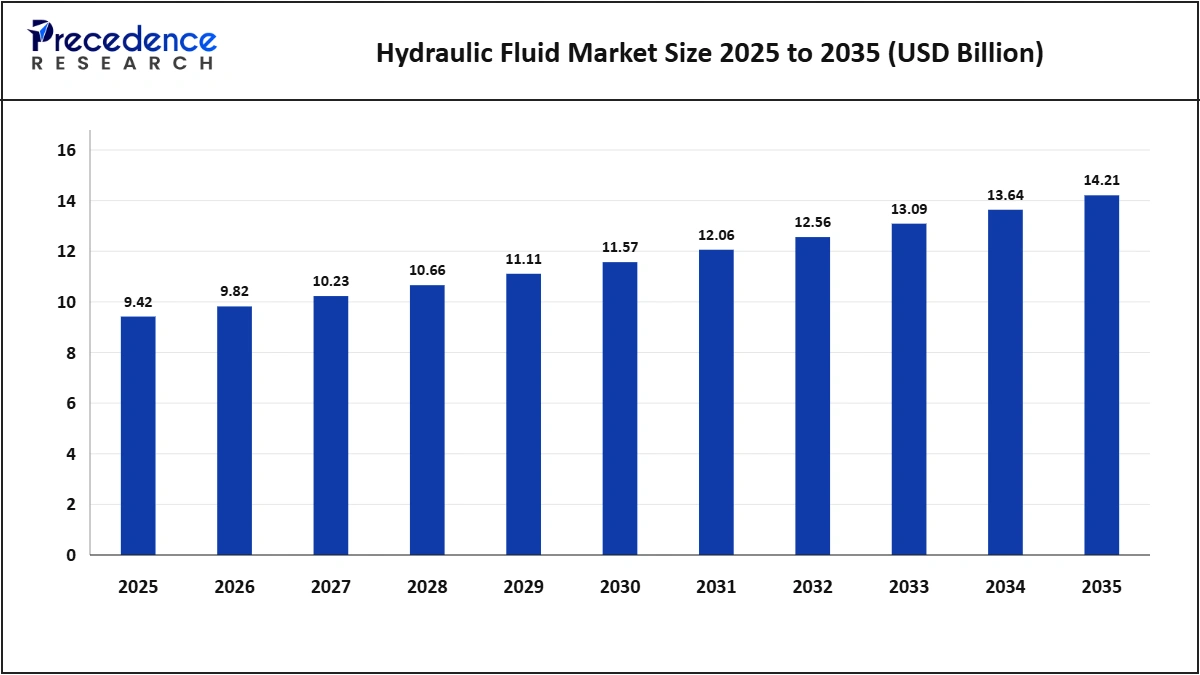
Note: 2025 is the base year, while the figures from 2026 to 2035 are forecasts.
Sources: Expert interviews, secondary sources, Precedence Research database and Precedence Research analysts.
The hydraulic fluid market is expected to grow from USD 9.42 billion in 2025 to USD 14.21 billion by 2035. This growth is supported by the use of hydraulic systems in construction, mining, agriculture and industrial equipment. These systems need hydraulic fluids to transfer power, reduce friction and control heat. The fluids also need to be topped up or replaced regularly.
Environmental rules and the need for better equipment performance are encouraging users to choose higher-value synthetic and bio-based fluids. As a result, the market is expected to reach USD 11.57 billion by 2030 and grow at a CAGR of 4.20% from 2026 to 2035.
- Analyst View: We estimated the market by looking at how much hydraulic fluid is used by different fluid types, end-use industries and regions. We then applied the average selling prices of mineral, synthetic, fire-resistant and bio-based fluids. The estimate includes fluids used to fill new equipment at the factory and fluids sold later for maintenance and replacement.
Our volume estimates are based on the number of construction, agricultural, mining and industrial machines in use, new equipment sales and the time between fluid replacements. We also compared the total estimate with the industrial lubricant revenue of major oil and lubricant companies and with published market estimates. This comparison places our base-year estimate slightly above similar figures. The expected growth reflects the rising use of equipment and the shift toward higher-value fluids, while longer replacement intervals may limit growth.
Market Trends
- Biodegradable fluids are becoming more popular in environmentally sensitive areas.
- Zinc-free additives are helping manufacturers develop cleaner hydraulic fluid products.
- Long-life fluids help equipment owners reduce how often fluids need to be replaced.
- Energy-efficient fluids can help reduce equipment fuel consumption.
- Fire-resistant, water-based fluids help improve workplace safety.
- Equipment manufacturers are increasingly promoting their own approved hydraulic fluids through warranty programmes.
Drivers, Restraints and Opportunities
Driver
More construction and infrastructure projects are increasing the demand for hydraulic equipment and fluids. Industrial automation and manufacturing also depend on hydraulic presses and machinery. The growing use of machinery in mining and agriculture is creating further demand. Environmental rules are increasing the need for biodegradable fluids in sensitive areas. Users are also looking for fluids that last longer and help save energy.
Restraint
Changes in base oil and additive prices can reduce profit margins. The growing use of electric technology in some machines may reduce the need for hydraulic systems. Longer fluid replacement intervals can also lower replacement sales. Bio-based and synthetic fluids usually cost more than mineral oils. In addition, competition from low-cost fluid manufacturers can make it difficult for companies to increase prices.
Opportunity
Biodegradable and renewable fluids have good growth potential as environmental rules become stricter. Fire-resistant fluids may see greater demand in mining, steel production and renewable energy. Fluid condition monitoring can create new service opportunities for suppliers. Infrastructure projects in Asia and Africa can increase sales volumes. Energy-efficient fluids can also help equipment users lower energy use and emissions.
Market Segmentation: 2025 Share and Value
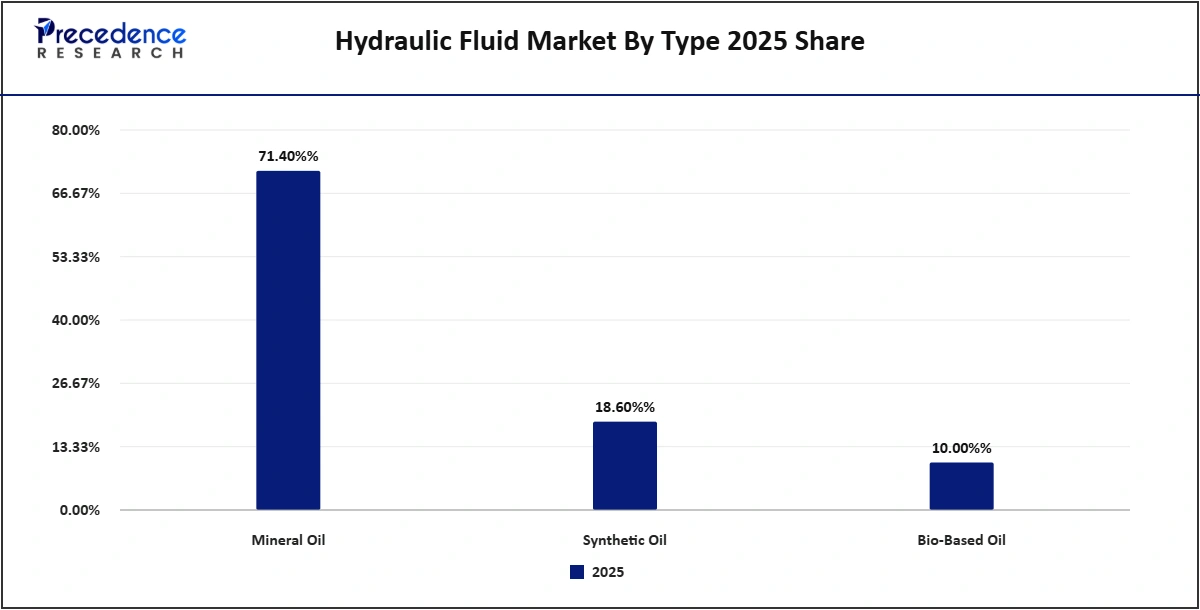
Hydraulic Fluid Market By Type 2025 Share
Note: 2025 is the base year.
Sources: Expert interviews, secondary sources, Precedence Research database and Precedence Research analysts.
Mineral oil fluids held 71.40% of the market, worth USD 6.73 billion, in 2025. They are widely used because they protect pumps and valves from wear and are affordable for most mobile and industrial hydraulic systems. Equipment manufacturers also commonly use them when filling new machines and recommend them for maintenance.
Group II and Group III base oils are helping improve fluid life and energy efficiency. Synthetic oil held 18.60% of the market, worth USD 1.75 billion. This category includes polyalphaolefins and esters used in extreme temperatures, as well as phosphate esters and water glycols used where fire resistance is important, such as in steel production, mining and aerospace.
Bio-based oil held 10.00% of the market, worth USD 0.94 billion, in 2025. It is the fastest-growing type because environmental rules are increasing the use of biodegradable fluids in forestry, marine activities, waterways and other environmentally sensitive areas.
Hydraulic Fluid Market by Distribution Channel 2025 Share & Size
| Segments | 2025 Share | 2025 Market Value |
| Aftermarket | 64.20% | USD 6.05 billion |
| OEM (Factory Fill) | 35.80% | USD 3.37 billion |
Note: 2025 is the base year.
Sources: Expert interviews, secondary sources, Precedence Research database and Precedence Research analysts.
The aftermarket held 64.20% of the market, worth USD 6.05 billion, in 2025. Hydraulic fluids need to be topped up and replaced during the working life of equipment. These products are often supplied through distributors and service providers.
OEM factory fill accounted for 35.80% of the market, worth USD 3.37 billion. This segment depends mainly on the production of new equipment. Fluids sold under equipment manufacturers' approved brands are gaining attention as manufacturers offer longer warranties and recommend longer fluid replacement intervals.
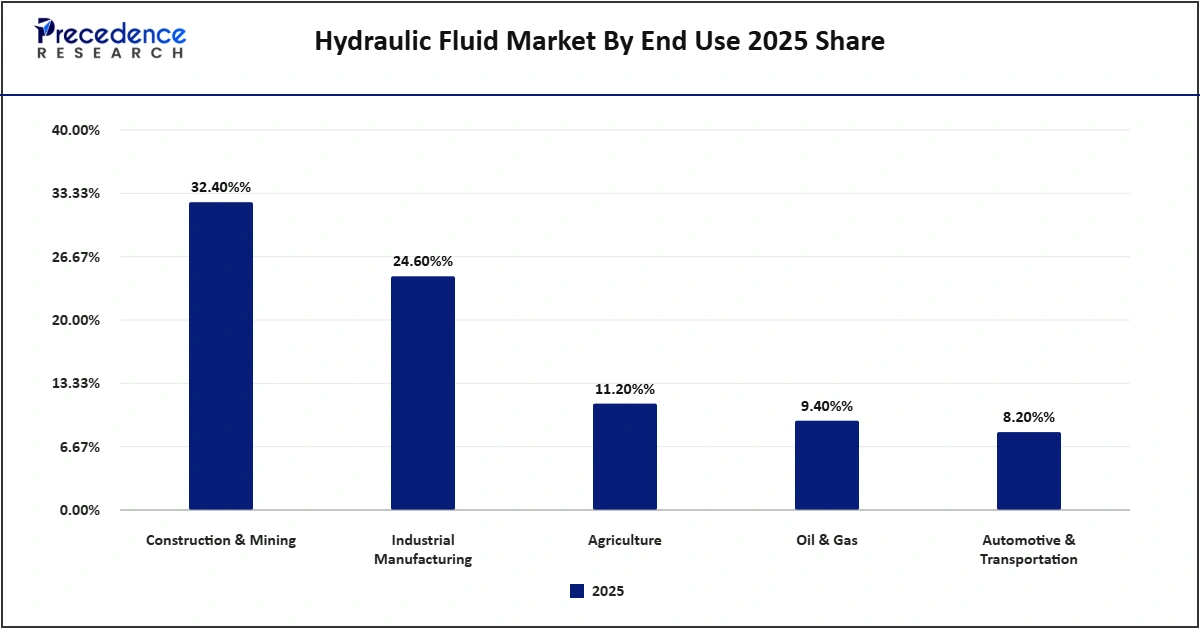
Hydraulic Fluid Market By End Use 2025 Share
Note: 2025 is the base year.
Sources: Expert interviews, secondary sources, Precedence Research database and Precedence Research analysts.
Construction and mining accounted for 32.40% of the market, worth USD 3.05 billion, in 2025. This is mainly because excavators, loaders, cranes and mining machines use large hydraulic systems.
Industrial manufacturing accounted for 24.60% of the market, worth USD 2.32 billion. Agriculture accounted for 11.20% (USD 1.06 billion), oil and gas accounted for 9.40% (USD 0.89 billion), automotive and transportation accounted for 8.20% (USD 0.77 billion), and marine, aerospace and other uses accounted for 14.20% (USD 1.34 billion).
Marine activities and other uses in environmentally sensitive areas are among the fastest-growing applications for bio-based fluids.
- Analyst View: We estimated the value of each segment by matching fluid volumes and prices with fluid types, sales channels and end-use industries. We also considered the number of machines in use and the revenue mix of lubricant companies. Mineral oil leads because it is affordable and works with a wide range of equipment. Construction leads because construction machines use large amounts of hydraulic fluid. We expect bio-based and synthetic fluids, along with fluids sold under equipment manufacturers' brands, to gain market share.
Regional Analysis
Hydraulic Fluid Market By Region 2025 Share
Note: 2025 is the base year. Sources: Expert interviews, secondary sources, Precedence Research database and Precedence Research analysts.
Asia Pacific held the largest market share in 2025, at 40.80% (USD 3.84 billion), and is also expected to grow the fastest. This growth is supported by the large number of construction machines and manufacturing facilities in China, along with rapid infrastructure development in India and Southeast Asia. Mining activities in Australia and Indonesia also support demand.
North America accounted for 24.20% of the market, worth USD 2.28 billion. Demand comes from construction, agriculture, oil and gas and industrial equipment. Europe held 22.60%, worth USD 2.13 billion, supported by its machinery manufacturing industry and strict environmental rules that encourage the use of biodegradable and fire-resistant fluids.
Latin America accounted for 6.80% of the market, worth USD 0.64 billion, while the Middle East and Africa accounted for 5.60%, worth USD 0.53 billion. Mining, construction and oil and gas activities support demand in both regions.
Asia Pacific held 40.80% of the market, worth USD 3.84 billion, in 2025. It is the largest and fastest-growing regional market. China has a large number of excavators and other hydraulic machines. India's infrastructure projects are increasing demand for construction equipment. Mining activities in Australia and Indonesia also use large amounts of hydraulic fluid.
North America accounted for 24.20% of the market, worth USD 2.28 billion, in 2025. Construction, agriculture and oil and gas equipment are important sources of demand. Environmental rules for vessels operating in US waters are encouraging the use of environmentally acceptable lubricants. Long-life, premium hydraulic fluids are also becoming more popular.
Europe accounted for 22.60% of the market, worth USD 2.13 billion, in 2025. European machinery manufacturers, including Bosch Rexroth, are working with fluid suppliers to develop more sustainable hydraulic systems. Biodegradable fluids are widely used in forestry and marine applications, while fire-resistant fluids are used in steel production and mining.
Latin America accounted for 6.80% of the market, worth USD 0.64 billion, in 2025. Mining in Chile, Peru and Brazil and agricultural activities in Brazil and Argentina support demand. Construction projects also add to fluid consumption.
The Middle East and Africa accounted for 5.60% of the market, worth USD 0.53 billion, in 2025. Oil and gas, construction and mining are the main sources of demand. Large infrastructure projects in Gulf countries also support market growth.
- Analyst View: We estimated regional market shares using fluid consumption, equipment numbers and prices in each region. Asia Pacific leads because it has a large construction equipment base and a strong manufacturing industry. We expect this region to grow the fastest because infrastructure projects and demand for machinery are increasing quickly.
Top 10 Companies in the Hydraulic Fluid Market
| Rank | Company Name | Market-Specific Revenue (USD Billion) | 2025 Share | Key Products / Business | Headquarters |
| 1 | Shell | 1.02 | 10.83% | Tellus hydraulic fluids | United Kingdom |
| 2 | ExxonMobil | 0.94 | 9.98% | Mobil DTE and Univis hydraulic oils | United States |
| 3 | Sinopec Lubricant | 0.62 | 6.58% | Great Wall hydraulic oils | China |
| 4 | TotalEnergies | 0.56 | 5.94% | Azolla and Equivis hydraulic fluids | France |
| 5 | Chevron | 0.52 | 5.52% | Rando hydraulic oils | United States |
| 6 | FUCHS | 0.48 | 5.10% | Renolin and Plantohyd fluids | Germany |
| 7 | BP Castrol | 0.42 | 4.46% | Castrol Hyspin and Performance Bio fluids | United Kingdom |
| 8 | PetroChina Lubricant | 0.30 | 3.18% | Kunlun hydraulic oils | China |
| 9 | Quaker Houghton | 0.22 | 2.34% | Fire-resistant hydraulic fluids | United States |
| 10 | Idemitsu Kosan | 0.20 | 2.12% | Daphne hydraulic fluids | Japan |
Note: Company revenues and market shares are 2025 estimates.
Sources: Company press releases, expert interviews, secondary sources, Precedence Research database and Precedence Research analysts.
Shell led the hydraulic fluid market in 2025, with an estimated 10.83% share and USD 1.02 billion in revenue. ExxonMobil followed with a 9.98% share (USD 0.94 billion), while Sinopec held a 6.58% share (USD 0.62 billion).
Shell has a strong position through its Tellus hydraulic fluid range. These products are approved by many equipment manufacturers and are sold through a wide distribution network. They are used in construction, industrial and mobile equipment. ExxonMobil competes through its Mobil DTE and Univis hydraulic oils, including products designed to last longer and improve energy efficiency. Sinopec Lubricant has a strong position in China, which is the world's largest market for hydraulic equipment.
TotalEnergies, Chevron, FUCHS, Castrol, PetroChina, Quaker Houghton and Idemitsu also compete in this market. Their products include mineral, synthetic, fire-resistant and biodegradable fluids. Additive suppliers such as Lubrizol also help develop new zinc-free and more sustainable formulations.
The top 10 companies accounted for an estimated 56.05% of the market, worth USD 5.28 billion, in 2025. The remaining 43.95%, worth USD 4.14 billion, was shared by regional lubricant blenders, lubricant businesses owned by national oil companies and specialist fluid manufacturers.
The market is moderately concentrated among large oil and lubricant companies, but many regional manufacturers compete by offering lower prices. Companies mainly compete on equipment manufacturer approvals, wear protection, resistance to oxidation, energy efficiency, biodegradability, fire resistance, distribution networks and price.
Recent Developments
- October 2025: Lubrizol launched AH933ZF, a zinc-free hydraulic additive designed to protect equipment against wear, support longer fluid replacement intervals, improve air release, and control foam in more environmentally friendly hydraulic fluids. (Source: lubrizol.com)
Hydraulic Fluid Market Segments
By Type
- Mineral Oil
- Synthetic Oil
- Bio-Based Oil
By Distribution Channel
- Aftermarket
- OEM (Factory Fill)
By End Use
- Construction & Mining
- Industrial Manufacturing
- Agriculture
- Oil & Gas
- Automotive & Transportation
- Marine, Aerospace & Others
By Region
- North America (U.S., Canada, Mexico)
- Europe (Germany, U.K., France, Italy, Spain, Rest of Europe)
- Asia Pacific (China, Japan, India, South Korea, Taiwan, Rest of Asia Pacific)
- Latin America (Brazil, Argentina, Rest of Latin America)
- Middle East & Africa (GCC, South Africa, Rest of MEA)
Research Methodology
This report covers mineral, synthetic, fire-resistant and bio-based hydraulic fluids used in new equipment and the aftermarket worldwide.
The 2025 base-year market size was estimated by calculating hydraulic fluid volumes and average selling prices across different product types, end-use industries and regions. The total was then compared with the industrial lubricant revenue of major oil and lubricant companies.
Market values for individual segments, regions and companies were estimated based on fluid types, sales channels, end uses and regional demand. Important estimates were checked against company disclosures, regulatory information, industry data and published estimates from third parties. Inputs that could not be matched or confirmed through these checks were excluded.
All segment, regional and company estimates were aligned with the same 2025 base year. The forecast for 2026-2035 was then calculated using a constant CAGR from the 2025 base and checked for consistency.
Analyst View: Overall Market
The hydraulic fluid market is an established market that is expected to grow steadily. It depends mainly on demand from construction, industrial and agricultural equipment. Growth is also supported by increasing equipment use in Asia and the shift toward higher-value synthetic and sustainable fluids.
Our estimate is based on fluid consumption, equipment numbers and prices. This means the forecast is closely linked to equipment activity, environmental rules and the growing use of premium products. The main growth opportunities come from bio-based and fire-resistant fluids. The main risks include the increasing use of electric technology in machinery and longer fluid replacement intervals.
Sources and References
- Bosch Rexroth. "Bosch Rexroth and TotalEnergies want to advance sustainable hydraulic fluids". 2023-12. Sustainable fluid partnership. (Source: boschrexroth.com)
- Business Wire. "Lubrizol launches zinc-free hydraulic additive". 2025-10-23. Lubrizol AH933ZF. (Source: businesswire.com)
For inquiries regarding discounts, bulk purchases, or customization requests, please contact us at sales@precedenceresearch.com
Frequently Asked Questions





Ask For Sample
No cookie-cutter, only authentic analysis – take the 1st step to become a Precedence Research client
 Get a Sample




 sales@precedenceresearch.com
 Schedule a Meeting
