



Hydrogen Peroxide Market Size, Key Companies, Company Market Share, Production Capacity, Raw Material Pricing, Export & Import Analysis, Manufacturing Cost, Competitive Positioning, and Demand Forecast
Hydrogen Peroxide Market (By Function: Disinfectant, Bleaching, Oxidant, Others; By Grade: <35%, >35%; By Application: Pulp & Paper, Chemical Synthesis, Wastewater Treatment, Mining, Food & Beverages, Personal Care, Healthcare, Textiles, Others; By Sales Channel: Direct Sale, Indirect Sale) - Global Industry Analysis, Size, Trends, Leading Companies, Regional Outlook, and Forecast 2026 to 2035
Source: https://www.precedenceresearch.com/hydrogen-peroxide-market
 Get a Sample
 Table Of Content


What is the Hydrogen Peroxide Market Size?
The global hydrogen peroxide market size is expected to be valued at USD 7.07 billion in 2025 and is anticipated to reach around USD 7.46 billion by 2026, to approximately at USD 12.13 billion by 2035, expanding at a CAGR of 6.98% over the forecast period from 2026 to 2035. The hydrogen peroxide market is driven by growing demand for clean water, expanding healthcare and electronics industries and strict environmental regulations.
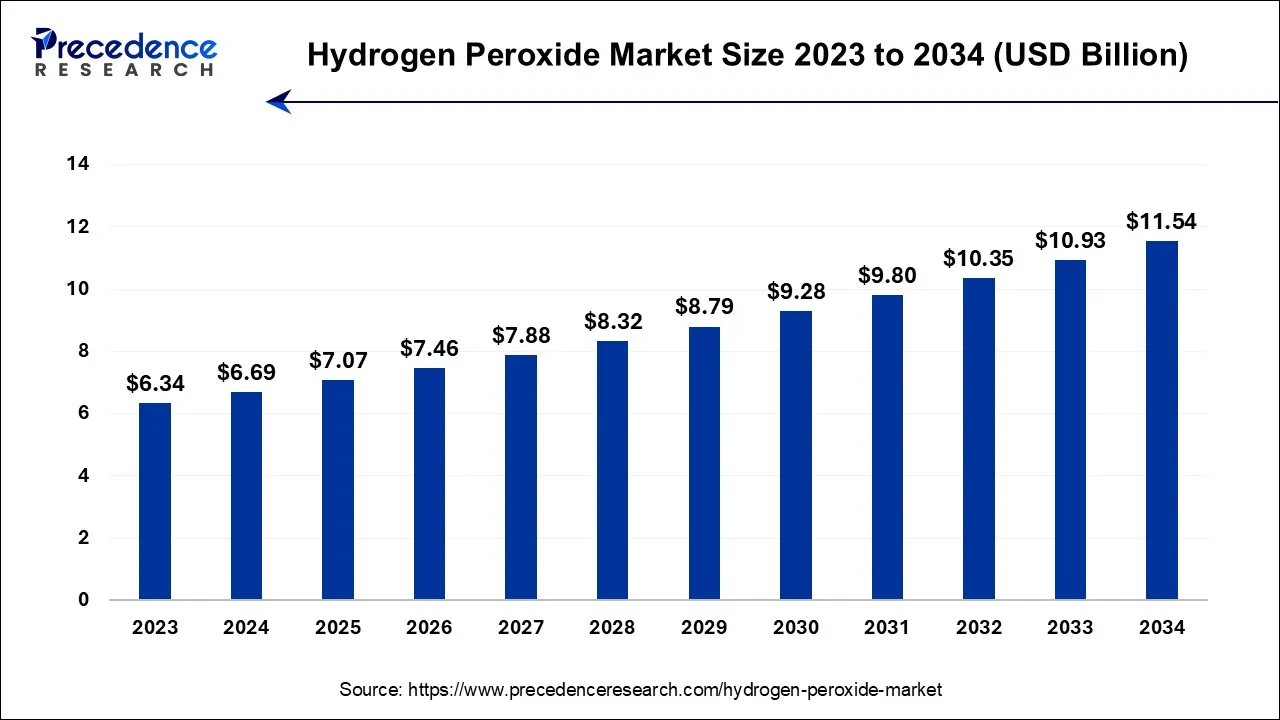
Hydrogen Peroxide Market Key Takeaways
- By region, Asia Pacific held the largest share of the Hydrogen Peroxide Market in 2025.
- By function, the bleaching segment accounted for the largest share of the market in 2025.
- By function, the disinfectant segment will register the fastest growth in the market during the foreseeable period.
- By grade, the <35% segment accounted for the largest share of the market in 2025.
- By application, the pulp & paper segment held the largest share of the market in 2025.
- By application, the healthcare segment is expected to grow significantly during the forecast period.
Market Overview
Hydrogen peroxide is one of the essential ingredients used in the creation of such disinfectants and sanitizing products. A typical disinfectant, for instance, typically contains 3% to 4% hydrogen peroxide, 0.5% to 1% peroxyacetic acid, a small amount of isopropyl alcohol, chlorine dioxide, and other ingredients. The material is also expected to continue to be in high demand throughout the industry for a considerable amount of time due to its great abilities to give resistance against viruses, bacteria, and a variety of other microbes, according to the Center for Biocide Chemistries.
Growing healthcare industry demand for the product as a result of its antiseptic qualities is anticipated to continue to be a major driver of market expansion. The substance is widely sought-after in the healthcare industry as an antiseptic, which is usually used to skin wounds and bruises to prevent infections. Due to its capacity to reduce mouth irritation, mucus, and other oral infections, it is also frequently used as a mouth rinse. The material primarily releases oxygen, which causes foaming on the bruised and cut skin and ultimately results in the efficient elimination of dead skin while protecting the area from infection.
Furthermore, because hydrogen peroxide is widely used in the creation of disinfection goods in light of the current COVID-19 epidemic, its demand has increased dramatically globally. Disinfecting both public and private areas is crucial, say a number of international government directives, to lessen the effects of the coronavirus spread. Commercial buildings, bus stops, airports, and train stations must be sterilised for more than 60 minutes inside restricted perimeters. Similar household cleaning guidelines have also been published by a number of countries, which has resulted in a notable increase in the market for sanitizer and disinfection solutions.
Major Applications of Hydrogen Peroxide:
| Uses | Application |
| Food/Aseptic Packaging | It is used to sterilize the internal aseptic areas of the manufacturing equipment with the surface of the packaging material that sustains contact with food. |
| Gardening | The all-purpose liquid can help with pest control, prevent infection on damaged trees, kill foliage fungus, combat root rot, as well as improve plant growth. |
| Remove Stains | The all-purpose liquid can be used for pest control, treatment of insect attacks on trees, treating foliage fungus, combating root rot, and encouraging plant growth. |
| Disinfectant | It is used in the practices of waste-water treatment to neutralize organic content. |
| Textile Industry | Hydrogen peroxide is a bleaching agent in natural and synthetic fiber treatments inclusive of wool, linen, cotton, silk, and rayon fiber. |
| Electronics Industry | The manufacturing process of semiconductors customs high-quality electronic-grade hydrogen peroxide as an oxidizing and cleaning agent. |
| Soil remediation | Technological processes also use Hydrogen Peroxide to decrease their negative environmental impact. Soil remediation, when polluted with hydro-carbons, is generally done using H2O2. |
Hydrogen Peroxide Market Growth Factors
Increasing need for disinfectants, increased demand from the healthcare sector, a rise in the number of paper & pulp producers, and an increase in the number of food processing facilities are some of the key drivers anticipated to propel the global hydrogen peroxide market. In addition to this, it is employed in the personal care, chemical synthesis, cosmetics, and wastewater treatment sectors.
- The increasing need for disinfectants, increased demand from the healthcare sector, a rise in the number of paper & pulp producers, and an increase in the number of food processing facilities are some of the key drivers anticipated to propel the global hydrogen peroxide market. In addition to this, it is employed in the personal care, chemical synthesis, cosmetics, and wastewater treatment sectors.
Market Outlook
- Industry growth overview - The hydrogen peroxide market is expected to grow steadily as demand rises from water treatment, healthcare, electronics, pulp and paper and chemical industries.
- Global expansion - Companies are expanding production facilities and distribution networks across Asia Pacific, North America, Europe and emerging economies to meet growing industrial demand.
- Sustainability trends - Manufacturers are adopting energy efficient production methods, reducing emissions and developing cleaner manufacturing processes to meet sustainability goals.
- Major Investors - Major investors in the market include Solvay, Evonik Industries, Arkema, Nouryon (backed by Carlyle and GIC), Mitsubishi Gas Chemical, Kemira, and SK Capital Partners.
- Startup ecosystem - The startup economy in the market is exploring advanced oxidation technologies, green chemical production and specialty applications.
Market Scope
| Report Coverage | Details |
| Market Size by 2035 | USD 12.13 Billion |
| Market Size in 2025 | USD 7.07 Billion |
| Market Size in 2026 | USD 7.46 Billion |
| Growth Rate from 2026 to 2035 | CAGR of 6.98% |
| Largest Market | Asia Pacific |
| Base Year | 2025 |
| Forecast Period | 2026 to 2035 |
| Segments Covered | Function, Grade, Application, Sales Channel, and Region |
| Regions Covered | North America, Europe, Asia-Pacific, Latin America and Middle East & Africa |
Market Dynamics
Drivers
- Wide applicability of chemical - Hydrogen peroxide serves a variety of purposes in various industrial, commercial, and domestic settings. It is ideal for bleaching paper and textiles due to its strong bleaching capabilities. It serves as an antiseptic and an antimicrobial agent in healthcare. In applications including food, personal care products, home care, and water purification, it works very well as an oxidising and disinfecting agent. It functions as a top-notch cleaning agent for devices. Additionally, it is employed in the creation of detergent bleaches such sodium perborate and percarbonate. Due to its applicability's realism, the hydrogen peroxide industry is expanding.
- Increasing demand from the pulp and paper industry - The paper and pulp industry make extensive use of hydrogen peroxide as a bleaching agent to create a variety of pulp types, including chemical, mechanical, and recyclable pulps. For these sectors, it is also utilised to optimally whiten the pulps. In addition, hydrogen peroxide is used to re-pulp waste paper instead of conventional bleaching agents since it lowers bleaching costs and the colour of the effluent. Online sales are rising in the two main markets for pulp and paper products, the United States and China. This is partially due to the need for innovative packaging due to the rise of online purchasing, which has improved product positioning on shelves. The demand for both raw materials and corrugated containers has grown, which is the cause of this rise.
Challenges
- Patient health hazards - Risks to patient health might prevent consumers from using hydrogen peroxide products. The substance's potent oxidising properties make it potentially harmful to the skin, eyes, and respiratory system. If not managed appropriately, extended exposure can cause hair bleaching as well as skin and eye irritation. Additionally, it accelerates thermal breakdown on its own with most basic materials, such as copper alloys or heavy metals. As a result, it should be handled and kept properly to prevent any potential health risks.
Opportunities
Green hydrogen peroxide (H?O?) are chemical compound that is produced with no emission of carbon dioxide. This chemical is referred to as the green chemical that dissolves in water and oxygen and upon usage it decomposes into both water and oxygen. Carbon-neutral hydrogen peroxide is a more sustainable method for hydrogen peroxide manufacture which will lower the carbon footprint. The primary and most effective active component in hydrogen peroxide solution is natural in its occurrence and is biodegradable because it is easily blended with water and forms oxygen gas which makes it an environmentally friendly item.
- In April 2024, Evonik launched carbon-neutral hydrogen peroxide in Europe. The strategy includes a concrete roadmap to climate-neutral production through, for example, the switch to renewable energy and green hydrogen.
Segment Insights
Function Insights
With a share of 40.2% in terms of volume in 2025, the bleaching segment dominated the market. The substance has a wide range of uses as a bleaching agent in several sectors, including pulp & paper, medicine, and textiles. The product is extremely helpful in the medical field as a dental bleach, hair bleach, mouthwash, and for maintaining oral hygiene. The textile sector uses a bigger amount of the material as bleach, where it is frequently used to brighten clothing and remove stains from both synthetic and natural fabrics. It is employed in the production of fabrics as well since it helps improve the mechanical qualities of fibres.
Over the projection period, the disinfection segment is anticipated to see the fastest volume growth. This is explained by the product's great indulgence in manufacturing several cleaning agents and hygiene goods. The global viral epidemic increased demand for this function starting in the first quarter of 2020, which greatly increased production of several disinfection items such, glass cleaners for indoor and outdoor use, and hand sanitizers. These factors contributed to a rise in the use of hydrogen peroxide as a disinfectant around the world, and the trend is expected to continue for the foreseeable future.
Application Insights
With a volume share of 34.8% in 2025, the pulp and paper application category led the market. Similar to bleach, the substance is acknowledged as a chlorine-free element, making it a crucial component of the pulp and paper industry across the world. It is utilised properly to enhance the mechanical and chemical qualities of pulp and raise the quality and brightness of paper. As it lowers manufacturing costs, offers better quality, is simple to use, and is environmentally benign, it has created a rising demand in the business.
Over the projected period, the fastest CAGR in terms of volume growth is anticipated for the healthcare application category. This is attributable to the product's extensive demand as a result of the quick production of disinfection and sanitization solutions by several multinational corporations throughout the world. Due to rising public awareness of the significance of these healthcare necessities in daily life in the wake of the global pandemic, the demand for these items will see considerable rise globally over an extended period of time.
- In January 2024, the United States Food and Drug Administration announced vaporized hydrogen peroxide (VHP) to be an established method of sterilization for medical devices, recognizing its long history of safety and effectiveness.
Grade Insights
The worldwide market is divided into various hydrogen oxide concentrations based on grade and is offered in accordance with their uses. In general, personal care, home care, and speciality applications employ less than 35% of lower concentrations. Applications involving paper, textiles, chemicals, and wastewater treatment typically use higher concentrations of more than 35%. Rocket propellants employ pure grades or concentrations greater than 90–95 percent. The main element promoting the growth of this market is the high use of goods with more than 35% concentration to produce optimal outcomes.
Sales Channel Insights
Why has the Direct Sale Segment dominated the Hydrogen peroxide Market?
The direct sale segment held a dominant position in the hydrogen peroxide market in 2025, due to industries such as chemicals, textiles, pulp and paper, electronics, and water treatment often sourcing hydrogen peroxide directly from manufacturers to ensure reliable deliveries and customized concentrations. The direct purchase from the manufacturers in bulk provides consistent quality, technical support and improves long term supply chain efficiency and price concession. This also helps in building strong customer relationships. These factors support the segment growth in the market.
The indirect sale segment is expected to grow at the fastest CAGR during the studied period in the hydrogen peroxide market. Indirect sales play an important role in serving small and medium sized businesses that purchase hydrogen peroxide in lower volumes or require variable quantities. Indirect sales include distributors, wholesalers, and regional chemical suppliers; these help manufacturers to reach a broader customer base. This channel is important in developing regions. The indirect sales support sectors such as healthcare, laboratories and retail applications by providing convenient access to the product.
Regional Insights
What is the Asia Pacific Hydrogen Peroxide Market Size?
The Asia Pacific hydrogen peroxide market size is accounted for USD 2.98 billion in 2026 and is projected to be worth around USD 4.92 billion by 2035, poised to grow at a CAGR of 7.16% from 2026 to 2035.
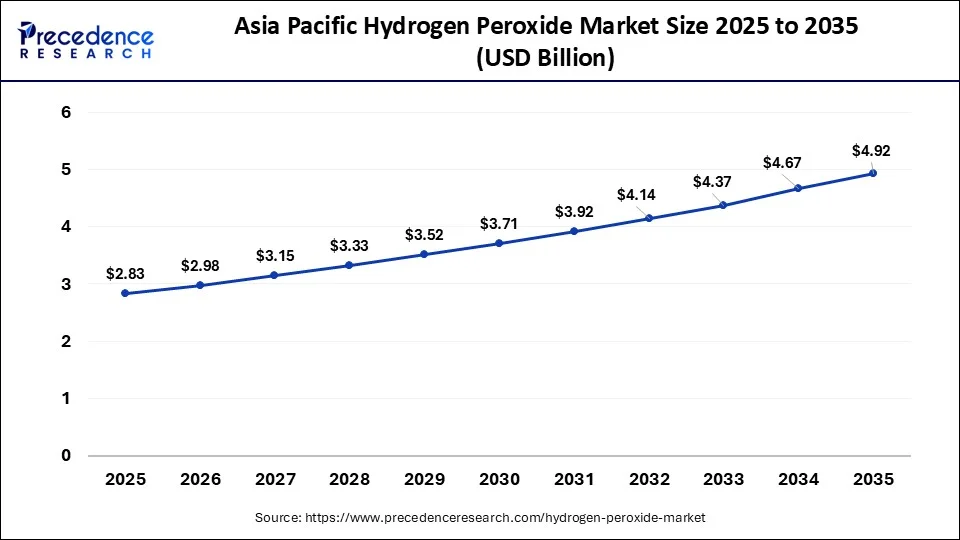
In 2025, the Asia Pacific region dominated the market and generated 40% of global revenue. This is explained by the growing influence of the medical, personal care, and chemical formulating businesses in the area. Due to cheaper land prices, the availability of trained labour, and an improved trade balance, China, Thailand, India, South Korea, and Japan have emerged as important centres for multinationals operating in various sectors to develop their business practises in the nation.
- China is considered the largest producer and consumer of pulp and paper products globally, further noted that the country produced more than 280 million tons in 2022 and also consumed over 230 million tons.
- According to the China Pulp and Paper Annual Report released by the China Paper Association in 2022, the industry has been growing to produce 283.91 million tons of pulp, paper, and paper products in the year 2022. It is a slight increase of 1.32 percent from 2021.
Due to the long-term prevalence of water-borne illnesses in the region, North America is seen as being at the forefront of the wastewater treatment sector. Every day, the U.S. purifies more than 34 billion gallons of contaminated water to make it safe for locals to drink. One of the main requirements in the nation is the removal of phosphorus and nitrogen from water sources, along with the oxidation of wastewater. This has ultimately resulted in a significant use of hydrogen peroxide throughout the nation's industries.
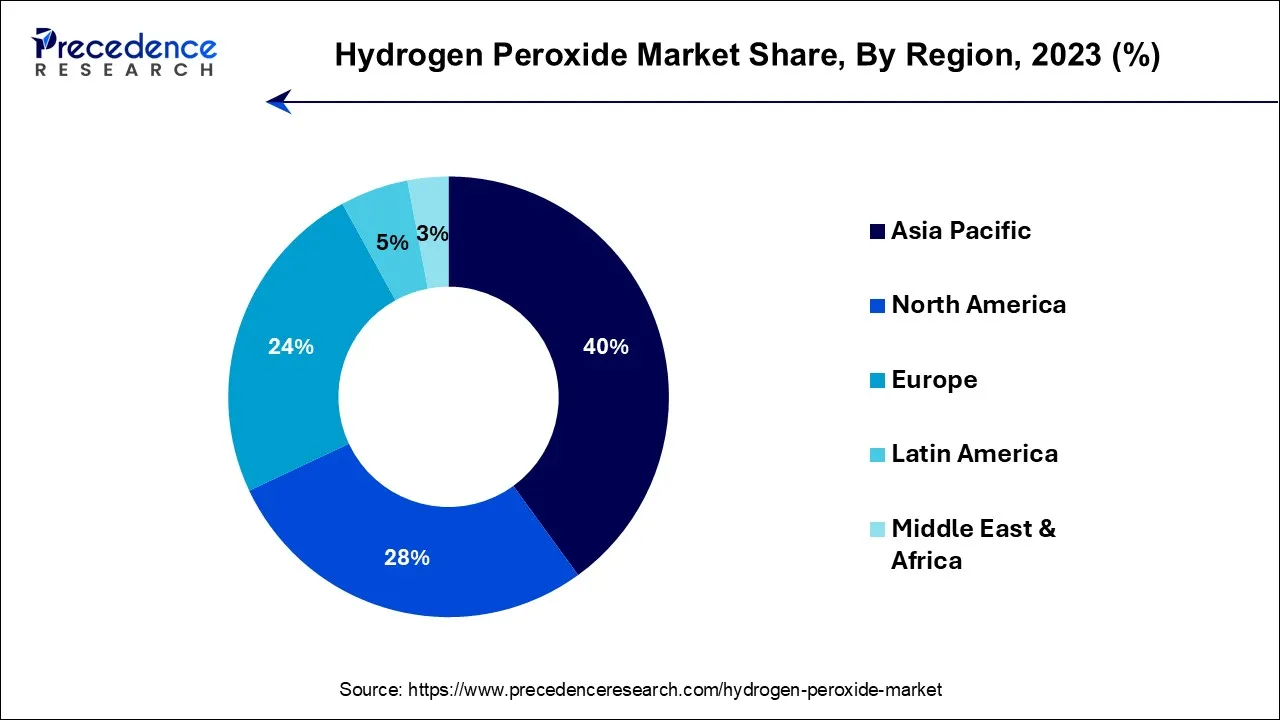
Hydrogen peroxide usage in the area is rising as a result of the expanding demand for various personal care products in the European market. Its oxidising and antibacterial qualities are the main reasons for the product's rising demand in this application. In nations including the United Kingdom, France, Italy, Germany, and Spain, cosmetics and personal care items like skincare creams and lotions have seen tremendous growth. This is primarily attributable to the increased market penetration of cosmetic manufacturers in these nations.
U.S.
The U.S. hydrogen peroxide market has experienced substantial growth. This growth is driven by increasing demand in various industries such as pulp and paper, textiles, and chemicals. Hydrogen peroxide's applications in environmental sectors, such as wastewater treatment and pollution control, further contribute to market expansion. The trends in recent times indicate a shift toward a more extensive application of hydrogen peroxide across various industries, driven by regulatory factors and consumer preferences focused on safety and sustainability. Furthermore, the food processing industry is increasingly incorporating hydrogen peroxide for food preservation and safety, highlighting its versatility.
In January 2024, the U.S. Food and Drug Administration announced that it regards vaporized hydrogen peroxide VHP to be an accepted practice of sterilization for medical devices, considering VHP's extensive history of safety and effectiveness. The FDA has revised the final guidance, Submission and Review of Sterility Information in Premarket Notification (510(k)) Submissions for Devices Labeled as Sterile, to list VHP as an exemplar of an Established Category A method of sterilization.
What are the Advancements in the Hydrogen Peroxide Market in Europe?
In March 2025, Nouryon, a worldwide leader in specialty chemicals, introduced Eka HP Puroxide™, a novel low-carbon hydrogen peroxide product. As the foremost Nordic company to provide this solution, Nouryon offered mining, pulp and paper, and water treatment companies a sustainable option to lower Scope 3 greenhouse gas emissions.
Evonik is one of the global forerunners in specialty chemicals. The industry is operational in more than 100 nations around the globe and created sales of € 15.3 billion and an operating profit of € 1.66 billion in 2023. Evonik is way beyond chemistry to formulate inventive, profitable, and sustainable solutions for consumers. Evonik is now providing carbon-neutral hydrogen peroxide to consumers in Europe.
Germany Hydrogen Peroxide Market Trends: The country has a high focus on innovation and sustainability, which fosters the adoption of hydrogen peroxide across various applications such as textiles and food processing. Furthermore, the region's stringent regulatory system regarding chemical usage compels industries to seek environmentally friendly alternatives such as hydrogen peroxide.
What are the Key Trends in the Hydrogen Peroxide Market in Latin America?
Latin America is expected to witness substantial growth in the market. This growth is due to growing pulp, paper, and mining activities in the region. Strong regulatory frameworks encourage the use of peroxide in eco-friendly bleaching, disinfection, and oxidation applications. In addition to that, the region's expanding manufacturing base and rising awareness regarding environmental sustainability drive the demand for hydrogen peroxide.
Brazil Hydrogen Peroxide Market Trends: The country is witnessing increased investments in infrastructure development and improvements in industrial processes, which are helping in enhancing the efficiency of hydrogen peroxide usage. Moreover, the push towards eco-friendly alternatives to traditional chemicals further supports market growth.
What are the Growth Factors in the Hydrogen Peroxide Market in the Middle East and Africa?
The Middle East and Africa region is expected to experience steady growth in the upcoming years. This growth is driven by the region's emerging industrial clusters and expanding wastewater treatment projects. The market is gaining traction through rising investments in cleaner processing methods across countries like the UAE, Saudi Arabia, and South Africa. Furthermore, there is also a growing emphasis on sustainable practices and regulatory compliance, which further encourages industries to adopt hydrogen peroxide.
Saudi Arabia Hydrogen Peroxide Market Trends: Saudi Arabia benefits from large-scale manufacturing clusters, which in turn help support high-volume peroxide consumption. This is due to its expanding industrial bases and steady investments. Market expansion is supported by government efforts to diversify the industrial base under Vision 2030, technological advances in production, and rising awareness of hydrogen peroxide as an eco-friendly alternative to chlorine-based chemicals, though challenges persist around handling safety, raw material price fluctuations, and regulatory compliance.
Value Chain Analysis
- Feedstock Procurement  
Feedstock procurement focuses on sourcing raw materials such as hydrogen, oxygen and chemicals like anthraquinone. A steady and affordable raw material supply is important for smooth hydrogen peroxide production.
Key Players: Solvay (Belgium), Evonik Industries (Germany), Arkema (France)
- Chemical Synthesis and Processing  
Hydrogen peroxide is mainly produced through the anthraquinone process. Raw materials undergo controlled chemical reactions, followed by purification and concentration.
Key Players: Mitsubishi Gas Chemical, Kemira
- Compound Formulation and Blending 
After production, hydrogen peroxide is diluted or concentrated to meet different industrial requirements. The finished product ensures uniform performance and strength. Manufacturers prepare various grades suitable for healthcare, water treatment, textiles and food processing industries.
Key Players: Solvay, Evonik Industries, and Arkema
- Quality Testing and Certification 
Each production batch is tested for purity, concentration, stability, and safety before shipment. Certification ensures the product meets quality standards as per industry standards.
Key Players: Solvay, Evonik Industries AG, and Mitsubishi Gas Chemical Company, Inc
- Distribution to Industrial Users 
Finished products are supplied directly or through chemical distributors to industries such as paper, healthcare, textiles, mining, and water treatment. Most sales happen through contracts. Timely delivery and technical support help factories avoid production delays.
Key Players: Solvay, Evonik Industries, and Arkema.
- Waste Management and Recycling 
Manufacturers treat wastewater and safely handle production residues to reduce environmental impact. Process chemicals are recovered while unused hydrogen peroxide naturally breaks down into water and oxygen.
Key Players: Solvay, Evonik Industries AG, and Kemira Oyj
- Regulatory Compliance and Safety Monitoring 
Manufacturers must follow regulatory guidelines during production, distribution and transportation. Regular inspection, product labelling and continuous monitoring help prevent accidents.
Key Players: Solvay, Evonik Industries, and Honeywell International
Competitive Landscape
The hydrogen peroxide market is highly competitive, with global manufacturers competing through production capacity, product quality and pricing. The leading companies in the market include Evonik Industries AG, Taekwang Industrial CO., LTD., Grupa Azoty, Gujarat Alkalies & Chemicals Ltd., National Peroxide Limited, OCI Company Ltd., Akzo Nobel N.V. and Airedale Chemical. The companies are expanding their manufacturing facilities to meet rising demand from water treatment, healthcare, electronics and pulp and paper industries. Strategic partnerships, collaborations, mergers, regional expansion, and long term supply agreements help in maintaining long term market presence.
For future growth in the hydrogen peroxide market, companies should focus on expanding sustainable production and investing in research and development.
Top Companies in the Hydrogen Peroxide Market and Their Offerings
- Solvay S.A. - A Belgium based company and one of the world's leading speciality chemical companies.
-
- Key of ferings - INTEROX Hydrogen Peroxide and Peroxyth
-
- Evonik Industries AG - A Germany based company and a major specialty chemical producer with a strong global presence.
- Key offerings - PERSYNT, HYPROX and OXTERIL
- Arkema S.A. - A France based company and global specialty materials and chemical company. It manufactures hydrogen peroxide for water treatment, chemical synthesis, paper bleaching and textile industries.
- Key offerings - Albone series
- Mitsubishi Gas Chemical Company, Inc - A Japanese company recognised for its expertise in performance chemicals.
- Key offerings - super-pure electronic-grade hydrogen peroxide
- Chang Chun Group - A Taiwan based company serves as the primary direct supply chain for massive semiconductor foundries in Taiwan and China.
- Key offerings - semiconductor-grade chemicals
- Kemira Oyj - A Finland based company specializes in sustainable chemical solutions for water intensive industries.
- Key offerings - Hydrogen peroxide for pulp and paper bleaching, water treatment chemicals and industrial solutions for water intensive industries.
Hydrogen Peroxide Market Companies
- Evonik Industries AG
- Taekwang Industrial, CO., LTD.
- Arkema
- Grupa Azoty
- Solvay
- Akzo Nobel N.V.
- Gujarat Alkalies & Chemicals Ltd.
- National Peroxide Limited
- OCI Company Ltd.
- Airedale Chemical
Recent Developments
- In July 2026, Evonik and its Chinese partner Fuhua officially started commercial operations at a new large scale hydrogen peroxide (H2O2) manufacturing facility in China. The plant has capacity of 200kilotons annual production of hydrogen peroxide. The facility provides industry garde H2O2 across China and also reduce supply constraints.
- In June 2026, Gujrat Alkalies and Chemicals Limited has approved a major investment of 67 crore to expand high end specialty chemicals used in advanced manufacturing sectors. The project aims at catering fast growing niche industries such as semiconductor fabrication, solar cell manufacturing and other advanced electronic applications.
- In January 2024, Solvay and Huatai announced a plan to expand their hydrogen peroxide production capacity in China. Considering the growing demand for hydrogen peroxide in the photovoltaic sector, where it is used as a cleaning agent in the production of photovoltaic cells. As a part of the expansion plan, the joint venture aims to produce 48 kilotons/year of photovoltaic-grade hydrogen peroxide by 2025.
- In December 2023, Evonik Industries AG collaborated with Thai Peroxide Co. Ltd, a Thai-based manufacturer of peroxide products. The acquisition expanded the company's production capacity for producing different peroxide products, including hydrogen peroxide.
- In October 2023, Dow and Evonik announced the startup of hydrogen peroxide to propylene glycol (HPPG) pilot plant.
- In September 2023, Shinsol Advanced Chemicals, a partnership between Solvay and Shinkong Synthetic Fibers Corporation, started operations for a new production plant in Tainan, Taiwan. The plant will produce electronic-grade hydrogen peroxide with a production capacity of 35,000 tons per annum.
Segment Covered in the Report
By Function
- Disinfectant
- Bleaching
- Oxidant
- Others
By Grade
- <35%
- >35%
By Application
- Pulp & Paper
- Chemical Synthesis
- Wastewater Treatment
- Mining
- Food & Beverages
- Personal Care
- Healthcare
- Textiles
- Others
By Sales Channel
- Direct Sale
- Indirect Sale
By Region
- North America
- Europe
- Asia-Pacific
- Latin America
- Middle East & Africa (MEA)
For inquiries regarding discounts, bulk purchases, or customization requests, please contact us at sales@precedenceresearch.com
Frequently Asked Questions
Tags





Ask For Sample
No cookie-cutter, only authentic analysis – take the 1st step to become a Precedence Research client
 Get a Sample




 sales@precedenceresearch.com
 Schedule a Meeting
