



Global Textile Market Size, Growth, Trends, and Forecast (2026-2035)
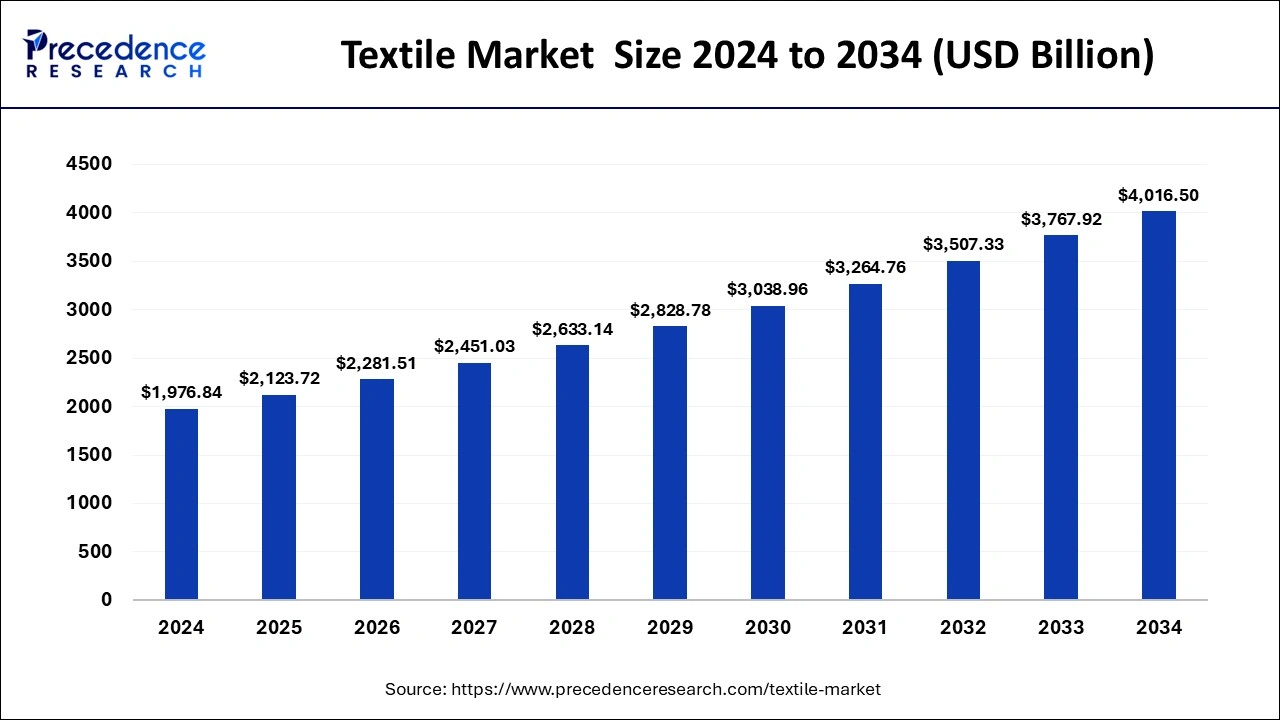
The global textile market is witnessing strong growth, driven by rising demand for natural fibers, sustainable fabrics, smart textiles, and advanced manufacturing technologies. Valued at USD 2,123.72 billion in 2025, the market is projected to reach USD 4,273.09 billion by 2035, expanding at a CAGR of 7.24% from 2026 to 2035. Government initiatives, changing consumer lifestyles, rapid urbanization, e-commerce growth, and increasing adoption of protective and technical textiles are accelerating market expansion across key regions.
Source: https://www.precedenceresearch.com/textile-market
 Get a Sample
 Table Of Content


Why Is the Global Textile Market Growing So Rapidly?
The global textile market size is estimated at USD 2,123.72 billion in 2025 and is predicted to increase from USD 2,281.51 billion in 2026 to approximately USD 4,273.09 billion by 2035, expanding at a CAGR of 7.24% from 2026 to 2035. The rising demand for natural fibers globally is driving the growth of the textile market. The market is supported by government initiatives, changing lifestyle, increased use of protective clothing, and advances in fabric manufacturing.
Market Highlights
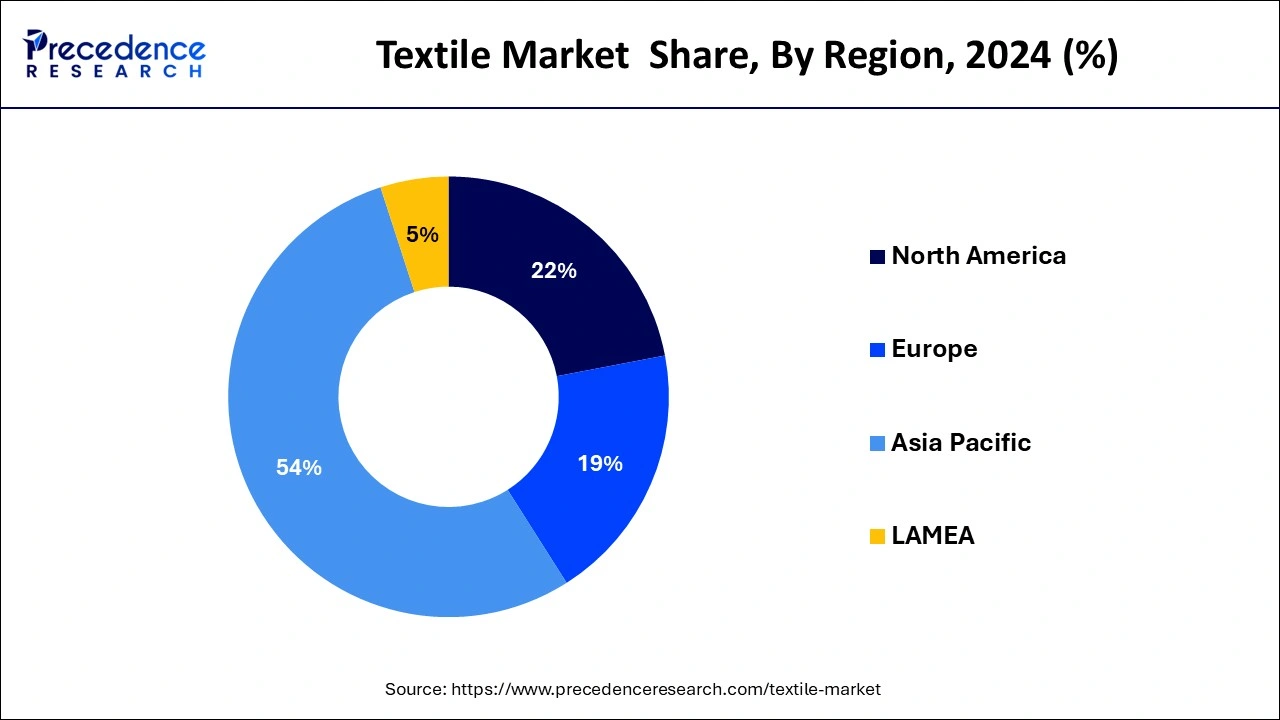
- Asia Pacific dominated the global market with the largest market share of 54% in 2025.
- North America is observed to experience the fastest rate of growth during the forecast period.
- By raw materials, the cotton segment dominated the textile market in 2025.
- By raw materials, the wool segment is expected to grow at the fastest rate during the forecast period.
- By product, the natural fibers segment led the market in 2025.
- By application, the fashion & clothing segment dominated the market in 2025.
- By application, the technical segment is estimated to be the fastest-growing segment during the forecast period.
Market Size and Forecast
- Market Size in 2025: USD 2,123.72 Billion
- Market Size in 2026: USD 2,281.51 Billion
- Forecasted Market Size by 2035: USD 4,273.09 Billion
- CAGR (2026-2035): 7.24%
- Largest Market in 2025: Asia Pacific
- Fastest Growing Market: North America
Market Overview
The textile market is one of the oldest industries in the world. This industry mainly deals in the production, designing, and distribution of a wide range of materials, such as clothing, fabrics, and yarn. The textile industry has experienced gradual evolution due to cultural influences and technological developments. Globalization has further increased the growth of the textile industry as it allows the buying and selling of textile-based products throughout the globe. This market is highly fragmented due to the presence of large and small market players that deal in the manufacturing of products ranging from apparel and home decor to medicinal fabrics, industrial uses, and others.
How is AI Contributing to the Development of the Textile Sector?
The textile sector is transforming through AI and digital solutions, speeding up and enhancing cloth manufacturing. The vision systems detect fabric defects, monitor the quality of raw material, and optimize inventory with AI by reducing waste and ensuring quality. The integration of digital printing and CAD accelerate product development and supports the use of conventional fabrics.
Automation and robotics increase productivity and cut costs, while IoT enables real-time monitoring and predictive maintenance. Additionally, substantial investments in AI and technological advancement help companies improve efficiency, shorten cycles, and strengthen global competitiveness.
Textile Market Trends
- Move Towards Sustainable Textiles: Consumer preference for organic, recycled, or biodegradable materials is driven by environmental awareness and sustainability practices, which are fueling this trend. Companies are reducing water, energy, and chemicals, and adopting eco-friendly methods to improve their textile brand status.
- Rising Demand for Smart Textiles: As industries focus on high-performance, functional textiles by integrating advanced textiles, demand continues to grow. Smart textiles with features such as antibacterial protection, temperature control, moisture management, and wearable sensors are in increasing demand.
- The progress of E-Commerce aligns with Changing Lifestyle: The textile and apparel industry is investing in digital platforms, efficient supply chains, and flexible manufacturing, which influence fashion trends and buying decisions. Consumers expect fast delivery, attractive prices, and personalised experiences.
- Rising Focus on Circular Economy: The textile industry has transformed towards a circular economy model focused on waste reduction and product longevity. Companies promote recycling, fiber recovery, refurbishment, and material reuse through eco-friendly practices and programmes.
- Expansion and Supply Chain Diversification: The rising incomes and urban population enable manufacturers to target increasing demand for clothing and home textiles. Supply chain diversification by sourcing from multiple countries reduces dependence on a single region and helps mitigate disruption risks.
Textile Market Growth Factors
- The rising demand for silk, due to its growing application in clothing, home furnishing, and surgical procedures worldwide, has boosted the market's growth.
- The upsurge in demand for woolen items such as sweaters, socks, caps, blankets, and others has driven the growth of the textile industry.
- The rise in the number of government initiatives to develop the textile sector will foster the growth of the textile market during the forecast period.
- Research and development activities related to advances in fabric manufacturing positively impact the textile industry.
- The growing demand for protective clothing from the construction sector also boosts the growth of the market.
- The ongoing trend of social media platforms involving buying and selling clothes online is further driving the market's growth.
- The rising use of synthetic and cellulose fibers for industrial applications also accelerates the growth of the textile market.
Market Report Coverage and Key Metrics
| Report Coverage | Details |
| Market Size in 2025 | USD 2,123.72 Billion |
| Market Size in 2026 | USD 2,281.51 Billion |
| Market Size by 2035 | USD 4,273.09 Billion |
| Growth Rate from 2026 to 2035 | CAGR of 7.24% |
| Largest Market | Asia Pacific |
| Base Year | 2025 |
| Forecast Period | 2026 to 2035 |
| Segments Covered | Raw-material, Product, Application, and Region |
| Regions Covered | North America, Europe, Asia-Pacific, Latin America, and Middle East & Africa |
Market Dynamics
Drivers
Rising awareness of people towards eco-friendly textile products
The rising demand for environmentally friendly and sustainable textiles is a prominent driver that has reshaped the textile industry. With the rising awareness regarding global environmental issues, buyers, regulatory bodies, and companies are adopting sustainable practices to minimize the environmental concerns related to textile production. Consumers have become highly aware of their purchasing choices and are opting for textiles that do not have any environmental impact. Thus, governments of countries such as the USA, India, China, and others have announced strict regulations and standards to encourage textile manufacturers to adopt clean production techniques and reduce chemical usage in the textile industry.
Restrain
High production cost
The rising prices of raw materials such as natural or synthetic fibers, yarns, and fabrics have negatively impacted the textile market. Also, high labor costs and the rising costs of machinery involved in the textile industry are challenges for market players to sustain in the industry. To maximize profits, companies tend to increase the cost of a finished item. This, in turn, is expected to restrain the growth of the textile market.
Opportunity
Adoption of smart clothing
Smart clothing is also known as e-textile or smart fabric and consists of embedded systems that monitor the functionalities of the human body. The growing adoption of smart clothes integrated with GPS and AI technology in sports and entertainment industries, along with their applications in mining industries, is an ongoing trend. Thus, the advent of smart clothing is expected to create ample growth opportunities for market players in the upcoming years.
Market Segmentation Analysis
Raw Materials Insights
What Made the Cotton Segment Dominate the Textile Market?
The cotton segment led the market while holding the largest share in 2025, due to its comfort, breathability, and versatility. The cotton's softness and moisture absorption are utilized in clothing, home textiles, medical, and industrial products. Textile firms invest in sustainable farming, seed technology and resource-efficient processing, which boosts fibre quality and efficiency. Growing sustainability awareness is prompting manufacturers to use more organic, responsibly sourced cotton in fashion and household textiles for long-term market growth.
The wool segment is projected to grow at the fastest rate in the upcoming years because of its demand for luxury clothing, winter gear, high-end home decor, and industrial uses. Wool offers superior insulation, elasticity, moisture control, and durability, making it crucial for comfort and longevity. The trend toward eco-conscious fashion and natural fibers, especially high-end brands, increases interest in sustainably sourced wool. Manufacturers are enhancing wool processing to produce softer fabrics, reduce shrinkage, and improve performance. Wool Segment, along with renewable textile fibers and premium fabrics, is accelerating the market expansion.
Product Insights
How did the Natural Fibers segment hold the Largest Share in the Textile Market?
The natural fibers segment dominated the market in 2025, driven by consumers' and producers' focus on sustainability. The increasing climate change awareness and stringent regulations encourage natural fibers product development for clothing, home textiles, and lifestyle goods for their gentleness and breathability. Manufacturers invest in processing and strategic partnerships that enhance the strength, biodegradability, and durability of natural fibres, including cotton, wool, silk, hemp, flax, and jute.
The polyester segment is experiencing the fastest growth in the market during the forecast period because of its versatility, affordability, and durability. Polyester fibers are utilized in sportswear, clothing, home furnishings, automotive components, and industrial fabrics. Improvements in polyester engineering innovations in synthetic textiles have increased comfort, softness, and performance, making it essential for daily and technical uses. The textile sector focuses on recycled polyester and circular production, which enhances sustainability by reducing reliance on virgin materials.
Application Insights
Which Application Segment holds the Largest Share in the Textile Market?
The fashion & clothing segment dominated the textile market in 2025, driven by changing lifestyles, expanding incomes, and demand for new clothing. The increasing focus on sustainable fashion encourages eco-friendly materials and responsible, comfortable, and durable production. The fast fashion trends drive manufacturers to innovate in designs, colors, and fabric combinations to meet diverse consumers through online shopping and social media purchasing. The textile corporations invest in flexible manufacturing, digital design, and faster supply chains that boost their competitive edge.
The technical segment is expected to grow the fastest in the market during the forecast period, supported by demand for high-performance materials in industries involving healthcare, automotive, agriculture, construction, aerospace, sports, and defense. Technical textile designed for specific functions such as higher strength, flame resistance, water resistance, antimicrobial properties, and thermal insulation. The expansion of infrastructure, healthcare funding, and industrial activities opens new opportunities for advancing lightweight textiles to achieve strict compliance. Governments support domestic manufacturing to lower imports and enhance capacity.
Market Regional Analysis: North America, Europe, Asia-Pacific
What is the Asia Pacific Textile Market Size?
The Asia Pacific textile market size was estimated at USD 1,146.81 billion in 2025 and is predicted to be worth around USD 2,334.24 billion by 2035 at a CAGR of 7.37% from 2026 to 2035.
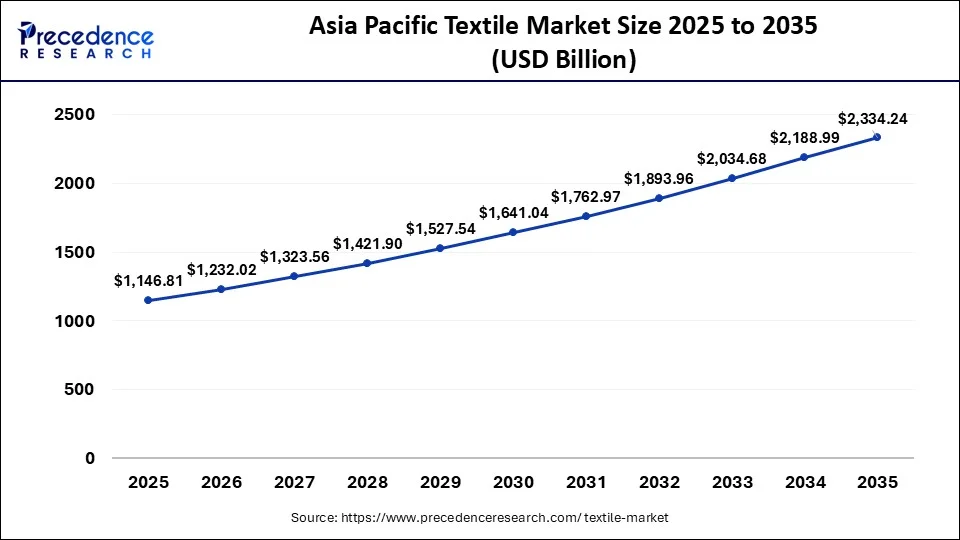
Asia-Pacific dominated the textile market in 2025. The growth of the market is generally driven by the easy availability of raw silk along with rising demand for fashionable clothes and home furnishing commodities. Moreover, the rising use of e-commerce for buying apparel, along with the rising young age population that tends to buy designer and fashionable clothes, is driving the growth of the textile market. Also, the rising interest of people in modeling and fashion designing, coupled with the increasing trend of wearing imported clothes, further accelerates market growth positively. Additionally, increased investments from the governments of countries such as India, China, Bangladesh, and others have also boosted the market growth. Furthermore, the presence of prominent market players such as Arvind Limited, Vardhman Textiles Ltd., Welspun India Ltd., Reliance Industries Limited (Textiles), Aditya Birla Group (Textiles), Raymond Ltd, and others are adopting strategies to strengthen their customer base and maintain their dominance in the industry.
- For instance, in February 2024, Reliance Industries launched ECOTHERM. This product comes with several benefits, such as lightweight, soft feel, versatility, high dyeability, thermal properties, and high longevity.
- For instance, the government of India announced an investment of USD 1.6 billion in the union budget 2021-22 for the development of the textile sector. This investment will be monitored by the Ministry of Textiles and was aimed at boosting growth and innovations in the textile industry.
India Market Trends
India stands as a global textile powerhouse, ranking as the second-largest exporter and employing over 45 million people throughout its entire value chain. The sector is rapidly evolving through strategic initiatives such as the PM-MITRA mega parks and the PLI Scheme for Textiles, in addition to landmark events like Bharat Tex, which showcase its manufacturing capabilities.
North America is estimated to be the fastest-growing region during the forecast period. The growth of the market is generally driven by the rising per capita income of people, a large number of warehouses for storage, a high standard of living, an increasing working population, and an upsurge in demand for durable clothes from the armed forces. For instance, in February 2024, GALLS, a leading supplier of America's military goods, acquired LVI.
This acquisition aimed to deliver clothing and textile functions, military logistics, and supply chain solutions to ensure accurate delivery in tough situations during warfare. Moreover, the availability of raw materials at low prices, along with rising demand for premium clothes from the sports sector and Hollywood, has also driven the market growth.
- For instance, in January 2024, Lilysilk launched a 2024 spring collection named "A Laidback Luxe." This new collection features modernity and sophisticated looks and will be used by premium customers and Hollywood actresses. Also, a rise in investment from private and public sector entities in the textile industry is further expected to drive textile market growth in this region.
- For instance, in March 2022, ThinkHUGE announced that it would invest 340 million USD 140 million in the Northern Triangle region, which comprises Guatemala, El Salvador, and Honduras, to develop the textile industry.
U.S. Market Trends
The U.S. is a key player in the global market, serving as the largest consumer of finished apparel and a leading exporter of high-value yarn and specialized smart textiles. To enhance trade, a significant bilateral agreement was reached, which reduced reciprocal tariffs and provided Indian exporters with advantageous access to the U.S. market. Additionally, the U.S. Department of Commerce funds strategic programs that accelerate the integration of IoT and wearable technologies for the market.
Europe is estimated to grow at a significant rate during the forecast period. The growth of the market is generally driven by the increasing demand for organic fabrics along with the rising trend of consumers towards online shopping. Moreover, the implementation of government policies and trade agreements such as the Euro-Mediterranean Dialogue and free-trade agreements that are favorable for textile manufacturing, in turn, boost the market growth.
Also, the market's growth can be attributed to factors such as growing awareness regarding the latest fashion trends and an upsurge in demand for designer clothes from the cinema industry. Furthermore, the presence of several market players such as Inditex, Tirotex, Salvatore Ferragamo SpA, Koninklijke Ten Cate NV, Chargeurs SA, and others that are engaged in research & development of textiles and adopting several strategies such as acquisition, product launches, and partnerships to maintain their dominance in the market.
- For instance, in May 2022, TIROTEX, a leading European textile brand, announced the acquisition of Dilmenler. This acquisition aimed to use Dilmenler's textile equipment to produce dry and saturated fabric with necessary finishing solutions.
Germany Market Trends
Germany is the largest market in Europe and a significant driver of industry innovation, leading the way in sustainable regulations and advanced manufacturing. Through technology programs like Textile Factory 7.0, Germany leverages AI and robotics to modernize production processes. The country enforces strict fair-trade and eco-friendly standards through initiatives like the Green Button label and the Supply Chain Due Diligence Act.
How will Latin America Emerge in the Textile Market?
Latin America is emerging as a significant region in the global market, largely due to the nearshoring of manufacturing, an abundance of local raw materials such as cotton, and a regional focus on eco-friendly production. Favorable trade terms under frameworks like the USMCA continue to incentivize this shift. Rapid urbanization in countries like Brazil, Argentina, and Colombia is driving technical textiles used for infrastructure and architectural development. As global brands aim to circumvent logistical bottlenecks in supply chains, countries like Mexico are becoming preferred sourcing hubs.
Brazil Market Trends
Brazil is a significant textile and clothing manufacturer in Latin America, supported by a vast agricultural base and a fully integrated supply chain in the southern hemisphere. To capitalize on these advantages, the ABIT and ApexBrasil Texbrasil Program assists Brazilian brands in expanding their global presence, while the Abrapa SouABR Program provides extensive domestic traceability from source to retail.
How will the Middle East and Africa grow in the Textile Market?
The Middle East and Africa are experiencing substantial growth in the global market. This expansion is driven by a young population, rapid urbanization, growth in e-commerce, and increasing demand for technical textiles in infrastructure and healthcare. The region is characterized by a youthful, trend-conscious population heavily influenced by digital media, which boosts apparel sales. Oil-dependent nations are actively funding manufacturing hubs and technical textile production as part of their economic diversification strategies.
UAE Market Trends
The UAE serves as a crucial trading and re-export hub. To capitalize on this position, the country launched Operation 300bn, an industrial strategy aimed at enhancing manufacturing competitiveness through advanced technology and sustainable practices. Recognized events such as the International Apparel and Textile Fair in Dubai also promote international collaboration.
Market Competitive Landscape: Leading Companies and Strategies
The global textile infrastructure market is competitive with the presence of intercontinental corporations, local producers, and major textile firms focusing on improving product quality, efficiency, and market influence. The recent innovation has involved advanced fibers, sustainable materials, and new manufacturing technologies through partnerships, acquisitions, and capacity growth to strengthen supply chains.
Textile manufacturers focus on recycled inputs, sustainability, responsible sourcing, and eco-friendly processes. Significant investments in digital manufacturing, automation, and AI boost efficiency and reduce costs. Robust distribution, textile product diversification, and customer-oriented innovation maintain competitiveness and continue to reshape the textile industry.
Textile Market Companies
- BSL Limited
- INVISTA S.R.L.
- Lu Thai Textile Co., Ltd.
- Heytex Bramsche GmbH
- B.D. Textile Mills Pvt. Ltd.
- DBL Group
- IBENA Inc.
- Levis
- Lakhmi Woollen Mills
- Wilh. Wülfing GmbH & Co. KG
- Wuxi Xiexin Group Co., Ltd.
- O'Formula Co., Ltd.
- The Bombay Dyeing & Mfg. Co., Ltd
- Adidas AG
- Mayur Fabrics
- Huafu Top Dyed Melange Yarn Co., Ltd.
- Nike Inc
Recent Developments in the Textile Market (2025-2026)
- In June 2026, the International Apparel Federation (IAF) released a worldwide manifesto encouraging intelligent, efficient, and sustainable apparel manufacturing. It calls for partnership among textile manufacturers, technology firms, and policymakers to accelerate smarter supply chain collaboration and end-to-end productivity across the global textile sector.
(Source: https://www.iafnet.com) - In December 2025, Circulose and Birla Cellulose announced a strategic alliance to develop high-quality, sustainable fiber solutions. Their collaboration focuses on expanding recycling efforts to promote circular textiles.
(Source: https://www.circulose.com) - In May 2024, Nike launched the jersey kit for Paris Saint-Germain men's and women's soccer teams for the 24/25 season. This new jersey is based on an old retro look and has the signature Hechter stripe that symbolizes a traditional presentation to the Paris Saint-German soccer team.
- In April 2024, Adidas announced team wear sponsorship for the Paris Olympic and Para Olympic games. These team wear kits will serve the fifteen competing teams and the French athletes. They feature uniqueness, signature flairs, quirky colors, repeated lines, and detailed graphics.
- In April 2024, Successori Reda S.p.A partner with the shirt dandy. This partnership aimed at introducing 3D configuration and AI features in the textile industry to enhance the efficiency of designers, develop unique products, scale operations, and accelerate market outreach.
- In January 2024, Levis launched 517 Bootcut jeans for men. These jeans are designed in retro style and will provide high durability and comfort, which you can wear in spring or summer.
- In April 2023, BSL Limited launched a cotton spinning unit in Rajasthan, India. This new unit was set up in the Bhilwara district and has a capacity of 30,000 spindles that can produce 700 tonnes of cotton yarn every month that will be sold commercially in domestic and global markets.
- In January 2023, Invista S.R.L. launched Navy Blue CORDURA TrueLock Fabric. This new fabric comes with abrasion resistance, color fastness resistance, UV fade resistance, and long-lasting color vibrancy. It will mainly used for Tactical, Military, and Law Enforcement applications.
Segments Covered in the Report
By Raw-material
- Cotton
- Chemical
- Wool
- Silk
- Others
By Product
- Natural Fibers
- Polyesters
- Nylon
- Others
By Application
- Household
- Bedding
- Kitchen
- Upholstery
- Towel
- Others
- Technical
- Construction
- Transport
- Medical
- Protective
- Fashion & Clothing
- Apparel
- Ties & Clothing Accessories
- Handbags
- Others
- Others
By Region
- North America
- Asia Pacific
- Europe
- Latin America
- Middle East & Africa
For inquiries regarding discounts, bulk purchases, or customization requests, please contact us at sales@precedenceresearch.com
Frequently Asked Questions
Tags





Ask For Sample
No cookie-cutter, only authentic analysis – take the 1st step to become a Precedence Research client
 Get a Sample




 sales@precedenceresearch.com
 Schedule a Meeting
