






 Request Consultation
Introduction
The AI agent market shifted from experimental pilots to billion-dollar revenue lines within about eighteen months. Salesforce's Agentforce grew from start to $1.2 billion in annual recurring revenue in barely a year and a half, meanwhile ServiceNow's Now Assist crossed the same billion-dollar threshold in just fourteen months. Behind the revenue race, the industry's biggest rivals, Anthropic, Google, OpenAI, and Microsoft, took the unusual step of jointly donating their competing technical protocols (MCP and A2A) to a shared, vendor-neutral foundation, betting that a genuinely interoperable agent ecosystem would raise the market faster than any single company's proprietary standard could.
This report draws entirely on firm SEC filings, official earnings releases, and even primary protocol announcements to map who the market's major players are, how fast the leading agent products are actually rising, and what the emerging technical and business-model battle lines look like heading into the rest of 2026.
Key Takeaways
- Salesforce's Agentforce annual recurring revenue approximately tripled in two quarters, from $500 million in Q3 FY2026 in November 2025 to $1.2 billion by Q1 FY2027 in May 2026, thus growing 205% year-over-year in the most recent period.
- OpenAI's annualized revenue run rate thus reportedly doubled from $20 billion at the end of 2025 to $40 billion by July 2026, according to third-party financial research company Sacra, with enterprise users now representing more than 50% of revenue.
- ServiceNow's Now Assist AI product crossed $1 billion in annual contract value in Q2 2026, up from just $250 million disclosed in May 2025, thus prompting management to raise its full-year 2026 AI revenue forecast to nearly $1.5 billion.
- In December 2025, direct competitors Anthropic, Google, OpenAI, and Microsoft jointly founded the Agentic AI Foundation (AAIF) under the Linux Foundation, donating both MCP and A2A for vendor-neutral governance, and then an unusual instance of rival AI labs agreeing to share common infrastructure.
- The AI agent industry converged on shared technical standards in 2025: Anthropic's Model Context Protocol (MCP), launched in November 2024, governs how agents connect to external tools, while Google's Agent2Agent protocol (A2A), launched in April 2025, governs how agents from different vendors coordinate with each other.
- More than 60% of Salesforce's Agentforce along with Data 360 bookings in Q4 FY2026 came from existing customer growth rather than new customer acquisition, thus a pattern consistent with early-stage enterprise AI agent adoption favoring deeper penetration of already-committed accounts.
- Salesforce introduced "Agentic Work Units" (AWUs) as a new metric for measuring AI agent value, thus counting discrete completed tasks rather than software seats or logins, delivering 2.4 billion AWUs in fiscal 2026 and even growing 111% quarter-over-quarter to 3.8 billion cumulative by Q1 FY2027.
- IBM's Agent Communication Protocol (ACP), a REST-native option to MCP and A2A, was merged into the A2A protocol under Linux Foundation governance in late 2025, thus consolidating what had briefly been a three-way protocol competition into two complementary standards.
- Despite Agentforce's rapid percentage growth, fewer than 13% of Salesforce's 150,000+ total users had signed an Agentforce agreement as of early 2026, thus illustrating that even the fastest-growing AI agent product remains in the early stages of enterprise penetration.
- Despite record AI-based revenue growth, ServiceNow's stock fell sharply following its results in a pattern some analysts labeled the "SaaSpocalypse": investor concern that increasingly capable AI agents from foundation-model labs could eventually disintermediate the enterprise software vendors thus currently building on top of them.
Visual Intelligence: 15 Data Stories on the AI Agent Market
Salesforce Agentforce ARR Nearly Tripled in Two Quarters
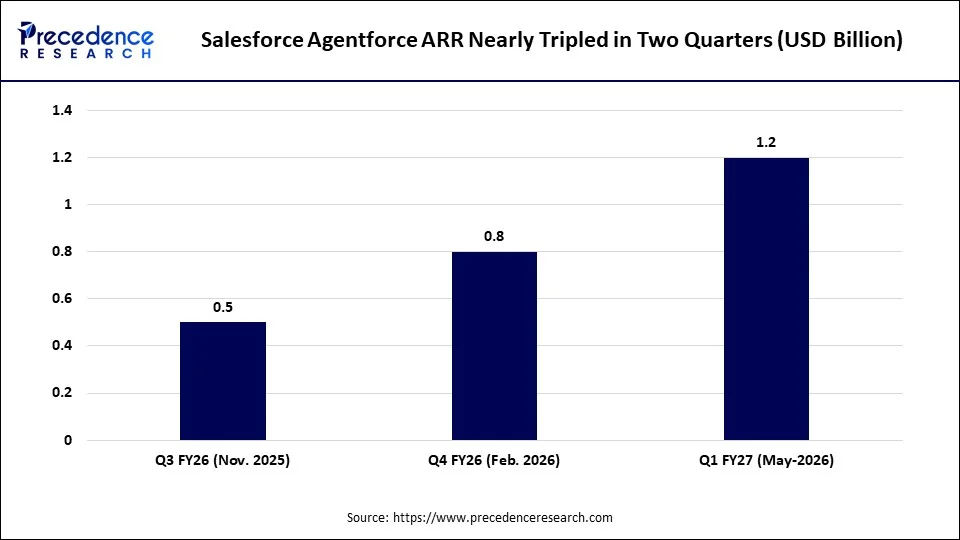
This chart tracks Salesforce's Agentforce annual recurring revenue across three consecutive quarters, based on the company's own official earnings releases.
- Salesforce reported that Agentforce annual recurring revenue (ARR) surpassed $0.5 billion in Q3 FY2026.
- In Q4FY26, the ARR was reported to be $0.8B.
- Salesforce reported that Agentforce reached $1.2 billion in ARR during Q1 FY2027, thus marking a 205% increase year-over-year.
Key Insight: The deceleration in year-over-year growth rate (330% to 169% to 205%) and continued strong absolute dollar growth suggest Agentforce is moving past its initial hypergrowth phase from a near-zero base into a more sustainable, still-rapid expansion phase and the kind of trajectory investors typically look for as an early-stage product line matures into a durable growth driver.
Source: Salesforce, Inc. - "Official quarterly earnings releases (Q3 FY2026, Q4 FY2026, Q1 FY2027)," November 2025 - May 2026.
The AI Agent Protocol Stack: MCP vs. A2A
| Protocol | MCP (Model Context Protocol) | A2A (Agent2Agent Protocol) |
| Created by | Anthropic | |
| Launched | Nov-24 | Apr-25 |
| Purpose | Connects an AI agent to external tools, data sources, and APIs (“agent-to-tool”) | Enables AI agents built by different vendors to discover, authenticate, and coordinate tasks with each other (“agent-to-agent”) |
| Adoption / Governance | Adopted by OpenAI, Google, Microsoft, and Anthropic across major developer tools | Donated to the Linux Foundation in June 2025, with 50+ launch partners |
Anthropic’s Model Context Protocol (MCP) and Google’s Agent2Agent (A2A) protocol are two open standards programmed to build structured, interoperable AI ecosystems. They do not compete; rather, they solve different problems at different layers of the AI stack and are even designed to work together.
Key Insight: The five-month gap between MCP's November 2024 launch and A2A's April 2025 launch is notable, given how quickly the industry moved to treat them as complementary rather than competing. Google explicitly designed A2A to operate alongside MCP rather than replace it, thus avoiding the kind of prolonged standards war that has slowed interoperability in other technology sectors.
Source: Anthropic; Google - "Official protocol announcements," November 2024, April 2025.
Agentic Work Units: A New Metric for Measuring AI Agent Value
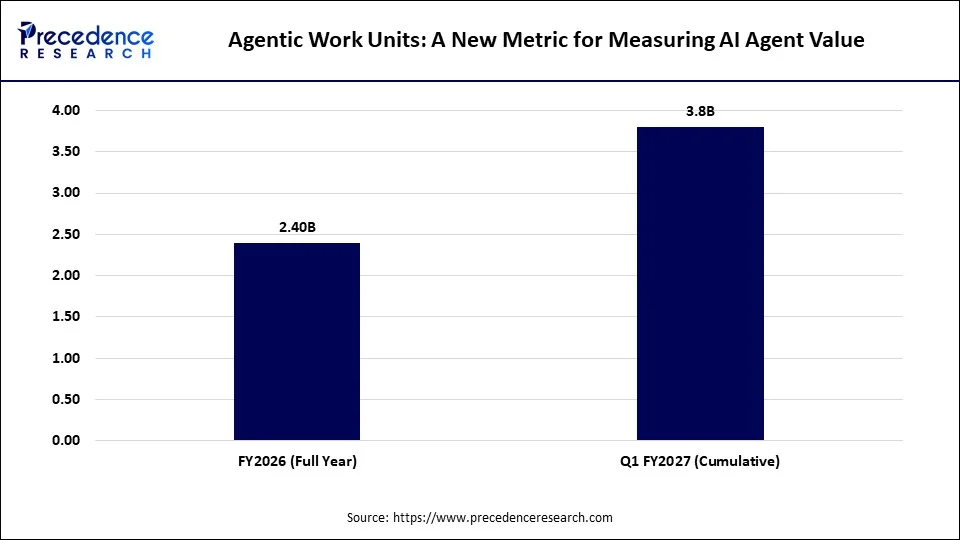
This chart shows Salesforce's disclosed Agentic Work Units (AWUs), a new metric counting discrete completed AI agent tasks, for fiscal 2026 and cumulative through Q1 fiscal 2027.
- In its Q4 FY2026 earnings report released in February 2026, Salesforce disclosed that its autonomous AI platform has officially crossed 2.4 billion Agentic Work Units (AWUs) delivered to date.
- Salesforce reported delivering 3.8 billion Agentic Work Units (AWUs) cumulatively to date over Agentforce and Slack in its Salesforce Q1 FY2027 Earnings Release.
Key Insight: The introduction of an entirely new metric, rather than continuing to report only ARR or deal counts, signals that Salesforce itself recognizes traditional software metrics such as seats, logins, subscriptions, don't adequately capture how AI agents actually create value, a task-completion metric more closely resembles how a services or labor business would measure output, and foreshadowing how the broader software industry may demand to rethink its own reporting conventions as agents become more autonomous.
Source: Salesforce, Inc. - "Q4 FY2026 and Q1 FY2027 earnings releases," February and May 2026.
ServiceNow's Now Assist AI Business Crossed $1 Billion in 14 Months
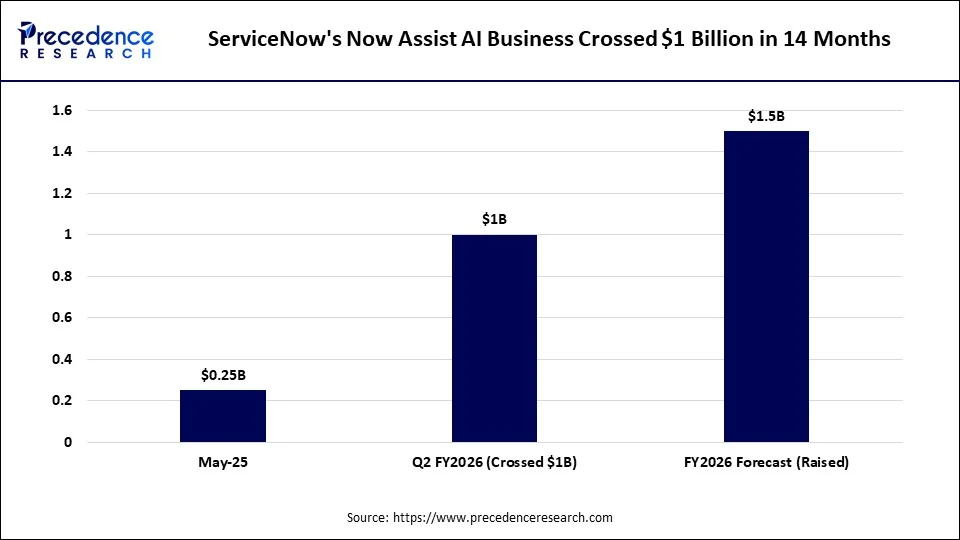
This chart traces ServiceNow's Now Assist annual contract value from its first disclosed figure in May 2025, crossing the $1 billion milestone in Q2 2026, to the firm's subsequently raised full-year forecast.
ServiceNow's generative AI product, Now Assist, surpassed $250 million in annual contract value (ACV) by early May 2025 before speeding to finish 2025 at over $600 million in ACV.
- ServiceNow's AI and Now Assist business officially crossed nearly $1 billion in annual contract value (ACV) during ServiceNow's Q2 2026 financial results.
- Now Assist and wider AI portfolio annual contract value (ACV) will reach $1.5 billion by the end of FY2026.
Key Insight: ServiceNow's decision to raise its 2026 AI revenue target from $1 billion to $1.5 billion mid-year, rather than simply meeting its original guidance, mirrors Salesforce's pattern of accelerating rather than merely sustaining early AI agent growth, thus suggesting the current wave of enterprise agent adoption is running ahead of even optimistic vendor projections industry-wide.
Source: ServiceNow, Inc. - "CFO Gina Mastantuono, May 2025 conference remarks; official Q2 2026 earnings announcement," May 2025, July 2026.
OpenAI's Revenue Run Rate Reportedly Doubled in Seven Months
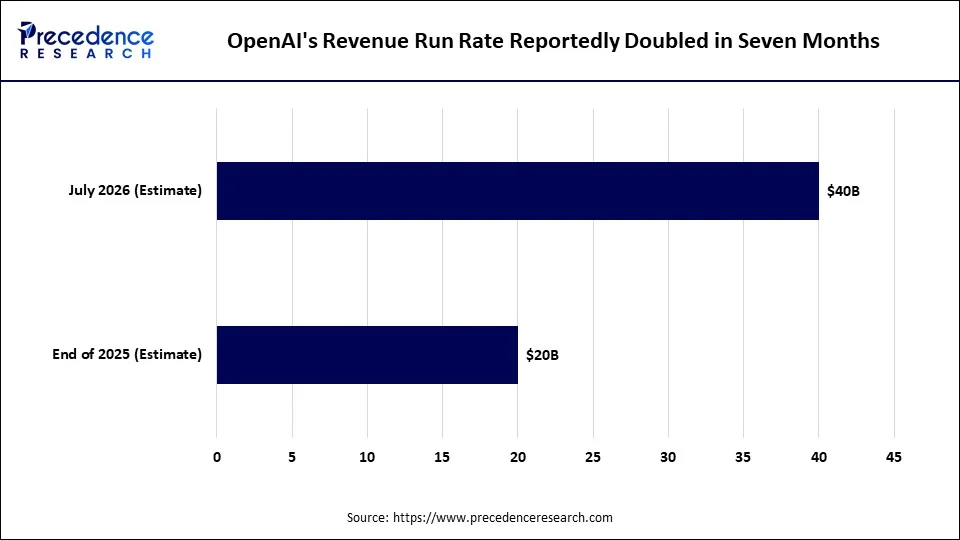
This chart shows OpenAI's estimated annualized revenue run rate at the end of 2025 versus July 2026, based on third-party financial research, since OpenAI, as a private firm, does not publicly disclose audited financial statements.
OpenAI officially stated that its annualized revenue run rate surpassed $20 billion at the end of 2025. It reached an estimated annualized revenue run rate of more than $40 billion based on its July 2026 performance.
Key Insight: OpenAI's reported inference costs $8.4 billion in 2025, projected to rise to $14.1 billion in 2026 and cash burn is projected to reach approximately $63 billion by 2027 growing alongside revenue states the capital intensity underlying the current AI agent boom unlike Salesforce or ServiceNow, whose agent revenue flows via an already-profitable core business, OpenAI's agent-driven growth is occurring within a firm still burning substantial cash to serve that demand.
Source: Sacra - "Private-company financial research and analysis, "OpenAI Revenue, Valuation & Funding"," Accessed August 2026.
The Agentic AI Foundation: Competitors Unite on Open Standards
This highlight summarizes the December 2025 founding of the Agentic AI Foundation under the Linux Foundation, based on Anthropic's own official announcement.
In December 2025, Anthropic declared the official founding of the Agentic AI Foundation (AAIF) as a directed fund under the Linux Foundation. It was co-founded by Anthropic, OpenAI, and Block, with backing from major industry leaders including Microsoft, Google, Amazon Web Services (AWS), Bloomberg, and Cloudflare. It aims to offer a vendor-neutral home ensuring autonomous AI agents and their underlying infrastructure evolve transparently, collaboratively, and interoperably.
Key Insight: Direct competitors co-funding shared infrastructure governance is rare enough in any technology sector that its occurrence here signals genuine industry-wide recognition that fragmented and proprietary agent standards would slow enterprise adoption for everyone, a collective-action response similar to how competing telecom firms once cooperated on shared cellular network standards despite fierce commercial rivalry.
Source: Anthropic - ""Donating the Model Context Protocol and Establishing the Agentic AI Foundation," official company announcement," December 2025.
Mapping the AI Agent Technology Stack
This process diagram traces the five-layer AI agent technology stack, from foundation models to business outcomes, highlighting where MCP and A2A each operate. The modern AI Agent Technology Stack bridges base artificial intelligence with concrete business outcomes. It moves the industry away from isolated, monolithic models and even into a highly collaborative, interconnected ecosystem.
Key Insight: The stack's layered, independently adoptable design means a company can implement MCP for tool access without yet needing A2A for multi-agent coordination, and it lowers the barrier to initial enterprise adoption considerably compared to an all-or-nothing architecture, likely a significant contributor to how quickly major platforms such as Salesforce, ServiceNow, and Microsoft, have been able to layer agent capability onto existing enterprise software footprints.
Source: Synthesized from official sources - "Anthropic MCP documentation and Google A2A protocol documentation," 2024-2026.
Key Players in the AI Agent Market: Side-by-Side Comparison
| Company | Flagship Agent Product | Key Metric | Protocol Role |
| Salesforce | Agentforce | $1.2B ARR (Q1 FY27, +205% YoY) | A2A launch partner |
| ServiceNow | Now Assist / AI Agents | >$1B ACV (Q2 2026, crossed milestone) | Multi-model: OpenAI, Anthropic, Google |
| OpenAI | ChatGPT Agent, Operator | ~$40B revenue run rate (Jul. 2026, estimated) | AIIF co-founder; MCP adopter |
| Anthropic | Claude, Computer Use, Claude Code | Creator of MCP (Nov. 2024) | AIIF co-founder; MCP creator |
| Gemini agents, Project Astra | A2A protocol creator (Apr. 2025) | AIIF supporting member; A2A creator | |
| Microsoft | Copilot agents, Agent 365 | Deep VS Code/GitHub Copilot MCP integration | AIIF supporting member |
| IBM | watsonx Orchestrate, Agent Communication Protocol (ACP) | ACP merged into A2A (late 2025) | ACP creator |
The AI agent market is transforming rapidly from simple chatbots to fully autonomous digital workforces. The industry spans dominant legacy enterprise players, cutting-edge foundation labs, and even emerging decentralized crypto-AI protocols.
Key Insight: The table reveals two distinct categories of "key player": firms monetizing agents directly within existing enterprise software such as Salesforce, ServiceNow, already report billion-dollar-plus agent-specific revenue lines, while the foundation-model labs and infrastructure companies such as OpenAI, Google, Anthropic, Microsoft, IBM, are more usually defined by their role in the underlying protocol ecosystem than by disclosed agent-specific revenue, the two groups are monetizing the same technology shift via fundamentally different business models.
Source: Multiple (see below) - "Salesforce and ServiceNow official earnings releases; Sacra estimates; Anthropic and Google official protocol announcements," 2025-2026.
Agentforce Deal Volume More Than Doubled in Two Quarters
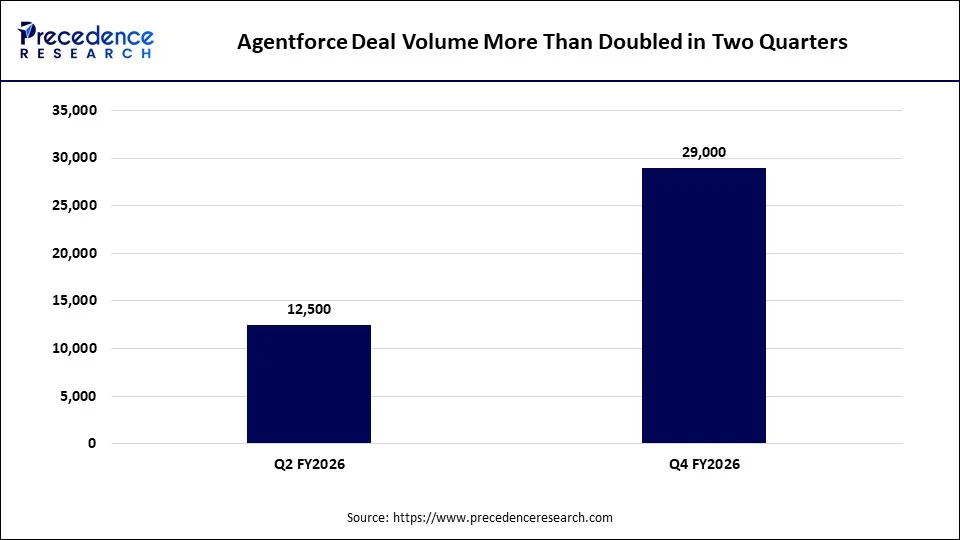
This chart compares the cumulative number of Agentforce deals Salesforce had closed since launch, as disclosed in its Q2 FY2026 and Q4 FY2026 earnings releases.
Salesforce between its launch and the end of Q2 FY2026 as of explosive enterprise need for autonomous AI agents and aggressive upselling.
Salesforce hit 29,000 cumulative Agentforce deals by Q4 FY2026 because of massive enterprise requirement for autonomous AI agents that execute real business workflows instead of just answering questions.
Key Insight: Deal count growth nearly tracked ARR growth over the same period, indicating Salesforce's Agentforce growth has come from a genuinely broadening user base rather than a smaller number of customers dramatically increasing their individual spend, a healthier growth pattern for long-term market penetration than concentration in a handful of large accounts.
Source: Salesforce, Inc. - "Q2 FY2026 and Q4 FY2026 official earnings releases," 2025-2026.
The Agent Protocol Ecosystem: Who's Backing What
| Protocol / Organization | Creator / Founded | Adoption / Launch Partners | Governance / Status |
| MCP (Agent-to-Tool) | Creator: Anthropic | Adopted by OpenAI, Google, Microsoft (GitHub Copilot, Gemini Code Assist), Cursor, VS Code | Governance: Agentic AI Foundation (Linux Foundation) |
| A2A (Agent-to-Agent) | Creator: Google | 50+ launch partners, including Salesforce, PayPal, Atlassian, AWS, Microsoft, SAP | Governance: Linux Foundation (donated June 2025) |
| ACP (Agent Communication) | Creator: IBM / AGNTCY | Positioning: REST-native alternative for existing HTTP toolchains | Status: Merged into A2A under Linux Foundation, late 2025 |
| AAIF (Governance Body) | Founded: December 2025 | Co-founders: Anthropic, Block, OpenAI | Supporting members: Google, Microsoft, AWS, Cloudflare, Bloomberg |
This comparison summarizes four components of the AI agent protocol ecosystem- MCP, A2A, ACP, and the AAIF governance body- and which organizations created or back each.
The AI agent protocol ecosystem offers open, standardized layers that let autonomous programs connect to data sources, tools, and even each other.
MCP: It was originally developed by Anthropic. Model Context Protocol acts like a universal port for AI, standardizing how a single agent connects to external tools, databases, and APIs.
A2A: It was initiated by Google; the Agent2Agent protocol allows independent AI agents built on different frameworks to discover one another, pass instructions, and even collaborate securely.
ACP: It was originally an IBM approach for lightweight, REST-based agent messaging; ACP has since combined with A2A to streamline peer-to-peer enterprise workflows.
Key Insight: IBM's decision to combine its own Agent Communication Protocol into Google's A2A rather than continuing to compete for adoption reflects a broader pattern across the ecosystem. Once MCP and A2A achieved sufficient adoption momentum with AAIF governance behind them, maintaining a separate and smaller protocol became a competitive liability rather than a differentiator, even for a firm as large as IBM.
Source: Multiple (see below) - "Anthropic official announcement; Wikipedia; industry reporting on IBM/AGNTCY's ACP," 2024-2025.
The Agent Protocol Race Accelerates: Key Milestones, 2024-2025
| Date | Key Milestone |
| Nov-24 | Anthropic launches Model Context Protocol (MCP) |
| Apr-25 | Google introduces Agent2Agent (A2A) protocol |
| Jun-25 | Google donates A2A to the Linux Foundation, with 50+ launch partners |
| Oct-25 | Salesforce launches Agentforce 360 at Dreamforce |
| Dec-25 | MCP and A2A are both donated to the Agentic AI Foundation (AAIF) |
This timeline traces five defining events in the AI agent protocol landscape from Anthropic's initial MCP launch to the founding of the Agentic AI Foundation.
- In November 2024, Anthropic launched Model Context Protocol.
- In April 2025, Google introduced the Agent2Agent protocol.
- In June 2025, Google donated Agent2Agent to the Linux Foundation for 50+ launch partners.
- In October 2025, Salesforce launched Agentforce.
- In December 2025, Model Context Protocol and Agent2Agent both donated to the new Agentic AI Foundation.
Key Insight: The entire sequence from MCP's launch to unified AAIF governance took just over thirteen months; thus, an extraordinarily fast standardization cycle for enterprise technology, where competing standards more typically take years or even decades to converge, reflecting the unusually high commercial urgency every major AI lab currently attaches to agent interoperability.
Source: Multiple (see below) - "Anthropic and Google official announcements; Salesforce Dreamforce 2025 press materials," 2024-2025.
ServiceNow's Multi-Model Strategy: Betting on Every Major AI Lab at Once
This highlight summarizes ServiceNow's simultaneous integration of OpenAI, Anthropic, and Google models into its Now Assist platform, based on industry earnings analysis.
ServiceNow's simultaneous integration of OpenAI, Anthropic, and Google models into its Now Assist platform thus marks a strategic shift toward an open, multi-model orchestration model that aids enterprises in avoiding vendor lock-in. Enterprises can deploy different models based on specific strengths, like using OpenAI for advanced multimodal and voice features, and even Anthropic's Claude for coding and regulated industry workflows.
Key Insight: ServiceNow's refusal to standardize on a single base model provider, even as it deepens its OpenAI collaboration with a dedicated multi-year deal. It reflects a deliberate hedging strategy against foundation-model concentration risk, enabling the firm to route different workloads to whichever model currently performs best or costs least, rather than locking its whole platform's capability ceiling to a single vendor's roadmap.
Source: Futurum; KSolves - "ServiceNow Q4 FY 2025 Earnings Highlight AI Platform Momentum"," January 2026.
Where Agent Revenue Really Comes From: Existing Customers, Not New Logos
| Metric | Share |
| Existing Customer Expansion | 60%+ of bookings |
| New Customer Acquisition | ~40% of bookings |
This chart shows the share of Salesforce's Agentforce and Data 360 Q4 FY2026 bookings that came from existing customer expansion versus new customer acquisition. Salesforce declared that Agentforce and Data 360 reached an annual recurring revenue (ARR) of $800 million by Q4 FY2026, thus marking it as one of the fastest-scaling product categories in the firm's history. Over 60% of Agentforce and Data 360 bookings came from existing customer growth rather than initial pilots.
Key Insight: A majority-expansion revenue mix this early in a product's lifecycle is somewhat unusual. It suggests Salesforce's existing enterprise relationships, along with data infrastructure, are proving more valuable as an AI agent distribution channel than pure product capability alone, a structural advantage that pure-play AI agent startups without an existing enterprise customer base and even a data footprint would find very difficult to replicate.
Source: Salesforce, Inc. - "Q4 FY2026 earnings release," February 2026.
The Adoption Gap: Even the Fastest-Growing Agent Product Has Room to Run
This highlight shows the share of Salesforce's total customer base that had signed an Agentforce agreement, despite the product's rapid revenue growth. Autonomous AI agents demand clean, unified data layers, like Data 360. Many organizations must first fix or organize their data governance before going live. A significant section of early agreements represents initial testing, proofs-of-concept, or bundled upgrades rather than full organization-wide digital labor deployment.
Key Insight: A sub-13% penetration rate against a billion-dollar-plus ARR product states just how large the total addressable market for enterprise AI agents likely remains. If Agentforce's current growth trajectory merely continues converting Salesforce's existing user base at a similar pace, rather than demanding any new market expansion, the product line has a long runway before penetration becomes a growth constraint.
Source: CirrusInsight - "Salesforce Statistics in 2025: Usage, Revenue, CRM Market Share", January 2026.
The "SaaSpocalypse" Narrative: Are AI Agents Disrupting the Companies Building Them?
This is a direct quote from Fortune's coverage of ServiceNow's stock decline in April 2026, despite the firm reporting record AI-driven revenue growth in the same results. ServiceNow is considered one of the biggest losers of the so-called SaaSpocalypse, which is the idea that increasingly capable AI agents from the largest labs could disintermediate traditional enterprise software vendors.
Key Insight: The disconnect between ServiceNow's strong stated AI metrics and its falling stock price captures a genuine, unresolved tension in how public markets are currently pricing the AI agent transition, investors appear uncertain whether companies such as ServiceNow and Salesforce will be the main long-term beneficiaries of enterprise AI agent adoption, or whether the foundation-model labs building the underlying intelligence such as OpenAI, Anthropic, Google, will eventually capture more of that value directly.
Source: Fortune - "ServiceNow's Strong Earnings Fail to Shift AI-Driven Anti-SaaS Vibes", April 23, 2026.
Quick-Reference Data Tables
The tables below present the same core figures from the Visual Intelligence section in a plain, sortable Word table format for quick reference and reuse.
AI Agent Revenue Leaders at a Glance
| Company | Product | Latest Metric | Growth Rate |
| Salesforce | Agentforce | $1.2B ARR (Q1 FY27) | +205% YoY |
| ServiceNow | Now Assist / AI Agents | >$1B ACV (Q2 2026) | Raised FY26 forecast to $1.5B |
| OpenAI | ChatGPT Agent, Operator | ~$40B revenue run rate (est.) | 2x in 7 months (est.) |
| Salesforce (combined) | Agentforce + Data 360 | $3.4B ARR (Q1 FY27) | >200% YoY |
Source: Salesforce and ServiceNow official earnings releases, 2025-2026; OpenAI figures are Sacra estimates, since OpenAI is a private company and does not publish audited financials.
AI Agent Protocol Ecosystem Timeline
| Date | Event | Organization |
| November 2024 | Model Context Protocol (MCP) launched | Anthropic |
| April 2025 | Agent2Agent (A2A) protocol introduced | |
| June 2025 | A2A donated to the Linux Foundation, 50+ launch partners | Google / Linux Foundation |
| Late 2025 | IBM's Agent Communication Protocol (ACP) merged into A2A | IBM / Linux Foundation |
| December 2025 | Agentic AI Foundation (AAIF) founded; MCP and A2A both donated for shared governance | Anthropic, Block, OpenAI (co-founders) |
Source: Anthropic and Google official protocol announcements; Wikipedia "Agent2Agent"; industry reporting on the ACP-A2A merger.
Recent Developments
Seven of the most consequential developments shaping the AI agent market over the past 18 months, prioritized by recency and business impact:
ServiceNow, Inc. - July 22, 2026
| Date | July 22, 2026 |
| Organization | ServiceNow, Inc. |
| Development | ServiceNow declared its AI business crossed $1 billion in annual contract value during Q2 2026, along with total revenue of $3.99 billion (+24% YoY). |
| What Changed | The management raised its full-year 2026 AI revenue forecast to nearly $1.5 billion, up 50% from its prior guidance, citing faster-than-anticipated Now Assist adoption. |
| Why It Matters | It confirmed AI agent revenue had become a material, fast-growing contributor to ServiceNow's overall business rather than a small experimental product line. |
| Business Significance | The stock rallied sharply following the announcement, with shares up 29% over the following month as of late August 2026, and price targets raised by Bank of America ($150) and Wells Fargo ($175). |
Source: ServiceNow official Q2 2026 earnings announcement; industry reporting, July-August 2026
Salesforce, Inc. - May 27, 2026
| Date | May 27, 2026 |
| Organization | Salesforce, Inc. |
| Development | Salesforce recorded Q1 FY2027 revenue of $11.1 billion (+13% YoY), with Agentforce ARR reaching $1.2 billion (+205% YoY) and even combined AI/Data 360 ARR of $3.4 billion. |
| What Changed | Agentic Work Units delivered to users reached 3.8 billion cumulative, growing 111% quarter-over-quarter, and the firm introduced "Headless 360," thus making Salesforce accessible via MCP, APIs, and Claude LLM prompts. |
| Why It Matters | It marked the second consecutive quarter Salesforce revenue exceeded $11 billion, with CEO Marc Benioff explicitly framing agentic AI as "the biggest growth opportunity for our customers, and for Salesforce." |
| Business Significance | The MCP/Claude integration signals that Salesforce is thus positioning its platform to be accessed by third-party AI agents and coding tools, not solely via its own Agentforce interface. |
Source: Digital Commerce 360, "Salesforce Credits Agentic AI with Driving Revenue in Q1 2027," May 30, 2026
Salesforce, Inc. - February 25, 2026
| Date | February 25, 2026 |
| Organization | Salesforce, Inc. |
| Development | Salesforce reported record Q4 FY2026 results, with full-year revenue of $41.5 billion (+10% YoY) and Agentforce ARR of $800 million (+169% YoY). |
| What Changed | The firm closed over 29,000 Agentforce deals since launch (up 50% quarter-over-quarter), and then combined Agentforce/Data 360 ARR reached $2.9 billion, including $1.1 billion from the acquired Informatica Cloud business. |
| Why It Matters | It confirmed sustained hypergrowth in Salesforce's core AI agent product line even as the firm's overall revenue growth remained in the single digits, illustrating a bifurcated growth profile between legacy and AI-native product lines. |
| Business Significance | Salesforce disclosed cutting nearly 4,000 customer support roles in 2025 as AI agents took over case volume, among the first concrete, company-confirmed examples of AI agents directly displacing human enterprise software support staff. |
Source: Salesforce, Inc., "Salesforce Delivers Record Fourth Quarter Fiscal 2026 Results," February 25, 2026
Anthropic; OpenAI; Google; Microsoft - December 2025
| Date | December 2025 |
| Organization | Anthropic; OpenAI; Google; Microsoft |
| Development | Anthropic, Block, along with OpenAI, co-founded the Agentic AI Foundation (AAIF) under the Linux Foundation, with Google, AWS, Microsoft, Cloudflare, and Bloomberg as supporting members, and donated both MCP and A2A for vendor-neutral governance. |
| What Changed | It ended the possibility of either protocol remaining under the control of a single AI firm, citing enterprise hesitancy about building critical infrastructure on a single-vendor-controlled standard. |
| Why It Matters | It represents one of the most significant instances of direct AI competitors agreeing to shared technical governance, and is comparable in scope to historical standards-body cooperation in telecommunications and web technology. |
| Business Significance | The near-simultaneous merger of IBM's separate Agent Communication Protocol (ACP) into A2A around the same period thus consolidated the protocol landscape from three major competing standards down to two complementary ones. |
Source: Anthropic, "Donating the Model Context Protocol and Establishing the Agentic AI Foundation," official announcement, December 2025
Salesforce, Inc. - October 13, 2025
| Date | October 13, 2025 |
| Organization | Salesforce, Inc. |
| Development | Salesforce started Agentforce 360 at its annual Dreamforce conference, declaring 12,000 customers on the platform and then rebranding Data Cloud as Data 360. |
| What Changed | The launch coincided with Salesforce declaring a $15 billion investment in San Francisco over the following five years. |
| Why It Matters | It represented Salesforce's most significant Agentforce platform update since the product's original September 2024 launch, consolidating the firm's AI and data offerings under a unified branding and product architecture. |
| Business Significance | The customer count disclosed at launch (12,000) nearly matches the deal-count trajectory disclosed in subsequent quarterly earnings, offering an early public checkpoint against which later quarterly growth could be measured. |
Source: Salesforce Dreamforce 2025 press materials, October 13, 2025
ServiceNow, Inc.; OpenAI - January 2026
| Date | January 2026 |
| Organization | ServiceNow, Inc.; OpenAI |
| Development | ServiceNow declared OpenAI's GPT-5.2 to be a preferred intelligence option under a new multi-year deal, adding native voice capability on top of ServiceNow's existing multi-model support. |
| What Changed | It deepened ServiceNow's direct commercial relationship with OpenAI specifically, while the company maintained parallel integrations with Anthropic Claude and Google Gemini across its Now Assist platform. |
| Why It Matters | It illustrates how enterprise software vendors are pursuing simultaneous deep collaborations with multiple foundation-model labs rather than exclusive arrangements, thus spreading dependency risk across providers. |
| Business Significance | It came alongside ServiceNow's announced Microsoft Agent 365 integration, further extending the firm's cross-platform interoperability strategy across all major AI and even cloud ecosystems. |
Source: Futurum, "ServiceNow Q4 FY 2025 Earnings Highlight AI Platform Momentum," January 30, 2026
Google - April 2025
| Date | April 2025 |
| Organization | |
| Development | Google started the Agent2Agent (A2A) protocol, an open standard defining how AI agents built by different vendors discover each other, exchange messages, along with coordinate tasks. |
| What Changed | In June 2025, Google transferred the protocol, its specification, and even related software development kits to the Linux Foundation to offer vendor-neutral governance. |
| Why It Matters | It addressed a distinct interoperability problem from Anthropic's earlier MCP protocol; while MCP connects a single agent to external tools and data, A2A specifically allows coordination between multiple independent agents. |
| Business Significance | More than 100 technology firms had declared support for the Agent2Agent project by the time the Linux Foundation formally adopted it, including Microsoft, which stated it planned to fund the protocol across its AI platforms. |
Source: Wikipedia, "Agent2Agent," citing Google and Linux Foundation announcements, 2025
Key Companies & Organizations
Enterprise Software Companies Monetizing AI Agents Directly
- Salesforce, Inc. is the A2A protocol launch partner and Agentforce, with $1.2B ARR (Q1 FY2027, +205% YoY).
- ServiceNow, Inc. is the Now Assist/AI Agents with nearly $ 1 B ACV (Q2 2026). It is a multi-model strategy across OpenAI, Anthropic, and Google.
- Microsoft Corporation has Copilot agents, Agent 365 with deep MCP integration across GitHub Copilot and VS Code.
- IBM watsonx Orchestrate is the original creator of the Agent Communication Protocol (ACP), later merged into A2A.
Foundation Model Labs Building Agent Products
- OpenAI is the ChatGPT Agent, AAIF co-founder and operator, with nearly ~$ 40 B estimated annualized revenue run rate as of July 2026.
- Anthropic is the creator of the Model Context Protocol (MCP) and AAIF co-founder, with Claude, Computer Use, and Claude Code.
- Google is an AAIF supporting member with Gemini agents and Project Astra, and the creator of the Agent2Agent (A2A) protocol.
Protocol & Standards Governance
- Agentic AI Foundation (AAIF) was founded in December 2025 under the Linux Foundation, co-founded by Anthropic, Block, and OpenAI.
- Linux Foundation is a vendor-neutral governance body hosting both MCP and A2A.
Other Notable AI Agent Ecosystem Participants
- Block, Inc. - AAIF co-founder.
- Amazon Web Services (AWS)- AAIF supporting member; A2A launch partner.
- Cloudflare, Inc. - AAIF supporting member.
- Bloomberg L.P. - AAIF supporting member.
- PayPal; Atlassian; SAP - A2A protocol launch partners.
Independent Research & Data Sources
- Sacra is the private-company financial research and analysis and primary source for OpenAI revenue estimates in this report.
Questions Answered in This Blog
- What are the current market trends shaping the AI agent industry, and also who are the key players?
- What are Agentic Work Units, and why did Salesforce introduce this new metric?
- How much annual recurring revenue does Salesforce's Agentforce generate, and how fast is it growing?
- How much revenue does OpenAI generate, and how is that figure estimated given the company is private?
- How large is ServiceNow's Now Assist AI business, and how quickly did it reach $1 billion?
- What is the Model Context Protocol (MCP), and who created it?
- What is the Agentic AI Foundation, and why did competing AI firms jointly found it?
- What is the Agent2Agent (A2A) protocol, and in which way does it differ from MCP?
- How do the major players in the AI agent market compare on flagship products and metrics?
- What are the stages of the AI agent technology stack, from foundation models to business outcomes?
- How much of Salesforce's total customer base has actually adopted Agentforce?
- What happened to IBM's Agent Communication Protocol, and why was it merged into A2A?
- Is Agentforce's growth coming from new users or existing customer expansion?
- What is the "SaaSpocalypse" narrative, and why are investors concerned about it?
- Why does ServiceNow use multiple AI foundation models instead of standardizing on one?
What Additional Questions Can Our Full Research Report Answer?
This blog draws on public disclosures. A commissioned research report can go further, combining proprietary market modeling, primary interviews, along with competitive benchmarking to answer questions such as:
- Which enterprise software firms are best positioned to capture durable long-term value from AI agent adoption, versus foundation-model labs capturing that value directly?
- How do customer acquisition cost and sales cycle length for AI agent products compare to traditional SaaS seat-based licensing within the same firms?
- What is the realistic timeline for Agentforce penetration to move meaningfully beyond the current sub-13% share of Salesforce's customer base?
- How exposed is each major AI agent vendor's growth to a potential slowdown in enterprise AI infrastructure capital expenditure?
- What is the total addressable market for enterprise AI agents by function such as customer service, sales, IT operations, and software development, and which companies are best positioned in each?
- Which firms are best positioned to benefit from the Agentic AI Foundation's continued protocol development, and even how might governance decisions favor incumbents over new entrants?
- What premium are enterprises actually paying for agentic AI capability relative to traditional software licenses, and then how sustainable is that pricing given falling foundation-model inference costs?
- What integration and switching-cost barriers do enterprises face when accepting AI agents from multiple vendors simultaneously, and how does MCP/A2A adoption decrease or fail to reduce that friction?
- How might OpenAI's reported cash burn trajectory approaching $63 billion by 2027 affect its competitive pricing strategy against better-capitalized incumbents such as Microsoft and Google?
- Which industry verticals like financial services, retail, healthcare, and manufacturing show the strongest early evidence of AI agent ROI, and which vendors are capturing that demand?
- How might OpenAI's reported cash burn trajectory approaching $63 billion by 2027 affect its competitive pricing strategy against better-capitalized incumbents such as Microsoft and Google?
- What is the realistic scenario range for further protocol consolidation or fragmentation in the AI agent standards landscape over the next two years?
- How does the AI agent labor-displacement pattern seen at Salesforce, nearly 4,000 support roles cut in 2025, compare across other companies deploying AI agents internally?
- Which mid-sized or emerging AI agent firms are most likely acquisition targets for the larger platforms profiled in this report?
- What competitive threat do vertical-specific, purpose-built AI agent startups pose to horizontal platform incumbents such as Salesforce and ServiceNow?
- How do net dollar retention and even expansion revenue patterns for AI agent products compare to the broader SaaS products they are embedded within at the same companies?
- What is the realistic long-term margin profile for AI agent products once foundation-model inference costs continue falling, and then how will that affect vendor pricing power?
- How might increased regulatory scrutiny of autonomous AI agent decision-making, mainly in regulated industries, affect adoption timelines and vendor liability exposure?
- How does each major vendor's multi-model versus single-model foundation strategy affect their negotiating leverage with AI labs over time?
- How might the "SaaSpocalypse" concern materialize concretely, via foundation-model labs building competing enterprise applications directly, or through some other mechanism, and which firms are most exposed?
- What collaboration and revenue-sharing structures exist between enterprise software vendors and the foundation-model labs whose models power their agent products?
References
All sources cited throughout this report, in order of first appearance:
| Source / Organization | Title | Date | URL | Supports |
| Salesforce, Inc. | Form 8-K, Q2 FY2026 Earnings Release | 2025 | https://www.sec.gov/Archives/edgar/data/1108524/000110852425000083/crm-q2fy26xexhibit991.htm | Q2 FY2026 Agentforce deal counts, Data Cloud/AI ARR |
| Salesforce, Inc. | Salesforce Delivers Record Fourth Quarter Fiscal 2026 Results | February 25, 2026 | https://www.salesforce.com/news/press-releases/2026/02/25/fy26-q4-earnings/ | Q4 FY2026 Agentforce ARR, deal counts, Agentic Work Units, FY2026 total revenue |
| Digital Commerce 360 | Salesforce Credits Agentic AI with Driving Revenue in Q1 2027 | May 30, 2026 | https://www.digitalcommerce360.com/article/salesforce-revenue/ | Q1 FY2027 Agentforce ARR, revenue, Agentic Work Units, Headless 360/MCP integration |
| Cynoteck | Salesforce Just Reported $11.1 Billion in Revenue and 3.8 Billion AI Work Units | May 29, 2026 | https://www.cynoteck.com/news/salesforce-q1-fy27-record-revenue-agentforce-2026 | Q1 FY2027 detailed Agentforce and AI/Data 360 ARR figures |
| Quantumrun | Salesforce Statistics 2026: Revenue, Market Share and Customer Growth | July 20, 2026 | https://www.quantumrun.com/consulting/salesforce-statistics/ | FY2026 revenue, Agentforce ARR, employee cuts, CRM market context |
| CirrusInsight | Salesforce Statistics in 2025: Usage, Revenue, CRM Market Share | January 16, 2026 | https://www.cirrusinsight.com/blog/salesforce-statistics | Agentforce customer penetration rate, self-resolution statistics |
| TechHQ | Salesforce's Agentforce Enterprise Bet Is Paying Off and the Numbers Prove It | April 2, 2026 | https://techhq.com/news/salesforce-agentforce-enterprise-agentic-ai/ | FY2026 Agentforce ARR detail, agentic work unit figures |
| Bloomberg | ServiceNow Eyes $1 Billion Revenue for AI Product by 2026 | May 5, 2025 | https://www.bloomberg.com/news/articles/2025-05-05/servicenow-eyes-1-billion-revenue-for-ai-product-by-2026 | Now Assist initial $250M ACV disclosure and 2026 target |
| Futurum | ServiceNow Q4 FY 2025 Earnings Highlight AI Platform Momentum | January 30, 2026 | https://futurumgroup.com/insights/servicenow-q4-fy-2025-earnings-highlight-ai-platform-momentum/ | Q4 FY2025 revenue, Now Assist customer counts, multi-model partnerships |
| Fortune | ServiceNow's Strong Earnings Fail to Shift AI-Driven Anti-SaaS Vibes | April 23, 2026 | https://fortune.com/2026/04/23/servicenow-earnings-forecast-blistering-growth-ai-product-sales/ | Now Assist customer growth, raised AI revenue forecast, stock reaction, "SaaSpocalypse" quote |
| Eciks | ServiceNow's Stock Rallies as AI Revenue Tops $1B Milestone | August 26, 2026 | https://eciks.org/23587-servicenow-stock-ai-revenue-billion | Q2 2026 AI ACV milestone, total revenue, stock price reaction |
| OpenInsightsCap | ServiceNow: When SAAS Meets AI = Opportunities | 2026 | https://www.openinsightscap.com/p/servicenow-when-saas-meets-ai-opportunities | FY2025 total revenue and subscription revenue breakdown |
| Sacra | OpenAI Revenue, Valuation & Funding | Accessed August 2026 | https://sacra.com/c/openai/ | OpenAI estimated revenue run rate, enterprise user counts, inference costs, cash burn projections |
| Anthropic | Donating the Model Context Protocol and Establishing the Agentic AI Foundation | December 2025 | https://www.anthropic.com/news/donating-the-model-context-protocol-and-establishing-of-the-agentic-ai-foundation | MCP donation, AAIF founding members and governance structure |
| Wikipedia | Agent2Agent | Accessed 2026 | https://en.wikipedia.org/wiki/Agent2Agent | A2A protocol creation, Linux Foundation donation, launch partner count |
| Medium (Greg Robison) | The Model Context Protocol: The Architecture of Agentic Intelligence | December 23, 2025 | https://medium.com/@gregrobison/the-model-context-protocol-the-architecture-of-agentic-intelligence-cfc0e4613c1e | MCP adoption detail across OpenAI, Google, and Microsoft developer tools |
| Zylos Research | Agent Interoperability Protocols 2026: MCP, A2A, ACP and the Path to Convergence | March 26, 2026 | https://zylos.ai/research/2026-03-26-agent-interoperability-protocols-mcp-a2a-acp-convergence/ | AAIF founding membership detail, ACP positioning |
| Beam.ai | Agent2Agent vs MCP: 2 Protocols Your 2026 Stack Needs | June 23, 2026 | https://beam.ai/agentic-insights/agent2agent-vs-mcp-2026-ai-agent-stack | A2A production-grade enterprise adoption timeline |
| KSolves | ServiceNow AI in 2026: Now Assist, Virtual Agent & AI Agents Explained | 2026 | https://www.ksolves.com/blog/servicenow/servicenow-ai-implementation-guide | GPT-5.2 partnership detail, multi-model support across Now Assist |
About the Authors

Aditi Shivarkar
Aditi, Vice President at Precedence Research, brings over 15 years of expertise at the intersection of technology, innovation, and strategic market intelligence. A visionary leader, she excels in transforming complex data into actionable insights that empower businesses to thrive in dynamic markets. Her leadership combines analytical precision with forward-thinking strategy, driving measurable growth, competitive advantage, and lasting impact across industries.



Aman Singh
Aman Singh with over 13 years of progressive expertise at the intersection of technology, innovation, and strategic market intelligence, Aman Singh stands as a leading authority in global research and consulting. Renowned for his ability to decode complex technological transformations, he provides forward-looking insights that drive strategic decision-making. At Precedence Research, Aman leads a global team of analysts, fostering a culture of research excellence, analytical precision, and visionary thinking.

Piyush Pawar
Piyush Pawar brings over a decade of experience as Senior Manager, Sales & Business Growth, acting as the essential liaison between clients and our research authors. He translates sophisticated insights into practical strategies, ensuring client objectives are met with precision. Piyush’s expertise in market dynamics, relationship management, and strategic execution enables organizations to leverage intelligence effectively, achieving operational excellence, innovation, and sustained growth.