






 Request Consultation
Explore how AI improves radiology accuracy, speeds up diagnosis, and enhances healthcare workflows with advanced imaging technologies.
Medical imaging plays a critical role in modern healthcare. Doctors do X-rays, CT scans, and MRIs to look inside the human body without surgery for analysis and medical intervention. However, interpreting these images requires time and training. The skilled professionals, called radiologists, are carefully reviewing images and identifying signs of disease. Hospitals handle thousands of images every day, and radiologists are expected to review them quickly and accurately. It can be challenging for humans due to a lack of skilled professionals and time constraints. Artificial intelligence can efficiently address the challenge and deliver better results.
Understanding AI in Medical Imaging
Artificial intelligence (AI) in medical imaging refers to the use of deep learning and machine learning to analyse scans such as X-rays, CT scans, MRIs, and ultrasound with speed and accuracy, and to identify patterns that detect disease. Machine learning and deep learning have the ability to learn and improve from experiences, which makes them suitable for analysing a large volume of data generated by medical imaging. Machine learning models are effective for segmentation, reconstruction, and noise reduction.
The hospital database has labelled scans with both disease showing and healthy tissues. By integrating AI in the system, the model can be trained on this data. Once trained, it can review new scans and highlight areas that might need closer attention from a radiologist. The main point is that AI integration in medical imaging and healthcare sectors will support the outcomes without replacing medical expertise. As the healthcare sector is critical and involves patients, human intervention is necessary. The final interpretation and diagnosis belong to the doctors. AI acts as a supporting tool that helps clinicians review images more efficiently.
The global AI in medical imaging market size surpassed USD 2.01 trillion in 2025 and is projected to increase from USD 2.57 trillion in 2026 to approximately USD 22.97 trillion by 2035, ragisturing a CAGR of 27.57% from 2026 to 2035.
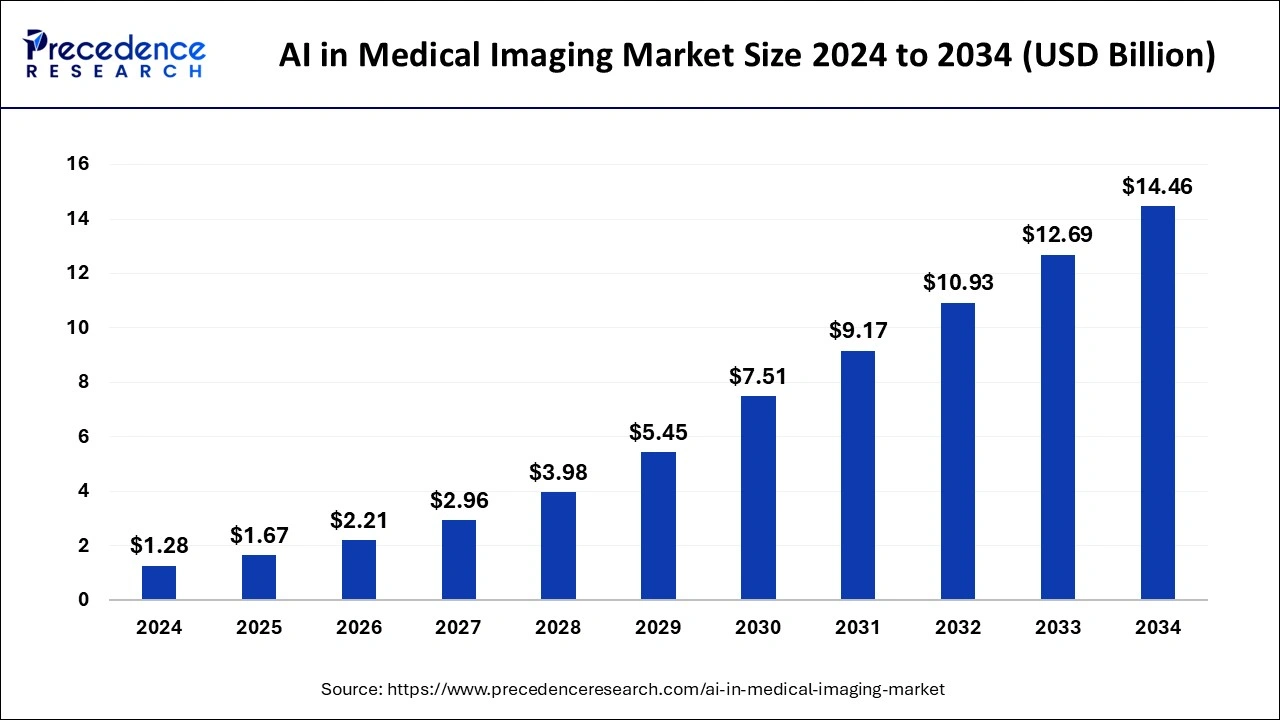
Key Concepts and Components of AI in Medical Imaging
Machine learning and deep learning
Machine learning allows computers system to learn from large amount of data instead of following only fixed instructions written by programmers. Deep learning uses complex neural network that resembles to human brain work systems. By using these two technologies in medical imaging, models are trained using thousands of scans that were already reviewed by experts. By studying these images, system learns and over the time it becomes better at spotting patterns linked with tumours, fractures, and tissue damage.
Image recognition and pattern detection
AI in medical imaging uses machine learning- Convolutional Neural Network (CNNs) for image recognition. Medical scans contain huge number of visual details, including different shapes, texture, and colour contrast. AI models are trained to analyse these visual characteristics and compare the patterns during training. When system reviews a new scan, AI recognizes the patterns and spot the areas where extra attention may require.
Workflow automation
AI also helps in managing databases and data integration. Hospitals perform a large number of scans daily and organizing, revieing and reporting these scans are time taking tasks. By integration of AI in the hospital systems, AI automatically sort and prioritize the data with organizing imaging data, preparing initial repots and tracking patient history. By handling these repetitive actions, AI allows radiologist to focus more on interpretation and patient care.
Key Applications of AI in Medical Imaging
AI in Radiology
AI is used in radiology to help doctors review medical images more quickly. It can scan X-rays, CT scans, or MRIs to identify disease. The use of AI in the department to prioritize emerging cases and reduce diagnostic errors.
Radiology is a heavy-data field. A single CT scan contains multiple images, and a large hospital might perform numerous scans per week. Reviewing all this data carefully requires time. AI can help to in analysing large amounts of data efficiently. AI-powered tools study patterns and highlight abnormalities. This can be very helpful for clinicians to reduce variation in results prediction among clinicians. AI systems trained on large datasets can learn to recognise patterns with improved accuracy.
- In Europe, AiMIFY is AI-powered contrast enhancement software used for amplifying existing contrast enhancement in brain MR images.
AI in Pathology
AI is used in pathology to examine digital microscope slides and support disease detection. The AI tools aid in identifying micro-patterns associated with malignancy, inflammation, or tissue damage. Integration of AI in pathology enhances digital slide reviews quickly, more consistent classification and automated quantification.
- Leica Biosystems is launched its Aperio HALO AP pathology platform, provides AI-powered image management with integrated digital slide review.
AI in Cardiology
In cardiology, AI tools are used to interpret echocardiography, cardiac MRI, and CT scans. Integration of AI in cardiology supports faster assessment of cardiac functions, early detection of atherosclerotic changes and advanced cardiac imaging.
- A real life example of AliveCor’s AI based ECG technology, which helps in the detection of atrial fibrillation during routine heart monitoring.
- McLaren Health Care has launched an artificial intelligence tool called – Carebricks, that will review medical charts and imaging test to detect early signs of heart disease.
Benefits of AI in Medical Imaging
Artificial intelligence is gradually becoming an important tool in medical imaging, helping healthcare providers interpret scans more efficiently and with greater confidence. The potential benefits of AI in medical imaging bring a transformative shift in healthcare.
- Improved Accuracy and Precision - The integration of AI in medical imaging improves diagnostic accuracy. AI tools can analyse images in detail and highlight areas with abnormal patterns. The use of AI does not replace the judgment of radiologists, but it offers extra support for confirmation.
- Data Management and Integration - AI can help in managing the vast amount of data generated in daily medical imaging. AI organises imaging data into structures, searchable formats, and links imaging data results with patient records. This makes it easier for clinicians to understand patients' health data in one place.
- Time Efficiency and Streamlining Workflow - Radiology departments are often under pressure due to the large number of imaging tests performed daily. With a huge volume of images, labor oriented tasks like image sorting, segmentation, ore-screening and report generation become difficult for staff. The use of AI helps to ease the pressure by quickly scanning images and highlighting areas where more attention is required.
Radiology learning
Real world – Use cases of AI in Medical Imaging
The Siemens Healthcare launched artificial intelligence - enabled services to help healthcare providers provide a hand in image interpretation in complex scenarios. These radiology services are designed to help with image generation and reporting. This will reduce the time of clinicians and promote custom-built summaries of clinically relevant observations. The integration of AI in radiology will reduce the burden on radiology staff and help them to work more efficiently.
The Wipro GE Healthcare announced the launch of SIGNATM Prime Elite, an Indian made magnetic resonance (MR) imaging system. This MR system is a deep learning based image construction technology – AIR Recon DLTM. This AI powered MR imaging system enhances image clarity with noise reduction and scan duration. SIGNATM Prime Elite integrates AI-enabled workflow tools that automatically select optimal coil configuration, and AIR x uses deep learning to detect anatomy and prescribe MRI slices. These features are used to standardize exam quality and reduce manual variability.
Challenges - AI in Radiology
Despite its advantages, the integration of AI into medical imaging has several challenges. One of the biggest issues is data quality. AI models depend heavily on data to train them. If the data used for training is limited or biased towards a certain population, then system generated outcomes will not be accurate.
Another issue related to data is data privacy and security. As AI models will be trained on a large volume of sensitive patient data, privacy and security must be maintained. The potential risk of data breaches remains significant. To address this issue, strong cybersecurity measures and clear regulatory guidelines must be implemented. Strict rules for protecting medical data safeguard sensitive patient information and ensure patient safety.
The deployment of AI in healthcare is concerning as it includes patients' lives. The accountability of AI -driven diagnosis and treatment decisions raises ethical questions. By establishing ethical standards and clear guidelines, AI can navigate through these issues.
Another challenge is transparency. Some AI systems function as complex algorithms- often called the “black box” problem- whose internal processes are difficult to interpret. This can hamper the acceptability of AI among healthcare professionals. By addressing this issue, AI can be used in medical imaging in a more accurate, efficient, and personalised way than before.
Future of Artificial Intelligence in Medical Imaging
AI in medical imaging is an evolutionary experience in healthcare technology, with its ability to improve diagnostic accuracy and streamline processes. The future of AI in medical imaging is expected to bring more advanced capabilities in the radiology field. A promising approach towards predictive imaging, where AI models may help predict disease progression or treatment response. As digital healthcare infrastructure is expanding, AI-powered imaging tools may become easily accessible to hospitals and diagnostic centres worldwide. In future, we will likely experience advancement in AI-driven medical imaging, such as AI-assisted personalised medicine, cloud based imaging platforms and integration of radiomics and genomics.
Final Thoughts
The integration of artificial intelligence is transforming how we approach medical imaging, diagnostics and treatment. AI assist in image analysis, improving detection accuracy and refining radiological workflows, which supports more efficient and reliable diagnostic processes. At the same time, technology must be implemented carefully, with attention to data quality, regulation, and clinical oversight. Ultimately, the goal is not to replace doctors in healthcare but to provide better innovative tools to improve patient outcomes. With ongoing advancements, AI in medical imaging has the potential to strengthen diagnostic care and improve outcomes for patients.
About the Authors

Aditi Shivarkar
Aditi, Vice President at Precedence Research, brings over 15 years of expertise at the intersection of technology, innovation, and strategic market intelligence. A visionary leader, she excels in transforming complex data into actionable insights that empower businesses to thrive in dynamic markets. Her leadership combines analytical precision with forward-thinking strategy, driving measurable growth, competitive advantage, and lasting impact across industries.



Aman Singh
Aman Singh with over 13 years of progressive expertise at the intersection of technology, innovation, and strategic market intelligence, Aman Singh stands as a leading authority in global research and consulting. Renowned for his ability to decode complex technological transformations, he provides forward-looking insights that drive strategic decision-making. At Precedence Research, Aman leads a global team of analysts, fostering a culture of research excellence, analytical precision, and visionary thinking.

Piyush Pawar
Piyush Pawar brings over a decade of experience as Senior Manager, Sales & Business Growth, acting as the essential liaison between clients and our research authors. He translates sophisticated insights into practical strategies, ensuring client objectives are met with precision. Piyush’s expertise in market dynamics, relationship management, and strategic execution enables organizations to leverage intelligence effectively, achieving operational excellence, innovation, and sustained growth.