






 Request Consultation
AI speech-to-text tools are transforming how we work by converting spoken words into clear, structured text. This blog explains their features, benefits, and how they improve productivity across industries and everyday tasks.
What are Speech to Text Tools?
The speech-to-text tool (STT), also known as automatic speech recognition (ASR) software, helps convert spoken audio into real-time text using recordings. Such texts are useful in multiple domains globally and are also one of the highly adopted methods for converting long spoken speech into easily readable and actionable data. Popular tools such as Google Cloud Speech-to-Text, Microsoft Azure Speech Service, and Otter.ai are highly preferable due to easy accessibility and their multiple functions, aiding the speech-to-text feature, coupled with various other services.
What is the Role of AI in Speech to Text Tools?
Deep learning, neural networks, and natural language processing (NLP) are utilized by speech-to-text platforms to convert speech into readable and actionable data. A key advantage of AI is that it does not depend on pre-programmed, traditional, and rigid tools for speech-to-text conversion. Modern technology employs deep learning algorithms to understand complex audio and easily convert it into understandable and readable data. This enables the extraction of highly accurate, readable data from speech samples of various styles. AI systems also enhance the analysis of speech quality, leading to improved transcription accuracy and better results.
Artificial Intelligence tools can analyze speech amidst disruptive background noise and produce accurate text. Additionally, AI tools assist in understanding different dialects, homophones, and natural language for enhanced performance. Improving AI systems is also vital for recognizing regional dialects, language accents, and technical terminology, converting them into accurate text for various applications. Furthermore, AI systems are essential for real-time processing, supporting live captioning and real-time agent assistance in call centers. Customization features allow the integration of specialized vocabulary or jargon to enhance recognition capabilities.
What is the AI Speech to Text Tool Market Size in 2026?
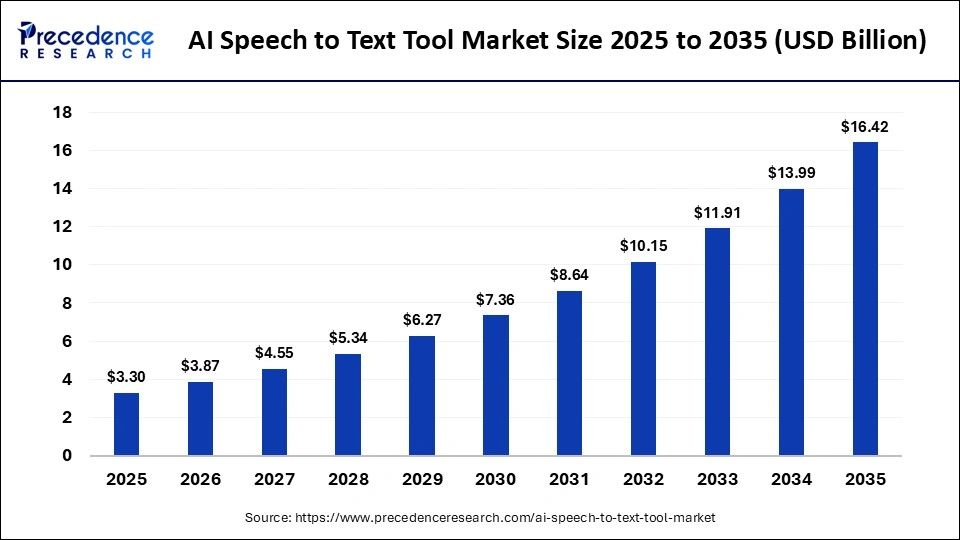
The global AI speech to text tool market size accounted for USD 3.30 billion in 2025 and is predicted to increase from USD 3.87 billion in 2026 to approximately USD 16.42 billion by 2035, expanding at a CAGR of 17.41% from 2026 to 2035.
Exploring Diverse Functionalities of AI Speech to Text Tools
- Dictation to Document Creation
Tools such as Microsoft Word Dictate and Google Docs Voice Typing use modern AI tools for speech-to-text transcription with higher accuracy and faster processing of bulk data. Such tools help create, edit, and format emails and reports. They are ideal for transcribing huge audio speeches into clean and crisp readable data useful for emails, scripts, and reports. They can also transcribe private data into text for companies with sensitive information and arrange the data accordingly in the right order with the help of AI to rearrange formats, by transcribing audio notes into articles, lists, and social media posts.
- Meeting and Lecture Transcription
Using AI tools to transcribe hours of speech data and convert it into text is just a matter of minutes now. Hence, instead of using manual methods for converting speech into text, people increasingly prefer AI-based tools with various other aiding features. Specialized applications such as Otter.ai and Fireflies.ai help transcribe huge speech data into readable texts and appropriate summaries. They help identify action items in real-time for accurate data transcription. AI systems also help distinguish between different speakers for transcribing audio into text in a set pattern and for effective results.
AI systems are also crucial for students to record lectures in real-time and transcribe them into the form of notes to shift the focus from manual writing to active listening and save their time for other crucial aspects. Such tools are also easy to integrate with virtual meeting platforms for in-person classroom recording. They are loaded with various features such as live transcription, AI summarization, searchable transcripts, and integration. Some common examples of AI speech-to-text tools that are most widely used by students include Otter.ai, NotebookLM (Google), Notta, Knowt, Mindgrasp, and Jamie.
- Customer Service and Call Analytics
AI speech-to-text tools help transcribe huge conversations between a customer and agent clearly into accurate text to improve their performance, ensure compliance, and uncover customer insights. Such tools utilize ASR and NLP to analyze intent and sentiment, ensuring clear and accurate transcribing. They record live calls and, with the help of relevant base knowledge articles or suggestions, display them on the agent’s screen. AI tools also help agents understand various emotions of the customer, such as frustration, joy, or aggression, and help supervisors intervene in case of high-risk calls.
- Media and Content Creation
AI-based speech-to-text tools help enhance the quality of audio and video for enhanced viewership, thereby increasing their productivity. They identify multiple speakers in the same audio for clear and real-time transcription for effective results. They can transcribe complex audio data into readable and understandable scripts, remove awkward pauses, and provide understandable and helpful captions for a global audience for high-quality edits. Commonly used AI-based speech-to-text tools by content creators for effective video quality are Descript, Happy Scribe, Vizard.ai, Otter.ai, Rev, and Sonix. The main aim of these tools in the content creation domain is to shift the focus from manual to creative and automated transcribing to create high-impact and audience-engaging content.
Real-World Applications of AI Speech to Text Tools
Healthcare
AI-based speech-to-text tools are widely used in the healthcare sector for various purposes, ensuring personalized patient care and saving time for both patients and physicians. They help record the interaction between physicians and patients in real-time to create accurate clinical notes helpful for future reference. Specialized software helps transcribe complex medical terminology and technical jargon into an easy and understandable language. They can convert several languages into the local language, enabling patients to seek medical care from diverse geographical locations. This enhances access to quality medical care and reduces the need for traveling to a far location.
AI-based tools also streamline administrative tasks by integrating with electronic health records, ordering prescriptions, or updating patient histories. They can also fill documentation gaps, suggest next steps for patient care, and find potential billing opportunities. The highly utilized speech-to-text AI solutions in the healthcare industry are Dragon Medical One, Suki AI, Whisper (OpenAI), Sunoh.ai, Heidi Health, Amazon Transcribe Medical, and Sonix.
Legal and Finance Industry
The legal industry is undergoing a tectonic shift, driven by the use of AI speech-to-text tools for automating various tasks precisely and lowering the manual strain to save maximum time. Such tools help in real-time transcriptions of legal proceedings, dictate briefs, contracts, memos, witness statements, and identify key testimonies. They can transcribe hours of audio speech with high accuracy and speed to avoid repetitive work by analyzing sensitive data.
In the finance sector, speech-to-text tools enable automatic transcription of trader and advisor conversations to ensure regulatory compliance and lower the risks of potential fraud. AI-powered assistants help handle customer inquiries using NLP. They also help in transcribing client meetings and investment committee discussions with ease for a detailed record without excessive manual efforts. They analyze customer feedback and calls to gauge mood and improve service. Several tools used by the legal and finance industries include Sonix, Rev AI, Otter.ai Business, Descript, Dragon Legal, and Quantiphi.
Media and Journalism
The media and journalism field is witnessing a revolution by converting long hours of speech in the form of interviews into text through the use of AI speech-to-text tools, enhancing workflow efficiency and eliminating the manual work of transcribing. These tools help in the creation of attractive, easy-to-read, and understandable captions. Hence, it is a highly cost-effective procedure. They simplify the investigation work by uploading long hours of speech videos and finding specific words with ease, allowing for a higher demand for such tools. Such applications also allow editors to edit audio/video by editing the text transcript, to make podcast and video production more effective. Popular tools used for editing videos and transcripts include Sonix, Otter.ai, Trint, Good Tape, Wispr Flow, and Google Pinpoint.
Conclusion
The main aim of AI-based speech-to-text tools involves analyzing the audio in various situations, and even outside the recording studio environment. Hence, such tools help in managing the disturbing background noises and transcribe audio into text with higher accuracy. Apart from various advantages, AI speech-to-text tools face limitations, such as identifying particular accents and dialects, judging homophones, and misinterpretations of expressions. Ongoing research focuses on training AI tools and overcoming these challenges. The future of AI-based tools is promising, driven by improvements in deep learning neural networks. Self-learning algorithms enable AI tools to interpret new accents, dialects, and domain-specific language, eliminating human intervention.
Expert Advise
According to Precedence Research, the use of AI speech-to-text tools is growing rapidly, driven by the increasing familiarity with AI tools and the rise of AI chatbot systems. Advancements in NLP enable features such as automatic punctuation, speaker diarization, and multi-language support for audio/video files. Developers are keen to introduce multi-lingual support in these tools and offer dual functionality of converting text to speech and vice versa. Modern AI tools are believed to offer 95% accuracy, entailing their widespread use across various sectors. The integration of speech-to-text tools with emerging technologies, such as augmented reality, virtual reality, and the Internet of Things, leads to immersive user experiences and amplifies their capabilities.
About the Authors

Aditi Shivarkar
Aditi, Vice President at Precedence Research, brings over 15 years of expertise at the intersection of technology, innovation, and strategic market intelligence. A visionary leader, she excels in transforming complex data into actionable insights that empower businesses to thrive in dynamic markets. Her leadership combines analytical precision with forward-thinking strategy, driving measurable growth, competitive advantage, and lasting impact across industries.



Aman Singh
Aman Singh with over 13 years of progressive expertise at the intersection of technology, innovation, and strategic market intelligence, Aman Singh stands as a leading authority in global research and consulting. Renowned for his ability to decode complex technological transformations, he provides forward-looking insights that drive strategic decision-making. At Precedence Research, Aman leads a global team of analysts, fostering a culture of research excellence, analytical precision, and visionary thinking.

Piyush Pawar
Piyush Pawar brings over a decade of experience as Senior Manager, Sales & Business Growth, acting as the essential liaison between clients and our research authors. He translates sophisticated insights into practical strategies, ensuring client objectives are met with precision. Piyush’s expertise in market dynamics, relationship management, and strategic execution enables organizations to leverage intelligence effectively, achieving operational excellence, innovation, and sustained growth.