






 Request Consultation
Artificial intelligence has shifted from simple automation to the strategic core of modern enterprises, powering adaptive, generative, and self-optimizing systems that redefine productivity and value creation.
Artificial Intelligence has moved from the periphery of enterprise innovation to the center of industrial transformation. What began as discrete experimentation automating workflows, predicting outcomes, or classifying data has evolved into a strategic foundation for the modern economy. Across industries, AI is no longer an auxiliary tool; it is now the core architecture upon which software, decision-making, and value creation are built. In the past decade, organizations have focused primarily on digital transformation, migrating to the cloud, adopting automation, and scaling analytics. The next decade, however, will be defined by AI transformation: systems that learn, adapt, and generate insights autonomously, at scale.At the heart of this revolution lies a new form of intelligence infrastructure at the AI-centric software stack, where generative models, adaptive architectures, and self-optimizing workflows redefine productivity, creativity, and strategy.
Abstract
Artificial intelligence is no longer a supplementary capability; it is the foundation upon which the next generation of software enterprises will be built. The industry is entering a decisive inflection point where organizations must transition from software-enabled to AI-native business models.
Companies that re-architect their operating models, technology stacks, and talent ecosystem around AI will not only accelerate innovation cycles but will also achieve compounding value creation. Those that fail to adapt risk being left behind as intelligence becomes the new source of competitive advantage.
What is Artificial intelligence Market Size 2024 to 2034
The global artificial intelligence (AI) market size was USD 638.23 billion in 2024, calculated at USD 638.23 billion in 2025 and is expected to reach around USD 3,680.47 billion by 2034, expanding at a CAGR of 19.20% from 2025 to 2034.

How AI is Building Architectures for Exponential Growth?
Over the past two decades, the software industry has undergone a profound transformation, evolving from handcrafted systems to scalable, cloud-native architectures. We now stand on the threshold of a new frontier characterized by self-learning and adaptive systems that enhance their performance through iterative data feedback loops. In this emergent paradigm, artificial intelligence (AI) is not merely an adjunct technology; it constitutes the essential infrastructure that informs decision-making processes, elevates user experience, and drives product evolution. Organizations are increasingly distinguishing themselves not through static feature sets, but by their systems' capabilities to learn dynamically and anticipate user needs effectively. An AI-native enterprise fundamentally diverges from traditional models that simply incorporate AI tools into existing workflows. These enterprises are purposefully designed for continuous, scalable learning, underpinned by sophisticated data pipelines, modular architectures, and rigorous governance frameworks.
Comprehensive industry analysts suggest that organizations that integrate AI throughout the software development lifecycle can achieve innovation cycles that are two to three times more efficient, along with substantial enhancements in productivity. The most effective companies conceptualize AI not merely as a resource to be managed, but as a strategic core component that warrants thoughtful scaling for maximized impact.
Fundamentals of Generative AI: From Imitations to Imagination
Defining Generative AI: Generative AI refers to the subset of AI systems designed to create new data that mimics existing patterns, leveraging probabilistic modelling, deep neural architecture, and transformer frameworks. Unlike discriminative models, which learn to classify or predict outcomes, generative models synthesize new possibilities from realistic imagery to coherent narratives and molecular structure.
- Core principles
Representation Learning:
- Generative models capture latent representations hidden structure in data that encode meaning and correlation.
- Probability Distribution Estimation: the model learns an approximate distribution Pmodel close to the true data distribution Pdata.
- Reconstruction and Creativity: through sampling from this learned distribution, the system generates novel outputs that preserve semantic integrity.
Organizational Transformation: The Rise of Intelligence Architects
As AI reshapes the nature of software, it also transforms the talent landscape. The enterprise of the future will rely on interdisciplinary teams comprising data scientists, machine learning engineers, UX designers, and ethicists working in unified, outcome-oriented structures. Leadership models must evolve in parallel. Executives will require fluency in AI governance, model interpretability, and responsible innovation. The shift from technical management to intelligence orchestration will define the next generation of digital leaders.
How Will We Weave the Future: Navigating Economic Transformation in the AI Landscape?
The economics of software are being redefined by AI’s compounding learning effects. Unlike traditional software, where value creation is linear, AI-driven systems improve with each interaction, generating a flywheel of performance enhancement. Early adopters are already realizing substantial competitive advantages through these dynamics. However, success demands strategic patience and sustained investment. Building AI-native systems involves upfront costs in data infrastructure, model training, and cultural transformation but the long-term return on intelligence is exponential.
As AI fundamentally reshapes the software landscape, it concurrently evolves the talent ecosystem. Future enterprises will depend on interdisciplinary teams composed of data scientists, machine learning engineers, UX designers, and ethical scholars, all functioning within unified, outcome-oriented structures. Leadership paradigms must concurrently evolve; executives will need fluency in AI governance, model interpretability, and responsible innovation. The transition from technical management to intelligence orchestration will demarcate the next generation of digital leaders.
Top 10 Countries with the Highest AI Budget Allocations in 2025
In 2025, a significant number of governments have committed substantial financial resources to capitalize on the transformative capabilities of artificial intelligence (AI), positioning it as a cornerstone of their national strategic frameworks. The following countries exemplify a strong commitment to economic advancement and technological innovation through their strategic investments in AI development. These nations are at the forefront of AI funding, reflecting their determination to lead in this critical field.
| Rank | Country | Total Investment (in USD, Billions) |
| 1 | United States | 470.9 |
| 2 | China | 119.3 |
| 3 | United Kingdom | 28.2 |
| 4 | Canada | 15.3 |
| 5 | Israel | 15 |
| 6 | Germany | 11.3 |
| 7 | India | 11.1 |
| 8 | France | 9 |
| 9 | South Korea | 7.3 |
| 10 | Singapore | 7.3 |
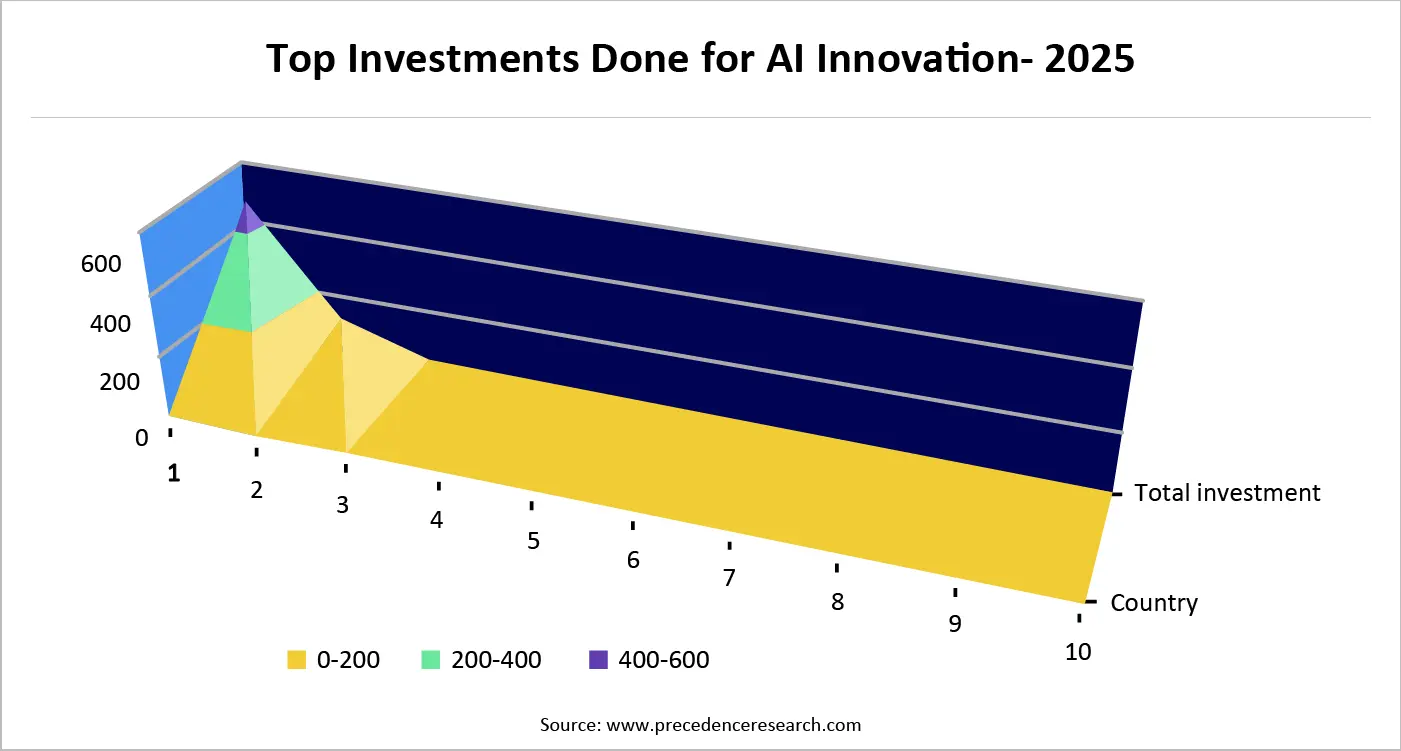
The current landscape of artificial intelligence (AI) development presents a multifaceted panorama, characterized by distinct approaches and inherent challenges across various global regions, reflective of their unique economic contexts and societal imperatives.
In the United States, a leading force in AI research and commercialization, a dynamic startup ecosystem is bolstered by significant venture capital investments, enabling rapid innovation across diverse sectors such as finance, healthcare, and automotive industries. However, alongside this dynamism, there exists a pressing discourse surrounding the ethical implications of AI, particularly concerning workforce displacement and the biases that may pervade AI systems. Thus, addressing these ethical quandaries is paramount for fostering sustainable growth and engendering public trust in AI technologies. Conversely, China's strategic incorporation of AI into its broader economic framework underscores its ambition to elevate its global standing in technology. The robust support from the government has catalyzed rapid advancements in AI applications spanning e-commerce and surveillance. Nonetheless, this accelerated progress raises significant ethical issues, particularly regarding privacy, censorship, and human rights, necessitating a balanced approach to ensure that technological advancement does not undermine societal values.
The European Union differentiates itself through its commitment to ethical governance and data privacy, positioning itself as a vanguard of sustainable AI development. While the regulatory framework aims to enhance responsible innovation, the challenge of harmonizing diverse regulations across member states persists, potentially stifling the pace of technological adoption. The EU's emphasis on ethical AI development could serve as a global benchmark; however, it must concurrently cultivate an environment conducive to competitiveness to avoid ceding leadership to more agile counterparts. In India, the burgeoning tech startup ecosystem, complemented by a rich pool of skilled professionals, signals the country's emergence as a significant player in the global AI arena. Government initiatives aimed at promoting AI research are particularly salient in critical sectors such as agriculture, healthcare, and education, thereby driving socio-economic growth. To harness the full potential of AI, India must prioritize inclusivity and accessibility, ensuring that technological advancements translate into broad-based prosperity.
In summation, while each region exhibits distinct strengths and challenges in the domain of AI development, common themes emerge regarding the imperatives of ethical considerations, robust regulatory frameworks, and the necessity for inclusive growth. As global competition intensifies, the capacity to balance innovation with social responsibility will be vital for sustainable progress across all regions, shaping the future of artificial intelligence in a manner that aligns with collective human values.on.
Taxonomy of generative AI Practices
| Practice Type | Description | Representative models | Applications |
| Text generation | produces coherent, content-aware language outputs. | GPT, LLaMA, Gemini | Conversational AI, code generation. |
| Image Synthesis | Generates realistic or stylized visual data | DALL.E, Stable diffusion, Midjourney. | Art, design, simulation. |
| Audio and speech generation | Converts text to speech and synthesizes sound. | Whisper, wavenet | Voice assistance, dubbing. |
| Video generation | constructs moving visual content using temporal data | Sora, Pika, runway | media, marketing, storytelling. |
Core Domains of AI Software Usage
- Business Intelligence and Analytics: AI-driven analytics platforms enable predictive forecasting, sentiment analysis, and automated reporting, transforming decision-making in finance, marketing, and operations.
- Healthcare and Life Sciences: AI algorithms power diagnostic imaging, drug discovery, and patient risk assessment. Generative AI accelerates molecular design and clinical documentation, improving both efficiency and precision.
- Manufacturing and Industrial Automation: Through predictive maintenance, computer vision-based quality control, and digital twins, AI software optimizes resource use and minimizes downtime.
- Retail and Consumer Behavior Modeling: AI personalizes consumer experiences through recommendation engines, dynamic pricing, and demand forecasting, reshaping global retail and e-commerce ecosystems.
- Transportation and Smart Mobility: AI supports autonomous vehicle navigation, traffic optimization, and fleet analytics, enhancing safety and sustainability in mobility networks.
- Creative and Knowledge Industries: Generative AI tools now power content creation, language translation, and synthetic media, democratizing creativity and redefining intellectual production.
Redefining Product Development
In an AI-centric ecosystem, software is a living entity constantly learning, adapting, and entity constantly learning, adapting, and optimizing. Traditional product development frameworks based on fixed release cycles are giving way to continuous iteration models. Leading organizations are restructuring R&D and product teams to operate as learning systems, integrating real-time data feedback to drive enhancements. This creates an adaptive ecosystem where products evolve in response to both user behaviour and algorithmic insights, ensuring sustained differentiation.
Organizational Transformation: The Rise of Intelligence Architects
As AI reshapes the nature of software, it also transforms the talent landscape. The enterprise of the future will rely on interdisciplinary teams comprising data scientists, machine learning engineers, UX designers, and ethicists working in unified, outcome-oriented structures. Leadership models must evolve in parallel. Executives will require fluency in AI governance, model interpretability, and responsible innovation. The shift from technical management to intelligence orchestration will define the next generation of digital leaders.
What Emerging Technologies Will Define the Next Era of Software Development?
The next software frontier is AI-native a world where models, data, and computation intertwine seamlessly. Their frontier is defined not just by technological progress but by organizational adaptation, architectural redesign, and ecosystem reformation. Many companies identify the emergence of a multi-layered AI stack, analogous to the early cloud revolution but far more complex in scope. Each layer represents a distinct value domain from foundational model innovation to enterprise orchestration.
|
Layer |
Description |
Industry Examples |
|
Infrastructure & Compute Layer |
Specialized AI chips, GPUs, and cloud clusters enabling massive parallel processing. |
NVIDIA, AWS Trainium, Google TPU. |
|
Foundation models layer |
Large scale pertained models for language, vision, and multimodal intelligence. |
GPT, Claude, Gemini, Liama |
|
Fine tuning and adaptation layer |
Domain specific for entreprise applications. |
Finetuned legal, healthcare, or finance models. |
|
Application layer |
Domain-specific tuning for enterprise applications. |
Finetuned legal, healthcare, or finance models. |
|
Orchestration & Governance Layer |
Tools ensuring safe, compliant, and efficient model deployment. |
Datarobot, scale, AI, ModelOps, platforms. |
This layered architecture reveals the modular nature of AI adoption. Just as the cloud stack transformed IT by separting storage, compute, and application layers, the AI stack is redefining software modality where each enterprise can choose its depth of integration, from API-level access to in-house model ownership.
The Rise of Foundational Intelligence
Foundation models trained on trillions of tokens across modalities represent the new substrate of software development. Unlike traditional models trained for single tasks, foundation models are general-purpose engines that can be adapted across verticals. This architecture mirrors the human brain's transfer learning capability: knowledge learned in one context can be reused elsewhere. In business terms, foundation models create economies of intelligence where one trained model fuels infinite downstream applications.
What is Trending Emerging AI stack?
Our analysis suggest that the architecture of the AI-centric world is no longer liner. It is a dynamic mesh of compute, data, models, and governance. Unlike the monolithic stacks of the digital era, the new AI stacks is fluid, composable, and learning driven.
Layer 1 Compute and Infrastructure The Silicon Substrate: At the foundation lies the physical substrate AI-optimized compute. General-purpose CPUs are being replaced by specialized processors (GPUs, TPUs, NPUs) capable of parallelized tensor operations. Major hyperscalers (AWS, Google, Azure) are vertically integrating by designing proprietary silicon, giving rise to a hardware-software symbiosis that mirrors Apple’s early design philosophy but scaled for intelligence workloads.
Layer 2: Data Fabric and Governance: Data is not merely input; it is the lifeblood of model performance. Enterprises are establishing data fabrics cross-functional architectures that unify structured, unstructured, and real-time streams under consistent governance.
Key design tenets include:
- Data lineage transparency: Tracking origin, transformation, and consent.
- Federated learning: Enabling decentralized model training across geographies without moving data.
- Synthetic data generation: Addressing scarcity and bias by augmenting datasets algorithmically. It is predicted that by 2027, over 60 percent of AI-driven firms are expected to deploy federated or privacy-preserving learning systems, aligning innovation with compliance.
Layer 3: Foundation Models and Domain Adaptation: This layer is the cognitive core of the AI stack. Foundation models trained on trillions of parameters function as general-purpose intelligence engines that can be fine-tuned for vertical specialization. The industrial playbook is shifting from model ownership to model orchestration: companies may subscribe to foundation models, layer domain data for fine-tuning, and integrate them via API or on-prem orchestration platforms.
|
Adaptive Approach |
Description |
Business Advantage |
|
Prompt engineering |
Lightweight alignment using crafted prompts. |
Fast experimentation. |
|
Parameter efficient turning |
Updating small subsets of models weights |
Lower cost, domain fit. |
|
Full Fine Turning |
Retraining the entire model with proprietary data. |
Maximum control, highest accuracy. |
Layer 4: Application and Interface Layer: Here, intelligence meets utility. Applications leverage APIs from foundational models to deliver context-aware experiences autonomous agents that schedule meetings, generate legal drafts, or design marketing campaigns.
This is where GenAI becomes tangible: customer-facing, responsive, and value-accretive. Companies embedding GenAI into their platforms have observed 20–40 percent improvements in customer-interaction efficiency and product-development velocity.
Layer 5: Orchestration, Security, and Ethics: The apex of the stack is trust orchestration ensuring reliability, explainability, and compliance. Enterprises now deploy ModelOps pipelines analogous to DevOps, managing the lifecycle of models from deployment to drift correction.
Ethical AI is evolving from principle to protocol:
- Explainability dashboards quantify model decisions.
- Bias-mitigation audits accompany regulatory filings.
- Algorithmic transparency indices are emerging as brand differentiators.
This orchestration layer transforms governance from a constraint into a competitive moat where trusted AI becomes the new currency of reputation.
Organizational Transformation in the AI-Native Enterprise
“AI Leadership is about commanding algorithms and more about curating intelligence”
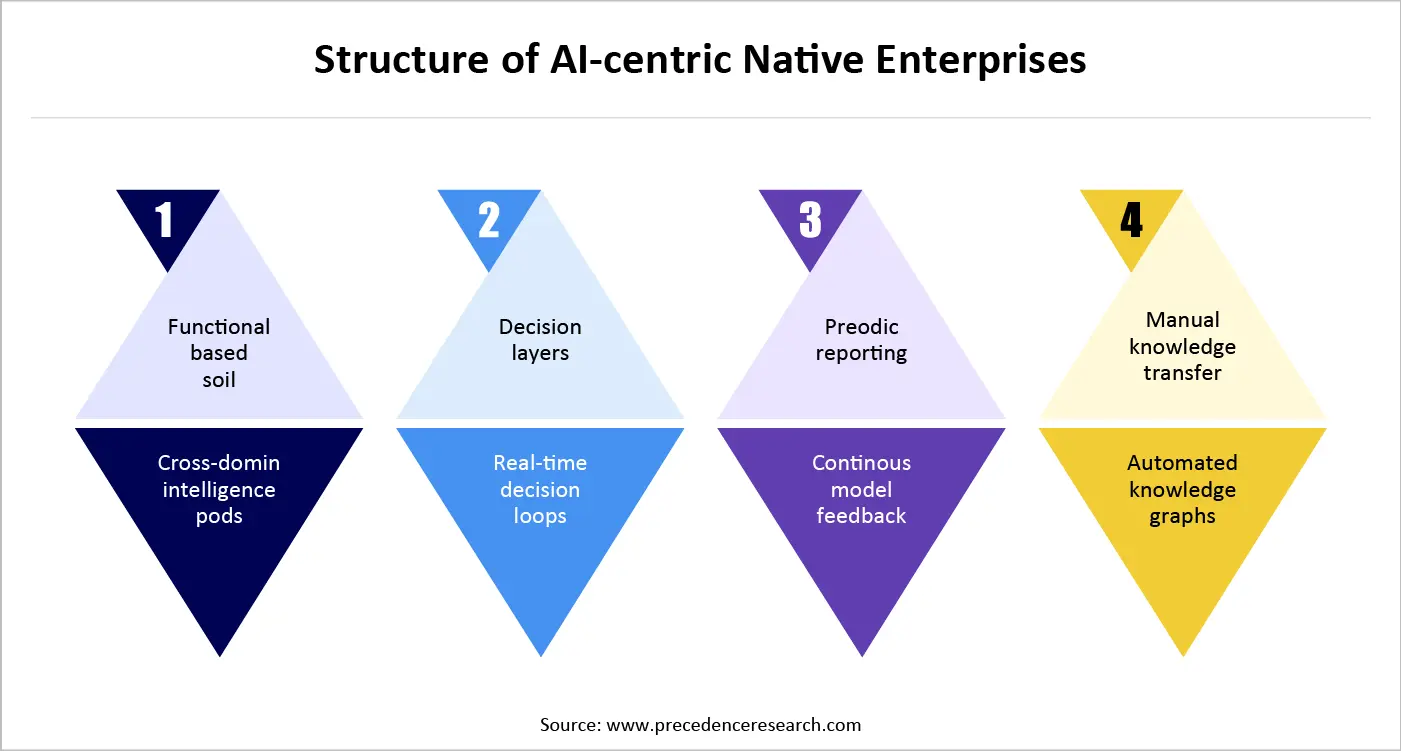
Our analysis suggests that in the rapidly evolving landscape of artificial intelligence, organizations are undergoing a profound metamorphosis, reconfiguring their architecture to embrace an AI-native ethos. This transformation is not merely a superficial integration of AI tools into existing frameworks; rather, it marks a paradigm shift in how enterprises conceptualize their operations, decision-making processes, and ultimately, their very identity.
At the nucleus of an AI-native enterprise lies the integration of intelligence into every facet of organizational functionality. Traditional hierarchies give way to agile, cross-functional teams adept at navigating the complexities of data ecosystems. These interdisciplinary coalitions comprising data scientists, machine learning engineers, software architects, and UX designers function in concert, fostering a culture of collaboration that transcends departmental boundaries. Their collective expertise catalyzes innovation, allowing for real-time responsiveness to market dynamics and consumer needs.
This structural evolution necessitates not only a reassessment of roles but also a reframing of leadership paradigms. Executives are now called upon to embody the roles of intelligence architects, seamlessly melding technological acumen with strategic foresight. Proficiency in AI governance and ethical considerations emerges as a paramount attribute for leadership, as the implications of AI-augmented decision-making ripple across the organizational landscape. C-suite executives must transcend traditional management models to embrace a stewardship approach, cultivating an environment where ethical innovation flourishes alongside technological advancement. Moreover, the introduction of sophisticated data pipelines and modular architectures reinforces the scaffolding of AI-native enterprises. These infrastructures facilitate dynamic learning and adaptation, ensuring that organizations continually refine their insights and operational efficiency through iterative feedback mechanisms. Consequently, the demand for rigorous governance frameworks becomes imperative to safeguard against biases and ensure the responsible deployment of AI.
As enterprises undergo this transformation, they also cultivate a value-oriented mindset, recognizing that AI is not merely a collection of technologies but a strategic cornerstone for differentiation. Organizations that embrace this AI-centric evolution will reap exponential benefits, harnessing the power of predictive analytics and generative models to create unparalleled consumer experiences and operational efficiencies. In this brave new world of AI-native enterprises, the societal implications are profound. Companies must navigate the delicate balance between innovation and ethical responsibility, ensuring that their AI-driven advancements serve not only their interests but also those of the communities they inhabit. This holistic vision of organization transcends transactional relationships, positioning AI as a catalyst for comprehensive value creation in an interconnected global economy. Thus, the AI-native enterprise stands at the forefront of a transformative movement an invitation to redefine the very fabric of enterprise engagement and success.
Industry-Level Impacts
How are Financial Services Revolutionizing Cognitive Capital Allocation?
Banks and insurers are leveraging AI to manage risk, personalize products, and optimize compliance. Generative models are now draft credit analyses, stimulate stress tests, and summarize regulatory filings, cutting analytical cycle time by 60 percent.
- Impact Metric: In the rapidly evolving landscape of AI-driven software development, establishing effective impact metrics is crucial for organizations aiming to measure and enhance their AI capabilities. These metrics help businesses assess the effectiveness, efficiency, and overall value generated by their AI systems.
- User Engagement Metrics: Metrics such as user retention rates, session duration, and user satisfaction scores provide insights into how AI-enhanced features impact user experience and engagement. Understanding user interactions with AI-driven systems is vital for optimizing those systems.
- Operational Efficiency: This metric evaluates how AI contributes to streamlining processes and reducing costs. It can be quantified through machine utilization rates, time savings in workflow, or reduction in error rates due to AI integration.
- Innovation Rate: Tracking the rate of new features developed or improved through AI can serve as a measure of how well an organization is leveraging AI for continual innovation. This metric reflects the agility and adaptability of teams working with AI technologies.
The frontier here is self-supervising compliance systems that detect anomalies in real-time. Also, AI models forecast machine failures, optimize energy consumption, and adjust production parameters autonomously. In consumer sectors, the shift from personalization to individualization is underway. Generative models curate micro-segments of one designing marketing, pricing, and experience in real-time. Retailers integrating AI into their customer stack report uplifts in conversion and loyalty indices. The future forefront is creative, adjusting ambience, recommendations, and promotions based on emotional analytics.
The Great Automation Renaissance: From Mundane Tasks to Intelligent Enterprise:
To capture this value, companies will need to evolve into AI-centric ecosystems. Automation has transcended its traditional role as a mere operational enhancer; it has become the nervous system of modern business transformation. Once confined to the discreet corridors of HR and finance, it now permeates every dimension of the enterprise, from the pulse of sales and marketing to the precision of customer support and professional services. This sweeping metamorphosis reflects an awakening across the software landscape: artificial intelligence is not simply an instrument of efficiency, but a strategic catalyst, a force capable of orchestrating scale, precision, and innovation in perfect synchrony. The forward-looking leaders of today no longer view automation as an auxiliary pursuit; they recognize it as the core enabler of sustainable productivity and creative liberation.
Pioneering organizations have already begun to weave generative and agentic AI into the fabric of their internal operations, not to supplant human talent but to amplify its brilliance. These systems streamline complexity, recalibrate workflows, and unburden employees from repetitive tasks, allowing them to devote their intellect and imagination to more consequential endeavours. In the dynamic realm of sales, AI has ignited a quiet revolution. Intelligent copilots and virtual assistants now accompany sellers through every stage of engagement, identifying promising opportunities, refining outreach strategies, composing persuasive communications, and even offering real-time insights during customer interactions. The result is not merely heightened efficiency but a re-enchantment of the human element in commerce, a renewed focus on empathy, intuition, and meaningful dialogue. Across industries, this new paradigm signals a profound shift. Automation, once the backstage machinery of business, now steps boldly into the spotlight as the architect of enterprise reinvention. It harmonizes machine logic with human creativity, forging an operational rhythm that is faster, smarter, and deeply attuned to the evolving cadence of the digital age.
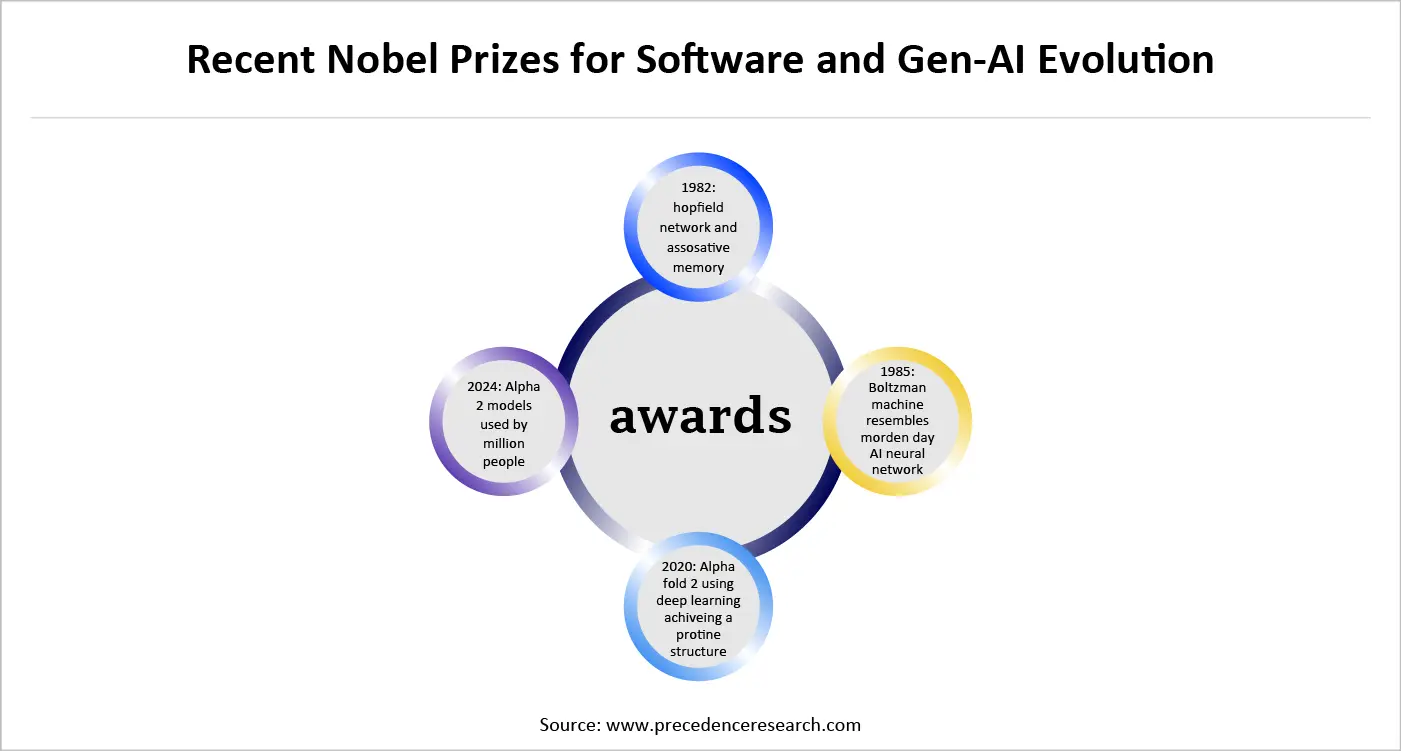
How are the Evolution of Software and Generative AI Connected to the Nobel Prize in Scientific Achievements?
Our experts believe that the history of artificial intelligence (AI) and generative AI in relation to Nobel Prize awards from 1982 to 2024 reveals an evolving recognition of AI’s impact across various fields. Although no specific Nobel Prize was awarded for AI in its early years, significant advancements in neural networks during the 1980s laid the groundwork for future computational techniques and data analysis. Noteworthy developments occurred in 1997 when IBM’s Deep Blue defeated chess champion Garry Kasparov, showcasing AI’s potential, although it did not garner a Nobel recognition at the time. In subsequent years, the intersection of AI with economics became evident, particularly in 1999 when Robert F. Engle and Clive W.J. Granger received the Nobel Prize in Economic Sciences for methodologies that involved computational analysis.
The 2000s saw the rise of machine learning, culminating in the 2016 Turing Award for Geoffrey Hinton, Yann LeCun, and Yoshua Bengio, marking a significant acknowledgment of their contributions to deep learning techniques foundational to generative AI. AI’s influence on economic auction theories was recognized again in 2018 when Paul R. Milgrom and Robert J. Shiller were awarded the Nobel Prize in Economic Sciences for their work involving algorithms informed by AI. As generative AI models like GPT-3 and DALL-E started transforming industries in 2021, the relevance of AI has grown, although explicit Nobel recognition in this domain continued to remain elusive.
By 2023, while various awards celebrated technological innovations stemming from AI, no Nobel Prize was explicitly attributed to its advancements. However, as AI and generative technologies gain prominence in creative fields, healthcare, and other domains, it is increasingly likely that the Nobel committee will recognize groundbreaking contributions in these areas soon. The dialogue surrounding the ethics and governance of AI continues to evolve, suggesting that the significant advancements in generative technologies could soon make their mark on future Nobel Prize considerations.
 Trust, Ethics, and Responsible Acceleration
The swift advancement of artificial intelligence (AI) technologies demands a comprehensive ethical framework that meticulously addresses pivotal issues such as data privacy, algorithmic bias, and transparency in decision-making processes. Practitioners and organizations operating within this domain must prioritize the integration of ethical considerations from the nascent stages of AI development. This proactive approach is essential not solely for adhering to regulatory mandates but also for preserving societal trust and maintaining the integrity of AI systems.
By embedding ethical principles into the core of AI strategies, organizations can significantly mitigate potential risks associated with biased algorithms and opaque decision-making. This commitment to responsible AI practices fosters equitable outcomes across diverse applications, ultimately enhancing the technology's positive impact on society. Furthermore, emphasizing ethics as a foundational element in AI evolution promotes sustainability, ensuring that advancements in technology align with societal values and expectations.
In an era where AI increasingly influences critical sectors, from healthcare to finance, establishing a robust ethical framework is imperative. It fosters long-term technological evolution that not only prioritizes innovation but also safeguards the rights and welfare of individuals and communities, thereby reinforcing the social contract essential for future advancements in AI.
The path Forward: Engineering and AI Native Future
The path forward requires a harmonious fusion of courage and clarity. Organizations must evolve from tentative experimentation to comprehensive enterprise orchestration, seamlessly embedding AI into every workflow, decision-making process, and customer interaction. The real hallmark of success will not simply lie in having access to advanced models or vast datasets, but rather in the strategic and thoughtful integration of intelligent systems into the very essence of value creation. This approach will ensure that technology enhances human potential, driving innovation and fostering deeper connections with customers.
Conclusion: The New Frontier of Software
AI is not merely transforming software it is redefining the nature of business evolution. The companies that master this transition will not just participate in the next frontier; they will architect it. The imperative is clear: adapt, learn, and lead through intelligence or risk obsolescence in a world where software no longer just executes instructions, but thinks, decides, and evolves.
About the Authors

Aditi Shivarkar
Aditi, Vice President at Precedence Research, brings over 15 years of expertise at the intersection of technology, innovation, and strategic market intelligence. A visionary leader, she excels in transforming complex data into actionable insights that empower businesses to thrive in dynamic markets. Her leadership combines analytical precision with forward-thinking strategy, driving measurable growth, competitive advantage, and lasting impact across industries.



Aman Singh
Aman Singh with over 13 years of progressive expertise at the intersection of technology, innovation, and strategic market intelligence, Aman Singh stands as a leading authority in global research and consulting. Renowned for his ability to decode complex technological transformations, he provides forward-looking insights that drive strategic decision-making. At Precedence Research, Aman leads a global team of analysts, fostering a culture of research excellence, analytical precision, and visionary thinking.

Piyush Pawar
Piyush Pawar brings over a decade of experience as Senior Manager, Sales & Business Growth, acting as the essential liaison between clients and our research authors. He translates sophisticated insights into practical strategies, ensuring client objectives are met with precision. Piyush’s expertise in market dynamics, relationship management, and strategic execution enables organizations to leverage intelligence effectively, achieving operational excellence, innovation, and sustained growth.