






 Request Consultation
CRP testing has become a key diagnostic tool for detecting inflammation and monitoring diseases such as cardiovascular and autoimmune conditions. Its growing adoption, supported by advanced technologies and healthcare expansion, is enhancing early diagnosis and patient care outcomes.
What is C-Reactive Protein (CRP) Testing?
C-reactive protein tests are one of the common diagnostic techniques that are used to determine the level of CRP, which is a protein secreted by the liver as a reaction to inflammation. CRP is a perfect biomarker for the diagnosis and monitoring of various diseases because its levels are highly elevated when there are infections, tissue damage, or chronic inflammatory activities in the body.
CRP testing is mostly applied in the diagnosis of infections, autoimmune diseases, and cardiovascular disorders. Its high accuracy, rapid results, and cost-effectiveness have made it a routine diagnostic tool across hospitals, laboratories, and point-of-care facilities. With the growing focus on preventive medicine, CRP testing is increasingly adopted for early disease detection and ongoing health monitoring.
Which Testing Methods Are in High Demand?
A range of diagnostic methods has been applied in the CRP testing to date, and each of them possesses specific benefits in terms of speed, accuracy, and scalability.
- Immunoturbidimetric Assays: The use of immunoturbidimetric assays is common because it is a fast method of processing data. These assays have high throughput and are cost-effective. They determine the turbidity based on the antigen-antibody reaction, which allows to quantify CRP accurately. These are highly compatible with automated analyzers, making them ideal for routine diagnostics in hospitals and large-scale laboratories.
- ELISA (Enzyme-Linked Immunosorbent Assay): ELISA is valued for its sensitivity and specificity in the detection of low CRP concentrations. It is extensively used in clinical diagnostics and research. With ongoing advances in technology, the sensitivity and accuracy of ELISA kits have improved, making them the preferred choice for detailed analysis and disease surveillance purposes.
- Chemiluminescence: Chemiluminescence assays have become popular because of their high sensitivity, accuracy, and capability to provide results in a short period of time. By measuring light produced in chemical reactions, these assays support advanced, automated laboratories and high-throughput diagnostic processes, enhancing analytical precision.
What is the C Reactive Protein Testing Market Size in 2026?
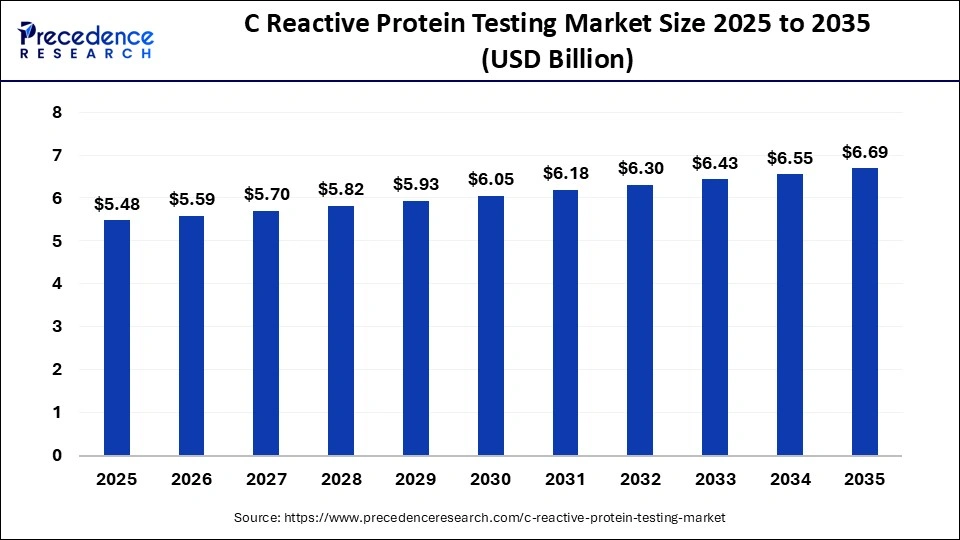
The global C reactive protein testing market was valued at USD 5.48 billion in 2025 and is expected to grow from USD 5.59 billion in 2026 to approximately USD 6.69 billion by 2035, registering a CAGR of 2.01% from 2026 to 2035. The market growth is primarily driven by the increasing prevalence of inflammatory diseases and the rising demand for early diagnostic solutions.
Get a Free Sample Report with Key Market Trends: https://www.precedenceresearch.com/sample/8216
Where is CRP Testing Widely Used?
CRP finds various applications in disease diagnosis, monitoring, and prevention.
- Cardiovascular Diseases: CRP testing is a very common method of cardiovascular risk assessment to identify low-grade inflammation associated with heart diseases via high-sensitivity CRP (hs-CRP). High triplets of CRP are linked to heart attacks, strokes, and atherosclerosis. It tends to be used together with lipid profiling to enhance the ability to predict risks and preventive cardiology. This facilitates timely intervention and lifestyle change, and improved long-term management of cardiovascular health outcomes amongst the at-risk individuals.
- Autoimmune Disorders: CRP is an important test that is used to monitor autoimmune disorders like rheumatoid arthritis and lupus through the measurement of the levels of inflammation in the body. It assists doctors by assessing the activity of the disease, monitoring the exacerbations and measuring the effectiveness of treatment in the course of treatment. Frequent CRP monitoring aids in the improved management of the disease and individualized approach to treatment, in terms of healthcare providers adjusting drugs and enhancing patient outcomes without causing excessive complications of chronic inflammatory diseases.
- Infectious Diseases: CRP elevates considerably when there is an infection, so CRP is a helpful test to identify the infection and differentiate between bacterial and viral infections. It helps healthcare givers in the direction of the right course of antibiotic treatment and observing the treatment outcome. Rapid CRP can be applied in emergency and critical care environments, especially to allow timely clinical decision-making, lessen rather than increase the unnecessary use of antibiotics, and enhance the general management of infections and patient outcomes.
- Oncology: CRP testing is increasingly used in oncology to monitor inflammation caused by cancer progression or treatment responses. Elevated CRP levels can indicate tumor activity or complications such as infections, helping clinicians assess patient status, track disease progression, and evaluate treatment effectiveness. When combined with other biomarkers, CRP testing enhances overall cancer management, supporting more accurate clinical decisions and improved patient care outcomes.
The Role of Artificial Intelligence in Modern CRP Diagnostics
Artificial intelligence (AI) is significantly enhancing the quality and efficiency of CRP testing by combining patient history, clinical data, and test results to reveal hidden disease patterns. This enables early detection of inflammatory conditions and supports faster, data-driven clinical decision-making. By integrating with digital health systems and electronic health records, AI allows real-time patient monitoring, timely treatment adjustments, and personalized care plans, improving patient outcomes and long-term health management. Additionally, AI-driven automation in laboratories reduces human intervention and errors, streamlines testing workflows, and ensures consistent, high-throughput results. This not only accelerates diagnostic services but also makes them more scalable and cost-effective, supporting the broader adoption of CRP testing in preventive and routine healthcare.
Core Factors Driving Demand for CRP Testing
- Focus on Preventive Healthcare: The growing emphasis on preventive healthcare and early disease detection is boosting demand for CRP testing. Individuals are increasingly opting for regular health check-ups to identify potential health risks early, reduce long-term treatment costs, and improve patient outcomes and healthcare system efficiency.
- Growing Prevalence of Chronic Diseases: The rising incidence of chronic conditions such as cardiovascular diseases, autoimmune disorders, and infections is driving the need for reliable diagnostic tools. CRP testing helps detect inflammation, supports early diagnosis, enables ongoing monitoring, and assists in effective disease management across diverse patient populations worldwide.
- Healthcare Infrastructure Development: Expanding healthcare infrastructure, particularly in developing regions, is making CRP testing more accessible. Investments in hospitals, diagnostic labs, and healthcare services, along with government initiatives, are facilitating timely disease detection and enhancing overall healthcare delivery systems.
Why Isn’t CRP Testing Fully Utilized Yet?
- Limited Access in Developing Regions: The lack of advanced diagnostic centers in rural and underserved communities restricts the adoption of CRP testing. Insufficient healthcare infrastructure, a shortage of trained personnel, and the unavailability of modern diagnostic equipment hinder timely disease detection and effective disease management in these regions.
- Cost Constraints: High costs of advanced CRP testing procedures and diagnostic devices pose significant challenges, particularly for smaller healthcare facilities and cost-sensitive areas. Many providers prioritize essential treatments over diagnostic testing, limiting widespread adoption of advanced CRP solutions.
- Lack of Awareness: Limited knowledge of preventive healthcare and diagnostic testing reduces CRP test uptake. Without awareness of the benefits of early disease detection, adoption rates remain low, delaying diagnosis and potentially affecting treatment outcomes and overall health management.
The Future of CRP Testing
The future of C reactive protein test is very bright, with recent innovations and increased demand for the diagnostic solution around the world. The development of point-of-care testing devices will make the process of diagnostics much faster and more convenient, making the results of both clinical and remote environments accessible within a short time. These are small and conveniently portable devices that are useful mostly in emergency care and decentralized care settings. The growth in the use of CRP testing across the world is growing due to awareness being created among the population and health care providers regarding routine health screening.
Leading Innovators Shaping the CRP Testing Landscape
- Abbott Laboratories: It is a global medical enterprise dealing with the full scope of diagnostic services, which include CRP testing kits and point-of-care systems. The company is geared towards quick diagnostics and health care technologies to enhance clinical outcomes.
- Roche Diagnostics: It is one of the major in-vitro diagnostics companies that provides the most innovative CRP diagnostic platforms, which include high-sensitivity assays and automated laboratory platforms to detect diseases precisely.
- Siemens Healthineers: It is a company that is associated with advanced diagnostic platforms, and it is capable of delivering CRP testing through automated analyzers to enhance effectiveness and assist in making rapid clinical judgments.
- Danaher Corporation: Offers innovative diagnostic devices through its subsidiaries and offers CRP testing systems that are more accurate, automated, and efficient in terms of workflow.
Expert Opinion
C-reactive protein (CRP) testing has emerged as a pivotal diagnostic tool that offers significant value to healthcare providers, hospitals, and diagnostic laboratories. Its ability to rapidly detect inflammation makes it essential not only for the management of infections, autoimmune disorders, and cardiovascular diseases but also for preventive healthcare programs. For healthcare businesses, the adoption of CRP testing presents a dual advantage: improving patient outcomes while optimizing operational efficiency. Early detection through CRP testing reduces long-term treatment costs by enabling timely interventions, which is particularly crucial in regions burdened by chronic diseases.
Advancements in high-sensitivity CRP assays, automation, and integration with digital health systems have increased throughput, accuracy, and scalability, making testing more cost-effective for large healthcare networks and laboratories. From a market standpoint, the rising demand for preventive medicine, the growing prevalence of chronic illnesses, and expanding healthcare infrastructure in developing economies are expected to drive sustained growth in the CRP testing industry. Companies that invest in efficient, automated, and accurate CRP testing solutions are well-positioned while supporting better clinical and economic outcomes.
Wrapping Up
C-reactive protein (CRP) testing has rapidly evolved into a vital tool in modern diagnostics. Its ability to detect inflammation early makes it indispensable across healthcare systems worldwide, supporting the management of infections, autoimmune disorders, cardiovascular diseases, and more. Growing emphasis on early diagnosis and timely medical intervention has driven its adoption in both clinical and preventive care settings. Additionally, advancements in technology, the increasing prevalence of diseases, and the global shift toward preventive medicine continue to fuel the growth of CRP testing.
About the Authors

Aditi Shivarkar
Aditi, Vice President at Precedence Research, brings over 15 years of expertise at the intersection of technology, innovation, and strategic market intelligence. A visionary leader, she excels in transforming complex data into actionable insights that empower businesses to thrive in dynamic markets. Her leadership combines analytical precision with forward-thinking strategy, driving measurable growth, competitive advantage, and lasting impact across industries.



Aman Singh
Aman Singh with over 13 years of progressive expertise at the intersection of technology, innovation, and strategic market intelligence, Aman Singh stands as a leading authority in global research and consulting. Renowned for his ability to decode complex technological transformations, he provides forward-looking insights that drive strategic decision-making. At Precedence Research, Aman leads a global team of analysts, fostering a culture of research excellence, analytical precision, and visionary thinking.

Piyush Pawar
Piyush Pawar brings over a decade of experience as Senior Manager, Sales & Business Growth, acting as the essential liaison between clients and our research authors. He translates sophisticated insights into practical strategies, ensuring client objectives are met with precision. Piyush’s expertise in market dynamics, relationship management, and strategic execution enables organizations to leverage intelligence effectively, achieving operational excellence, innovation, and sustained growth.