






 Request Consultation
Generative AI is revolutionizing the way developers write, test, and debug code. This blog explores its benefits, leading tools, and impact on software development workflows. Learn how AI-powered coding is boosting productivity and shaping the future of development.
In the fast-paced world of software development, time is precious, and efficiency is everything. Enter generative AI, a groundbreaking technology that is transforming the way developers write, test, and refine code. With AI models capable of understanding natural language prompts, generating entire code snippets, and even debugging complex projects, the line between human creativity and machine intelligence is blurring. From accelerating routine tasks to reducing errors, generative AI is not just a tool; it’s becoming an indispensable coding companion for developers worldwide.
What makes this revolution truly exciting is how it’s reshaping the software development lifecycle. Developers are no longer tied down by repetitive tasks or stuck manually translating requirements into lines of code; instead, they can focus on high-level problem-solving, innovative design, and optimizing workflows. Whether it’s building applications faster, experimenting with new solutions, or scaling projects across massive codebases, generative AI is empowering engineers to work smarter, not harder. The era of AI-assisted coding is here, and it promises to redefine productivity, precision, and creativity in ways we’ve never seen before.
How is Generative AI Reshaping the Coding Processes?
The rapid expansion of generative AI is redefining the coding landscape by setting new standards for writing, editing, and managing code. Developers are increasingly moving away from manual syntax creation and toward high-level system design, guiding AI agents, and reviewing AI-generated outputs. Popular tools like GitHub Copilot and ChatGPT are automating repetitive coding tasks, allowing teams to focus on strategic decision-making and complex problem-solving rather than routine code generation. Reports suggest that nearly 75% of developers using AI feel more productive and can complete tasks 30-50% faster than traditional methods.
As a result, the role of developers is evolving into that of AI supervisors, prompting, reviewing, and refining the work generated by AI systems. These tools also lower the barrier for non-technical users, enabling them to create simple applications or fully functional websites for business and marketing purposes. Consequently, there is a growing demand for engineers who can seamlessly integrate AI into workflows while applying strong technical knowledge to validate outputs, ensuring reliability and efficiency in modern software development.
What is the Generative AI in Coding Market Size in 2026?
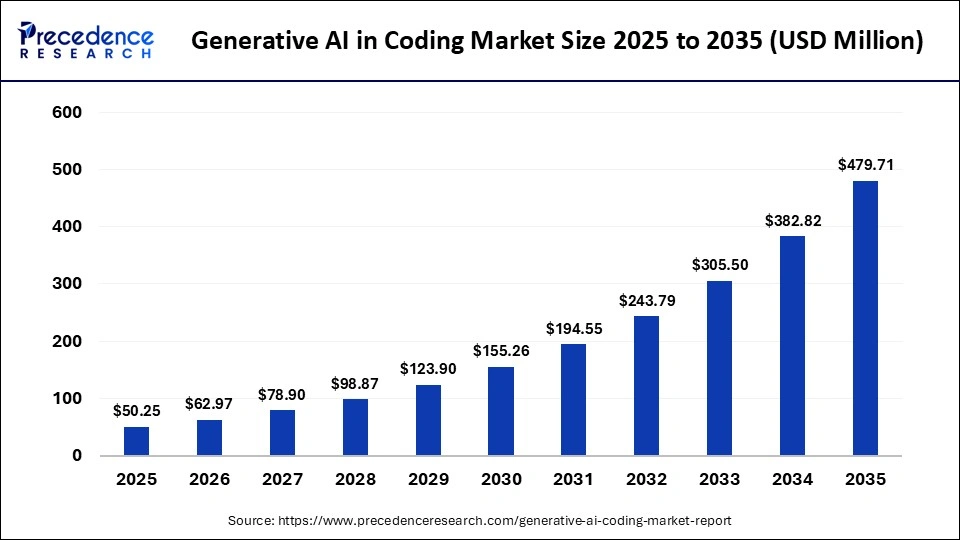
The global generative AI in coding market size was valued at USD 50.25 million in 2025 and is predicted to increase from USD 62.97 million in 2026 to approximately USD 479.71 million by 2035, expanding at a CAGR of 25.31% from 2026 to 2035. The market growth is primarily driven by the increasing demand for productivity gains by various industry verticals, the rise of low-code/no-code solutions, and massive investment in AI R&D.
Get a Free Sample Report with Key Market Trends: https://www.precedenceresearch.com/sample/8226
What are the Benefits of Generative AI in Coding?
- More Productivity with Faster Development
AI-powered code creation solutions significantly accelerate the software development process by automating repetitive and time-consuming tasks. By handling routine code generation, developers can focus on high-level system architecture and complex problem-solving, ultimately building fully functional applications more efficiently. According to reports, nearly 88% of developers feel more productive using tools like GitHub Copilot compared to manual coding, while 60% report higher job satisfaction when leveraging AI-assisted development.
- Reduced Mental Pressure
The use of generative AI in coding isn't just about faster development or speedy coding creation, but it also assists in reducing mental efforts and brain fog that comes with completing repetitive tasks like debugging. Detecting a bug can involve digging through endless possibilities to find a way where it goes wrong, which is highly exhausting and increases unnecessary mental load. Generative AI solves this issue by automating debugging and making developers feel highly enthusiastic about solving another complex issue that requires human touch and cognition beyond just logic.
- Lowered Context Switching
In the process of software development, developers need to navigate through various complex tasks, projects, or environments that can affect their workflow and reduce productivity due to the continued stress of dealing with multiple tasks, like remembering syntax details and managing the complex structure of code. However, by leveraging GitHub Copilot, developers reported that they feel highly confident and can bypass various levels of context switching, staying in their IDEs instead of searching on Google or accessing external files. Generative AI further reduces the compulsion to remember syntax or every detail of code generation, which assists in resolving mental load, which is crucial nowadays to complete any task effectively and with an optimum productivity level.
How AI Assists in Code Generation?
- AI-Assisted Code Completion: By starting a piece of code, AI can automatically suggest the remaining lines, building on earlier versions of code generation. These suggestions are generated by AI agents that evaluate all possible options, allowing programmers to accept, modify, or reject the code as needed. Experienced developers can leverage these suggestions effectively, producing high-precision code with optimized results.
- Explicit Code Comments Using NLP: Another powerful approach is using natural language comments to guide AI-generated code. By providing clear, descriptive comments, function names, and variable names, developers can help AI systems like GitHub Copilot understand the intended functionality, resulting in more accurate and context-aware code suggestions.
- Direct Interaction with AI Systems: Developers can also interact directly with AI chatbots to generate and refine code. This method allows programmers to ask for explanations, enhance syntax, generate test cases, and modify existing code, offering a versatile and interactive approach to coding with AI.
Top Gen AI Development Enterprises
- OpenAI: It builds foundation models like the GPT series and enterprise platforms for custom AI applications and fine-tuning. It powers nearly 70% of enterprise chat/agents via API and assists various industries like tech, finance, healthcare, and legal to integrate AI systems within their existing IT infrastructure.
- Anthropic: The company offers cloud models that are optimized for enterprise safety, long-context reasoning with agentic workflows. It stands out as a responsible AI leader with their partnership with leading tech company IBM for Watsonx integration and collaboration with Accenture for highly AI-regulated industries. They are working for sectors like finance, govt, research, and enterprise software.
- Techmango: Techmango offers business-grade generative AI services from custom model fine-tuning, enterprise integration, to AI development and governance trails. They are highly popular for their production-ready focus, seamless data platform integration, and scalable offshore delivery with regulatory compliances like PDPL and HIPAA.
- Accenture AI: The company claims a massive AI investment of $3 billion with offerings of full-stack transformation by partnering with leading AI tech companies like OpenAI, Anthropic, and Snowflake. They stand out for their 390% GenAI revenue growth, 14 million AI training hours, and AI workflow mapping with risk surfacing tools. The company supports AI adoption in highly regulated sectors like pharma and finance.
- Cognizant AI and Analytics: The company is known for its AI modernization for legacy systems while presenting industry-specific GenAI, like Neuro-symbolic models. It stands out for proven scale in the Fortune 500, strong migration expertise with an emphasis on agent accuracy through retrieval enhancements.
How to Choose an Enterprise-Ready AI Code Generation Tool?
Selecting an enterprise-ready AI code generation tool is a critical decision that can significantly impact productivity, efficiency, and overall enterprise growth. To ensure the right choice, organizations should follow key steps when evaluating AI systems:
- When selecting an enterprise-ready AI code generation tool, security and compliance should be a top priority, with options for self-hosted or virtual private cloud deployments and strict adherence to standards like GDPR and SOC 2 Type II.
- The tool should be capable of analyzing an entire codebase, rather than just a single file, to understand repository structure, dependencies, and coding standards, ensuring precise context awareness.
- The capability of the tool to integrate with the toolchain is also an important factor to consider while selecting AI systems for coding. The tool must plug into a company’s existing IDEs, like VS Code and IntelliJ, with CI/CD pipelines to streamline workflows.
- The platform should support different access levels for developers, contractors, and managers to maintain audit trails for regulatory compliance.
- Enterprises should also look for tools that provide access to high-performance, up-to-date AI models with the ability to fine-tune them using internal codebases.
- AI system should function as an intelligent agent capable of handling complex tasks, such as multi-file edits, writing unit tests, and debugging, rather than merely offering basic autocompletion.
What will be the Future of Generative AI in Coding?
The future of generative AI in coding is highly promising, as these tools evolve from simple assistants to active partners capable of supporting entire code creation workflows at unprecedented speed. Developers will increasingly take on roles as managers or editors, leveraging AI to boost productivity and efficiency without being replaced, while companies integrate these tools into their software development pipelines.
Looking ahead, AI systems will advance from generating individual snippets to becoming autonomous, end-to-end coding agents capable of building, testing, and deploying applications from scratch. With enhanced context awareness of entire projects, these tools will provide precise debugging, intelligent code recommendations, and optimized workflows, making software development more accessible even to individuals with minimal coding experience. However, maintaining a strong Human-in-the-Loop approach remains critical to ensure code quality, safety, ethical compliance, and proper data handling, ensuring that AI serves as a reliable partner rather than a risk.
About the Authors

Aditi Shivarkar
Aditi, Vice President at Precedence Research, brings over 15 years of expertise at the intersection of technology, innovation, and strategic market intelligence. A visionary leader, she excels in transforming complex data into actionable insights that empower businesses to thrive in dynamic markets. Her leadership combines analytical precision with forward-thinking strategy, driving measurable growth, competitive advantage, and lasting impact across industries.



Aman Singh
Aman Singh with over 13 years of progressive expertise at the intersection of technology, innovation, and strategic market intelligence, Aman Singh stands as a leading authority in global research and consulting. Renowned for his ability to decode complex technological transformations, he provides forward-looking insights that drive strategic decision-making. At Precedence Research, Aman leads a global team of analysts, fostering a culture of research excellence, analytical precision, and visionary thinking.

Piyush Pawar
Piyush Pawar brings over a decade of experience as Senior Manager, Sales & Business Growth, acting as the essential liaison between clients and our research authors. He translates sophisticated insights into practical strategies, ensuring client objectives are met with precision. Piyush’s expertise in market dynamics, relationship management, and strategic execution enables organizations to leverage intelligence effectively, achieving operational excellence, innovation, and sustained growth.