






 Request Consultation
Ligation devices are transforming modern surgery by enabling precise vessel sealing and reducing procedural risks. Their role in minimally invasive procedures improves recovery time, safety, and overall surgical efficiency.
What is a Ligation Device?
A ligation device is a specialized surgical instrument designed to close or tie off anatomical structures such as blood vessels, ducts, or tissue pedicles. The whole procedure is known as ligation, in which the main aim is to stop excessive blood flow and lower the chances of haemorrhage, and prevent blood flow during a surgical procedure. The procedure is also useful to permanently block a passage, such as tubal ligation for birth control procedures. Growing demand for minimally invasive procedures globally by patients and healthcare providers further propels the demand for ligation devices. Different types of ligation devices are used for different types of surgical procedures for quicker recovery, lower pain, and to save time as well.
Types of Ligation Devices
- Band Ligatures: They are endoscopic or surgical instruments used to apply a small elastic band to tissue to cut off the blood supply, leading to tissue necrosis and eventual removal. They are often used for esophageal varices and internal haemorrhoids. They are also available in various types, such as multi-band ligatures, single-band ligatures, and haemorrhoidal ligatures, which are helpful for various surgical and minimally invasive procedures.
- Clip Appliers: The clip appliers are special surgical instruments that are used to apply metallic or polymer clips to blood vessels or tubular structures for haemostasis. They are highly useful to replace traditional suturing and lower the overall time of the surgical procedure. They are used to pinch or duct shut a vessel. Modern versions of clip applicators are available in a spring-loaded version to apply consistent pressure without permanently deforming the clip until it is released. They are also available in different forms for different procedures, such as open surgery appliers, laparoscopic appliers, titanium clip appliers, and polymer appliers.
- Loop Ligatures: It is a device used to deliver a pre-tied, self-locking suture loop through an endoscope. They are endoscopic or laparoscopic devices used as a pre-tied, detachable suture loop to encircle and ligate tissue stalks. They are highly useful for endoscopic, laparoscopic, and gynecological procedures. It consists of a suture loop, a delivery catheter, a control handle, and a deployment system. The loop ligatures are beneficial for enhancing security and absorbability, and are non-conductive.
- Suture Devices: Such devices are categorized under a specialized category that allows for active stitching, knot-tying, and tissue apposition through an endoscope or laparoscope. These devices are also ideal for performing complex reconstructive tasks such as closing large perforations or reducing stomach volume without performing an open surgery. The primary clinical applications of such devices involve bariatrics, defect closure, stent fixation, and laparoscopic surgery.
What is the Ligation Device Market Size in 2026?
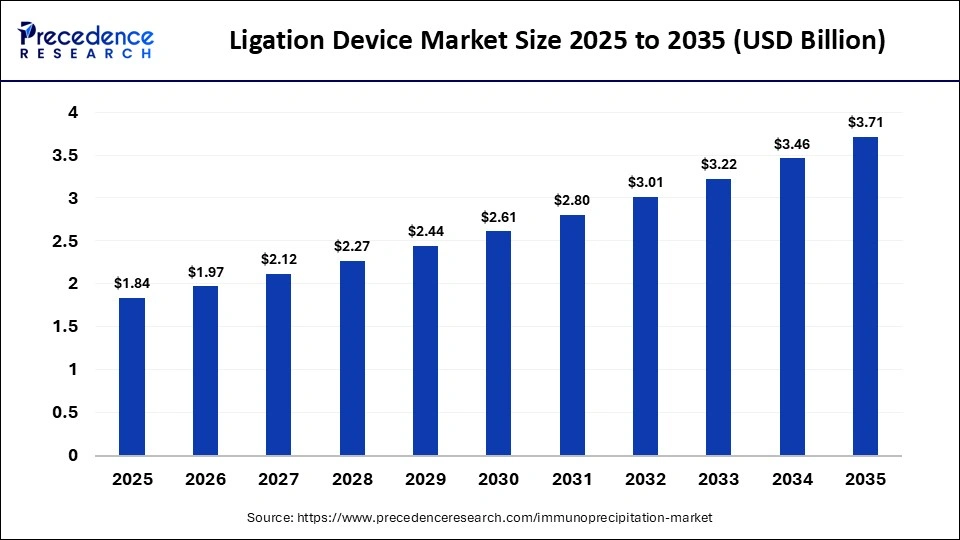
The global ligation device market was valued at USD 1.84 billion in 2025 and is projected to grow from USD 1.97 billion in 2026 to approximately USD 3.71 billion by 2035, registering a CAGR of 7.26% during the forecast period from 2026 to 2035. The market growth is driven by the increasing demand for minimally invasive surgical procedures among patients and healthcare providers, offering effective outcomes and faster recovery. Additionally, the rising number of surgical procedures worldwide across various medical conditions is further propelling market expansion.
Get a Free Sample Report with Key Market Trends: https://www.precedenceresearch.com/sample/8210
Clinical Uses of Ligation Devices
- Variceal Hemostasis: Such devices are helpful for frontline treatment for bleeding esophageal varices. The device helps to apply small elastic bands to strangulate the varix, leading it to collapse, thrombose, and eventually slough off. The procedure also involves the use of standard ligation devices for performing different types of surgical and minimally invasive procedures.
- Endoscopic Mucosal Resection (EMR): The technique involves variceal banding technology to treat flat mucosal or submucosal lesions by creating a ‘pseudopolyp’ which can be easily resected with an electrocautery snare. The procedure is performed with the help of specialized EMR devices such as the Duette Multi-Band Mucosectomy Device, Captivator EMR Device, and Full-Thickness Resection Device. The whole procedure is divided into 4 major steps: inspection, aspiration, ligation, and resection.
- Gynecological Surgery: Ligation devices for gynecological surgeries are used for permanent sterilization and hemostasis for procedures such as hysterectomies or emergency obstetric care. Such surgical procedures may involve the use of ligation devices such as mechanical clips and rings to advance energy-based sealing. Such devices also have a major role in life-threatening situations such as post-partum haemorrhage.
- Colonic Diverticular Bleeding: Ligation devices are highly useful to treat colonic diverticular bleeding, as they help to prevent re-bleeding. Various other devices, such as standard band ligatures, endoscopic detachable snare ligation, and over-the-scope clips, are also used to aid the procedures performed to treat colonic diverticular bleeding.
- Mallory Weiss Tears: Ligation devices are highly essential for treating actively bleeding Mallory Weiss tears. Such devices help to handle severe cases as they are technically simpler and more effective than traditional thermal or injection therapies. Safety, technical ease, and efficiency are some of the major advantages of using ligation devices and propelling their demand to treat such issues.
Challenges and Opportunities for Ligation Devices
Challenges
- Visualization and Access: When a band ligature cap is attached to an endoscope, it reduces the peripheral field of view, making it harder to navigate through narrow areas such as the upper esophagus or a twisted sigmoid colon. Another major challenge faced by ligation devices is that they aren’t highly operable or successful in capturing scarred tissue from previous treatments, to deploy a band or a loop securely. Hence, such visualization issues are observed during the usage of litigation devices.
- Technical Device Issues: Technical issues are another major challenge faced while using ligation devices. The mechanical springs may spring off if the tissue is too thick or in case of significant movements such as heavy breathing or peristalsis. If a knot is not tightened enough with a loop ligator, then it may slip, or if it is overly tightened, then it may prematurely sever a tissue before it has thrombosed. If a band or loop falls off eventually, then it may also result in a post-ligation ulcer, which can also severely bleed.
Opportunities
- AI Integration: One of the major opportunities for ligation devices occurs in the form of AI integration. It helps smart devices to improve functionality and enhance intraoperative decision-making. Smart clips with sensors provide real-time feedback on vessel sealing and tissue healing. AI algorithms help to predict tissue deformation and blood flow changes, allowing surgeons to fine-tune ligation in real-time. AI robotic systems help to automate routine tasks such as suturing with high consistency.
- Robotic-Assisted Ligation: Robotics are highly used in complex and minimally invasive surgeries. Various robotic platforms offer digitally enabled, one-handed powered articulation for superior control. The latest systems have the technology allowing surgeons to feel tissue tension and pressure during delicate suturing tasks. The next-generation miniature high-performance motors allow the development of smaller surgical robots for highly intricate procedures.
- Sustainable and Bioabsorbable: The segment involves the use of patient-friendly, along with environment-friendly solutions, leading to its higher demand. The segment also involves a major focus of manufacturers on bioabsorbable ligation clips that eventually dissolve in the body, eliminating the need for removal and reducing long-term foreign body complications. Environmentally conscious designs in the form of new anti-slip, latex-free band designs to improve the band retention.
Applications of Ligation Devices in Various Domains
Clinical Use: Ligation devices are highly useful for the medical and surgical domains to secure tubular structures or tissues, leading to tissue necrosis and shedding. Ligation devices are highly useful to treat esophageal varices, where small rubber bands are placed around bleeding veins to stop bleeding. Multi-band ligatures are highly useful to treat internal haemorrhoids, similar to variceal ligation.
Such devices are also essential to manage conditions such as colonic diverticular bleeding, bleeding polyps, and post-polypectomy stumps. The polymer ligation clips are useful for laparoscopic surgeries to secure blood vessels or other tubular structures. Such devices also aid gynaecological procedures, such as blocking the fallopian tubes for permanent contraception.
Biochemistry Domain: The segment focuses on joining the broken fragments of DNA and RNA or binding proteins together with the help of enzymes. The T4 DNA ligase is used to join DNA fragments with sticky or blunt ends into a vector to create recombinant DNA. Such devices are also helpful for fragmented genomic vectors for sequencing. Chemically orthogonal ligation domains are useful to link proteins for designing functional hydrogels for tissue engineering. Detecting specific nucleic acid sequences is done with the help of Ligase Chain Reaction (LCR). Different types of litigation tools also help in research to detect protein-protein interactions in cells using antibody-based probes.
Conclusion
Ligation devices are essential for the medical industry to aid different types of surgical procedures. Growing demand for minimally invasive procedures due to less recovery time and effective results has also propelled the demand for ligation devices. Ligation devices, when paired with technological advancements, help healthcare providers predict possible issues in advance in a surgical procedure and correct them accordingly. Different types of ligation devices are used for different types of surgical procedures and severe medical scenarios.
Expert Advise
Our analysis suggests that ligation devices are essential tools for complex surgeries, especially for minimally invasive surgeries. Ligation devices are selected based on the target vessel size, surgical field accessibility, and risk of slippage. The demand for ligation devices is increasing due to the increasing number of endoscopic procedures, innovations in the medical device sector, and growing awareness of environmental sustainability. Developers make constant efforts to develop sustainable ligation devices, reducing environmental burden and medical waste. Moreover, ongoing research studies and clinical trials aim to identify novel applications for ligation devices.
About the Authors

Aditi Shivarkar
Aditi, Vice President at Precedence Research, brings over 15 years of expertise at the intersection of technology, innovation, and strategic market intelligence. A visionary leader, she excels in transforming complex data into actionable insights that empower businesses to thrive in dynamic markets. Her leadership combines analytical precision with forward-thinking strategy, driving measurable growth, competitive advantage, and lasting impact across industries.



Aman Singh
Aman Singh with over 13 years of progressive expertise at the intersection of technology, innovation, and strategic market intelligence, Aman Singh stands as a leading authority in global research and consulting. Renowned for his ability to decode complex technological transformations, he provides forward-looking insights that drive strategic decision-making. At Precedence Research, Aman leads a global team of analysts, fostering a culture of research excellence, analytical precision, and visionary thinking.

Piyush Pawar
Piyush Pawar brings over a decade of experience as Senior Manager, Sales & Business Growth, acting as the essential liaison between clients and our research authors. He translates sophisticated insights into practical strategies, ensuring client objectives are met with precision. Piyush’s expertise in market dynamics, relationship management, and strategic execution enables organizations to leverage intelligence effectively, achieving operational excellence, innovation, and sustained growth.