






 Request Consultation
Medical cyclotrons are revolutionizing oncology by enabling the production of critical radioisotopes used in PET imaging and targeted therapies. Their role in early cancer detection, precision medicine, and real-time treatment monitoring is significantly improving diagnostic accuracy and patient outcomes across healthcare systems.
Healthcare systems are under tremendous pressure to implement more accurate, effective, and timely diagnostic tools because cancer continues to be one of the world's leading causes of death. The ability to identify and treat cancer at an earlier stage has greatly improved over time, thanks to developments in medical technology, ultimately improving patient outcomes. Among these developments, medical cyclotrons have become a revolutionary force in contemporary oncology.
Previously limited to highly specialized research facilities, medical cyclotrons are now an essential component of hospitals and diagnostic centers. Their capacity to create short-lived radioactive isotopes, which are utilized in cutting-edge imaging methods, has revolutionized the diagnosis and treatment of cancer. Cyclotrons are bridging the gap between complex nuclear physics and routine patient care, from supporting targeted therapies to enabling real-time tumor imaging.
Understanding Medical Cyclotrons
A medical cyclotron is a kind of particle accelerator that uses electromagnetic fields to accelerate charged particles, usually protons, to very high speeds. After being aimed at a target material, these high-energy particles cause nuclear reactions that result in radioactive isotopes, or radioisotopes. The production of radiopharmaceutical compounds used in diagnostic imaging and treatment requires these isotopes. Fluorine-18, a crucial component of PET scans, is one of the most used isotopes on site, and nearby cyclotrons are crucial because these isotopes must be produced close to their intended use due to their extremely short half-lives.
What is the Medical Cyclotron Market Size in 2026?
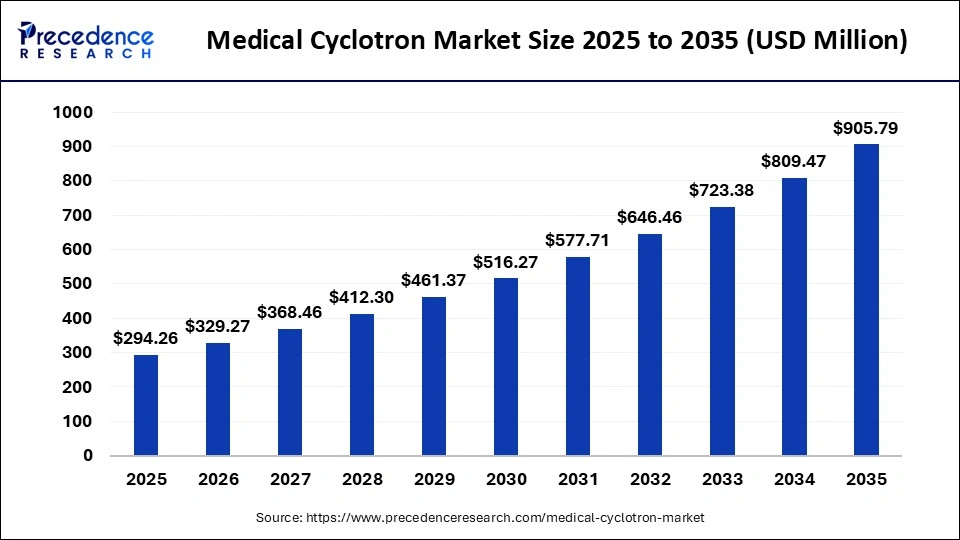
The global medical cyclotron market was valued at USD 294.26 million in 2025 and is projected to grow from USD 329.27 million in 2026 to approximately USD 905.79 million by 2035, registering a CAGR of 11.90% from 2026 to 2035. This growth is driven by the increasing demand for cancer diagnostics and radiopharmaceuticals.
Get a Free Sample Report with Key Market Trends: https://www.precedenceresearch.com/sample/8219
The Role of Cyclotrons in Cancer Diagnosis
Effective cancer treatment relies on early and accurate diagnosis. Advanced imaging techniques, particularly PET scans, provide detailed insights into the body’s metabolic activity, a capability largely made possible by medical cyclotrons. Unlike conventional imaging methods such as CT or MRI, which focus on structural changes, PET scans reveal cellular-level function, which is critical in oncology since cancer cells often exhibit higher metabolic activity than normal cells.
Medical cyclotrons produce radiotracers that bind to specific biological targets, enabling physicians to:
- Detect tumors at an early stage
- Differentiate between benign and malignant growths
- Monitor the spread of cancer (metastasis)
- Evaluate the effectiveness of ongoing treatments
This level of precision significantly reduces diagnostic uncertainty and helps clinicians make more informed decisions.
Exploring the Role of Medical Cyclotrons in Precision Medicine
In addition to diagnosis, medical cyclotrons are increasingly being used in cancer treatment. Accurate imaging and targeted therapies are key components of the precision medicine concept, which involves customizing treatment for each patient based on their distinct biological traits.
Cyclotron-produced radiopharmaceuticals can be engineered to minimize harm to surrounding healthy tissues while delivering radiation directly to cancer cells. This method works especially well for treating cancers that are hard to treat with traditional techniques, like some brain tumors or metastatic cancers.
In addition, cyclotron-produced isotopes are used in theragnostic, a combined approach of therapy and diagnostics. This allows doctors to:
Identify the exact location of tumors
- Deliver targeted treatment
- Monitor treatment response in real time
- Such integrated approaches are transforming oncology into a more personalized and effective field.
Top Factors Accelerating the Expansion of Medical Cyclotrons
Growing Demand for PET Imaging
The need for sophisticated diagnostic tools has increased due to the rising incidence of cancer worldwide. Because of its accuracy and dependability, PET imaging, which uses isotopes produced by cyclotrons, has become the gold standard in oncology. To guarantee a consistent and timely supply of radiotracers, healthcare providers are increasingly investing in cyclotron facilities. This is particularly crucial because many isotopes have short half-lives, which restricts their ability to be transported over great distances.
PET imaging has spread beyond industrialized areas. Additionally, emerging economies are investing in nuclear medicine infrastructure because they understand the value of early cancer detection. Medical cyclotrons are becoming more widely used as a result of this global expansion.
Technological Advancements in Cyclotron Systems
These systems are now more affordable, efficient, and compact thanks to advancements in cyclotron technology. The accessibility of traditional cyclotrons was limited by their size, cost, and substantial infrastructure requirements. Nonetheless, hospitals can install contemporary compact cyclotrons to lessen their reliance on outside vendors.
Key advancements include:
- Miniaturization of cyclotron systems
- Automation in isotope production processes
- Improved safety features for radiation handling
- Higher production efficiency with reduced operational costs
These developments are making cyclotrons more accessible to a wider range of healthcare facilities, including mid-sized hospitals and diagnostic centers.
What’s Slowing Down the Adoption of Medical Cyclotrons?
The adoption of medical cyclotrons is being slowed by several structural and economic challenges. One of the primary barriers is the high initial capital investment required for installation, infrastructure, and radiation shielding, making it difficult for smaller hospitals and diagnostic centers to adopt the technology. Additionally, the need for highly skilled professionals to operate and maintain cyclotron systems creates a talent gap, particularly in developing regions.
Regulatory complexities also play a significant role, as the production and handling of radioactive materials require strict compliance with safety standards, often leading to delays in approvals and deployment. Furthermore, limited accessibility in rural and low-resource settings, along with logistical challenges in radiotracer distribution due to their short half-life, restricts widespread use.
Together, these factors increase operational complexity and cost, slowing adoption despite the growing demand for advanced diagnostic and therapeutic solutions in oncology and nuclear medicine.
Opportunities in Emerging Markets
There are substantial growth prospects for the medical cyclotron industry in emerging economies. An environment that is conducive to adoption is being created by increased investments in healthcare, increased awareness of cancer, and improved infrastructure. To create nuclear medicine facilities, increase diagnostic capacity, and enhance access to cutting-edge medical technology, governments and private entities are working together. This trend is being further supported by the expanding middle class and rising healthcare costs.
In countries like India and China, the demand for early cancer detection and advanced treatment options is driving the installation of new cyclotron facilities. This expansion is expected to enhance the availability of radiopharmaceuticals and improve patient outcomes.
Cyclotron Impact Across Cancer Care
| Aspect | Before Cyclotrons | After Cyclotron Integration |
| Diagnosis Accuracy | Limited to structural imaging | Functional + metabolic imaging improves accuracy |
| Detection Stage | Often detected at later stages | Early-stage detection possible |
| Treatment Approach | Generalized therapies | Personalized & targeted therapies |
| Imaging Technology | CT, MRI dominant | PET scans widely adopted |
| Radiotracer Availability | Limited & inconsistent | On-demand, reliable supply |
| Patient Outcomes | Lower survival rates | Improved survival and quality of life |
| Treatment Monitoring | Delayed evaluation | Real-time monitoring of therapy effectiveness |
Integration with AI and Digital Healthcare
The integration of AI and digital healthcare technologies is transforming the capabilities of medical cyclotrons and enhancing their role in modern diagnostics and treatment. AI-driven algorithms can optimize radiotracer production, improve imaging accuracy, and enable faster interpretation of PET scan results, leading to more precise and timely clinical decisions.
Digital health systems, including electronic health records (EHRs) and connected diagnostic platforms, allow seamless data sharing and real-time patient monitoring. This integration supports personalized treatment planning, better workflow management, and improved coordination between radiology, oncology, and clinical teams.
This combination enhances:
- Image interpretation accuracy
- Early detection capabilities
- Workflow efficiency in diagnostic centers
Digital healthcare platforms also enable remote monitoring and data sharing, allowing specialists to collaborate and make informed decisions regardless of location.
Future Outlook
Medical cyclotrons appear to have a bright future, with ongoing improvements anticipated to further expand their potential. New isotopes with longer half-lives and better targeting characteristics are being researched, which could increase the range of diagnosis and treatment options. Cyclotron adoption is expected to grow steadily because of technological advancements and the growing emphasis on personalized medicine. Cyclotrons will play an even more important role as healthcare systems continue to place a high priority on early detection and efficient treatment.
Strengthening hospital independence and operational efficiency is another important aspect of medical cyclotron adoption. Due to transportation limitations and short isotope half-life, healthcare facilities have historically relied largely on outside suppliers for radiotracers, frequently experiencing delays. However, hospitals can guarantee a consistent and dependable supply of radiopharmaceuticals with in-house cyclotron installations, greatly reducing downtime in diagnostic procedures. This increases revenue generation for healthcare providers in addition to increasing patient throughput.
Furthermore, the case for incorporating cyclotrons into contemporary healthcare ecosystems is further strengthened by the capacity to tailor isotope production to individual patient needs.
Key Benefits of In-House Cyclotron Facilities
| Parameter | External Supply Mode | In-House Cyclotron Model |
| Radiotracer Availability | Dependent on third-party delivery | On-demand, controlled supply |
| Turnaround Time | Delays due to logistics | Immediate availability |
| Operational Efficiency | Limited scheduling flexibility | Improved workflow and scheduling |
| Cost Over Time | Recurring purchase costs | High initial cost but long-term savings |
| Customization | Limited options | Tailored isotope production |
| Patient Throughput | Restricted by supply | Higher number of scans per day |
| Reliability | Vulnerable to supply disruptions | High reliability and consistency |
Wrapping Up
By enabling accurate imaging, facilitating targeted therapies, and enhancing overall patient outcomes, medical cyclotrons are transforming the field of cancer diagnosis and treatment. Nuclear medicine has evolved from a specialized field to a mainstay of contemporary healthcare due to its capacity to produce necessary radioisotopes on demand. Cyclotrons are now more accessible than ever, thanks to continuing technological advancements and increasing investments despite ongoing challenges with cost and expertise.
The significance of cutting-edge treatments like medical cyclotrons cannot be emphasized enough, given the rising incidence of cancer worldwide. Medical cyclotrons are not only revolutionizing oncology but also redefining healthcare as a whole by bridging the gap between cutting-edge science and patient care.
About the Authors

Aditi Shivarkar
Aditi, Vice President at Precedence Research, brings over 15 years of expertise at the intersection of technology, innovation, and strategic market intelligence. A visionary leader, she excels in transforming complex data into actionable insights that empower businesses to thrive in dynamic markets. Her leadership combines analytical precision with forward-thinking strategy, driving measurable growth, competitive advantage, and lasting impact across industries.



Aman Singh
Aman Singh with over 13 years of progressive expertise at the intersection of technology, innovation, and strategic market intelligence, Aman Singh stands as a leading authority in global research and consulting. Renowned for his ability to decode complex technological transformations, he provides forward-looking insights that drive strategic decision-making. At Precedence Research, Aman leads a global team of analysts, fostering a culture of research excellence, analytical precision, and visionary thinking.

Piyush Pawar
Piyush Pawar brings over a decade of experience as Senior Manager, Sales & Business Growth, acting as the essential liaison between clients and our research authors. He translates sophisticated insights into practical strategies, ensuring client objectives are met with precision. Piyush’s expertise in market dynamics, relationship management, and strategic execution enables organizations to leverage intelligence effectively, achieving operational excellence, innovation, and sustained growth.