






 Request Consultation
Microprinting is emerging as a powerful anti-counterfeiting solution with ultra-fine, hard-to-replicate designs. This blog highlights its applications across currency, pharmaceuticals, and electronics. It also covers key technologies, industry adoption, and future innovations driving secure printing.
In a world where counterfeiting is becoming increasingly sophisticated, traditional security measures are no longer enough. Microprinting emerged as a cutting-edge technology that uses ultra-fine text and intricate designs to protect currency, documents, and high-value products from fraud. Often invisible to the naked eye and impossible to replicate without specialized equipment, microprinting is rapidly emerging as the next frontier in anti-counterfeiting, offering businesses, governments, and consumers a powerful tool to ensure authenticity and safeguard trust.
How Does Microprinting Enhance Security in Modern Industries?
Microprinting enhances security in modern industries by adding intricate, hard-to-replicate details to documents, currency, and product packaging, making counterfeiting extremely difficult. In banking and finance, it protects banknotes, checks, and certificates from fraud, while in pharmaceuticals, luxury goods, and electronics, it ensures product authenticity and prevents tampering. Combined with technologies like laser engraving, nanotechnology, and UV/infrared inks, microprinting enables multi-layered security solutions that are traceable, verifiable, and extremely difficult for counterfeiters to mimic, safeguarding both businesses and consumers.
What is the Microprinting Market Size in 2026?
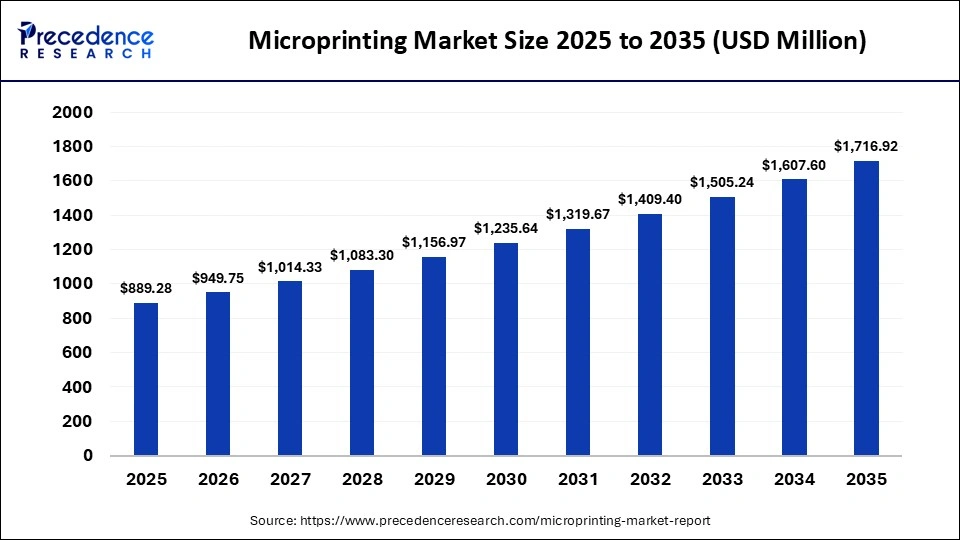
The global microprinting market size was valued at USD 889.28 million in 2025 and is expected to grow from USD 949.75 million in 2026 to approximately USD 1716.92 million by 2035, registering a CAGR of 6.80% from 2026 to 2035. The growth is driven by increasing demand for advanced anti-counterfeiting and security solutions across banking, government, and packaging sectors.
Get a Free Sample Report with Key Market Trends: https://www.precedenceresearch.com/sample/8239
Key Type of Microprinting
- Monochrome Microprinting: The monochrome microprinting involves the use of one color to produce very fine text, patterns, or images. It is used in banknotes, passports, and official documents as a simple and effective anti-counterfeiting measure, which is quite accurate, durable, and hard to duplicate without special printing equipment.
- Color Microprinting: Color microprinting involves the use of several colors or gradients to create detailed writing and designs on a microscopic scale. This improves security as it creates complexity and counterfeiting becomes very hard, and is commonly used in packaging and luxury goods, as well as valuable documents, in order to offer advanced verification and tamper protection capabilities.
Microprinting in Action: Key Applications in Modern Security
- Securing Currency and Government Documents: Banknotes, passports, visas, and identity cards incorporate ultra-fine microprinting to prevent forgery and counterfeiting. By embedding intricate text and patterns, microprinting enhances the security of official records and safeguards financial and governmental systems from illegal duplication.
- Protecting Consumer Products and Packaging: Luxury items such as perfumes, high-end electronics, and premium pharmaceuticals utilize microprinting on packaging to combat counterfeiting. These microscopic security features are extremely difficult to replicate, preserving product integrity, boosting consumer confidence, and minimizing financial losses from counterfeit goods.
- Ensuring Pharmaceutical and Healthcare Integrity: Microprinting labels and markings on medicines, medical devices, and diagnostic equipment help verify authenticity and maintain regulatory compliance. This prevents counterfeit drugs, safeguards patient safety, and ensures that critical healthcare products are genuine and reliable.
- Securing Electronics and Technology Devices: Microprinting is applied to PCBs, casings, and connectors to prevent tampering and counterfeiting. It enables manufacturers to implement authentication features, maintain product integrity, and safeguard sensitive technology while supporting quality control processes.
- Authenticating Legal Documents and Certificates: Diplomas, licenses, certificates, and other legal documents use microprinting to confirm authenticity. The complex and finely detailed designs make forgery extremely difficult, protecting intellectual property and ensuring that academic, corporate, and legal records remain trustworthy.
Key Equipment Powering the Microprinting Technology
| Tool/Equipment | Product Name | Application |
| High-Resolution Inkjet Printer | Epson SureColor P700 | Precision microtext printing on passports, banknotes, certificates, and packaging. |
| Laser Engraving System | Trotec Speedy 360 | Creation of microprinted patterns and anti-counterfeiting and security designs on documents and packaging. |
| Offset Printing Press | Heidelberg Speedmaster XL 106 | High-speed banknote, ID card, and secure government printing. |
| Security Ink & Micro-Ink System | SICPA Microtext Ink | Specialized inks are applied to money, certificates, and luxurious packaging to prevent counterfeiting. |
| Optical Inspection & Verification | Keyence VHX-7000 Digital Microscope | Examining and checking anti-counterfeit and microtext elements on the documents and other valuable products. |
| Nanotechnology Printing Tool | Nanoscribe Photonic Professional GT | Fabricating mini-textures and 3D security designs on electronic, medical, and high-security packages. |
Core Drivers Accelerating Microprinting Adoption
- Need to Combat Fraud Across Industries: With rising fraud in currency, pharmaceuticals, luxury goods, and government documents, microprinting has emerged as a non-invasive and highly secure solution. By using microscopic text and intricate patterns, microprinting ensures that products, documents, and identity materials cannot be easily duplicated or counterfeited, safeguarding authenticity across industries.
- Securing 5G and Advanced Electronics: The rapid growth of 5G networks, connected devices, and high-value electronics has driven the adoption of microprinting in the tech sector. It enables precise, miniature security features on phones, equipment, and communication hardware, ensuring product authenticity without altering or compromising advanced electronic designs.
- Innovation Through Advanced Technologies: Advances such as laser engraving, nanotechnology, and AI-assisted printing have significantly enhanced the precision and versatility of microprinting. Fine patterns and microtext can now be applied to a wide variety of surfaces, reducing the risk of replication, improving verification accuracy, and even enabling integration with digital authentication for next-generation secure printing solutions.
Overcoming Barriers to Widespread Adoption of Microprinting
- High Manufacturing Costs: Microprinting relies on high-tech printers, laser engraving, and skilled professionals, making production expensive. These costs limit adoption, particularly for small and medium-sized enterprises, despite the growing demand for secure, anti-counterfeiting solutions.
- Compatibility Challenges: Integrating microprinting into diverse packaging, electronics, and textured surfaces can be complex. Variations in substrate materials, device designs, and production processes often require additional customization, slowing large-scale adoption across industries.
- Supply-Chain Complexities: Distribution of microprinted products and equipment is often hampered in remote or emerging regions. Poor infrastructure, long lead times, and logistical coordination challenges restrict adoption, even as secure printing technologies become increasingly critical.
Top Innovators Securing the Future with Microprinting
- KBA Group: KBA Group provides high-tech printing and security solutions, specializing in anti-counterfeiting and microtext technology. They specialize in printing banknotes, producing documents of high security, and printing microprinting in high precision, with clients in the banking, government, and high-value packaging industries across the world.
- De La Rue: De La Rue offers secure banking note printing, passport printing, and identity document printing, together with microprinting, which ensures great security. The company pays attention to anti-counterfeiting, authentication, and secure document production and assists financial institutions and governments around the world.
- Koenig & Bauer (KBA): Koenig & Bauer offers services of microprinting on high-speed banknotes, secure documents, and packaging of goods. They offer their clients worldwide their anti-counterfeiting and tamper-proof printing solutions, which are precise, efficient, and reliable.
- Giesecke+Devrient : Giesecke+Devrient comes up with secure printers that can be used with banknotes, IDs, and the authentication of products. Microprinting and high-security levels assist the company to offer services to governments, financial institutions, and manufacturers of high-value products that enable them to enhance the integrity of documents, reduce fraud, and decrease fraud.
- SICPA: SICPA focuses on bank note inks, official documents, premium packaging, and microprinting that is secure microprinting. Their solutions are a combination of high-resolution printing, counterfeiting, and authentication technology to provide security, traceability, and prevention of fraud in industries.
Innovations Driving the Future of Microprinting
- AI-Enhanced Microprinting Verification: Modern microprinting systems are now equipped with advanced AI and machine learning, enabling real-time detection of defects and authentication of documents and products at a microscopic scale. This innovation increases accuracy, reduces fraud, and strengthens the security of sensitive packages, currency, and valuable documents.
- Nanotechnology-Based Microtext: Nanotechnology allows the creation of ultra-fine images and patterns on banknotes, certificates, and product packaging. These microscopic features are nearly impossible to replicate, scaling up anti-counterfeiting measures and providing enhanced protection for official documents, pharmaceuticals, luxury goods, and electronics.
- Laser-Activated Security Features: Laser activation techniques enable the fabrication of complex 3D microprinted elements on curved or irregular surfaces. This technology ensures that packages, electronic devices, and identification documents maintain high security, durability, and resistance to tampering while accommodating intricate designs.
- Green Materials and Inks: The development of bio-circular and mineral-oil-free inks supports environmentally friendly microprinting. These green technologies are applied to currency, certificates, packaging, and high-value products, offering both reduced environmental impact and high-security levels.
- Digital Authentication Integration: Microprinting is increasingly combined with QR codes, blockchain, and digital traceability systems to create multi-layered security solutions. This integration enhances verification, tracking, and authentication of documents and products, bridging the gap between physical and digital anti-counterfeiting measures.
Wrapping Up
Microprinting is increasingly becoming a cornerstone for ensuring the security and authenticity of high-value products, official documents, and electronic devices. It is widely applied in currency, passports, pharmaceuticals, luxury goods, and packaging, providing an essential safeguard against counterfeiting and fraud. Adoption is further driven by government investments and regulatory requirements, highlighting its critical role across industries in today’s security landscape.
Looking ahead, the evolution of microprinting is closely linked with eco-friendly materials, AI-powered inspection systems, and digital authentication solutions. These innovations are shaping the next generation of secure, compact, and reliable printing technologies, ensuring that microprinting keeps pace with advancements in electronics, connected devices, and modern security needs.
About the Authors

Aditi Shivarkar
Aditi, Vice President at Precedence Research, brings over 15 years of expertise at the intersection of technology, innovation, and strategic market intelligence. A visionary leader, she excels in transforming complex data into actionable insights that empower businesses to thrive in dynamic markets. Her leadership combines analytical precision with forward-thinking strategy, driving measurable growth, competitive advantage, and lasting impact across industries.



Aman Singh
Aman Singh with over 13 years of progressive expertise at the intersection of technology, innovation, and strategic market intelligence, Aman Singh stands as a leading authority in global research and consulting. Renowned for his ability to decode complex technological transformations, he provides forward-looking insights that drive strategic decision-making. At Precedence Research, Aman leads a global team of analysts, fostering a culture of research excellence, analytical precision, and visionary thinking.

Piyush Pawar
Piyush Pawar brings over a decade of experience as Senior Manager, Sales & Business Growth, acting as the essential liaison between clients and our research authors. He translates sophisticated insights into practical strategies, ensuring client objectives are met with precision. Piyush’s expertise in market dynamics, relationship management, and strategic execution enables organizations to leverage intelligence effectively, achieving operational excellence, innovation, and sustained growth.