



Microprinting Market Trends, Companies, Revenue / Sales Performance, Manufacturing Yield, Fab Capacity, Export & Import Dynamics, Supply Chain Analysis, Competitive Landscape, and Growth Forecast
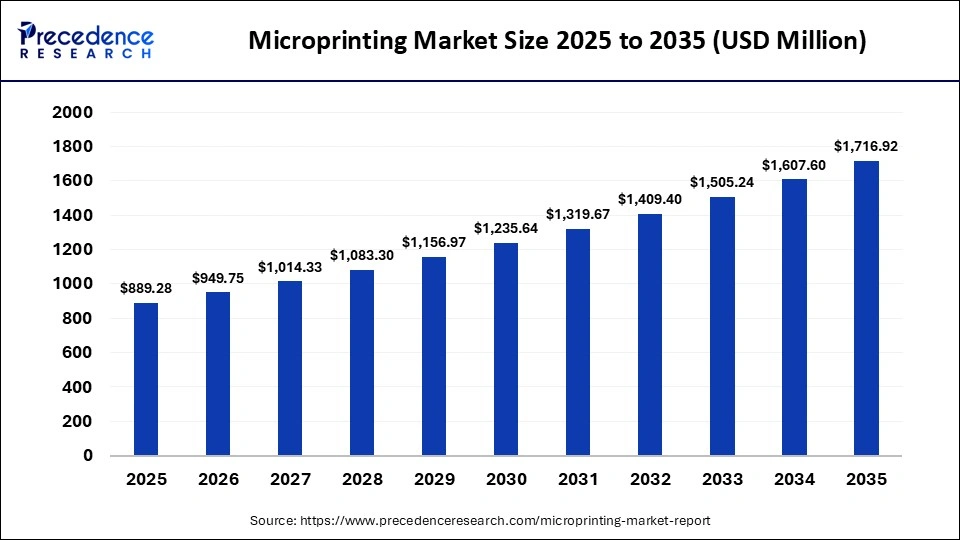
According to semiconductor and electronics specialist Laxmi Narayan, the microprinting market is valued at USD 949.75 million in 2026 and is forecast to reach USD 1,716.92 million by 2035, reflecting a CAGR of 6.80%. Leading microprinting market companies, including Xerox Corporation, Brady Worldwide, Inc., H.P. Development Company L.P., Zebra Technologies Corp. are strengthening their presence across key segments such as By Type, By Ink Type, By Application, By End-use.
Source: https://www.precedenceresearch.com/microprinting-market
 Get a Sample
 Table Of Content


What is the Microprinting Market Size in 2026?
The global microprinting market size was calculated at USD 889.28 million in 2025 and is predicted to increase from USD 949.75 million in 2026 to approximately USD 1,716.92 million by 2035, expanding at a CAGR of 6.80% from 2026 to 2035. The market is driven by rising demand for advanced anti-counterfeiting and security solutions across banking, government, and packaging sectors.
Key Takeaways
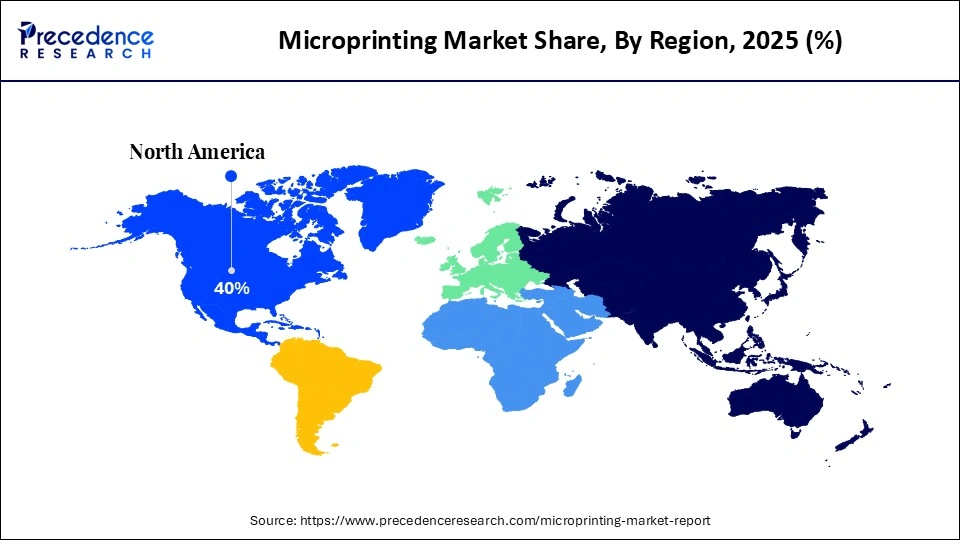
- North America dominated the global market with the largest share of 40% in 2025.
- Asia Pacific is expected to experience the fastest growth over the forecast period.
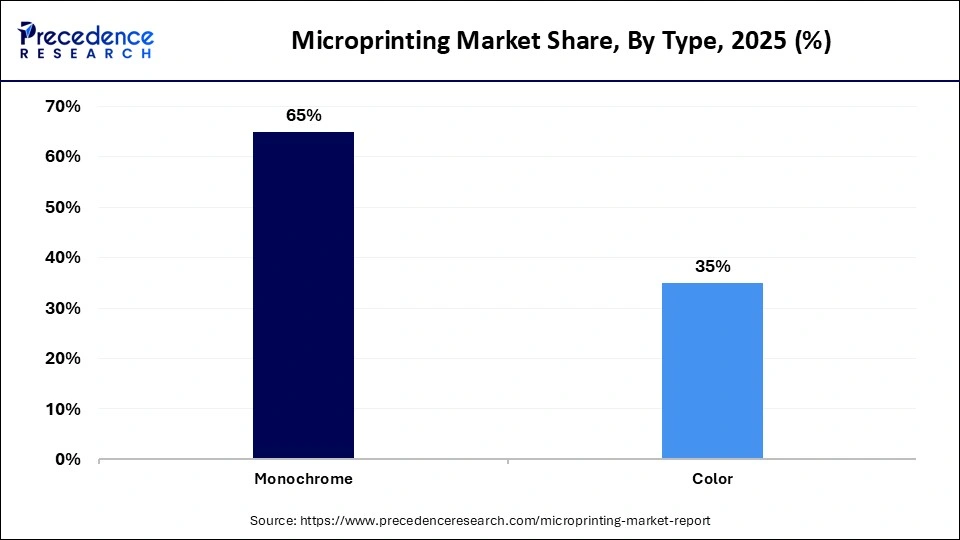
- By type, the monochrome segment held the major market share of 65% in 2025.
- By type, the color segment is anticipated to grow at a significant rate in the market over the forecast period.
- By ink type, the magnetic inks segment held a major share of the market in 2025.
- By ink type, the UV invisible inks segment is anticipated to grow at the fastest rate in the market over the forecast period.
- By application, the labels segment held the largest market share in 2025.
- By application, the currency segment is anticipated to grow at a rapid pace in the market over the forecast period.
- By end use, the BFSI segment held a major share of the market in 2025.
- By end use, the packaging segment is anticipated to grow at the fastest CAGR in the market over the forecast period.
Market Overview
Microprinting is a highly detailed printing technique that produces microtext or intricate images often invisible to the naked eye, commonly used for security and authentication on items such as banknotes, passports, certificates, and packaging. The microprinting market is growing due to increasing concerns over counterfeiting, fraud, and brand protection across diverse industries. Advanced forms of microprinting are being embraced by governments, financial institutions, and manufacturers with the aim of protecting sensitive documents and high-value goods. The significant increase in demand for anti-counterfeiting solutions is a key factor driving the growth of the market. The increased global e-commerce has led to a high chance of the introduction of counterfeit goods in the market, supporting market growth.
How is AI Influencing the Microprinting Market?
The integration of artificial intelligence in the printing industry is making a revolutionary impact on the market by enhancing accuracy, security, and efficiency in printing and verification. The highest quality of printing can be achieved through advanced AI algorithms that can detect any microscopic defects and inconsistencies in the patterns printed to guarantee higher accuracy and reliability. Complex microtext and pattern design based on machine learning models is also very hard to mimic and fortify the anti-counterfeiting measures. Also, AI-based image recognition technologies can be used to authenticate documents and items faster and more efficiently by detecting microprinted features at a larger scale.
Microprinting Market Trends
- Government Documents and Currency: Governments are increasingly incorporating microprinting into currency and official documents to enhance security, prevent sophisticated counterfeiting, and ensure authenticity. High-precision, tamper proof printing technologies are in demand across global markets.
- Product Packaging and Labeling: Microprinting adoption is rising in product packaging, particularly for pharmaceuticals, cosmetics, and luxury goods, as brands aim to protect their identity, prevent duplication, and maintain consumer trust in competitive markets.
- Advanced Printing Technologies: Emerging high resolution and nano-printing technologies are improving the precision and complexity of microprinted components, making them harder to replicate and expanding their use in applications requiring high security and authentication.
- Regulatory Compliance: Increasing regulatory requirements in banking, healthcare, and manufacturing are driving organizations to adopt microprinting solutions, ensuring document security, product authenticity, and compliance with stringent anti counterfeit and verification standards.
Market Scope
| Report Coverage | Details |
| Market Size in 2025 | USD 889.28 Million |
| Market Size in 2026 | USD 949.75 Million |
| Market Size by 2035 | USD 1,716.92 Million |
| Market Growth Rate from 2026 to 2035 | CAGR of 6.80% |
| Dominating Region | North America |
| Fastest Growing Region | Asia-Pacific |
| Base Year | 2025 |
| Forecast Period | 2026 to 2035 |
| Segments Covered | Type, Ink Type, Application, End-use, and Region |
| Regions Covered | North America, Europe, Asia-Pacific, Latin America, and Middle East & Africa |
Market Dynamics
Drivers
Increasing Demand for Sophisticated Anti Counterfeiting Solutions
The growing need for robust anti-counterfeiting solutions in sectors such as banking, pharmaceuticals, packaging, and government is expected to drive the microprinting market. Rapid growth in trade and e-commerce has made counterfeit products and forged documents increasingly sophisticated, posing risks to the economy and security. Microprinting addresses these challenges with its high precision and tamper resistant features, and its adoption is being accelerated by governments and financial institutions to enhance the security of currencies, passports, and certificates.
Restraint
High Implementation Costs and Technical Complications
Microprinting needs specialized equipment and printers that have high resolution and trained professionals, which may be very expensive in terms of operation, especially for small and medium enterprises. Moreover, because of the need to control processes strictly and monitor them constantly at a microscopic level, it requires additional complexity in production. Additionally, counterfeiters are developing increasingly sophisticated replication technologies that challenge traditional microprinting methods, which may slow market growth in price-sensitive regions.
Opportunity
Digital and Smart Authentication Technologies Integration
The integration of micro printers with digital and smart authentication technologies creates immense opportunities in the market. Combining microprinting with QR codes, blockchain, and AI-based verification enables multi-layered security systems that are much harder to forge. This integrated approach enhances traceability, allowing real-time monitoring and authentication of goods across supply chains, while ongoing advancements in nanotechnology and digital printing continue to expand future applications in security.
Segment Insights
Type Insights
Microprinting Market Share, By Type, 2025 (%)
| Type | 2025 |
| Monochrome | 65% |
| Color | 35% |
Why Does the Monochrome Segment Lead the Microprinting Market?
The monochrome segment led the market while holding the largest share in 2025. This is because of its affordability and ability to produce high-quality texts. It is reliable and efficient, making it the preferred choice in government, retail, education, publishing, and commercial sectors. The dominance of the segment is further reinforced due to the growth in e-commerce, where monochrome microprinting has been widely applied in packaging and labelling products. The adoption of this printing guarantees safe packaging while providing companies with brand integrity and enhancing consumer confidence.
The color segment is expected to grow at a significant CAGR over the forecast period because of the increasing demand from various industries. Color microprinting is becoming more common in banking, finance, government, corporate, healthcare, education, and packaging sectors to increase the level of safety and security of documents and products. Color microprinting allows distinguishing the financial statements, certificates, and other official documents, enhancing the verification and minimizing the possibility of fraud. Its use is driven by the heightened concern over security, as well as the necessity to have visually distinct, tamper-proof, microprinted elements.
Ink Type Insights
The Magnetic Inks Segment Led the Market in 2025
In 2025, the magnetic inks segment led the microprinting market with a major revenue share. This is primarily due to the crucial role of magnetic ink in securing banking and financial transactions. Magnetic inks are usually used to print checks, banknotes, and official papers to prevent fraud and unauthorized duplication. Their magnetic properties allow them to be integrated easily with automated checks, and they have been effectively implemented in ATMs and other banking institutions to offer swift and precise processing. Growing digitalization and increasing complexity in financial transactions are further boosting demand for magnetic inks worldwide.
The UV invisible inks segment is expected to grow at the fastest CAGR over the forecast period. The growth of the segment is driven by the increasing use of UV invisible inks on banknotes, certificates, and stamps by governments and financial institutions, so that any replication can barely be done without specialized equipment. The increasing sophistication of printing technologies and rising counterfeit risks across sectors such as pharmaceuticals and high-value goods have further boosted the adoption of UV-based microprinting. These inks provide an additional layer of security, enabling multi-level verification systems alongside conventional microprinting, holograms, and barcodes.
Application Insights
The Labels Segment Contributed the Most Revenue in the Microprinting Market in 2025?
The labels segment dominated the market, contributing the most revenue in 2025. This is because of the increasing demand for security labels from numerous industries. Security labels protect products from tampering, counterfeiting, and unauthorized diversion while assuring consumers of authenticity. Microprinted labels in supply chains also enable companies to track goods, provide warranty information, and display manufacturing and expiry details. Growing adoption by e-commerce, consumer electronics, and apparel industries is driven by the need for reliable, tamper-proof labeling across complex logistics networks.
The currency segment is expected to grow at the fastest rate in the market throughout the forecast period because of the growing global issues regarding counterfeit money. Governments and central banks are using microprinting on banknotes to make replication very difficult, since the fine microtexts and the complex designs cannot be copied by traditional printing methods. Microprinting provides multi-layered protection through visual, tactile, and machine-readable features, enhancing financial security, reducing the risks of counterfeit transactions, and strengthening public trust.
End-use Insights
Why Did the BFSI Segment Lead the Microprinting Market?
The BFSI segment led the market by capturing the largest revenue share in 2025 due to the sector's high demand for secure banking and financial records. Microprinting is widely used for employee identification, banknotes, checks, stamps, bonds, and other official documents to ensure authenticity and prevent fraud. Banks, insurance firms, and other financial institutions rely on these measures to combat counterfeiting and unauthorized duplication. The increasing digitalization, regulatory compliance requirements, and growing operational complexity are driving the adoption of advanced microprinting technologies in the BFSI sector.
The packaging segment is expected to grow at a significant CAGR over the forecast period, owing to growing concerns over product counterfeiting and brand protection. Microprinting is increasingly applied on labels, tags, boxes, and other packaging materials to provide secure authentication for consumer goods, electronics, pharmaceuticals, and apparel. High-quality microprinted components help businesses differentiate authentic products from counterfeits, protect revenue, and maintain consumer confidence. Growing regulatory requirements for safe and authentic labeling, combined with the integration of microprinting with other security measures such as holograms, further support market growth.
Regional Insights
North America Microprinting Market Size and Growth 2026 to 2035
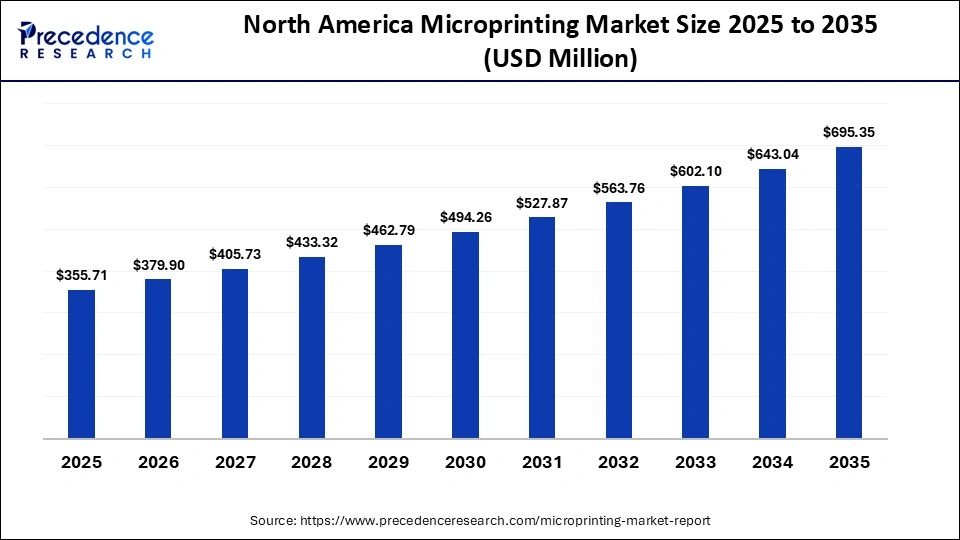
The North America microprinting market size is estimated at USD 355.71 million in 2025 and is projected to reach approximately USD 695.35 million by 2035, with a 6.93% CAGR from 2026 to 2035.
Why Did North America Lead the Global Microprinting Market?
North America dominated the microprinting market in 2025 by capturing the largest share. This is mainly due to the high demand for secure packaging and authentication systems. The growing popularity of packaged food and drinks has been a major factor in the growth of the packaging sector, which consequently leads to the development of microprinting to maintain the authenticity of the product and avoid imitations. Also, the region is at the forefront of developing innovative printing solutions. Early adoption of microprinting and strict regulatory requirements on labeling, product safety, and document security also contributed to the region's market dominance.
U.S. Microprinting Market Size and Growth 2026 to 2035
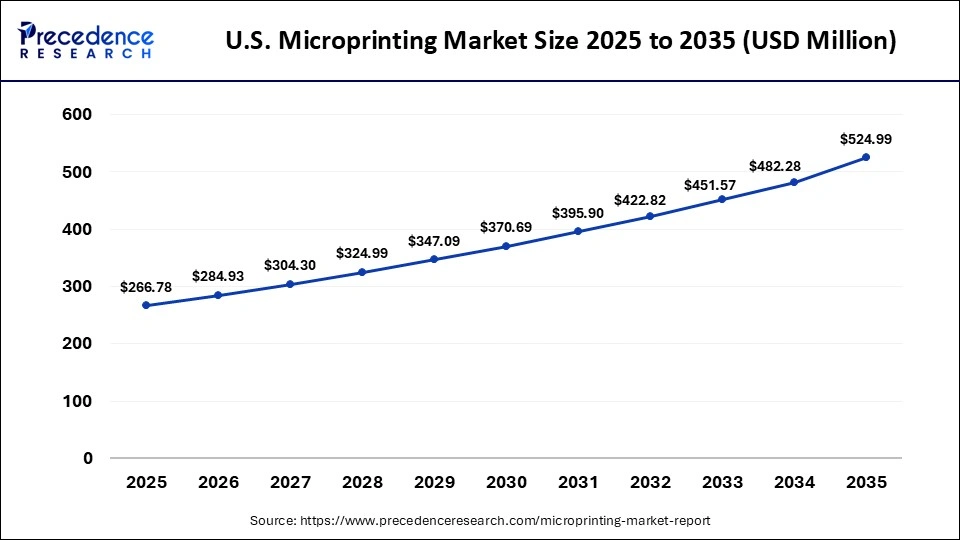
The U.S. microprinting market size is calculated at USD 266.78 million in 2025 and is expected to reach nearly USD 524.99 million in 2035, accelerating at a strong CAGR of 7.00% between 2026 and 2035.
U.S. Microprinting Market Analysis
The U.S. is a major contributor to the North American Microprinting market. The country boasts top-tier academic institutes, research centers, and biotechnology companies, which facilitate the quick adoption of synthetic stem cell technologies. The country is witnessing a rise in R&D spending and funding from both government bodies like the California Institute for Regenerative Medicine (CIRM) and private industry players to accelerate the development of novel therapies. The favorable regulatory frameworks of the FDA in the country provide clear guidelines and accelerated pathways for clinical trials , promoting a secure and supportive environment for testing synthetic and induced pluripotent stem cells (iPSCs).
Why is Asia Pacific Experiencing the Fastest Growth in the Microprinting Market?
Asia Pacific is expected to grow at the fastest CAGR in the market during the forecast period, driven by the region's large number of banking and financial institutions, government agencies, and expanding corporate sector. Countries such as India and China are seeing widespread adoption of microprinting, particularly for currency, checkbooks, and official documents to enhance security and prevent fraud. In India, microprinting is essential in the banking and finance sector for secure transactions and document verification. Rapid industrialization, urbanization, and growth in the manufacturing and packaging industries are further boosting the demand for microprinting.
Microprinting Market Companies
- Xerox Corporation
- Brady Worldwide, Inc.
- H.P. Development Company L.P.
- Zebra Technologies Corp.
- Videojet Technologies, Inc.
- Canon Inc.
- Ricoh
- Huber Group
- Matica Technologies Group S.A.
Recent Developments
- In July 2025, Xerox Holdings Corporation completed its $1.5 million acquisition of Lexmark International, Inc., including net debt and assumed liabilities, from Ninestar Corporation, PAG Asia Capital, and Shanghai Shouda Investment Centre. The deal strengthens Xerox's global print and managed services portfolio and advances its strategic transformation in the evolving hybrid workplace. CEO Steve Bandrowczak stated that combining Lexmark's reputation, client base, and global presence with Xerox's offerings will enhance solutions for clients and partners, supporting long-term profitable growth.(Source: https://investors.xerox.com)
- In October 2024, Orion S.A. introduced the bio-circular PRINTEX Nature 35 ink, which complied with the French mineral-oil regulations. The product enables the use of environmentally friendly printing solutions in accordance with the regulatory and sustainability demands.(Source: https://www.inkworldmagazine.com)
- In September 2024, Domino Printing Sciences released a series of coders (Dx-series) at FACHPACK 2024, with 30 times faster processing speeds. The new coders will maximize efficiency regarding the printing and marking of variable information.
(Source: https://www.domino-printing.com)
Segments Covered in the Report
By Type
- Monochrome
- Color
By Ink Type
- Micro-Embossing
- Special Inks
- Magnetic Inks
- UV Invisible Inks
- Infrared Ink Markings
By Application
- Currency
- Stamps
- Bank Checks
- Labels
- ID and Payment Cards
- Documents
- Others
By End-use
- BFSI
- Government
- Consumer Electronics
- Healthcare
- Education
- IT and Telecom
- Packaging
- Others
By Region
- North America
- Latin America
- Europe
- Asia-pacific
- Middle and East Africa
For inquiries regarding discounts, bulk purchases, or customization requests, please contact us at sales@precedenceresearch.com
Frequently Asked Questions
Tags





Ask For Sample
No cookie-cutter, only authentic analysis – take the 1st step to become a Precedence Research client
 Get a Sample




 sales@precedenceresearch.com
 Schedule a Meeting
