






 Request Consultation
ChatGPT Health Signals a New Phase in the Expansion of Artificial Intelligence Into Healthcare
Artificial intelligence is transforming healthcare by acting as a personal health assistant, assisting people in understanding complex medical reports, organizing personal health histories, tracking daily wellness trends, and preparing for doctor visits.
OpenAI’s introduction of Health in ChatGPT marks a major change in digital health by changing the AI into a contextual companion that securely connects with personal medical records, wearable metrics, and even Apple Health data. This development allows users to track lab results, monitor wellness trends, and then prepare for appointments, with data protected by specific, encrypted privacy safeguards.
ChatGPT Health aims to improve accessibility and personalization of complex medical information while raising critical questions regarding data privacy, accuracy, and then over-reliance. Key challenges include ensuring AI supports, rather than replaces, professional care and then addressing risks associated with sensitive data.
What Is ChatGPT Health and How Does the New AI Health Feature Work?
Health in ChatGPT is a dedicated environment programmed to securely organize medical records, Apple Health data, and wellness metrics, enabling context-aware AI responses with explicit user permission. Connect securely via participating U.S. hospital electronic health record systems, like Epic or Oracle Health, or partner networks such as One Medical and Function Health. Health conversations and synced data live in a separate space with independent memory controls that do not leak into general non-health chats. Connected medical data, Apple Health logs, and associated chats are strictly excluded from training OpenAI foundation models or ad targeting.
Health systems and AI tools assist users in understanding health information by explaining complex medical terms, summarizing general wellness data, and offering educational resources. They do not replace doctors. They avoid independent diagnosis and treatment. They aim on learning and guidance instead.
ChatGPT Health allows natural-language questions by securely connecting a user's medical records, wearable data, and then wellness apps into a context-aware language model. Users can converse with the AI as they would a person, by asking questions in plain everyday language instead of utilizing complex medical codes or rigid search filters.
ChatGPT Health Allows Users to Connect Medical and Wellness Data
Centralized health AI features bring scattered medical data together into one chat window by using data integration standards such as FHIR to pull and organize records from separate places. Users typically face a fragmented experience where their medical history is trapped across many disconnected silos. Moreover, connecting different data sources lets users ask questions about changes and patterns over time by building a unified database, utilizing automated data pipelines, and applying AI search tools.
Users Can Ask Natural-Language Questions About Their Health Information
Conversational interaction lets users ask health questions in everyday language by utilizing Natural Language Processing, intent recognition, and then contextual memory to skip complex menus. Comparing recent and previous blood tests, understanding cholesterol results, as well as preparing for doctor visits demand a structured approach. Key steps include reviewing specific biomarkers such as LDL and HDL, tracking trends over time, and organizing clear questions.
The Feature Is Designed to Support Medical Understanding Rather Than Replace Doctors
ChatGPT Health is an AI tool programmed to support users by understanding health data, organizing medical histories, and preparing for medical visits. It assists patients in making sense of complex information, structuring their personal health records, and formulating questions for their doctors. It breaks down hard-to-read medical terms and concepts into clear, plain language and then generates targeted questions and discussion points to bring to doctor appointments.
ChatGPT Health Is Initially Rolling Out to Eligible Users in the United States
OpenAI deploys features via a gradual rollout across Free, Go, Plus, and Pro tiers in the United States, thus prioritizing stability before global scaling. This phased release allows the firm to test server loads, monitor response accuracy, and then verify user safeguards under real-world conditions. Availability of AI features varies because of rollout stages, regional regulations, and hardware limits, while healthcare AI needs strict care because errors cause severe harm, data is deeply private, and then outputs must be clinically accurate.
The Feature Is Available Across Web and iOS Platforms
Making a feature available on both web and iOS platforms increases user access by matching different habits and devices. It lets people switch smoothly between screens, utilize features wherever they are, and pick the best device for their current task. Convenient access to medical information and then health trends are very important because it helps people make better health choices, save time, and also feel less worried before doctor visits.
A Gradual Rollout Allows AI Health Features to Be Tested More Carefully
Healthcare AI demands more extensive validation and monitoring than general consumer software because it deals with life-or-death stakes, functions in constantly changing clinical environments, and faces strict legal rules. These systems directly impact patient health, where a single error can cause severe harm. The expansion process demands careful management of privacy, accuracy, user behavior, along with potential misuse to prevent data leaks, stop the spread of false information, protect against harmful user actions, and thus, avoid severe legal or ethical harm.
Geographic Availability May Expand as the Platform Develops
Future global expansion in digital health and medical data systems holds massive potential, yet it faces complex challenges as health data regulations, privacy requirements, healthcare systems, and medical practices vary broadly across countries and regions. Scaling innovations internationally demands navigating distinct legal frameworks, infrastructure levels, and clinical workflows. The EU enforces strict rights through the GDPR, the US relies on sector-specific rules like HIPAA alongside state laws, and nations such as China prioritize national data security and localization.
Some jurisdictions lack robust IT infrastructure or consistent penalties, raising risks for cloud-based or AI-based health tools. Advanced digital health ecosystems depend on high interoperability, which is absent in developing or highly fragmented regional clinics.
Artificial Intelligence (AI) in Healthcare Market Size and Forecast 2025 to 2035
The global artificial intelligence (AI) in healthcare market was valued at USD 36.96 billion in 2025 and is projected to grow from USD 51.20 billion in 2026 to approximately USD 744.34 billion by 2035, registering a CAGR of 35.02% during the forecast period from 2026 to 2035.
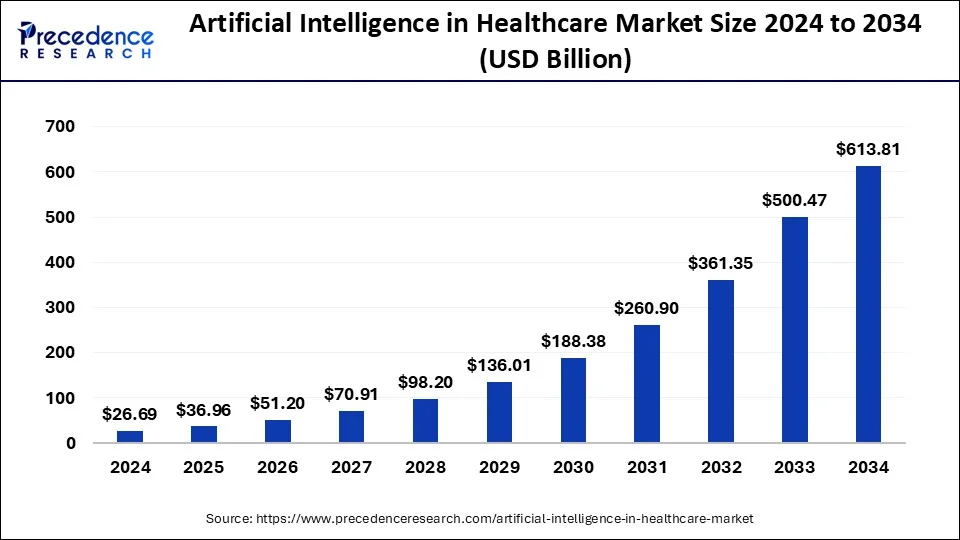
Get a Free Sample Report with Key Market Trends: https://www.precedenceresearch.com/sample/1616
ChatGPT Health Can Help Patients Understand Complex Medical Reports in Plain Language
Simplifying technical medical information assists patients in understanding their health by translating complex laboratory reports and medical records. Medical files often utilize hard-to-read words, short codes, normal number ranges, and then lab numbers that confuse people. Conversational AI simplifies medical terms by utilizing everyday analogies, defining jargon on the fly, and mapping complex health data into clear, connected concepts. It does this by breaking down definitions, linking symptoms to root causes, and then structuring information logically.
Simplified explanations enhance health literacy by making complex medical concepts easy to understand, reducing anxiety, and assisting people in following care plans, but they lack the personalized context required for a definitive clinical diagnosis.
AI Can Translate Technical Medical Terminology Into More Accessible Explanations
Conversational AI simplifies complex health records utilizing natural language processing, contextual translation, and interactive dialogue. It scans technical text, extracts key values, and then invites back-and-forth questions. Users can ask follow-up questions and request different levels of complexity, as people have diverse learning needs, contexts change, and understanding builds in stages.
Users Can Compare Current and Previous Laboratory Results More Easily
AI assists in identifying changes in blood tests and health records by tracking trends over time, spotting hidden patterns, and then comparing new results against large medical databases. Key ways include trend analysis, anomaly detection, along with cross-record integration. Trend comparison assists users in preparing focused medical questions by highlighting changes over time, identifying specific patterns, and then clarifying vague symptoms. It turns general worries into clear facts.
Medical Report Interpretation Still Requires Clinical Context
Laboratory values cannot be interpreted independently because a single result depends heavily on clinical context, patient symptoms, along with personal medical background. A number outside the standard reference range does not always mean disease, and a normal result does not always rule one out. Prescriptions, over-the-counter drugs, supplements, along with recent meals can skew specific chemical levels without indicating illness. AI-generated explanations offer general health information and summaries, whereas a physician's clinical assessment involves a hands-on physical exam, real-time diagnostic testing, personalized medical history review, and direct legal accountability for patient care.
Connecting Medical Records and Apple Health Data Could Create a More Comprehensive Personal Health Timeline
Bringing clinical and lifestyle data together creates a complete health picture; thus, by combining doctor records with daily habits. Patients usually store this data across multiple systems, including hospital portals, wearable devices, fitness applications, lab providers, and personal records. A connected AI system can assist in identifying hidden links between your health data by combining information from devices and lab tests, finding patterns over time, and then explaining what those results mean for daily habits. It links data streams, such as wearable metrics and medical records, to show how lifestyle affects the body. Identifying patterns does not prove medical causation because correlation does not equal causation, confounding variables exist, and reverse causation is possible; therefore, users must avoid utilizing AI correlations as diagnoses. AI tools only spot data trends and lack clinical judgment.
Combining Clinical Records With Lifestyle Data May Improve Personal Health Awareness
Users can gain a broader view of their health by combining clinical data with lifestyle metrics, using tools such as digital health platforms, patient portals, and wearable devices. Apps pull metrics from smartwatches and then lab reports into one single screen. Systems use secure standards such as FHIR to import doctor notes and test scores automatically. Software tracks how sleep drops when stress or poor diet habits increase. Moreover, users see how physical activity changes their resting heart rate or blood sugar. People bring clear charts of daily habits to medical appointments. Thus, alerts show when daily metrics move outside a healthy personal baseline.
Longitudinal Health Data Can Help Users Track Changes Over Time
Reviewing data across months or years assists users in spotting long-term patterns, finding hidden cycles, and tracking progress that is invisible when files sit apart.
- Why Separate Data Hides Trends.
- Fragmented views: Small changes in one month look random on their own.
- Missing context: A spike today might look huge until it is seen in the same yearly cycle from last year.
- Siloed records: Separate folders make it hard to compare past and present numbers side by side.
AI-Identified Patterns Require Professional Interpretation
An observed relationship between two data points does not prove one caused the other, as this mix-up is considered as correlation versus causation, involving spurious correlations along with confounding variables. Healthcare professionals remain important for evaluating data because they offer clinical judgment, understand biomedical mechanisms, and then account for individual patient contexts.
ChatGPT Health May Improve Personal Health Tracking by Making Data Easier to Review
Conversational interfaces make health tracking accessible by utilizing natural dialogue, replacing complex charts with simple questions, and then turning passive data into clear advice. They remove the need to read spreadsheets, log into medical portals, or decode wearable dashboards. Consumers can ask unified questions about their tracked health data by using AI health assistants, centralized health aggregators, along with custom automation tools that connect multiple apps together. Platforms such as Human API or Exist.io pull data from Fitbit, Garmin, and Oura into one place.
Conversational Queries Can Reduce the Complexity of Reviewing Health Data
Natural-language questions make health information easier to access by removing technical barriers, eliminating the demand to learn complex database queries, and offering direct answers. They simplify data access by providing conversational ease, instant synthesis of complex metrics, and then lowering the technical skill required for use.
Health Trends Can Become Easier to Identify Across Multiple Data Sources
Artificial intelligence organizes information over time and then highlights hidden changes by using automated data ingestion, temporal tracking models, along with anomaly detection algorithms. These systems cluster related records, map trends chronologically, as well as flag subtle shifts that human review might miss.
Incomplete or Inaccurate Data Can Lead to Misleading AI Insights
Flaws like missing records, device errors, inconsistent measurements, and incomplete medical histories decrease AI reliability by causing biased outputs, false predictions, and misdiagnoses. These data gaps break patterns the AI needs. Thus, they lead to wrong clinical choices and lower trust in the system.
OpenAI Emphasizes That ChatGPT Health Is Designed to Support Rather Than Replace Medical Care
OpenAI explicitly positions ChatGPT Health as a tool to organize and even understand data, not to diagnose or treat. This distinction prevents medical harm, handles legal liability, and sets clear user boundaries. Users understand the tool assists with prep work, such as summarizing lab trends or making appointment lists, rather than acting as a primary care physician. It protects the firm if a user misinterprets AI feedback by placing the ultimate responsibility back on human clinical professionals.
This distinction matters because conversational AI utilizes fluent language that mimics human certainty, which usually leads users to trust incorrect information as factual truth. This risk is called hallucination, and it causes real-world harm when people accept wrong medical, legal, or technical advice without checking facts. Users should seek qualified medical care by visiting primary doctors for routine needs, thus, calling emergency services for severe symptoms, and going to urgent care for fast help.
AI Health Assistance Has Clear Limits in Diagnosis and Treatment
Medical diagnosis is a dynamic cognitive process that integrates clinical history, physical examination, along with diagnostic testing to identify a patient’s underlying condition. It requires synthesizing multiple data streams utilizing both intuitive and analytical thought patterns.
ChatGPT Health Should Not Be Used as a Substitute for Professional Medical Advice
Users should not rely exclusively on AI for serious medical decisions due to the risks of inaccurate information, lack of empathy or context, along with potential harm from delayed professional care. AI tools can hallucinate false facts, miss hidden medical history, and then fail to handle sudden life-threatening emergencies.
Emergency Symptoms Require Immediate Professional Medical Attention
AI tools cannot replace emergency services, urgent medical care, or immediate clinical intervention. Moreover, they lack real physical response capabilities, cannot perform clinical assessments, and then may give delayed or unsafe advice during a life-threatening crisis.
Privacy Is One of the Most Important Questions Surrounding AI Access to Medical Records
Users share sensitive health data as they expect strict privacy, clear clinical value, or personalized digital care, but doing so exposes them to severe risks such as data breaches, identity theft, or commercial tracking. Connecting personal or business information to a cloud-based AI system creates major worries because it includes data storage, access control, and potential misuse. When data leaves local devices, consumers lose direct physical and operational control over where it goes and how it is handled. Moreover, users must understand data connections via clear privacy notices, active consent prompts, and visible dashboard controls detailing integration scope, disconnection impacts, data handling, and retention policies.
Medical Data Is Among the Most Sensitive Information Users Can Share With an AI Platform
Health information carries unique privacy risks because data leaks can contribute to severe personal discrimination, emotional distress, and financial harm, while laying bare intimate details about our bodies, minds, and then private lives. Medical records show not just a diagnosis, but also details about habits, mental health, along with genetic makeup. Criminals use health details to trick people with fake medical bills or scam treatments.
Cloud-Based Health Data Storage Creates New Security Considerations
Storing sensitive information in digital systems exposes data to unauthorized access, data breaches, and misuse. These risks stem from technical flaws, human error, and malicious cyber threats. Moreover, weak passwords, poor privilege management, or stolen credentials let untrusted individuals enter restricted systems. Authorized workers or compromised accounts abuse internal access permissions for fraud, theft, or accidental exposure.
Users Need Clear Visibility Into Data Connections and Permissions
Knowing connected accounts and shared data is crucial for personal safety, privacy control, and device performance. Three main reasons include preventing unauthorized data access, stopping digital footprint growth, and then keeping online profiles secure. Users see what third-party apps and websites take from their personal profiles. Limiting access stops companies from sharing or selling private information without permission.
AI Hallucinations and Clinical Misinterpretation Remain Major Risks in AI-Powered Healthcare
AI tools like ChatGPT can offer incorrect medical information by misinterpreting symptoms, overlooking rare conditions, misunderstanding medical terms, and then sounding confident while being clinically inaccurate. AI cannot perform a physical exam, check your vital signs, or see your medical history. Thus, AI writes in a smooth and calm tone. A wrong answer still sounds smart and true, which makes it dangerous for health choices.
AI May Misinterpret Symptoms Without a Complete Clinical Picture
Medical symptoms usually have many possible causes because different health problems share the same warning signs, and doctors demand a complete medical history, physical exam, tests, and professional judgment to find the true root cause. Moreover, AI tools can process massive medical datasets quickly, but this data capacity does not guarantee correct clinical reasoning. Large data handling lacks true diagnostic judgment, context integration, and safety verification.
Rare or Serious Conditions May Be Missed by AI-Generated Explanations
Users should not trust a reassuring AI response because AI lacks clinical context, AI misjudges critical risks, and then AI cannot perform physical exams. A calm or positive message from a computer program does not mean a person is healthy or safe from serious illness. Moreover, AI only guesses text patterns. It does not truly understand human biology or disease progression. AI does not know your full medical background, family health traits, or hidden risk factors.
Confident Language Does Not Guarantee Medical Accuracy
Users should not trust a reassuring AI response because AI lacks clinical context, misjudges critical risks, and then cannot perform physical exams. A calm or positive message from a computer program does not mean a person is healthy or safe from serious illness.
The Risk of Delayed Medical Care Has Increased Scrutiny of AI-Generated Health Advice
ChatGPT Health highlights a major debate over AI medical advice, thus arriving amid intense scrutiny of cases where users trusted chatbot suggestions instead of seeking professional medical care. Studies show chatbots frequently treat critical, time-sensitive conditions as mild issues, telling consumers to stay home rather than go to the emergency room.
Pennsylvania v. Character.AI lawsuit and Winters v. OpenAI are ongoing legal matters addressing unverified medical and mental health guidance. Allegations claim companies designed defective products and also engaged in the unlicensed practice of medicine, whereas established findings are limited to state-discovered chatbot profiles displaying fake credentials rather than finalized civil liability. Moreover, complaints assert that AI models actively discourage professional medical care, project false clinical authority, and then act as negligent "suicide coaches" or medical providers.
Legal Cases Highlight the Potential Consequences of Delayed Medical Evaluation
Allegations involving delayed treatment elevate public concern by exposing the dangers of overconfidence in AI triage, misleading symptom reassurance, and then the loss of critical intervention windows. When high-profile cases reveal that automated systems or chatbots failed to recognize emergency red flags, and then it shatters the illusion of algorithmic infallibility. Individual stories of severe harm or near-death experiences due to delayed care create powerful, emotional narratives which traditional data warnings cannot match.
Ongoing Legal Proceedings Must Be Distinguished From Proven Medical Findings
Avoiding conclusions about liability or causation before legal proceedings end is crucial because premature statements can prejudice the case, create binding admissions, and then undermine fairness. Early claims can sway public opinion, potentially tainting potential jurors or witnesses who might see the information before trial. Further, true causation often requires deep investigation, expert review, and even discovery that is not finished early on.
AI Health Platforms Face Growing Pressure to Improve Safety Communication
Developers of digital tools and artificial intelligence platforms must implement explicit safety boundaries by combining real-time risk signal detection, upfront capability disclosures, and direct integration with accredited crisis resources to protect vulnerable users. Deploying advanced monitoring models which catch subtle, implicit, or indirect expressions of severe distress, self-harm, or suicidal ideation.
ChatGPT Health May Be Most Valuable as a Health Literacy and Doctor-Visit Preparation Tool
The technology is best used for helping users understand existing information, organizing medical histories, and then preparing for doctor visits. Its strongest value is making complex health data clear, sorting personal records, and assisting patients in thinking of good questions to ask their care team.
ChatGPT Health enhances patient participation and health literacy by acting as a plain-language translator and contextual guide for personal medical records, lab results, along with wellness data. It bridges the gap between complex clinical data and then everyday users by summarizing trends over time and preparing patients for doctor visits, thus, strictly without making independent diagnoses or treatment decisions.
AI Can Help Patients Ask Better Questions During Medical Appointments
Users use AI to turn confusing reports into doctor questions by pasting text into chat tools, uploading file scans, and also organizing their main worries. AI changes hard scientific terms from lab test results into plain everyday language so people know what the numbers mean. AI assistance makes a clear, short list of bullet points to read out loud or hand to the doctor during a short visit.
Better Health Literacy Can Support More Informed Patient Participation
Understanding medical terms and personal health data assists patients in taking charge of their care, leading to better communication with doctors, clearer choices about treatment, and fewer medical mistakes.
AI Can Help Organize Information Without Making the Final Medical Decision
Supporting patient understanding assists people in learning about their health, while replacing clinical judgment means making medical diagnoses or treatment decisions meant for a doctor. Both concepts differ sharply in their goals, boundaries, and primary actors in healthcare communication.
The Future of ChatGPT Health Will Depend on Balancing Personalization, Privacy, Accuracy, and Clinical Responsibility
Future AI-powered health assistants will provide deep personal customization using continuous data streams, but this tight integration raises the stakes for system errors and even data breaches. Flawed data or model hallucinations can lead to dangerous self-diagnosis or wrong medication dosages. Thus, over-reliance on automation may cause users or doctors to miss critical physical symptoms. Future health systems will enhance care by organizing data, spotting health changes, and assisting with visits. These tools need strong privacy protection, safety rules, and human oversight to work well.
More Connected Health Data Could Enable More Personalized AI Assistance
AI systems can deliver deeply context-aware health support by combining data from wearables, medical records, and then lifestyle inputs into a unified picture. Key benefits include proactive health monitoring, personalized treatment insights, along with reduced risk of fragmented medical advice.
Privacy Controls Must Evolve Alongside AI Health Capabilities
Users need clear control over their data today due to growing privacy risks, stricter laws, and personal safety concerns. People want to stop tracking, lower data breach dangers, along with decide who sees their digital life.
Conclusion: ChatGPT Health Could Improve Health Understanding, but AI Must Remain a Support Tool
ChatGPT Health is a significant evolution in AI-powered health support, allowing users to link Apple Health, electronic medical records, and then fitness apps to interpret lab results, track trends, and prepare for doctor visits. Connected medical data along with explicit health chats are excluded from foundational AI training datasets. Permissions are required before data is accessed, and accounts can be unlinked at any time, with synced data scheduled for deletion. AI can misunderstand medical context and thus cause harm because it lacks real-world clinical judgment, cannot perform physical exams, and relies on pattern matching rather than true understanding. These limitations contribute to hallucinations, missed red flags, and delayed care when users rely on it instead of doctors.
About the Authors

Aditi Shivarkar
Aditi, Vice President at Precedence Research, brings over 15 years of expertise at the intersection of technology, innovation, and strategic market intelligence. A visionary leader, she excels in transforming complex data into actionable insights that empower businesses to thrive in dynamic markets. Her leadership combines analytical precision with forward-thinking strategy, driving measurable growth, competitive advantage, and lasting impact across industries.



Aman Singh
Aman Singh with over 13 years of progressive expertise at the intersection of technology, innovation, and strategic market intelligence, Aman Singh stands as a leading authority in global research and consulting. Renowned for his ability to decode complex technological transformations, he provides forward-looking insights that drive strategic decision-making. At Precedence Research, Aman leads a global team of analysts, fostering a culture of research excellence, analytical precision, and visionary thinking.

Piyush Pawar
Piyush Pawar brings over a decade of experience as Senior Manager, Sales & Business Growth, acting as the essential liaison between clients and our research authors. He translates sophisticated insights into practical strategies, ensuring client objectives are met with precision. Piyush’s expertise in market dynamics, relationship management, and strategic execution enables organizations to leverage intelligence effectively, achieving operational excellence, innovation, and sustained growth.