



Light Beer Market Size, Share, and Trends 2026 to 2035
Light Beer Market (By Production: Macro-brewery, Micro-brewery, Craft Brewery, Others; By Package: Glass, Pet Bottle, Metal Can, Other; By Distribution Channel: Hypermarkets and Supermarkets, On-Trade, Specialty Stores, Convenience Stores, Others) - Global Industry Analysis, Size, Trends, Leading Companies, Regional Outlook, and Forecast 2026 to 2035
Source: https://www.precedenceresearch.com/light-beer-market
 Get a Sample
 Table Of Content


What is the Light Beer Market Size?
The global light beer market size was estimated at USD 328.87 billion in 2025 and is predicted to increase from USD 337.16 billion in 2026 to approximately USD 420.83 billion by 2035, expanding at a CAGR of 2.50% from 2026 to 2035. The primary reason behind this market's growth is a rise in fitness awareness among beer consumers.
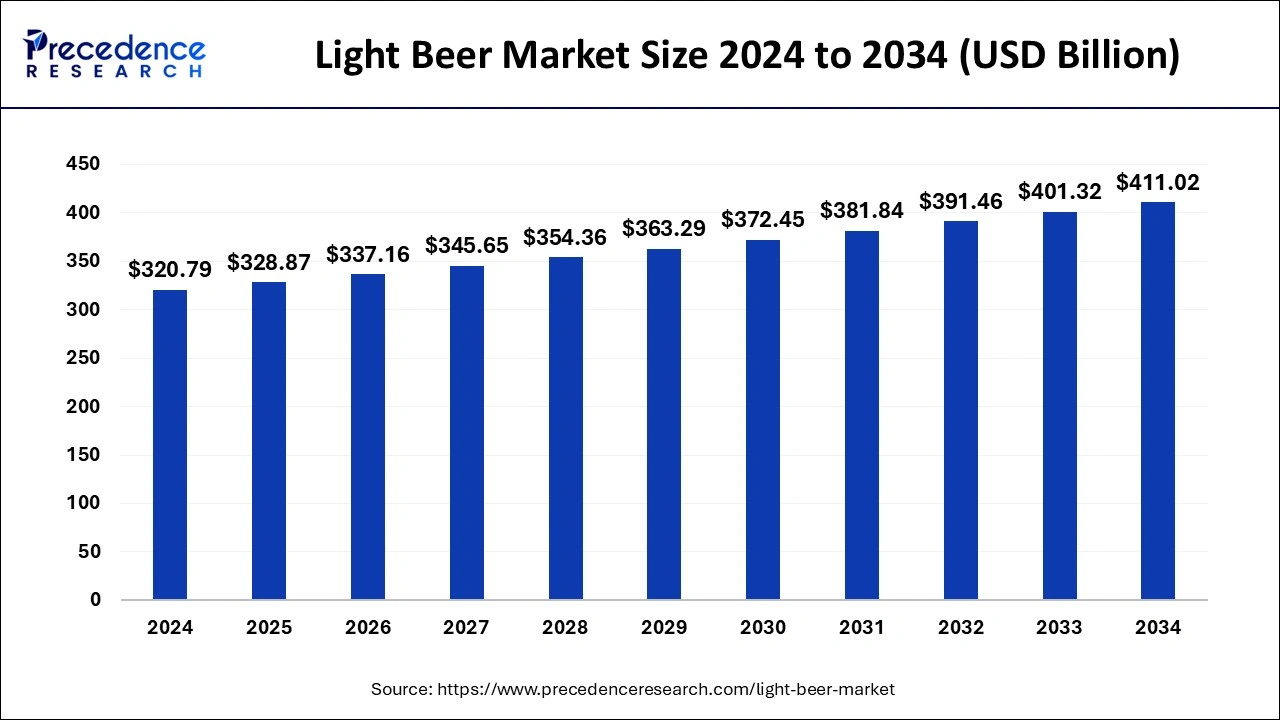
Light Beer Market Key Takeaways
- In terms of revenue, the global light beer market was valued at USD 320.79 billion in 2025.
- It is projected to reach USD 411.02 billion by 2035.
- The market is expected to grow at a CAGR of 2.51% from 2026 to 2035.
- North America dominated the light beer market in 2025.
- Asia Pacific is expected to show significant growth in the market during the forecast period.
- By production, the craft brewery segment dominated the market in 2025.
- By production, the microbrewery segment is expected to witness the fastest growth in the market during the forecast period.
- By package, the pet bottle segment accounted for the largest share of the market in 2025.
- By package, the glass segment will show the rapid expansion in the market over the forecast period.
- By distribution channel, the hypermarkets & supermarkets segment dominated the market in 2025.
- By distribution channel, the specialty stores segment is projected to witness rapid growth during the forecast period.
Market Overview
Beer is an extremely ancient popular drink. After water and tea, it is the third most consumed drink. Beer is made up of brewing and fermenting starches of cereal grains like barley, wheat, maize, rice, or oats. Beer tastes bitter because it is brewed with hops. Fruits or herbs are used to add flavors as well. The beer industry is huge, and beer is distributed in bottles or cans. It is a global business with several active players worldwide, and there are several players operating at a small scale as well. Normally, beer has a 6-8% alcohol content by volume.
Light beer, however, is a beer with a low alcohol content by volume. Light beer is made in order to reduce the calorie content in the beer and the inebriating effect while maintaining its taste. Light beer is available in different flavors and styles. They are manufactured by reducing the carbohydrate and alcohol content. Alcohol content and carbohydrates both contribute to the caloric content of beer. Light beers are less flavorful than regular beers, as they are more diluted. Advertisers advertise the quality of their light beers by highlighting that their beers have better retention of taste and flavor. Light beer usually does not have any age limit, and it is also popular among teenagers who have not reached the legal age of drinking.
Artificial Intelligence: The Next Growth Catalyst in Light Beer
AI is transforming the light beer industry by enhancing efficiency, quality, and personalization across the entire value chain. Machine learning algorithms and data analysis are used to optimize brewing parameters like temperature and pH levels in real-time, ensuring a consistent and high-quality product while reducing waste. In product development, AI helps predict successful flavor profiles and even suggests novel ingredient combinations, accelerating the creation of new and appealing light beer options that cater to changing consumer tastes.
Light Beer Market Growth Factors
- A good marketing strategy that targets the youth has resulted in a boost of growth in the light beer market.
- In the light beer market, key players are rapidly making better flavors available that cater to different tastes.
- Attractive advertisements and innovative packaging solutions further drive the light beer market globally.
Market Outlook
- Market Growth Overview: The light beer market is expected to grow significantly between 2025 and 2034, driven by the rising number of consumers seeking lower-calorie, lower alcohol options, the introduction of flavored light beers, and growing youth populations fueling market growth.
- Sustainability Trends: Sustainability trends involve packaging innovation, water conservation and efficiency, energy efficiency, and renewable sources.
- Major Investors: Major investors in the market include Anheuser-Busch InBev, Molson Coors Beverage Company, Heineken N.V., Carlsberg Group, and Constellation Brands.
- Startup Economy: The startup economy is focused on niche product innovation, direct-to-consumer engagement, and beer tech solutions.
Market Scope
| Report Coverage | Details |
| Market Size in 2025 | USD 328.87 Billion |
| Market Size in 2026 | USD 337.16 billion |
| Market Size by 2035 | USD 420.83 Billion |
| Growth Rate from 2026 to 2035 | CAGR of 2.50% |
| Largest Market | North America |
| Base Year | 2025 |
| Forecast Period | 2026 to 2035 |
| Segments Covered | Production, Package, Distribution Channel, Regions |
| Regions Covered | North America, Europe, Asia-Pacific, Latin America, and Middle East & Africa |
Market Dynamics
Drivers
Rising preference for low-calorie intake
Light beers have very little alcohol content. It can be consumed by teetotalers (those who don't consume alcohol) but want a taste of beer. It can also be consumed by those who have not achieved the legal age of drinking. People are also health conscious these days and prefer consuming low-calorie foods or beverages. Regular beer has a higher calorie content, and these are just empty calories. So, drinking this beer means that one is consuming sugary foods. This can lead to obesity, and hence, people prefer drinking light beer, which has a lower calorie content. This is preferred by GenZ consumers and those under the legal age of drinking.
Proper marketing and innovations in breweries
Many market players, like Kingfishers or Budweiser, are leading producers of beer and other alcoholic beverages. They even package the light beer in such a way that one can get the actual feel of drinking beer. The bottles are made the same as regular beer bottles, and the company also writes ‘non-alcoholic beverage' on the bottle or can.
The breweries are constantly innovating their products, and new ways of brewing are coming up. Tasty flavors are added to beer, and the bitterness of the product is controlled as well. This gives consumers a broad range of options. There are several restaurants and bars that have their own brewery in the restaurant itself, which attracts customers.
Restraint
Regular beer is a tough competitor
Light beers are good for health because they are low in calorie and alcohol content. However, they are in tough competition with regular beers. Regular beers give a proper ‘feel' to the consumers that they have drank beer. However, in the case of light beer, one might have to consume more beer to get that feeling of ‘fullness.' Light beers have poor taste, and consumers find them to be more diluted than regular beers.
Light beers cannot be as expensive as other soft drinks. Other soft drinks have a high content of sugar, and it has been found that the sugar content generates the craving for those drinks among people. So people who like other soft drinks won't buy these light beers, which have a bitter taste and are expensive as well. There are also rising trends towards health consciousness, and people prefer healthier beverages over beer.
Opportunity
Overall growth in the beverage market
The light beer market will help in the overall growth of the beverage market. Light beer producers can tie up with other soft drink companies to bring innovations in the beverage industry and make them more popular among consumers. There is a rising awareness among the people, and several social media influencers are making people aware of the contents of packaged beverages. Hence, companies should take this in a positive way and reduce the calorie content in light beers as much as possible while maintaining their taste and quality. New and better-tasting flavors can be introduced in the market to ensure that a wider range of consumers prefer them. This will help in increasing the popularity of light beers further and grow this market on a global scale.
Segment Insights
Production Type Insights
The craft brewery segment dominated the light beer market in 2024. Craft beer has a better taste. There is a variety of choices when it comes to craft beers. Craft beer contains antioxidants, protein, and vitamin B complex, and hence, these beers offer health benefits as well. Craft beer also happens to be cheaper in price and offers a high-quality taste because of the high-quality ingredients being used. For these reasons, craft beer dominates the light beer market.
The microbrewery segment is expected to witness the fastest growth in the light beer market during the forecast period. Microbrewery beers offer a strong taste. There is a wide variety of flavors available, and hence, users have a choice. It is customized and tastier. Microbrewery beer is fresh, and this adds to its taste. Microbreweries produce a limited amount of beer, and there is no mass production. Hence, the producers don't have to use a lot of preservatives for it. While offering high quality, microbrewery light beer has low pricing because there are no extra costs of branding the product by hiring celebrities or no expenditure in packaging, as this beer is directly served to the consumers.
Package Type Insights
The pet bottle segment accounted for the largest share of the light beer market in 2024. Pet bottles are lightweight, contribute to less greenhouse emissions, offer a high strength, and can be recycled many times. The cost of recycling and producing pets is low. These bottles can offer a good seal and avoid leakage of the product. These bottles have an advantage over glass bottles in that they cannot crack or break. Pets also have a high level of flexibility, and hence, these bottles can be molded in any desired shape after recycling. For these reasons, the pet bottle segment dominates the light beer market.
The glass segment will show the rapid expansion in the light beer market over the forecast period. Glass bottles are better than plastic bottles because they extend the shelf life of beer and protect it from sunlight. The flavor of light beer is retained better in glass bottles, which are also recyclable.
Distribution Channel Insights
The hypermarkets & supermarkets segment dominated the light beer market in 2024. Supermarkets and hypermarkets have a wide variety of beers, and there is a dedicated section for beers in these places. Multiple customers can be targeted. People can shop for light beers while shopping for their groceries. Supermarkets are the places where top-quality brand beers can be sold, and hence, they also help in marketing. Buyers get high discounts if they buy from supermarkets. While billing, information about the users is also collected, and hence, the sellers can understand the age of the consumer while selling the light beer. Hence, specific age groups can be targeted.
The specialty stores segment is projected to witness rapid growth during the forecast period. Specialty stores take beer selling to a niche level, and they can be called liquor supermarkets. Light beers can have a dedicated section where users can buy the brands they like. A large variety of beers can be made available in a specialty store, and hence, it is favored by many people. Usually, people who are connoisseurs and take a deep interest in trying out a variety of beers or light beers favor the specialty stores. Specialty stores can have not only top brands but also local brands, and hence, it also benefits small-scale brewers.
Regional Insights
North America dominated the light beer market in 2024. Light beer, and beer in general, is gaining popularity among the younger generation. Consumers demand better taste and variety, and the key players in the market are ensuring that the quality and taste are being delivered. Microbreweries choose the products that are the most popular and ensure that their production is high in quality and quantity. Hence, consumers are getting more homogenous and a better-quality light beer. Packaged light beers in bars and restaurants are being sold in large amounts, and this, too, contributes to the growth of the light beer market in North America.
U.S. Light Beer Market Trends
U.S. consumers are prioritizing lower calories and alcohol content, boosting demand for light beers, and introducing new flavor profiles and leveraging advanced brewing techniques, and rising trends towards sport marketing and digital channels, and continuous investment in innovation and diverse product offerings fuel the market growth.
Asia Pacific is expected to show significant growth in the light beer market during the forecast period. There have been changes in the lifestyle of a large population, and this is helping in the growth of the light beer market in Asia Pacific. People are earning better incomes and have also become health conscious. Hence, they are also spending a good amount of money on light beers. Social media is helping to increase the popularity of light beers. Light beer brands offer a wide variety of flavors. The young generation enjoys light beer, and hence, they help in growing the light beer market in the Asia Pacific.
China Light Beer Market Trends
China's consumers are increasingly choosing low-alcohol, low-calorie, and functional beers, and e-commerce online sales and delivery are booming, with the diversifying new flavors, lighter options, and functional ingredients to meet evolving demands.
How did Europe experience notable growth in the Light Beer Market?
Europe's Gen Z and millennials are driving demand for healthier, seasonal beers that fit busy lives, including NA and low-alcohol craft variants. The craft movements focus on quality and flavor, extending to lighter styles, attracting new drinkers, and boosting market growth.
The UK Light Beer Market Trends
The UK's younger demographics prioritize alcohol moderation, which has catalyzed the rapid expansion of the fruit-led and hybrid lager sectors. Consequently, manufacturers are pivoting toward flavor innovation and transparent nutritional labeling to capture evolving consumer preferences for lighter, lifestyle-compatible beverages.
Value Chain Analysis of Light Beer Market
- Raw Material Supply
This stage involves sourcing essential agricultural ingredients such as malted barley, hops, yeast, and water, along with other potential ingredients for flavor innovation.
Key Players: Cargill, Inc., Boortmalt, and Malteurop Groupe. - Production/Manufacturing (Brewing and Packaging)
In this stage, breweries combine the raw materials through a specific brewing and fermentation process to produce the light beer.
Key Players: Heineken N.V., Molson Coors Beverage Company, Carlsberg Group, The Boston Beer Company, and Sierra Nevada Brewing Co. - Distribution and Logistics
Finished products are transported from manufacturing facilities to various sales channels.
Light Beer Market Companies
- Asahi Breweries expanded into the light beer market with products like Asahi Style Free, a sugar-free, low-calorie beverage designed for health-conscious consumers in Japan.
- Guinness, traditionally known for its stout, contributes to the light beer segment through brands like Guinness Blonde and its low-calorie options in various markets.
- Suntory Beer contributes to the light beer market with options such as All-Free, a non-alcoholic, zero-calorie, and zero-sugar beer-like beverage that appeals to health-conscious consumers.
- AB InBev dominates the light beer market globally with cornerstone brands like Bud Light and Michelob Ultra, which are top-selling light beers.
- MillerCoors, now part of Molson Coors Beverage Company, significantly shaped the U.S. light beer market with flagship products like Miller Lite and Coors Light.
Other Major Key Players
- Pabst
- Crown import
- Heinkein
- Carlsberg
Recent Developments
- In January 2026, Anheuser-Busch (AB InBev) introduced this new alcohol-free brew, which has 0.0% alcohol, 39 calories, and a twist of real lime. Michelob ULTRA Zero Lime is the top-selling and fastest-growing beer. It aims to capture the 21+ demographic seeking flavor-forward.
(Source: https://www.anheuser-busch.com ) - In February 2024, Flying Monkey, a crafted beer brand, was launched in Hyderabad. The brand promises the users a great experience and taste. It was launched in a grand event, and the event also had a tasting session. Many bloggers, vloggers, and popular social media influencers were invited to the event.
Segments Covered in the Report
By Production
- Macro-brewery
- Micro-brewery
- Craft Brewery
- Others
By Package
- Glass
- Pet Bottle
- Metal Can
- Other
By Distribution Channel
- Hypermarkets and Supermarkets
- On-Trade
- Specialty Stores
- Convenience Stores
- Others
By Geography
- North America
- Asia Pacific
- Europe
- Latin America
- Middle East & Africa
For inquiries regarding discounts, bulk purchases, or customization requests, please contact us at sales@precedenceresearch.com
Frequently Asked Questions





Ask For Sample
No cookie-cutter, only authentic analysis – take the 1st step to become a Precedence Research client
 Get a Sample




 sales@precedenceresearch.com
 Schedule a Meeting
