



Refrigerated Transport Market Trends, Leading Companies, Company Revenue / Sales Performance, Food Production, Processing Capacity, Sales Volume, Distribution Performance, Competitive Landscape, and Industry Outlook
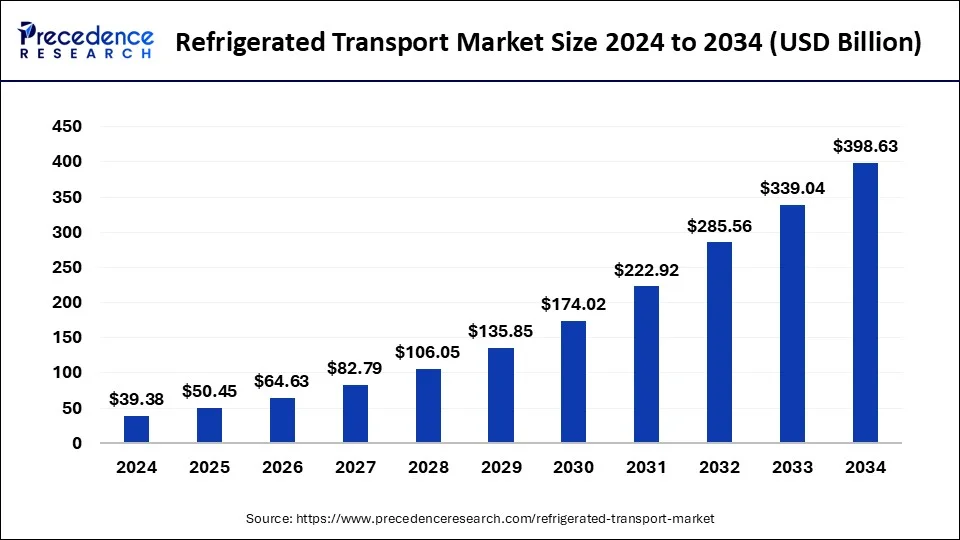
Food and beverage specialist Vidyesh Swar puts the refrigerated transport market at USD 64.63 billion in 2026, with the market expected to reach USD 398.63 billion by 2034 at a CAGR of 24.58%. Major refrigerated transport market companies such as Carrier Transicold, Thermo King, Daikin Industries, Ltd. are responding to changing consumer demand across segments including By Product, Temperature, Technology,Vehicle Used, Mode of Transport.
Source: https://www.precedenceresearch.com/refrigerated-transport-market
 Get a Sample
 Table Of Content


What is Refrigerated Transport Market Size?
The global refrigerated transport market size is estimated at USD 50.45 billion in 2025 and is predicted to increase from USD 64.63 billion in 2026 to approximately USD 398.63 billion by 2034, expanding at a CAGR of 24.58% from 2025 to 2034.
Market Highlights
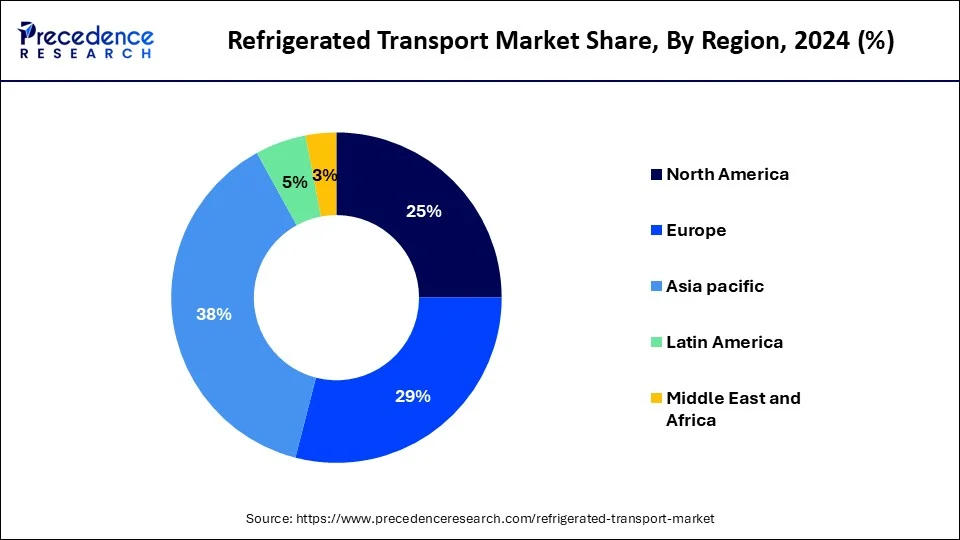
- Asia Pacific region held the highest revenue share of 38% in 2025.
- Europe region accounted for a market share of around 29% in 2025.
- By technology, the air-blown evaporators segment has garnered a revenue share of around 49% in 2025.
- The eutectic devices technology segment accounted for a revenue share of 32% in 2025.
What is meant by Refrigerated Transport?
The refrigerated transport is a special method used for transportation of various products which need control temperature during the transport. In order to transport perishable goods like fruits, vegetables, frozen foods and other chemicals that are temperature sensitive the refrigerator transport is used. The built in system which helps in keeping the temperature regulated throughout the process is extremely beneficial for many industries.
The refrigerated transport market is driven by rising demand for the safe and timely delivery of perishable goods, including food, pharmaceuticals, and chemicals. Increasing e-commerce, globalization of food supply chains, and stringent regulations for temperature-sensitive products further fuel market growth. Refrigerated transport refers to the logistics and transportation of temperature-sensitive goods using specialized vehicles equipped with cooling systems. These systems maintain precise temperatures throughout transit, ensuring product quality, safety, and shelf life. Common modes include refrigerated trucks, railcars, and shipping containers, supporting industries like food distribution, healthcare, and biotechnology.
Revolutionizing Cold Chains: AI Integration Enhancing Efficiency in Refrigerated Transport
AI integration significantly influences the refrigerated transport market by optimizing route planning, reducing energy consumption, and maintaining precise temperature control throughout the supply chain. Machine learning algorithms analyze real-time data from sensors to predict equipment failures, adjust cooling systems, and ensure consistent product quality. AI also enables predictive maintenance, fuel efficiency, and automated monitoring of perishable goods, minimizing spoilage and waste. Additionally, AI-driven analytics improve logistics decision-making, enhance traceability, and streamline operations, making refrigerated transport safer, more efficient, and cost-effective.
Refrigerated Transport Market Growth Factors
There would be major loss to the food industry as the food items would perish even before reaching the end consumers without the availability of the refrigerated transport. Various products which are ready for consumption and produced at places which are extremely far away from the place of consumption have a great demand for refrigerated transport. The availability of fridge vans and trucks are helpful in providing gods in a condition which is suitable for consumption. The usage of refrigerated transport helps in reducing the wastage and therefore it is extremely environment friendly. These vehicles are the reason why the items remain fresh. There's an increase in the demand for the refrigerated transport as many manufacturers are seeking this type of transport to move their products. As the food products of the pharmaceutical products are preserved in the best state the nutrients in these foods are intact.
The growing awareness among the consumers regarding healthy food habits and good availability of various products are creating a demand for the usage of these transport vehicles. These trucks are also important for the growth of the economy. The transport trucks have an extremely important function of transporting various items to nooks and corners of the country. The local government and the companies find it extremely beneficial to use these refrigerated transports as they help in providing better revenues during the freshness of the items delivered. The use of a medium for transport is extremely important for the companies. The success of any organization depends upon the products that are offered in the market. The products in the refrigerator trucks or vans can be monitored and the temperature can be set as per the requirement. It also offers ease of delivery to the locations of the end user. Owing to all of these reasons the market for refrigerated transport is expected to grow during the forecast period.
Latest Technology
Energy-efficient operation and reduced emissions can make refrigerated systems less costly for organizations in a potential future of operations. Phase change material technology has excellent potential as an energy-efficient solution. It focuses on very high latent energy absorbing and releasing attributes that can be found using familiar material phase transitions, like melting and solidification, to maintain cool temperatures. This technology both reduces the use of dangerous refrigerants while it boosts operational efficiency, thus making it suitable for cold chain distribution. The renewable advances in refrigerated logistics have introduced a combined approach for sustainable temperature-controlled delivery of sensitive goods.
Market Outlook
- Industry Growth Overview: The refrigerated transport market is expected to expand rapidly between 2025 and 2034, driven by rising demand for safe, temperature-controlled delivery of perishable goods across the food, pharmaceutical, and chemical sectors. Technological advancements, cold-chain optimization, and global supply chain expansion are driving efficiency and adoption.
- Sustainability Trends: Sustainability trends focus on energy-efficient refrigeration units, electric-powered transport, and reduced fuel consumption. Companies are integrating AI for route optimization, eco-friendly refrigerants, and recyclable packaging, minimizing environmental impact while maintaining product quality and enhancing operational efficiency across cold-chain logistics.
- Global Expansion: The refrigerated transport market is expanding globally due to growing international trade of perishable goods, increasing e-commerce penetration, and rising demand for temperature-controlled logistics. Strategic partnerships, infrastructure investments, and technology adoption are accelerating cross-border supply chain integration.
- Major investors: Investors in refrigerated transport include venture capital firms, private equity, and corporate investors such as Carrier Transicold, Thermo King, and DSV. They fund fleet expansion, advanced refrigeration technologies, AI-driven logistics, and sustainable cold-chain solutions, driving innovation and global market growth.
- Startup Ecosystem: The startup ecosystem is thriving with companies focusing on electric and hybrid refrigerated vehicles, AI-based route optimization, IoT monitoring, and sustainable cold-chain logistics. Startups collaborate with established logistics providers, attracting investments to enhance efficiency, reduce emissions, and improve real-time visibility in perishable goods transport.
Market Scope
| Report Coverage | Details |
| Market Size in 2025 | USD 50.45 Billion |
| Market Size in 2026 | USD 64.63 Billion |
| Market Size by 2034 | USD 398.63 Billion |
| Market Growth Rate from 2025 to 2034 | CAGR of 24.58% |
| Largest Market | Asia Pacific |
| Base Year | 2025 |
| Forecast Period | 2025 to 2034 |
| Segments Covered | Product, Temperature, Technology, Vehicle Used, Mode of Transport (Road), and Region |
| Regions Covered | North America, Europe, Asia-Pacific, Latin America, and Middle East & Africa |
Segments Insights
Product Insights
On the basis of the product type, the chilled products segment has had the largest market share in 2025 and is expected to grow during the forecast period as there is an increase in the demand for dairy products, beverages, fresh fruits, bakery and confectionery items. Even though there has been saturation in the developed nations the developing nations are seeing a great growth of this segment. There's a growing demand for chilled food products indie emerging countries. The other factors that are responsible for the growth of the chilled food products segment is the increase in the supermarkets across the globe which is providing good opportunities for the growth of this segment.
The frozen food products segment is also expected to garner good amount of market share. Various plant based and animal based perishable products are in demand and therefore the frozen food segment is also expected to see a growth during the forecast period. As there is a growing demand for ready to cook food which is available in the frozen form which is extremely time saving and easy so it is preferred by the working class. This creates a need for the refrigerated transport for moving these frozen food products from one place to another. The frozen food products available in the market can be extremely perishable if there is an alteration in the temperature and it may also be unfit for consumption. Therefore there is a growing demand for refrigerated transport especially for this segment.
Technology Insights
The vapor compression segment had a larger market share in the 2025. The vapor compression segment shall have a dominating position in the years to come. This method or technology which is used in the refrigerated transport system is extremely useful in preserving the frozen food products. This technology happens to be the most effective technology available in the market across the developed and the developing nations. This technology helps in preserving the food in their exact form until it reaches the destination.
In the cryogenic method liquid nitrogen or solid carbon dioxide is used. The cryogenic freezing is extremely useful for maintaining very low temperature to maintain the quality of the products in transport. In the cryogenic refrigeration the temperatures could be as low as 150 Kelvin.
Temperature Insights
On the basis of temperature, the single temperature segment had a market share of about 31% in the recent years. In the future the multiple temperature segment will dominate the market. In a refrigerator truck or van which is used for transport the temperature is set at once for all the perishable goods that are carried in the truck. The refrigerated transport which uses single temperature is useful for many products. Single temperature of segment is expected to grow due to usage in the transport of dairy products, pharmaceuticals, fruits and vegetables, meat and fish.
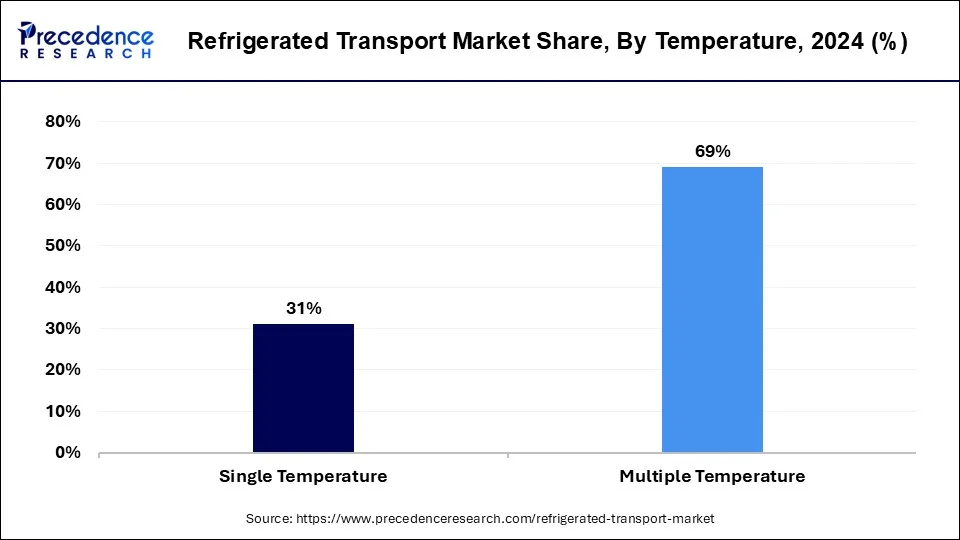
The multi temperature segment is expected to grow as it helps in carrying frozen food products in the same refrigerator transport which acts as a freezer for these products.
Vehicle Used Insights
There are many different types of vehicles which are used for the transport of perishable food items and other products. The lightweight commercial vehicle segment is expected to have the largest market share during the forecast period. This segment had seen a significant growth in the recent years. Due to a growing demand for home delivery services which are provided by various online websites the use of light commercial vehicles for carrying the frozen products order refrigerated products for delivery in short distances is seeing great demand. There was a good amount of demand for the light commercial vehicles segment during the pandemic as many online stores were providing delivery services which made use of these lightweight vehicles for transporting products from one place to another.
The light commercial vehicle segment had also seen a good demand during the pandemic due to the increase in the consumption of various pharmaceutical products. Heavy commercial vehicles are used for transporting goods over a long distance. It is extremely useful for transporting perishable items which happened to be the raw materials of other manufacturer's beard.
Regional Insights
Asia Pacific Refrigerated Transport Market Size and Growth 2025 to 2034
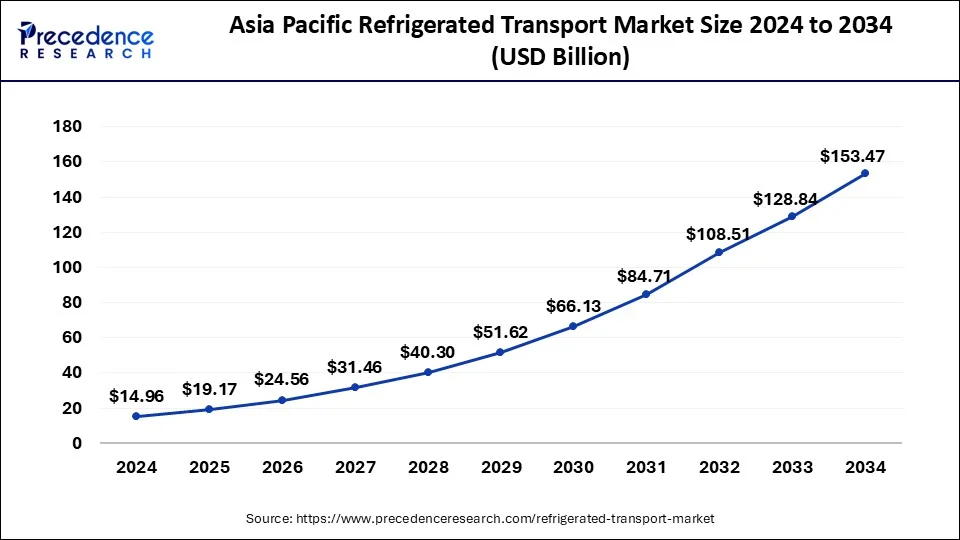
The Asia Pacific refrigerated transport market size is valued at USD 24.56 billion in 2026 and is expected to be worth around USD 153.47 billion by 2034, growing at a CAGR of 24.77% from 2025 to 2034.
Why Did Asia Pacific Dominate the Refrigerated Transport Market in 2025?
Asia Pacific dominated the refrigerated transport market with the largest share in 2024 due to rapid growth in the region's food and beverage industry, expanding e-commerce, and increasing demand for fresh and frozen products. Rising urbanization and higher disposable incomes have boosted the consumption of perishable goods, driving the need for efficient cold-chain logistics. Additionally, strong government support for infrastructure development and advancements in temperature-controlled transport technologies further strengthened the region's market position.
The Asia Pacific region had the largest market share for the refrigerator transport market. The European nations and the North American countries I expected to have a steady growth during the forecast period there has been saturation in the North American and European countries over the period of time. The developing nations in the Asia Pacific region are growing rapidly due to industrialization and growing population. Order to provide developed and advanced transport infrastructure governments in the Asia Pacific region or providing investments. The major countries which are contributing to the growth of the refrigerated transport market are India, Japan and China.
Asia Pacific region due to rapid industrialization and two income households as a growing demand for refrigerated transport as the frozen food products or convenient to cook and happen to be time saving. The busy lifestyle in nations like India, China and Japan is creating a great demand for refrigerated transport. Emerging economies are also consuming frozen food products as it is easily available in the market.
China Refrigerated Transport Market Analysis
The market in China is driven by its vast population, strong demand for perishable food, and rapid expansion of e-commerce and grocery delivery services. The country's growing cold-chain infrastructure and government initiatives to reduce food waste have further fueled market growth. Additionally, increasing exports of seafood, meat, and pharmaceuticals require reliable temperature-controlled logistics, reinforcing China's dominant position in the region.
Why is Europe Considered the Second-Largest Market?
Europe is the second-largest market, holding a significant share in 2025, and is expected to grow at the fastest rate in the coming years due to rising demand for fresh and organic food, stricter regulations on food safety, and the expansion of cross-border trade within the EU. The region's strong focus on sustainability has accelerated the adoption of energy-efficient and low-emission refrigerated vehicles. Moreover, advancements in cold-chain digitalization and real-time monitoring technologies are improving operational efficiency. Increasing consumer preference for ready-to-eat and frozen meals is also driving the need for reliable temperature-controlled logistics across Europe.
The refrigerated transport market in Europe is developing profitability because people increasingly focus on creating sustainable food supply systems to reduce waste. The shift towards environmental responsibility by consumers and businesses creates a rising demand for efficient and low-emission cold chain solutions because of their environmentally friendly transportation needs. European markets continue expanding steadily for eco-friendly food logistics systems because government policies merge with consumer preferences for carbon-reduction measures.
Germany Refrigerated Transport Market Analysis
The market in Germany is being driven by its large food processing industry, advanced logistics infrastructure, and high demand for fresh and frozen products. The country's stringent food safety regulations and emphasis on efficient cold-chain management have further driven the adoption of temperature-controlled transport solutions. Additionally, Germany's central location in Europe makes it a key hub for cross-border distribution of perishable goods, strengthening its market leadership.
What Makes North America a Significantly Growing Area in the Refrigerated Transport Market?
North America is expected to grow at a significant rate in the upcoming period, driven by high demand for fresh, frozen, and ready-to-eat foods across retail and e-commerce channels. Rapid expansion of cold-chain infrastructure, coupled with advancements in temperature-controlled vehicle technologies, is enhancing efficiency and reliability in food logistics. The U.S. lead the market. Strict food safety regulations and increasing consumer preference for perishable and organic products are further fueling market growth. Additionally, the rise of online grocery delivery and pharmaceutical cold-chain requirements is boosting the need for sophisticated refrigerated transport solutions throughout the region.
How Crucial is the Role of Latin America in the Refrigerated Transport Market?
Latin America is growing at a notable rate in the refrigerated transport market due to rising demand for perishable food and pharmaceutical products, expansion of cold-chain infrastructure, and increasing adoption of temperature-controlled logistics. Investments in modern refrigerated fleets and technological advancements are enhancing efficiency and reliability across the region. Brazil is a major contributor to the Latin American refrigerated transport market due to its large agricultural and food processing sectors, which produce significant volumes of perishable goods for both domestic consumption and export.
How Big is the Opportunity for the Growth of the Middle East and Africa Refrigerated Transport Market?
The Middle East and Africa offer significant growth opportunities in the refrigerated transport market, driven by rising demand for perishable food, pharmaceuticals, and temperature-sensitive goods. Expanding cold-chain infrastructure, increasing e-commerce penetration, and growing investment in modern refrigerated fleets are driving market adoption. Technological advancements such as AI-enabled monitoring, energy-efficient refrigeration units, and electric transport solutions further enhance efficiency, reliability, and sustainability across the region's logistics and supply chain networks.
Saudi Arabia is a major contributor to the MEA refrigerated transport market due to its growing food import requirements and expanding retail and foodservice sectors. Investments in cold-chain infrastructure and modern temperature-controlled logistics have enabled efficient transport of perishable goods across the country and for re-export.
Value Chain Analysis
- Raw Material Procurement Suppliers procure perishable goods, including fresh produce, dairy, meat, seafood, and pharmaceuticals, from farms and manufacturers, ensuring quality and safety. These goods are then packaged and prepared for cold-chain transport.
Key Players: Cargill, Tyson Foods, Nestlé, Sysco Corporation, and McLane Company. - Processing and Preservation Perishable goods are processed, sorted, and preserved using temperature-controlled facilities and refrigeration technologies to keep them fresh. Packaging is designed for protection, shelf life, and regulatory compliance before being loaded onto refrigerated transport vehicles.
Key Players: ConAgra Foods, Kraft Heinz, Dairy Farmers of America, Americold Logistics, Lineage Logistics. - Retail Sales and Marketing Refrigerated goods are transported to supermarkets, pharmacies, restaurants, and e-commerce fulfillment centers. Effective marketing strategies, cold-chain tracking, and inventory management ensure products reach consumers efficiently while maintaining quality and compliance.
Key Players: Walmart, Kroger, Amazon Fresh, CVS Health, Sysco Corporation. - Waste Management and Recycling Unsuitable or expired perishable goods are collected for composting, energy recovery, or safe disposal. Refrigeration equipment, packaging materials, and transport vehicles are recycled or refurbished to minimize environmental impact.
Key Players: Veolia Environnement, Covanta, Clean Harbors, Republic Services, Waste Management Inc.
Company Profiles
Carrier Transicold
- Headquarters: Palm Beach Gardens, Florida, the U.S.
- Founded: 1999
- Business overview: Carrier Transicold is a part of Carrier Global Corporation, a leading global provider of healthy, safe, and sustainable building and cold chain solutions.is a provider of heating, ventilating, air-conditioning, refrigeration systems, building automation, and fire and security technologies, overall creating refrigerated transport solutions.
- Products: Its product line comprises furnaces, air conditioners, heat pumps, ductless systems, refrigeration equipment, boilers, indoor air quality products, compressors, thermostats, and refrigeration equipment under the Carrier, Carrier Transicold, Kidde, Edwards, LenelS2, and Automated Logic brand names.
- Geographic presence: Carrier Transicold operates across Asia-Pacific, Europe, the Middle East, Africa, and the Americas.
- Revenue: The Company generated USD 21.7 billion in revenue in 2024.
Thermo King
- Headquarters: Bloomington, Minnesota
- Founded: 1938
- Business overview: Thermo King leads in sustainable transport climate control solutions for refrigerator trucks and trailers, refrigerated containers, and refrigerated railway cars, along with heating, ventilation, and air conditioning systems for bus and passenger rail applications. It offers advanced technology and innovative solutions, helping meet global consumer demand.
- Products: trailer, SLXI hybrid, truck, small truck, bus HVAC, rail HVAC, marine, connected solutions, Thermokare, genuine parts, and accessories
- Geographic presence: Its business operates across North America, Latin America, Asia Pacific, Europe, the Middle East, and Africa.
- Revenue: The Company's estimated annual revenue is USD 2.3 billion in 2025.
- Recent Development: In March 2026, Thermo King launched the E‑Volution range, a high-capacity electric refrigeration solution for rigid trucks between 7.5 and 26 tonnes by advancing practical electrification technologies
Daikin Industries, Ltd.
- Headquarters: Osaka, Japan
- Founded: 1924
- Business overview: Daikin Industries Ltd is a global HVAC company offering advanced and high-quality air conditioning. It focuses on research and development, manufacturing, sales, and services related to air conditioning systems for residential, commercial, and industrial applications.
- Products: It offers split/multi-split air conditioners, air-to-water heat pump systems, heating systems, air purifiers, and ventilation control systems.
- Geographic presence: Daikin has a significant presence across Europe, Asia, the Middle East, Africa, Oceania, North America, and Latin America, ranking first by unit sales in Europe, Southeast Asia, India, Oceania, Taiwan, and Japan.
- Revenue: Daikin Industries accounted for USD 31.825 billion in revenue in 2025.
Schmitz Cargobull AG
- Headquarters: Horstmar, Germany
- Founded: 1892
- Business overview: Schmitz Cargobull AG is a German manufacturer of semi-trailers, trailers, and truck bodies. The company also manufactures transport cooling units for refrigerated box body semi-trailers for temperature-controlled freight transport and supports customers' total cost of ownership and digital transformation.
- Products: Trailers, refrigerated trailers, semi-trailers, box bodies, skellies, and tippers.
- Geographic presence: Significant presence across Western, Northern, Central, and Eastern Europe, as well as the Asia-Pacific and the Middle East.
- Recent Development: In April 2026, Schmitz Cargobull started offering the TrailerConnect telematics system in a version certified specifically for the Turkish market.
Recent Developments
- In May 2024, Carrier introduced the Vector HE 17 trailer unit with inverter technology and all-electric E‑Drive architecture, reducing fuel consumption by up to 30 % and enabling quieter, more efficient urban and long-haul deliveries.
- In March 2025, Carrier showcased the EverFRESH Active Controlled Atmosphere system and the Addvolt PowerPack plug-in battery-electric refrigeration system for vans and trailers, supporting zero-emission cold-chain transport.
- In April 2025, with its flagship LEGEND series and the first Asian-made trailer refrigeration unit production line at its Wujiang, China, plant, Thermo King, a strategic brand of Trane Technologies, a global climate innovator, is positioned to serve the Asia-Pacific market.
(Source: https://www.prnewswire.com)
Segment covered in the Report
By Product
- Chilled Food
- Milk
- Bakery & confectionery products
- Dairy products
- Beverages
- Fresh fruits & vegetables
- Frozen Food
- Ice cream
- Frozen dairy products
- Meat-processed
- Fish & sea food
- Bakery products
By Temperature
- Multiple Temperature
- Single Temperature
By Technology
- Vapor Compression Systems
- Air Blown Evaporators
- Eutectic Devices
By Vehicle Used
- Heavy Commercial Vehicle
- Light Commercial Vehicle
- Medium Commercial Vehicle
By Mode of Transport (Road)
- LCV
- MHCV
- HCV
By Region
- North America
- Europe
- Asia-Pacific
- Latin America
- Middle East & Africa
For inquiries regarding discounts, bulk purchases, or customization requests, please contact us at sales@precedenceresearch.com
Frequently Asked Questions





Ask For Sample
No cookie-cutter, only authentic analysis – take the 1st step to become a Precedence Research client
 Get a Sample




 sales@precedenceresearch.com
 Schedule a Meeting
