



Mammography Market Size, Key Companies, Company Market Share, Patient Volume, Treatment Adoption Rates, Pricing Analysis, Regulatory Landscape, Competitive Positioning, and Demand Forecast
Mammography Market (By Product: Film Screen Systems, Digital Systems, Analog Systems, Biopsy Systems, 3D Systems, Others; By Technology: Breast Tomosynthesis Mammography, CAD Mammography, Digital Mammography; By Modality: Portable, Non-Portable; By End Use: Hospitals, Special Clinics, Diagnosis Centers, Ambulatory Surgical Centers, Educational & Research Institutes) - Global Industry Analysis, Size, Trends, Leading Companies, Regional Outlook, and Forecast 2026 to 2035
Source: https://www.precedenceresearch.com/mammography-market
 Get a Sample
 Table Of Content


What is the Mammography Market Size?
The global mammography market size is accounted at USD 2.8 billion in 2025 and predicted to increase from USD 3.02 billion in 2026 to approximately USD 5.89 billion by 2035, representing a CAGR of 7.72% from 2026 to 2035. The mammography market growth is driven by rising breast cancer prevalence, expanding screening programs, and technological advancements in digital imaging, growing awareness, and increasing healthcare investments.
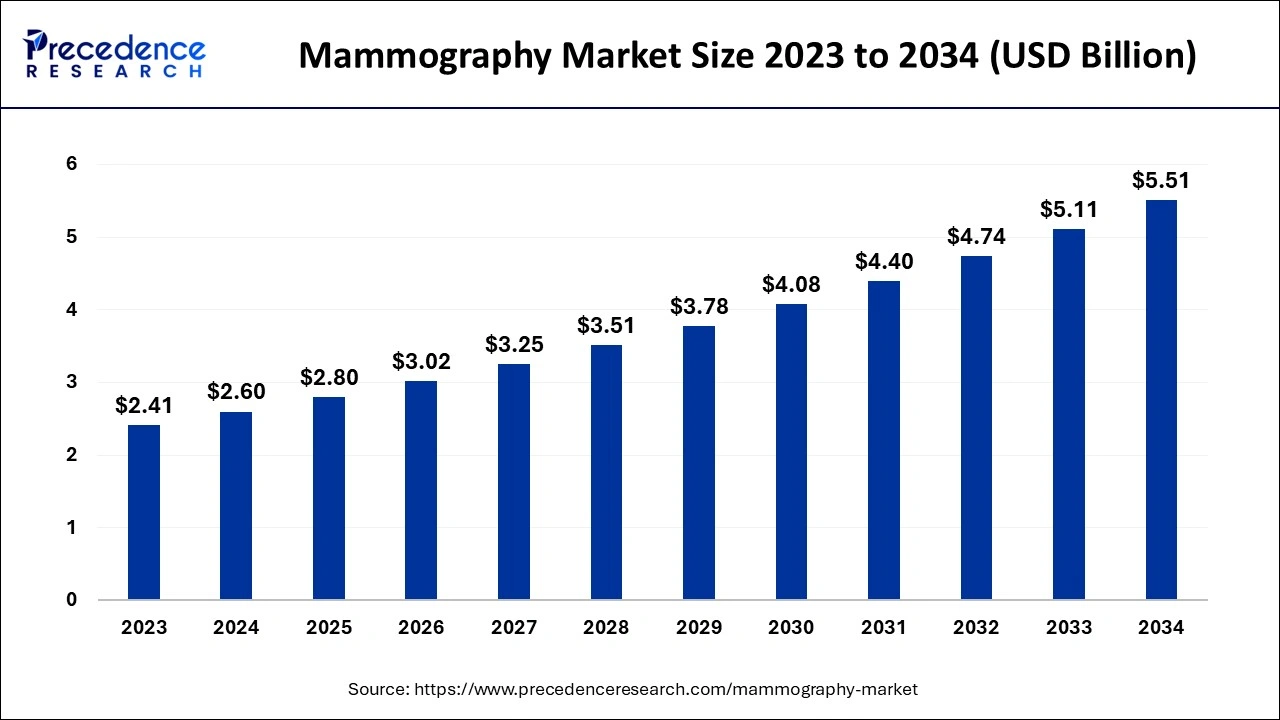
Mammography Market Key Takeaways
- North America ruled the market and represented the biggest share of around 43% in 2025.
- Asia Pacific, is expected to experience the fastest growth during the predicted timeframe.
- By technology, the digital mammography innovation segment accounted 69% revenue share in 2025.
- By technology, breast tomosynthesis technology segment is projected to grow at a CAGR of 7% from 2026 to 2035.
- By product, the digital systems segment has garnered 63% market share in 2025.
- By product, 3D systems product segment is expected to reach at a 9.2% over the forecast period.
Market Overview
The Mammography market is made up of imaging devices, software solutions, and supporting services that are utilized in identifying and diagnosing breast disorders, especially breast cancer, with the help of low-dose X-ray technology. These include digital mammography, 3D tomo-synthesis, contrast mammography, and AI-powered image-analysis technologies, among other products. The overall market is expected to grow steadily with the increase in breast cancer incidence, rising recognition of the importance of early diagnosis of the disease, and the growth of population-based screening initiatives. Technological advancements aimed at enhancing the quality of images, minimizing radiation dosage, and maximizing the accuracy of diagnostic outcomes continue to add to the demand in the mammography market.
Additionally, rising investment in the health sector, growing access to modern health conveniences in developing nations, and increasing utilization of customized and preventative health programs continue to drive the development of the industry.
How is AI Changing the Mammography Diagnostic Landscape?
AI is revolutionizing the mammography sector through improved image analysis, increased diagnostic accuracy, and improved clinical workflow efficiency. AI-oriented solutions enable radiologists to discover small lesions in their early stages as well as micro-calcifications, which decreases both the chances of missing a diagnosis and pulling patients in unnecessarily. The combination of deep learning with digital breast tomosynthesis allows for quicker analysis and standardization of reports in hospitals and clinics. Furthermore, AI is able to prioritize urgent tests, optimize screening programs, and reduce the burden of work for radiologists in the times of ever-increasing imaging volumes. AI-powered solutions are instrumental in enabling remote exam analysis, which is essential for the quality of breast cancer diagnostics. Traditional and tele-radiology providers have begun implementing intelligent imaging solutions in mammography as approvals by relevant government bodies are received more frequently.
Mammography Market Growth Factors
- Rising medical care uses, a flourishing medical services business, and a developing longing for successive checking are only a couple of the key drivers anticipated to drive interest for mammography machines later on years.
- Developing government drives to improve clinical translation and elevate admittance to mammary organ malignant growth screening systems are probably going to fuel interest all through the projected period.
- The rising predominance of breast malignant growth and expanding interest for beginning phase finding among patients are a portion of the key elements expected to drive interest for Breast cancer demonstrative gadgets over the estimate period.
- Expanded admittance to Breast cancer screening systems and developing government drives to help clinical understanding are a portion of the crucial variables expected to move market development. For example, the Health Resources and Services Administration (HRSA) had acquainted a medical services program with increment the screening methodology in medicinally underserved regions.
Recent Trends
- Growing adoption of advanced imaging technologies like 3D tomosynthesis, digital mammography, and AI-assisted systems for better accuracy.
- Expansion of screening programs due to aging populations and higher breast cancer awareness, increasing demand for mammography services.
- Mobile units and cloud-based imaging are being used to reach underserved areas and improve workflow efficiency.
- Upgrades from analog to digital systems are encouraged by regulatory and reimbursement policies, boosting premium equipment sales.
- Workforce shortages and patient anxiety remain challenges, prompting innovations in training, automation, and patient experience
Integration of AI and analytics helps in faster diagnosis, reducing false positives, and supporting preventive care. - Vendors are focusing on smaller, patient-friendly devices to improve comfort and screening adherence.
- 3D Dominance: Digital Breast Tomosynthesis (DBT) is now standard due to higher accuracy and fewer callbacks.
- AI Integration: Artificial intelligence is widely used to assist radiologists with detection, improve accuracy, and streamline workflow efficiency.
- Patient Comfort Focus: Innovations like curved paddles and faster scans aim to reduce discomfort and increase screening participation.
Market Outlook
- Industry Growth Overview: The mammography market is expanding steadily, driven by breast cancer and improvements in imaging technology. Due to their position and capacity for early detection, digital mammography and 3D tomosynthesis are becoming more and more popular. In hospitals, diagnostic facilities, and mobile screening units, adoption is increasing.
- Sustainability Trends: Manufacturing is focusing on energy-efficient imaging systems and reducing radiation exposure for patients. Efforts are also being made to develop environmentally friendly equipment and minimize waste from consumable healthcare practices.
- Startup Ecosystem: Startups develop cloud-based diagnostic solutions for portable devices and AI-assisted mammography. Many work together with medical facilities and research centers to increase workflow efficiency and early detection. New players are also focusing on underserved areas by offering high-quality quality reasonably priced screening services.
Market Scope
| Report Coverage | Details |
| Market Size by 2035 | USD 5.89 Billion |
| Market Size by 2026 | USD 3.02 Billion |
| Market Size by 2025 | USD 2.80 Billion |
| Growth Rate from 2026 to 2035 | CAGR of 7.72% |
| North America Market Share in 2025 | 43% |
| Base Year | 2025 |
| Forecast Period | 2026 to 2035 |
| Segments Covered | Product, Technology, Modality, End Use, Geography |
Segments Insights
Product Insights
The digital systems section ruled the mammography market and represented the biggest market share in 2024 and is supposed to observe significant development over the gauge period. Rising interest for mechanically further developed Breast cancer screening systems is one of the fundamental variables expected to drive the market. The 3D framework is expected to be the quickest developing section with a CAGR of 12.1%. Government provided Acts, for example, Medical Imaging Modernization Act, 2015, appointed to advance mechanical headways, brought about a flood of interest for 3D systems.
The 3D systems portion is expected to be the quickest developing section over the gauge period. Attributable to a few benefits, clinics, and demonstrative facilities are changing to 3D systems as 2D systems are much of the time insufficient in identifying each indication of disease, expanding the requirement for extra screenings, which, thus, builds the generally symptomatic expense. The 3D systems market has become so aggressive that organizations, for example, Hologic have started publicizing their items straightforwardly to clients.
Technology Insights
In 2025, the digital mammography innovation segment accounted largest revenue share. Mechanical headways in the breast malignant growth screening gadgets market are expected to improve the usage and reception of computerized mammography. The breast tomosynthesis innovation portion is supposed to observe the quickest development over the estimate period.
Likewise, immense business accessibility and rising interest for mammography innovation among medical services experts are factors driving the portion. A portion of the central participants working significantly in this section are Siemens Healthcare Private Limited and General Electric Company (GE Healthcare). In 1996, computerized innovation was presented in these gadgets as a model innovation. Starting around 2015, it has turned into an experienced portion of the market.
Regional Insights
What is the U.S. Mammography Market Size?
The U.S. mammography market size is evaluated at USD 842.80 million in 2026 and is predicted to be worth around USD 1,643.46 million by 2035, rising at a CAGR of 7.70% from 2026 to 2035.
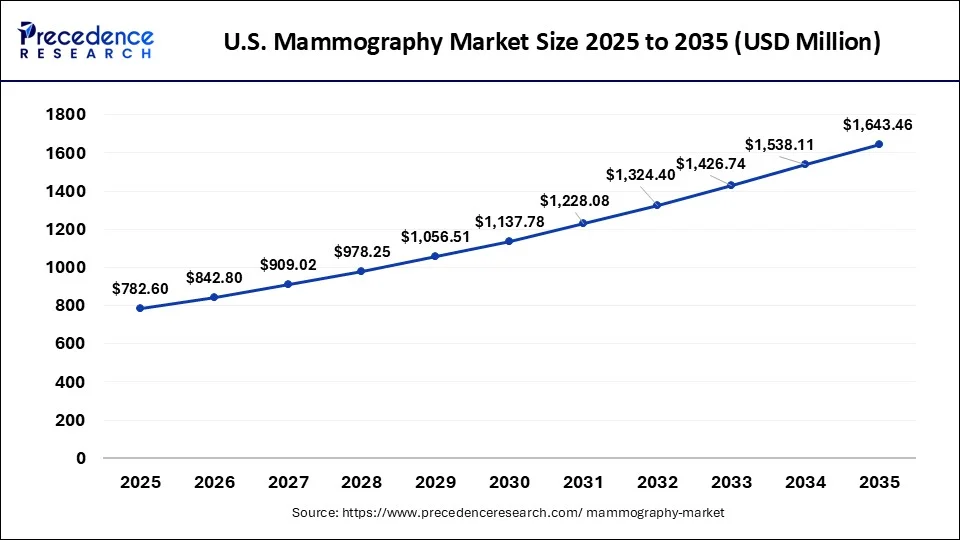
North America dominated the market in 2025. The district is supposed to display an impressive development rate over the conjecture period. The rising frequency of breast malignant growth is one of the main considerations driving the market in the district. Moreover, the presence of profoundly evolved medical services framework and expanding medical services spending are among factors expected to drive the market in the district over the figure period.
U.S. Market Trends
The mammography market in the U.S. is expanding due to growing breast cancer prevalence and technological advancements such as AI and 3D digital breast tomosynthesis. There is a strong focus on AI integration, improving image analysis, shortening reading times, and even enhancing diagnostic accuracy. Moreover, supportive policies and funding for breast cancer screening programs drive market growth in the country.
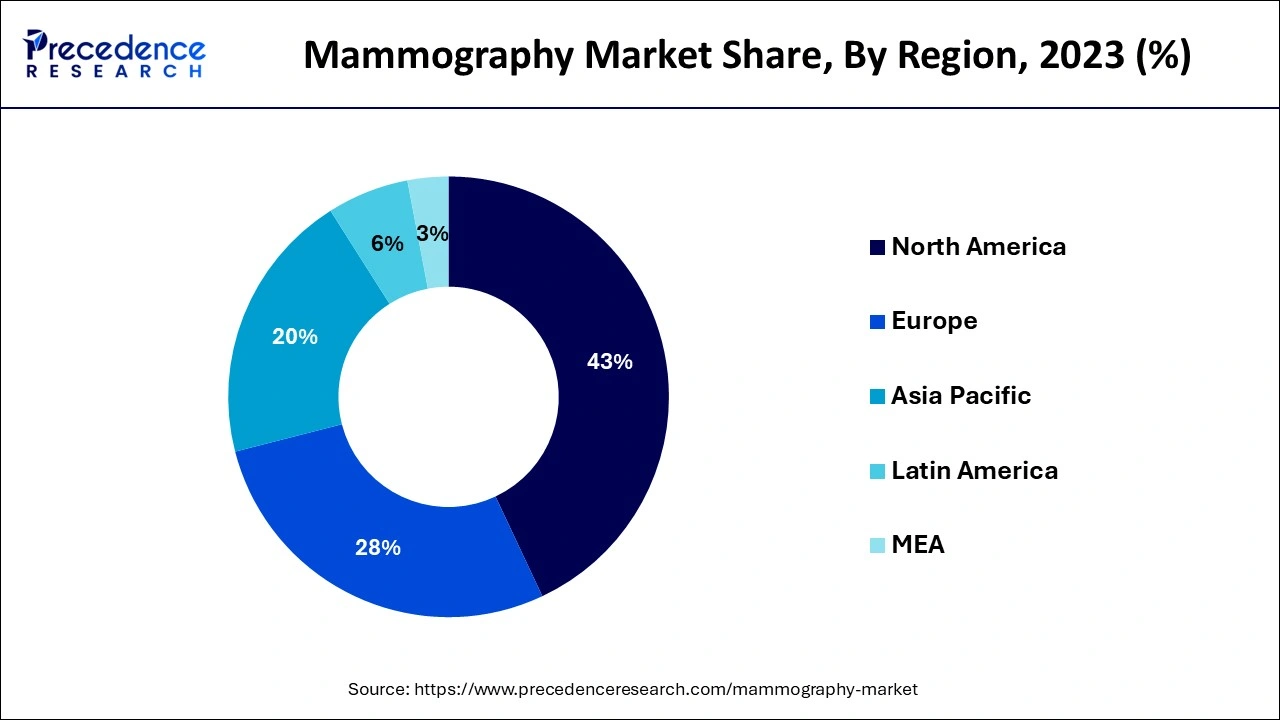
In Asia Pacific, the market is expected to observe the quickest development over the estimate period. The presence of agricultural nations, like China, and Japan, is expected to help market development in Asia Pacific district. What's more, vital participants are putting forth steady attempts to enter developing business sectors of Asia Pacific, as would be considered normal to help the market over the estimate period.
As a result of the rising recurrence of breast malignant growths and rising per capita medical services spending nearby, the mammography market in the Americas is anticipated to overwhelm the worldwide business. Breast cancer is the best reason for mortality in women, as per the World Health Organization (WHO), with north of 2,000,000 new cases analyzed every year.
China Market Trends
China's mammography market is driven by growing breast cancer incidence, government screening programs, and rising awareness of health. There is a rapid shift toward advanced digital and 3D mammography, contributing to market growth. Moreover, the increasing awareness about the importance of early detection among women and investments in diagnostic infrastructure are expected to support market expansion.
Europe's market is extending at a fast speed. This is because of the presence of a deeply grounded medical services framework and rising government motivations for the improvement of creative therapy options and is supposed to introduce the mammography piece of the pie with solid development potential. The presentation of cutting-edge 3D mammography innovation, for instance, has expanded the effectiveness of Breast cancer activities and treatments. The Asia-Pacific market is supposed to create at a consistent rate during the conjecture time frame, inferable from rising patient consciousness of Breast cancer and an expansion in the quantity of government endeavors for medical services change.
Spain Market Trends
The mammography market in Spain is growing due to the rising incidence of breast cancer and strong emphasis on early detection through nationwide screening programs. Government-supported public healthcare initiatives and organized breast cancer screening campaigns are driving regular mammography adoption among women.
How is the Opportunistic Rise of Latin America in the Mammography Market?
Latin America is experiencing an opportunistic rise in the market, driven by increasing breast cancer cases and a shift toward advanced digital and 3D mammography for better diagnostic accuracy, mainly for dense breast tissue. Brazil leads the market in the region, driven by increased awareness about breast cancer and government investments in digital upgrades such as 3D tomosynthesis within its Unified Health System.
Brazil Market Trends
Brazil has been a market leader in the region by furthering public breast cancer screening programs, increasing health care investments, and deploying digital mammography systems on a larger scale. The growing interest in early diagnosis and the advancement of imaging access is positively impacting on the increasing demand.
What Drives the Market in the Middle East & Africa?
The mammography market in the Middle East & Africa (MEA) is primarily driven by government awareness campaigns, rising breast cancer cases, and increasing adoption of advanced imaging technologies. There is a rising adoption of 3D tomosynthesis, supporting market growth. Saudi Arabia is a major player in the regional market, driven by government initiatives for breast cancer screening and remarkable investment in advanced digital technologies such as 3D tomosynthesis, AI integration, and mobile units to enhance detection and access. Strong government backing also encourages the early detection of breast cancer, contributing to market growth.
Saudi Arabia Market Trends
Saudi Arabia is experiencing growth in mammography due to healthcare reforms, increased services for women's health, and funding for national healthcare improvement programs. Rising awareness about the benefits of preventive screening is boosting the use of breast imaging technology.
Value Chain Analysis
- R&D: Mammography systems are developed through research in imaging technology, AI integration, and 3D tomosynthesis. Innovations focus on improving detection accuracy and patient comfort.
- Clinical Trials and Regulatory Approvals: To guarantee safety and diagnostic accuracy, new mammography devices go through clinical testing. Before going on sale, regulatory approvals from health authorities are necessary.
- Packaging and Serialization: Hospitals and diagnostic facilities receive carefully packaged devices. Accurate operation and equipment longevity are guaranteed by proper installation, calibration, and continuous maintenance.
Mammography Market Companies
- Hologic
- Fujifilm
- Siemens Healthcare
- Phillips Healthcare
- Toshiba Medical Systems
- GE Healthcare
- Metaltronica
- I.M.S. Srl
- Koninklijke Philips NV
- Gamma Medica, Inc.
- Konica Minolta Business Solutions India Private Limited
- Carestream Health.
- BMI Biomedical International SRL
- Canon Inc
- MetaltronicaSpA, PLANNED OY
- GENERAL MEDICAL ITALIA
- Villa Systems Medical SpA
Key Market Developments
- In Sep 2025, Hologic, Inc. announced new data on its AI‑powered mammography solution (Genius AI Detection) to be presented at European Society of Breast Imaging (EUSOBI), showing performance comparable to expert radiologists in screening. (Source: Hologic)
- In Sep 2024, Siemens Healthineers launched the Mammomat B.brilliant system, a 3D mammography unit featuring wide-angle tomosynthesis (50 sweep), rapid ~5-second scan time, and AI‑enhanced image reconstruction. Source: Siemens
Segments Covered in the Report
By Product
- Film Screen Systems
- Digital Systems
- Analog Systems
- Biopsy Systems
- 3D Systems
- Others
By Technology
- Breast Tomosynthesis Mammography
- CAD Mammography
- Digital Mammography
By Modality
- Portable
- Non-Portable
By End Use
- Hospitals
- Special Clinics
- Diagnosis Centers
- Ambulatory Surgical Centers
- Educational & Research Institutes
By Geography
- North America
- U.S.
- Canada
- Europe
- U.K.
- Germany
- France
- Asia-Pacific
- China
- India
- Japan
- South Korea
- Malaysia
- Philippines
- Latin America
- Brazil
- Rest of Latin America
- Middle East & Africa (MEA)
- GCC
- North Africa
- South Africa
- Rest of the Middle East & Africa
For inquiries regarding discounts, bulk purchases, or customization requests, please contact us at sales@precedenceresearch.com
Frequently Asked Questions
Tags





Ask For Sample
No cookie-cutter, only authentic analysis – take the 1st step to become a Precedence Research client
 Get a Sample
.webp)



 sales@precedenceresearch.com
 Schedule a Meeting
