



Dx&Vx Expands KRNA Nucleic Acid Stabilisation Programme into Latin America
Published: 25 Aug 2026
Author: Towards Healthcare



The South Korean healthcare organization has signed two material transfer arrangements to evaluate its room-temperature nucleic acid stabilisation technology with isolated and public-sector collaborations.
South Korean pharmaceutical organization Dx&Vx has entered into two material transfer agreements in Latin America for its KRNA room-temperature nucleic acid stabilisation platform.
The arrangements were signed with an Argentine biopharmaceutical organization and a South American public health care institution.
The Argentine collaboration develops and manufactures vaccines, while the public-sector institution manufactures vaccines for distribution in the region and previously participated in COVID-19 vaccine production.
- The characteristics of both organisations were not disclosed.
- KRNA is intended to help long-term stabilisation of nucleic acid-based products at room temperature.
- The platform applies to modalities involving mRNA vaccines, RNA therapeutics, DNA vaccines, aptamers, gene therapies and gene-editing solutions.
- Under the material transfer agreements, the collaboration organisations conduct their own stability testing using internal protocols.
- Dx&Vx said these assessments show a step towards possible licensing agreements if the solution meets the partners’ needs.
The organization completed its agreement with the Argentine organisation about one month after initial discussions at the BIO International Convention in June.
The collaboration with the public health organisation followed around 10 months of technical review.
Dx&Vx has recently signed five KRNA material transfer agreements worldwide, including two in Latin America.
The organization is focused on specific regions where maintaining ultra-cold-chain infrastructure is challenging, with room-temperature nucleic acid stability significantly lowering dependence on specialized storage needs.
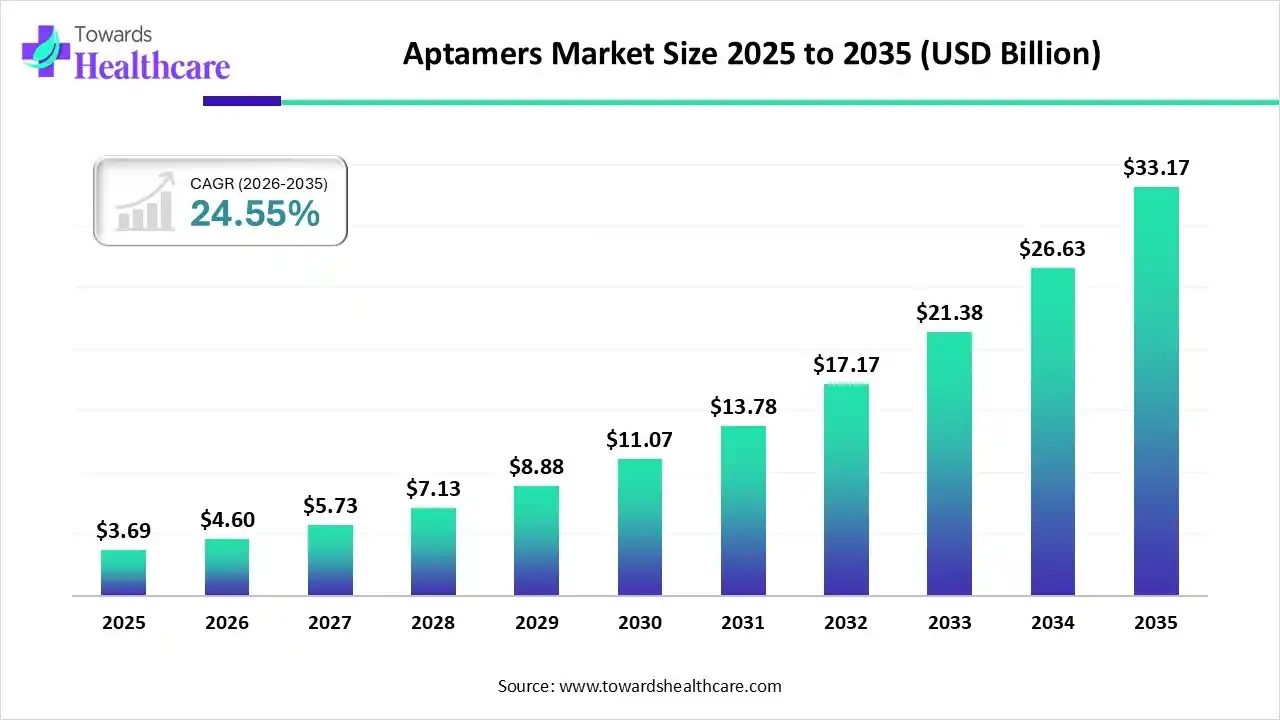
According to Towards Healthcare, the aptamers market is projected to grow significantly, with estimates indicating the market size will increase from USD 4.60 billion in 2026 to approximately USD 33.17 billion by 2035, expanding at a CAGR of 24.55% from 2026 to 2035. Aptamer-based nanomedicine provides a focused, comprehensive strategy for cardiovascular health by tackling different aspects of cardiovascular diseases.
The accuracy of aptamers, integrated with the adaptability of nanosystems, offers a platform for early diagnosis and targeted treatment. Aptamer-driven nanosystems, integrated with signal-amplifying components, allow the development of sensitive biosensors for identifying pathogens, contaminants, and disease biomarkers, providing rapid and precise diagnostics for early disease identification. Aptamers have some benefits over antibodies. They exhibit strong inertness towards non-target cells, which means that specific aptamers have significantly high specificity for their specific molecules. Compared to antibodies, aptamers are smaller, which facilitates their ability to penetrate deeper into tissues and reach intracellular targets. Aptamers provide significant benefits, involving high specificity and stability, simplicity of modification, low immunogenicity, and affordable synthesis, positioning them as viable substitutes to traditional antibodies and small molecules for medicinal interventions.
About Dx&Vx
Dx&Vx is a public Korean biotech company listed on KOSDAQ. Dx&Vx is one of the most significant organizations with uniquely differentiated pipelines and platforms. Dx&Vx is developing highly differentiated pipelines, involving cancer - Oral GLP-1 RA small molecule, dry eye disease: AVI-4015 is a new ophthalmic therapy for Dry Eye Disease (DED) Dx&Vx also owns allow platforms, involving: - Universal Nucleic acids stabilizing platform, Next-generation cell-penetrating peptide platform(ACP) - NGS platform - K-Sensor Beyond R&D, Dx&Vx provides molecular diagnostic products and solution, microbiome-driven health supplements, and distribution of medical care and medical tools in the Korean market. Furthermore, Dx&Vx is advancing a universal COVID vaccine and a universal antiviral therapy (preclinical stage). This parent company, Coree Group, provides additional strategic growth potential in its expanding businesses.
About Aptamers
Aptamers are a promising class of molecules that function as the chemical equivalents of antibodies. They form the basis of biosensors that have become powerful tools for point-of-care analysis. These aptamer-based biosensors enable precise detection of biomarkers and are known for their versatility, stability, and affordability. Applications include early detection of cancer, monitoring chronic diseases, and identifying infectious agents.
A recent report by Towards Healthcare highlights that the aptamers market is growing, as aptamers are widely used in medical and research settings because of their high specificity, flexibility, and ability to bind targeted molecules. They are employed in sensitive detection devices to identify pathogens, toxins, or biomarkers in real-time, aiding point-of-care testing and environmental surveillance. Additionally, they serve as accurate binding probes in laboratory tests and imaging, facilitating disease diagnosis through molecular recognition.