



Union Agriculture Minister Launched AI-Based Farmer Platform Bharat-VISTAAR in Jaipur
Published: 31 Aug 2026
Author: Laxminarayan



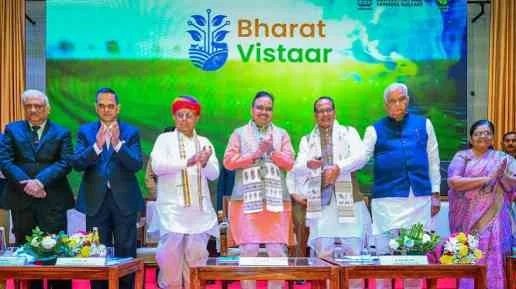
In February 2026, the government of India launched an AI-based farmer platform, Bharat-VISTAAR, in Jaipur. The Union Minister for Agriculture and Farmers Welfare and Rural Development, Shivraj Singh Chouhan. This platform is particularly designed to offer farmers across the country reliable, real-time agricultural information along with advisory support by leveraging its advanced AI technology.
Inside Bharat-VISTAAR
Bharat-VISTAAR not only transforms the information landscape for farmers, but also helps those are previously struggled with a fragmented system dependent on multiple government portals, local offices, and intermediaries for essential updates on weather, pest outbreaks, market prices, and government schemes. This often resulted in time-consuming and confusing experiences, especially for small and marginal farmers with limited digital literacy.
Key Fundamentals of Bharat-VISTAAR
- It provides real-time weather update alerts to help farmers plan irrigation, planting, and harvesting.
- It delivers mandi price information so farmers can make informed sales decisions.
- Pest and disease advisory also provides alerts and advice on managing crop pests and diseases.
- Soil health insights also guide farmers based on soil conditions to enhance fertility and yields.
- Initially available in Hindi and English, with plans to encourage support for many regional languages.
- Farmers can talk to the AI in conversational language for their farm demands.
Government scheme information also covers the benefit status, eligibility, and grievance tracking of various government schemes, including PM-KISAN, PM Crop Insurance Scheme (PMFBY), Soil Health Card (SHC), Modified Interest Subvention Scheme, Sub-Mission on Agricultural Mechanisation, Per Drop More Crop, PM Krishi Sinchayee Yojana, and others.
The platform leverages advanced AI to generate personalized recommendations based on specific conditions, enabling farmers, even in remote areas, to receive expert guidance instantly. The platform's success hinges on expanding language support, improving rural connectivity, and training farmers to use digital tools. Bharat-VISTAAR improves productivity, mitigates challenges, optimizes input usage, and ultimately accelerates profitability, contributing to the significant advancement towards technology-driven agriculture in India.
Impact on the Agricultural Industry
This scheme positively impacts the Agriculture industry by offering a single and reliable source of weather, market rates, insurance, and soil health in their own language, through text- and voice-based communication.
This Bharat-VISTAAR offers a comprehensive, ultimately digital agricultural service through a voice call or mobile app, providing integrated access to weather data, market analytics, pest alerts, soil health advice, and government scheme information in one interface without smartphones to benefit from AI-driven advice. Ultimately, this efficiently connects digital farmer IDs with central initiatives like PM-KISAN and crop insurance for seamless service delivery.
This also helps to address industry limitations by integrating fragmented data sources such as AgriStack, ICAR research, and IMD weather forecasts into a single digital window for information silos with operates through standard phone calls. Furthermore, it addresses the language and literacy challenges by replacing complex text interfaces with voice-first conversational AI for multiple regional languages.
Impact on the Farm Management Software Industry
The global farm management software market size accounted for USD 3.10 billion in 2025 and is predicted to increase from USD 3.53 billion in 2026 to approximately USD 11.32 billion by 2035, expanding at a CAGR of 13.80% from 2026 to 2035.
According to Precedence Research, this platform will significantly benefit the farm management software industry by offering free public data APIs and voice-first tools, transforming commercial software from basic data collection to advanced and value-added crop planning and local advisory execution.
This generally offers an open API ecosystem developing plug official land records, weather, and scheme data directly into commercial apps. This strong shift is pushing software providers away from spending resources on basic data aggregation. Voice-based onboarding through tools helps bridge digital divides, expanding the potential user base for private apps by addressing data fragmentation into a single unified backbone.