



Danaher Accelerates Life Sciences Research with New AI-Powered Autonomous Lab
Published: 13 Oct 2026
Author: Deepa Pandey



Artificial intelligence is transforming life sciences research by helping scientists analyze complex biological data, automate experiments, and accelerate the discovery of new research tools. As pharmaceutical and biotechnology companies seek greater research efficiency, autonomous laboratories are emerging as a promising approach to connect computational intelligence with experimental science.
On October 7, 2026, Danaher Corporation announced plans to launch its first AI-powered of custom antibodies and other molecules tools. The laboratory is expected to operate at scale in early 2027 and will combine artificial intelligence, robotics, and technologies from multiple Danaher businesses.
The company expects the initiative to accelerate affinity reagent discovery by up to eight times and potentially increase annual reagent generation by tenfold as operations scale. The project highlights Danaher’s strategy to integrate AI, automation, and scientific expertise to improve research productivity and support future discoveries.
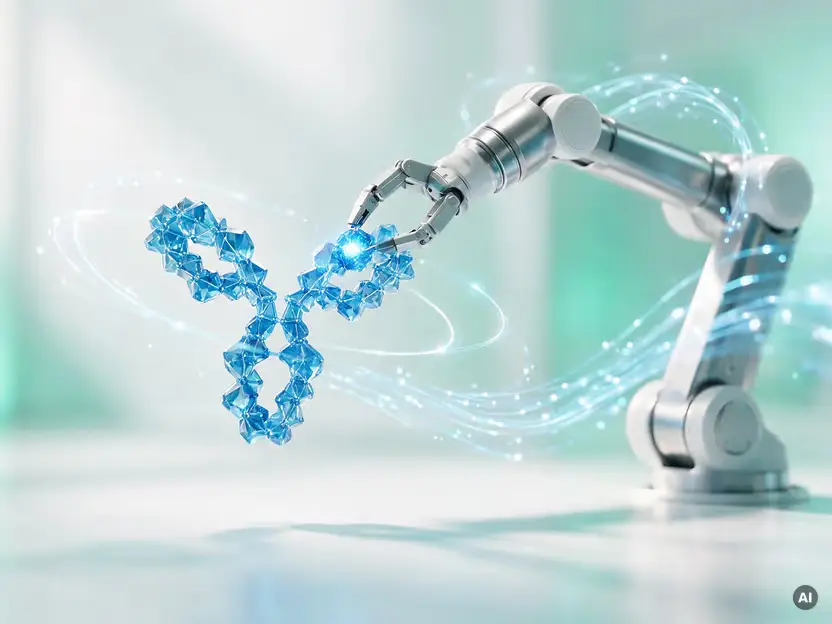
Focus on AI-Powered Autonomous Laboratory Research
The primary objective of Danaher’s initiative is to make scientific discovery faster and more scalable. Traditional laboratory research often involves repeated cycles of designing molecules, conducting experiments, evaluating results, and refining subsequent designs. These activities can require substantial time and resources.
The planned autonomous laboratory will use AI to support the design of affinity reagents, including antibodies that bind to specific biological targets. Robotic systems and connected laboratory technologies will help produce and test these reagents, allowing experimental results to inform subsequent designs.
This integrated approach connects computational prediction with physical experiments. BY reducing manual steps and improving coordination between research activities, the laboratory aims to shorten the discovery cycle and help scientists evaluate more candidates.
The facility will be based at Abcam, a Danaher company. Although automation will support experimental processes, scientific oversight and validation will remain important to ensure the quality and reliability of research outcomes.
Integration of AI, Robotics, and Laboratory Technologies
A major feature of the initiatives is the integration of technologies from several companies within danaher’s life sciences portfolio. The laboratory will combine capabilities from Beckman Coulter Life Sciences, Cytiva, Genedata, Integrated DNA Technologies, and Molecular Devices.
Automata has also collaborated on device orchestration and robotic automation. These technologies are intended to connect laboratory instruments, coordinate workflows, and support consistent experimental processes.
Integrating these capabilities could reduce operational gaps between individual research stages. Connected systems may also help scientists manage experiments, collect structured data, and compare results more efficiently.
The initiatives reflect a broader industry shift toward connected laboratories in which instruments, software, robotics, and analytical platforms operate as part of a coordinated research environment.
Improving Research Speed and Productivity
One of the most significant expectations for the laboratory is the potential to accelerate affinity reagent discovery by up to eight times. Danaher also anticipates a tenfold increase in annual reagent generation as the system scales from producing tens of reagents to hundreds per year.
These figures represent the company’s expected performance targets rather than independently established outcomes across every research application. Actual results will depend on biological targets, experimental complexity, reagent quality, and the effectiveness of the integrated workflow.
Nevertheless, the initiatives demonstrate how laboratory automation could help research increase experimental throughput without compromising scientific standards.
Faster design and testing cycles could allow research teams to investigate more candidates and identify promising molecules earlier. And allocate resources more effectively. The system’s feedback process is also expected to help improve future design using information generated through experimental testing.
Impact of Life Sciences and Biological Research
Autonomous laboratories could influence how pharmaceutical companies, biotechnology organizations, and academic institutions approach early-stage research. Antibodies and other affinity reagents are widely used to investigate biological processes, study proteins, and support diagnostic and therapeutic research.
Faster access to research reagents could help scientists explore disease mechanisms and evaluate biological targets more efficiently. It may also improve the productivity of research programs that depend on specialized molecules.
The initiative could encourage additional investment in AI-enabled laboratory infrastructure. As research organizations seek greater efficiency, systems that connect computational predictions with experimental validation may become increasingly valuable.
However, accelerating reagent discovery does not automatically accelerate drug approval. Pharmaceutical development still requires preclinical studies, clinical trials, safety evaluations, and regulatory review. Danaher's initiative primarily targets research tools and discovery workflows that may contribute to broader scientific progress.
Importance of Data Quality and Scientific Validation
AI-powered research depends on reliable experimental data. Models must be evaluated and refined using information that accurately represents the biological systems under investigation.
Danaher's design-make-test-learn approach is intended to incorporate experimental results into subsequent design cycles. Testing helps researchers assess whether predicted reagents perform as expected and provides information for improving future candidates.
This feedback mechanism could help identify unsuccessful designs earlier and prioritize candidates with stronger experimental potential. Standardized workflows may also support consistency and reproducibility.
However, biological systems remain complex, and AI predictions require appropriate laboratory validation. Results obtained under one experimental condition may not translate directly to another setting.
Maintaining scientific oversight, quality controls, and reliable data management will therefore remain essential as autonomous research technologies develop.
Future Opportunities for AI-Enabled Laboratories
Danaher's laboratory represents an important step toward developing connected scientific systems that combine intelligent software, automated instruments, and integrated research workflows.
Future opportunities may include automated experimental planning, predictive analysis, improved laboratory scheduling, and more efficient interpretation of complex biological data. These capabilities could help research organizations manage larger workloads while reducing repetitive manual activities.
The approach may also encourage collaboration between molecular biologists, data scientists, engineers, and laboratory technology specialists. Combining these areas of expertise could support more adaptable research environments.
Nevertheless, wider adoption will depend on implementation costs, system reliability, compatibility with existing equipment, workforce training, and the quality of generated data. Organizations will need to evaluate these factors when determining whether autonomous laboratories can deliver measurable operational benefits.
Conclusion
Danaher's planned AI-powered autonomous laboratory highlights the growing integration of artificial intelligence, robotics, and life sciences research. Expected to operate at scale in early 2027, the facility will combine technologies from multiple businesses to accelerate custom antibody and affinity reagent discovery.
The company expects discovery to become up to eight times faster, with annual reagent generation potentially increasing tenfold as the laboratory scales. These targets reflect the potential of connected design, production, testing, and learning workflows to improve research productivity.
Although the expected benefits will require validation through implementation, the initiative demonstrates how AI and automation could reshape laboratory operations. As biotechnology and pharmaceutical research becomes increasingly data-driven, autonomous laboratories may play an important role in improving experimental efficiency and supporting future scientific discoveries.