



Googles India-First Agricultural AI Expands Globally
Published: 15 Sep 2026
Author: Laxmi Narayan



In September 2026, Google expanded two India-first agricultural AI models. These models provide granular, timely, and accessible agricultural intelligence for better decision-making by leveraging satellite imagery and machine learning to accelerate India's agricultural monitoring and food security globally.
How Google’s India-First AI is Reshaping Global Agriculture
Google has expanded two agricultural AI models, Agricultural Landscape Understanding (ALU) and Agricultural Monitoring & Event Detection (AMED), developed by Google DeepMind’s AnthroKrishi team, to enhance agricultural intelligence globally. These models leverage satellite imagery, remote sensing, and machine learning to offer detailed insights into India's farming landscape. An Indian farmer leverages a tablet to analyze crop conditions through an AI-powered agricultural dashboard that provides insights on crop health, weather, yield predictions, and water management.
Alok Talekar from Google DeepMind emphasized that these models address gaps in India's agricultural data by focusing on individual farms over district-level information, making agricultural intelligence more accessible and timely. ALU maps agricultural landscapes by identifying features like farm boundaries and water bodies, while AMED monitors crop activities, including key stages like sowing and harvesting.
The system leverages two layers of information to provide real-time agricultural intelligence over just historical assessments
A landscape layer updated every six to 12 months
A crop-monitoring layer refreshed twice a month, with data visualized through Google Earth.
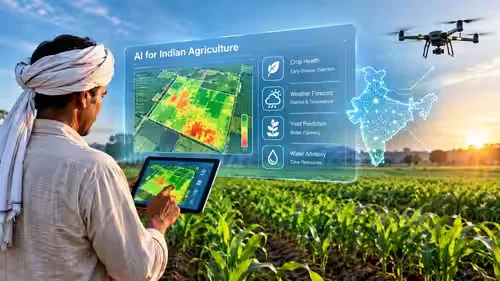
AI can enhance farm decision-making by transforming extensive satellite and agricultural data into precise, field-level information. Overall, AI-generated data supports crop monitoring, irrigation management, weather planning, and agricultural advisories.
In Karnataka, local authorities are using models to manage 2.6 million hectares of irrigated land, while Telangana's Agriculture Data Exchange is leveraging these datasets for digital agriculture initiatives. India's agriculture faces hurdles such as climate uncertainty and increasing costs, making timely information essential. Satellite-based AI also offers equitable data for farms of all sizes by helping governments to allocate resources effectively.
Google's models have practical applications, such as land-record digitization and crop monitoring, with partnerships extending beyond research.
Organizations like TerraStack and CarbonFarm are already integrating satellite data for farming applications. Google's initiative envisions a shift from periodic assessments to continuous field-level intelligence, with data updated roughly every 15 days.
However, challenges such as data quality and technology adoption remain. Collaborations with governments and organizations are essential to build a foundational digital infrastructure, potentially extending beyond India to enhance agricultural resilience and food security globally.
Impact on Agriculture Industry
These agricultural AI models positively impact the agriculture industry by turning high-resolution satellite imagery and remote sensing into actionable and field-level data.
Google’s ALU and AMED models build a spatial intelligence platform transforming fragmented land, crop, and income data into actionable intelligence for every farm in India. Together, these innovations develop a stronger digital foundation for agricultural services and innovation across Telangana to adopt climate-resilient techniques. Additionally, programs like low-carbon rice farming use these APIs to track water management and verify methane reductions.
This also helps to address industry limitations such as the lack of clean, digitized farm records by automating land and crop mapping through space-based data rather than manual surveys. That offers clear visibility at an individual field level with the help of hyper-fragmentation. Climate vulnerability also supports stakeholders in responding faster to erratic monsoons and localized weather changes with data-backed advisories, while reducing expenses by offering remote verification for subsidies and insurance claims.
Impact on the Generative AI in Agriculture Industry
The global generative AI in agriculture market size was worth around USD 269.78 million in 2025 and is predicted to increase from USD 337.28 million in 2026 to approximately USD 2,361.99 million by 2035, growing at a CAGR of 24.23% over the forecast period from 2026 to 2035.
According to Precedence Research, these models significantly benefited the industry by offering foundational spatial data that powers precise and automated farm-level insights.
Generative AI tools like Gemini leverage structured data from ALU and AMED to convert raw satellite imagery into accurate farm advisories. Financial institutions leverage these data layers for remote assessments of land and crop health, streamlining micro-loans and credit approvals for underserved farmers. These tools not only automate complex workflows to map field boundaries but also calculate low-carbon farming metrics without human intervention.
These tools also address challenges like fragmented data by automatically mapping farm borders and natural features from space, eliminating the need for costly field visits. AMED also offers dynamic updates on crop growth and harvesting every 15 days for real-time insights into seasonal changes. Initially developed for India, these models have successfully scaled to 11 countries across Africa and Asia Pacific, demonstrating the global potential of agricultural AI.
About Google
Google is a multinational technology corporation focused on information technology, online advertising, search engine technology, email, cloud computing, software, quantum computing, e-commerce, consumer electronics, and AI. The company's business areas involve advertising, search, platforms and operating systems, and enterprise and hardware products.
Its portfolio of products and services includes Google Search, Google Chrome, Google Calendar, Google Docs, Google Drive, Google Photos, Google Meet, Google Finance, Google News, Google Play Books, Google Earth, Google Ad Manager, Google Play, AdMob, Google Maps, AdSense, Gmail, Google Groups, and YouTube. Its overall goal is to advance AI to improve how billions of people access knowledge, communicate, work, and solve complex global challenges, mainly ranging from healthcare breakthroughs to sustainable technology.