



Food is Medicine NITI Aayog Member Dr Srinivas Calls for Nutrition and Lifestyle to Become Core Clinical Competencies at AIIMS National Symposium
Published: 17 Aug 2026
Author: Towards Healthcare



Dr. M. Srinivas, Member of NITI Aayog, advised that nutrition, diet, and healthy lifestyle choices become core healthcare competencies in undergraduate health education to establish a preventive and patient-driven healthcare system.
Calling for a significant transformation in healthcare delivery, Dr. M. Srinivas, Member, NITI Aayog, urged that nutrition, diet, and lifestyle be integrated into mainstream clinical solutions and undergraduate healthcare education.
Tackling the creating session of the national symposium "Lifestyle & Diet: Nutrition, Wellness and Clinical Practice", organised by the Department of Physiology, AIIMS New Delhi, in association with the Food Future Foundation (FFF) under the aegis of the Coalition for Food Systems Transformation in India (CoFTI), Dr. Srinivas greeted the participation of experts from varied disciplines, noting that cooperative dialogue is significant to address India's evolving nutrition challenges. He called for nutrition, diet, and healthy lifestyle education to be suitably integrated into healthcare curricula, saying it is significant to prepare future medical care professionals and strengthen preventive health care. He also urged stakeholders to work together to strengthen nutrition and lifestyle education and contribute practical recommendations for a more holistic strategy approach to enhancing the nation's health.
The symposium brought together leading clinicians, nutrition scientists, medical educators, regulators and policymakers, including Dr. Nikhil Tandon, Director, AIIMS New Delhi; Dr. Govind Makharia, Associate Dean, AIIMS New Delhi; and Mr. Pawan Agarwal, Founder and CEO, Food Future Foundation and Former CEO, FSSAI, to discuss how evolving scientific evidence should reshape healthcare education and healthcare solutions. A major highlight was the release of the textbook Nutrition, Diet & Lifestyle: Learning and Teaching Diet, Food, Nutrition & Lifestyle in Clinical Practice, edited by Dr. Raj Kumar Yadav, Dr. Alexander Thomas, and Mr. Pawan Agarwal and developed by a team of nutrition and lifestyle experts led by senior nutritionist Parisksha Rao.
In the foreword to the book, Dr. Srinivas writes that "scientific evidence now leaves little doubt that food, nutrition and lifestyle are among the most powerful determinants of health," yet these subjects receive "far less attention in undergraduate medical education than they deserve." Describing nutrition as "an essential clinical competency for every doctor," he said the textbook integrates physiology, nutrition and lifestyle medicine to help future physicians understand how everyday food and lifestyle choices influence health, disease and patient care, and expressed confidence that it would become "a catalyst for strengthening nutrition and lifestyle medicine across medical education in India."
Dr. Ratna Sharma, Head, Department of Physiology, AIIMS, said development in nutrition science and lifestyle therapeutics needs a corresponding transformation in healthcare education. Dr. Raj Kumar Yadav, Professor of Physiology and lead editor of the textbook, said doctors must increasingly integrate healthcare management with nutrition and lifestyle counselling as part of routine patient care. Prof Sheffali Gulati and Prof Vandana Jain delivered their talks focusing on paediatric age group dietary therapy in epilepsy, autism, obesity, and metabolic dysfunction. Prof Naval K Vikram discussed skeletal muscles and metabolic health. Dr Ritesh Netam presented his research about high-fat diet, obesity, and neuroinflammation.
A significant scientific session identified healthier food reformulation and the role of monosodium glutamate (MSG) in lowering sodium without compromising taste. Dr. Miro Smriga, Chairman, International Glutamate Technical Committee (IGTC), shared international experiences demonstrating how evidence-driven reformulation is supporting improved public health in major countries. Prof HN Mallick discussed MSG, and Dr Trina Sengupta presented findings from a recent systematic review published in Frontiers in Nutrition, concluding that MSG is safe for the general population, involving infants, pregnant women, and breast-feeding mothers.
Major renowned faculty, physicians & scientists were present during the symposium and actively participated involving Prof Girija Prasad Rath (AIIMS), Prof Rajesh Khadgawat (AIIMS), Dr SubbaRao MG, (Scientist G, National Institute of Nutrition, ICMR), Ms Anuja Agarwala (Senior Dietitian), Prof Vimal Katiyar (IIT, Guwahati), Prof Jamuna Prakash (University of Mysore), Prof Komal Chauhan, Prof Seema Puri, Prof Eram S Rao (University of Delhi) and Prof Pulkit Mathur (Lady Irwin College).
Mr. Pawan Agarwal, Founder and CEO, Food Future Foundation, said the symposium marks the beginning of a larger national effort to bridge the long-standing gap between nutrition science and healthcare medicine.
The symposium concluded with a wide consensus that strengthening nutrition and lifestyle therapeutics in healthcare education is significant for building a more preventive, patient-centred, and wellness-oriented healthcare technology in India.
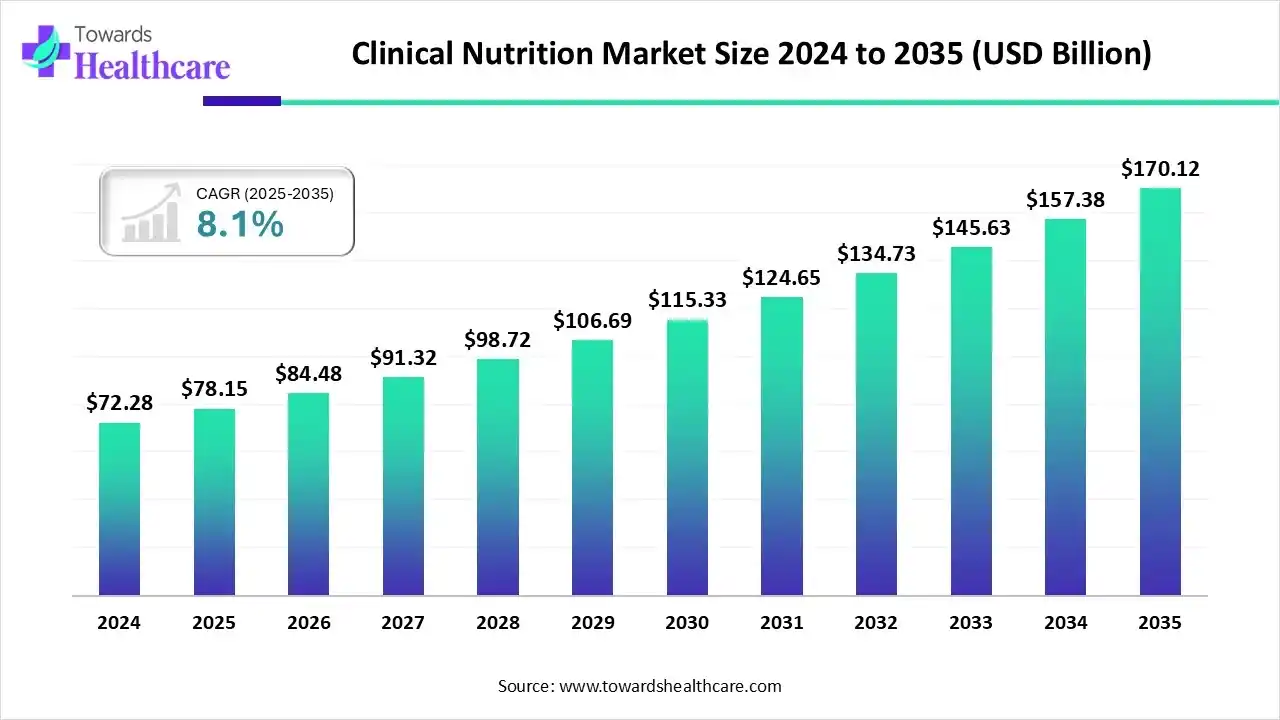
According to Towards Healthcare, the clinical nutrition market is projected to grow significantly, with estimates indicating the market size will increase from USD 84.48 billion in 2026 to approximately USD 170.12 billion by 2035.The market is growing at a CAGR of 8.1% between 2026 and 2035.Clinical nutrition is a significant part of a healthy lifestyle. It involves assessing nutritional requirements based on individual health aims, healthcare conditions, and lifestyle. The significant aim is to ensure the body receives the right nutrients in the right amounts to support growth, repair, and overall health. Clinical nutrition is a significantly emerging sector of interest for doctors and patients, with novel technology and feeding formulas continually being advanced. The maintenance of precise nutrition in patients with acute and chronic illness is well recognized as a significant part of medical and surgical care. Clinical nutrition is a significant part of care. Critical artificial nutrition has evolved from a helpful device in a therapy that needs close attention and monitoring.
About Kukje Pharma
NITI Aayog serves as the Government of India’s apex strategy tank, mandated to offer directional and policy inputs. It was constituted via a resolution of the Union Cabinet dated 1st January 2015. In addition to formulating long-term approaches, policies, and programmes for the Government of India, NITI Aayog provides strategic and technical advice to the Centre, State Governments, and Union Territories. It functions as an institutional platform to foster cooperative federalism by driving collaborative engagement in the States in pursuit of national advancement objectives. NITI Aayog could evolve as an agent of change over time and contribute to the government’s agenda of enhancing governance and realizing innovative measures for better delivery of public solutions.
NITI Aayog continues to be representative of an efficient, transparent, innovative, and accountable governance system in the country with distinguished work ethics.
A recent report by Towards Healthcare highlights that the clinical nutrition market is growing, as clinical nutritionists support patients in understanding how food interacts with therapeutics, helps immune function, and influences disease development. Clinical nutrition plays a significant role in managing chronic conditions such as diabetes, heart disease, and obesity. It supports controlling blood sugar levels, reducing cholesterol, and managing weight efficiently. Clinical nutritionists ensure patients receive the right balance of macronutrients such as carbohydrates, proteins, and fats, and micronutrients (vitamins and minerals) to maintain health and prevent deficiencies. A significant aspect of clinical nutrition is educating patients about healthy eating habits, portion control, and the impact of different foods on their health. Healthcare nutrition focuses on endorsing a healthy gut microbiome, which is linked to enhanced digestion, an advanced immune system, and even mental health.