



Raythink Showcases Gas Leak Detection Solutions for the Oil & Gas Industry at OGA 2026
Published: 09 Sep 2026
Author: Laxmi Narayan



In September 2026, Optical Gas Imaging (OGI) cameras detect gas leaks by capturing infrared radiation absorbed or emitted by specific gases within their spectral bands. Unlike conventional point gas detectors, an OGI camera can visualize gas plumes from a distance in real time, allowing operators to identify potential leaks without direct contact with the source.
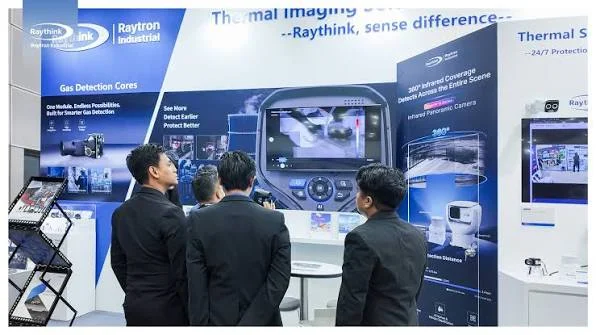
Raythink has combined high-performance gas detection cores and detectors with AI-powered recognition algorithms to enhance gas leak detection sensitivity and inspection efficiency. Its AI cloud coloring technology enhances the visibility of gas plumes against complex backgrounds, helping operators quickly identify and locate potential leakage points. Raythink solutions also support multi-platform data integration, thus enabling inspection data from different devices and platforms to be combined for a more comprehensive analysis.
The GT260 fixed gas detection camera can also be equipped with an explosion-proof enclosure, enabling 24/7 continuous monitoring over a wider area. It helps operators identify potential gas leaks across pipelines, valves, storage tanks, and other high-risk assets, reducing the need for frequent manual inspections. Handheld OGI cameras, including the RG630 Series, provide flexible on-site inspection capabilities for routine maintenance.
Impact on the Chemical Market
For the oil and gas industry, Raythink helps to provide a multi-level gas leak detection solution covering fixed monitoring, explosion-proof gas detection, handheld inspection, and robotic inspection, addressing the diverse inspection and safety requirements of oil and gas facilities. For large-scale facilities and hard-to-access or potentially hazardous areas, Raythink's gas imaging cores and detectors can also be integrated with robotic platforms to support remote inspection and gas leak detection.
By enabling inspection in areas that may be difficult or unsafe for personnel to access, these solutions can help expand inspection coverage while reducing personnel exposure to hazardous environments.
Impact on the Gas Leak Detectors Market
The global gas leak detectors market size was calculated at USD 2.03 billion in 2025 and is predicted to increase from USD 2.15 billion in 2026 to approximately USD 3.57 billion by 2035, expanding at a CAGR of 5.82% from 2026 to 2035.
According to Precedence Research, the market is growing rapidly as industries and households increasingly adopt advanced detection systems to ensure safety, prevent accidents, and comply with stringent environmental and regulatory standards. Ongoing advancements in sensor technology are significantly transforming the gas leak detectors market by making systems more accurate, intelligent, and reliable. The integration of artificial intelligence also enables real-time data analysis, early fault detection, and reduced false alarms, improving overall safety and efficiency. Advanced sensors such as infrared, electrochemical, and laser-based technologies provide faster response times and higher sensitivity.
Additionally, IoT-enabled and wireless detectors also allow remote monitoring through cloud platforms, while portable wearable and even broad-mounted gas detection systems are used in high-risk industries like oil and gas and mining. These innovations are enhancing precision, connectivity, and worker safety, making modern gas detection solutions an essential part of industrial and environmental protection strategies.
Impact on the Fixed Fire and Gas Detection Systems Market
The fixed fire and gas detection market is shifting toward a connected, intelligent, and integrated safety architecture to enhance hazard identification and emergency response. Industrial facilities are increasingly linking together fixed gas detectors, flame detectors, fire detection systems, safety logic controllers, software applications, monitoring platforms, and communication technologies.
According to Precedence Research, due to the demand for enhanced detection performance, reduced maintenance needs, and reliability, the market is moving towards open path detection, wireless transmission, infrared, and software-based detection technologies by operators. Modernization of ageing industrial infrastructure, expansion of investment in facilities for hazardous processes, and increased integration of fire and gas systems are all influencing the market.
These advancements further reflect the industry's transition to integrated sensing, constant monitoring, predictive maintenance, and innovative detection systems. There are also retrofits and upgrades, offshore/onshore facilities, data centers, manufacturing facilities, oil & gas facilities, and other high-hazard industrial facilities in the market.