



Fixed Fire and Gas Detection Systems Market Trends, Companies, Revenue / Sales Performance, Production Capacity, Equipment Utilization, Pricing Analysis, Distribution Performance, Competitive Landscape, and Demand Forecast
Laxmi Narayan is an industrial safety and detection systems market research analyst. His research continuously tracks adoption of fixed fire and gas detection, hazardous-environment protection technologies, integration of fire and gas architectures, industrial end-use demand, retrofit activity, and requirements for fire and gas. His analysis is useful for detection-system manufacturers, industrial operators, engineering contractors, and safety technology providers for not only competitive benchmarking, but also for strategic planning. The fixed fire and gas detection systems market is estimated to reach USD 7.12 billion by 2035.
Source: https://www.precedenceresearch.com/fixed-fire-and-gas-detection-systems-market
 Get a Sample
 Table Of Content


Fixed Fire and Gas Detection Systems Market Trends, Growth and Market Size Analysis
The fixed fire and gas detection market is shifting toward a connected, intelligent, and integrated safety architecture, says Laxmi Narayan, to enhance hazard identification and emergency response. Industrial facilities are increasingly linking together fixed gas detectors, flame detectors, fire detection systems, safety logic controllers, software applications, monitoring platforms, and communication technologies. Due to the demand for enhanced detection performance, reduced maintenance needs, and reliability, the market is moving towards open path detection, wireless transmission, infrared, and software-based detection technologies by operators.
The fixed fire and gas detection market is valued at USD 7.60 billion in 2026 and is extimated to reach around USD 13.67 billion by 2025 growing at 6.74% CAGR between 2026 to 2035.
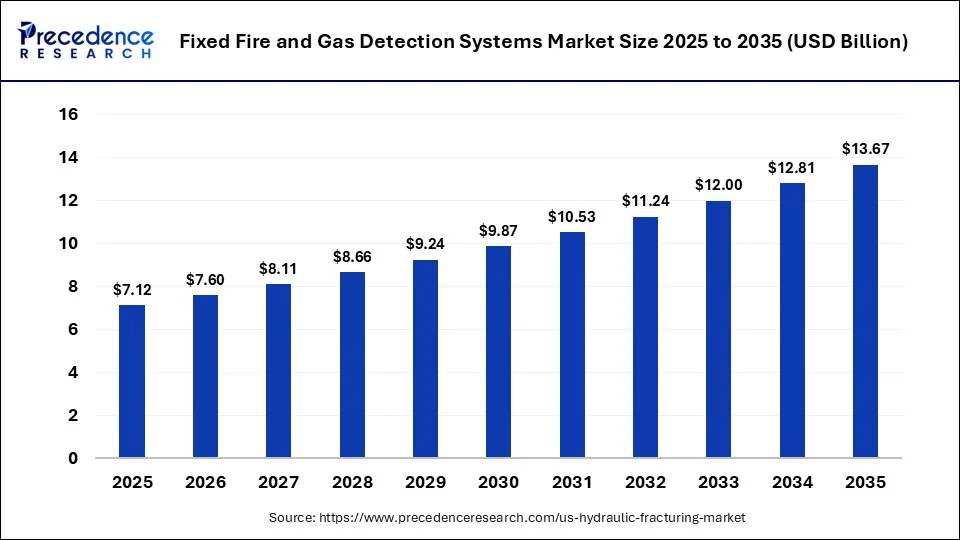
Modernization of ageing industrial infrastructure, expansion of investment in facilities for hazardous processes, and increased integration of fire and gas systems are all influencing the market. The changes in the offerings of major suppliers illustrate this shift towards digital smoke and gas alarms. MSA Safety unveils the acquisition of Autronica Fire and Security, Siemens introduces cloud-connected Nova-generation fire detection equipment, and Honeywell is introducing an NDIR hydrocarbon gas sensor. These advancements reflect the industry's transition to integrated sensing, constant monitoring, predictive maintenance, and innovative detection systems.
There are also retrofits & upgrades, offshore/onshore facilities, data centers, manufacturing facilities, oil & gas facilities, and other high-hazard industrial facilities in the market. The growing significance of connected and digital safety infrastructure is evidenced by the fact that fixed fire and gas detection systems are growing at 6.74% CAGR, and the Asia-Pacific region is the fastest-growing opportunity with a 33% market share in 2035.
Key Takeaways
- By end user industry, the oil and gas segment led the market with a 38% share in 2025.
- By connectivity type, the wired segment captured a major revenue share of 71% in 2025.
- By component, the detectors and sensors segment captured the largest fixed fire and gas detection systems market share of 44% in 2025.
Fixed Fire and Gas Detection Systems Market Companies
| Company | Headquarters | Role in Market | Strategic Relevance |
| Honeywell | Charlotte, North Carolina, US | Major/incumbent | Broad portfolio spanning Searchline open-path detectors, Sensepoint fixed gas detectors, XNX transmitters, FS24X/FSX flame detectors, and NOTIFIER fire alarm systems; recently launched NDIR gas-sensing technology. |
| MSA Safety | Cranberry Township, Pennsylvania, US | Major/incumbent | Portfolio includes Ultima X5000, General Monitors S5000, FL5000 flame detector, IR5500 open-path detector, and HazardWatch integrated platform; expanded via the 2026 Autronica acquisition. |
| Siemens | Munich, Germany | Major/incumbent | Cerberus and Sinteso fire-safety portfolios; recently introduced cloud-connected Nova-generation detectors with predictive maintenance capability. |
| Emerson | St. Louis, Missouri, US | Major/incumbent | Rosemount and Spectrex flame and gas detection portfolio, including wireless flame & gas detection products. |
| Dräger | Lübeck, Germany | Major/incumbent | Fixed gas detection and flame detection systems (Polytron, Flame 2700) with modular, expandable controller architecture; strong process-industry presence. |
| Det-Tronics | Minneapolis, Minnesota, US | Specialist/SME | Specialized fixed flame and gas detection technology for high-hazard industrial applications; part of Spectrum Safety Solutions. |
| Crowcon Detection Instruments | Abingdon, UK | Specialist/SME | Fixed and portable gas detection instruments for industrial safety applications. |
| Autronica Fire and Security | Trondheim, Norway | Specialist/SME (acquired by MSA Safety, 2026) | Fire detection, gas detection, and alarm systems for maritime, oil & gas, and infrastructure sectors. |
| International Gas Detectors (IGD) | Poole, UK | Specialist/SME | Fixed gas detection technology for industrial applications. |
| Micropack | Aberdeen, UK | Specialist/SME | Flame and gas detection systems for hazardous-area industrial applications. |
Recent Developments
July 9, 2026-MSA Safety: Completed acquisition of Autronica Fire and Security
- What Happened: MSA Safety finalized the sale of its roughly $555 million cash purchase of Norwegian company Trondheim-based Autronica Fire and Security. Its sales were around $160 million in 2025, and it is specialized to solutions for fire and gas detection and alarm, which are typically used in maritime, oil and gas, infrastructure, as well as industrial applications.
- Why It Matters: Sweetens MSA's installed base in the fixed detection market and boosts addressable market in the critical infrastructure, energy, and marine sectors. It also gives MSA a more integrated involvement in the design phase of projects since it offers more in-built fire and gas safety solutions.
- Business Impact: Growing consolidation in the fixed detection market is reflected through the deal. It's clear from the bids that MSA is willing to spend around three and a half times as much as Autronica's expensive 2025 sales, indicating how strategic special detection businesses have turned out to be for big industrial safety firms.
Source: MSA Safety press release / SEC Form 8-K, July 9, 2026
March 27, 2026 - Siemens Smart Infrastructure: Unveiled Sinteso Nova and Cerberus Nova cloud-connected fire detector portfolio
- What Happened: Siemens introduced Disturbance-Free Testing, 24/7 automated self-checks, Smoke Entry Supervision, and cloud connectivity with its Building X Fire Apps, which now deliver a new generation of fire detectors. The portfolio enables remote diagnostics and prognostics.
- Why It Matters: The launch marks a move away from traditional periodic manual testing and towards continuous and self-monitoring detection mechanisms in the industry. It also provides solutions to current issues experienced with false alarms, maintenance, and system reliability.
- Business Impact: Engel Software and other major vendors are getting tougher in the software, connectivity, and monitoring arena. This helps the expansion of the Software & Monitoring Systems segment at a 9.8% CAGR.
Source: Siemens press release, March 27, 2026; Fire & Safety Journal Americas
March 23, 2026 - Honeywell: Launched 4-Series NDIR Hydrocarbon Gas Sensor
- What Happened: Honeywell introduces a new optical non-dispersive infrared (NDIR) gas sensor for flammable gases like methane, propane, and butane. Designed for higher levels of resistance to poisoning than traditional catalytic-bead sensors, the sensor is targeted toward mining, oil and gas, petrochemical, and plastics manufacturing applications.
- Why It Matters: The introduction resolves issues of unproven reliability and false positive rates from traditional catalytic-bead technology. It also enables an 8.3% CAGR growth rate in the industry's transition from catalytic-bead technology to infrared detection, which is growing at 5.0%.
- Business Impact: The development consolidates the current technology evolution from traditional catalytic sensing towards infrared and optical sensing. Existing vendors are making more efforts to build research and development on new sensing platforms.
Source: Honeywell press release, March 23, 2026
December 2025 - Honeywell: Multi-year Official Building Automation Partnership with Hornets Sports & Entertainment
- What Happened: Installation of Honeywell Spectrum Center building management, smart fire detection solutions (XLS4000), unified security, access control, and integrated building automation systems will be installed in the Spectrum Center and Novant Health Performance Center.
- Why It Matters: The project demonstrates the application of intelligent detection and automation technologies in commercial environments and can support the development of similar technologies for use in industrial fire & gas applications.
- Business Impact: The partnership is a testament to the ability of large vendors to develop AI-based detection solutions, as well as deliver and commercialize them at scale in the commercial, institutional, and industrial sectors.
Source: Honeywell announcement, December 2025, as reported by MarketsandMarkets vendor research
March 11, 2024 (effective May 10, 2024)-U.S. EPA: Finalized the Safer Communities by Chemical Accident Prevention rule
- What Happened: EPA finalized changes to the Risk Management Program at 40 CFR Part 68 that increase requirements for facilities in Safer Technologies and Alternatives Analysis related to the highly hazardous materials they contain. The rule does not replace but runs parallel to, and shares some similar components of, OSHA's PSM standard.
- Why It Matters: The changes reinforce the covered facilities' hazard analysis and safety-safeguard evaluation requirements. Fixed fire/gas detection systems can assist in meeting these safety and compliance needs.
- Business Impact: The regulations will have a positive effect on the demand for fixed detection systems that are based on compliance. Higher compliance needs can stimulate replacement and upgrading investment even with moderate levels of industrial growth.
Source: U.S. EPA, Safer Communities by Chemical Accident Prevention Final Rule, March 11, 2024
Effective January 26, 2024-U.S. OSHA: Issued updated Process Safety Management enforcement directive
- What Happened: OSHA changed its 1994 instructions for enforcing the PSM portion of the 29 CFR 1910.119 standard to a Q&A format to clarify interpretations of the standard. It came after OSHA had reviewed the regulations for Process Safety Management.
- Why It Matters: There is more clarity in the revised guidance regarding process-safety expectations, such as detection of hazards, and emergency-response requirements that rely on fixed fire and gas detection systems.
- Business Impact: An enforceable expectation will provide relief to covered facilities and promote investments in investments related to facility safety and detection.
Source: OSHA enforcement directive, effective January 26, 2024, as reported by AIHA
Top Strategic Insights
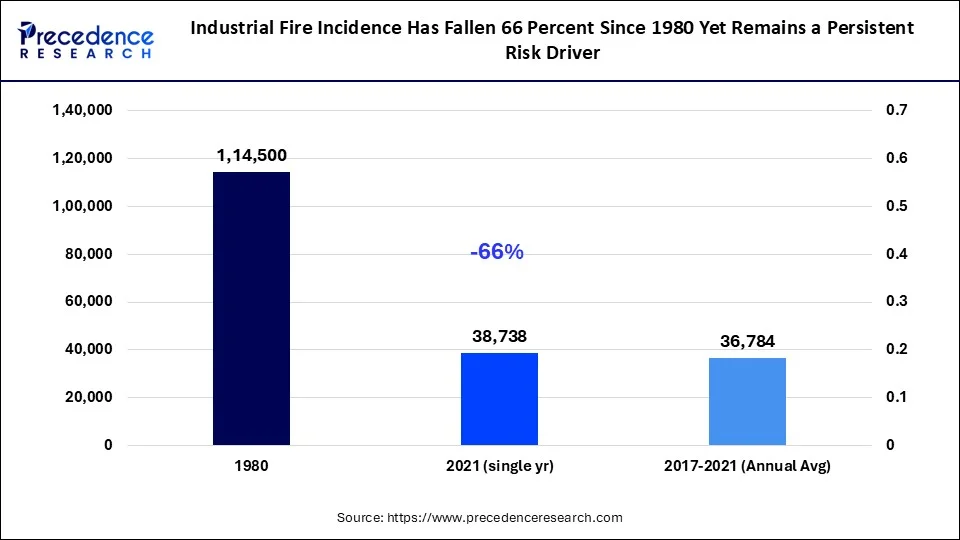
Industrial Fire Incidence Has Fallen 66% Since 1980, Yet Remains a Persistent Risk Driver
Source: Precedence Research Database
The estimated annual fires at U.S. industrial and manufacturing properties from 1980 to the last 5-year reporting period and the drop are indeed staggering just by looking at the figure. By itself, the 2017-2021 period averaged just 36,784 annual incidents, a 66% drop from 1980, which resulted from decades of code tightening, sprinkler requirements, and standpipe (detection) system installation in the U.S. industry. By itself, a 66% reduction appears to be a problem whose size is getting smaller towards zero. It's hardly a problem to displace with this sustained effort, even though it has come down from nearly 37,000 industrial fires reported annually in the U.S. alone.
- Key Insight: An estimated 37,000 incidents per year have persisted for decades despite decades of code tightening and detection deployment, indicating an ongoing market for these replacements and upgrades, not a build-out.
False Alarms Outnumber Genuine Fire Alarms by Roughly Two to One
Source: NFPA 72 / NFIRS data, cited in Consulting-Specifying Engineer, "Alarm Fatigue and Life Safety: Improving Fire Notification"
According to data from the U.S. National Fire Incident Reporting System. In total, alarms are about 66.7% false or unwanted, and 33.3% are genuine, which means that skydivers are statistically more likely to find a false or unwanted alarm than a real one when they go to operate a fire alarm on a facility. That imbalance is not simply an inconvenience.
Alarm fatigue, the adaptation of operators to alarms due to repeated false alarms, is not only a known safety failure mode but is related to a slow response to a true alarm. One large reason detection vendors over the last ten years have been driving multi-sensor and AI-powered detection technology specifically targeting false-positive reduction. That becomes evident in the connectivity and components segment.
- Key Insight: Alarm fatigue risk is probably as big a safety issue as detection coverage gaps, and that is simply the business case of the fastest-growing sub-segments of the market, both of which are geared toward high alarm reliability.
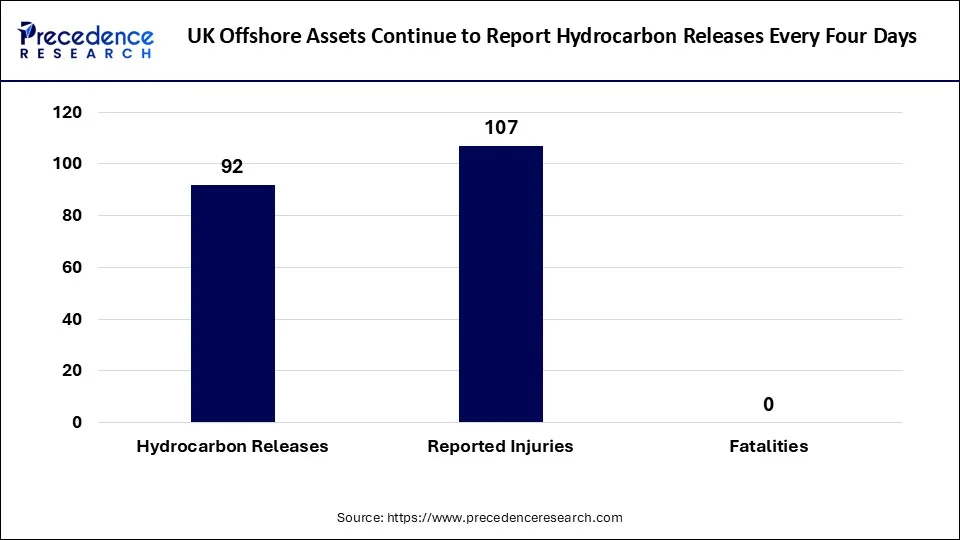
UK Offshore Assets Still Report Hydrocarbon Releases Every Four Days
Source: UK Health and Safety Executive (HSE), Offshore Statistics and Regulatory Activity Report 2024
This map shows the offshore hydrocarbon releases, injuries, and fatalities by the UK Health and Safety Executive for the 2024 UK Continental Shelf offshore safety statistics. In 2024, a total of 92 hydrocarbon releases were documented on the UK Continental Shelf, which equates to approximately 1 every 4 days, with 107 injuries and zero deaths reported for the year.
Around 92 loss-of-containment events with zero deaths is an unequivocal positive safety metric. Aman believes this gives a veritable true picture of how well today's offshore facility detection and automatic shutdown barriers perform. But this release level isn't shrugged off, and it isn't zero either, and even when well contained safely nearly all the time, those releases, as this report's regional data demonstrates, continue to compound at 7.5% a year, well ahead of onshore's 6.4%.
- Key Insight: If no one has ever lost their life, and 92 loss-of-containment events suggest effective detection and shutdown mechanisms, it is not too late to invest in offshore fixed gas detection. The residual risk continues to make the investment worthwhile compared to onshore investment.
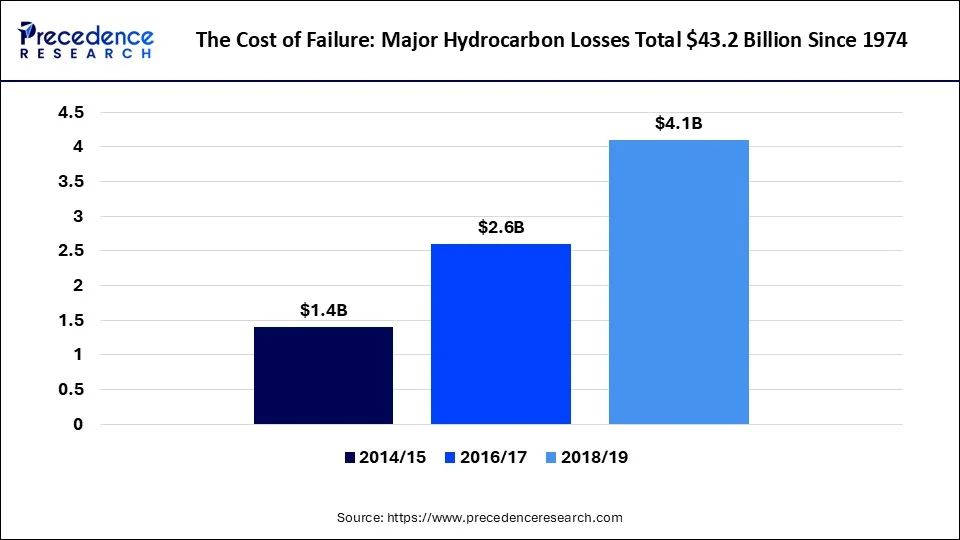
The Cost of Failure: Major Hydrocarbon Losses Total $43.2 Billion Since 1974
Source: Marsh, "100 Largest Losses in the Hydrocarbon Industry" (26th-27th editions)
The graph depicts the 100 largest losses in the hydrocarbon industry, by property damage, across three reporting periods over the past 2 years. New entries added USD 1.4 billion in property damage during 2014 and 2015, USD 2.6 billion during 2016 and 2017, and USD 4.1 billion during 2018 and 2019, bringing the full cumulative total across all one hundred listed loss events since 1974 to USD 43.2 billion.
The figures are just land when they are compared with the real cost of a detection system. A large process unit (LP) is equipped with a complete fixed fire and gas system that costs millions of dollars in the low range, and one of the events on this list can run to the hundreds of millions of dollars or even billions. It's not the cost of the detection gear per se, but that asymmetry that should be the determining factor for most capital-allocation discussions in determining if the purchase is worth it.
- Key insight: The capital-argue price for detection capex is not the price of the detection system, but rather it's the cost of losing a single qualifying fire or gas loss event. The magnitude of the capital-argue is in the low eights, millions of dollars vs hundreds of millions to billions for a single event.
Fixed Fire and Gas Detection Sits at the Center of Three Overlapping Regulatory Regimes
Source: Precedence Research Database
Aditi interpreted that this chart provides a graphical overview of three key regulatory/global standards regimes that intersect fixed fire and gas detection as a required control. Namely, US OSHA Process Safety Management under 29 CFR 1910.119, the EU's Seveso III Directive 2012/18/EU, and the globally applied IEC 61508 and IEC 61511 functional-safety standards. Each regime is administered at different facilities, and each is administratively independent of the other two.
OSHA applies to U.S. facilities with threshold quantities of highly hazardous chemicals; Seveso III applies to EU facilities with large quantities of dangerous substances. On the other hand, IEC standards apply internationally, without regard to jurisdiction, to safety instrumented systems. One regulator cannot be satisfied with satisfying one region, and the other two comply, as there is no harmonization of the three regimes, resulting in compliance as a multi-dimensional issue instead of a checklist.
- Key Insight: In addition to cost and complexity, multinational operators must navigate three different and non-harmonized regimes for detection. This creates another hurdle in the process of deciding what systems to purchase and working with vendors that can offer systems certified in all three regimes simultaneously.
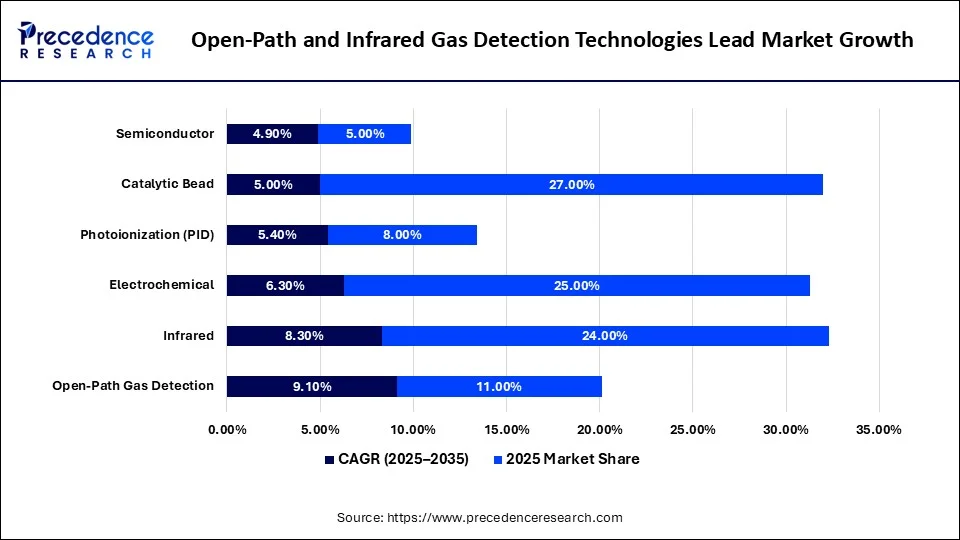
Open-Path and Infrared Sensing Are Displacing Catalytic Bead as the Growth Engine
Source: Precedence Research Database
This chart highlights six technologies that are expected to gain in market share over the next five years and their current percentage of the gas detection technology market for 2025. The second-largest technology overall by installed share is catalytic bead (27.0%). This has the second-lowest growth rate in the category at 5.0% CAGR for an established, legacy-installed, and stable technology that continues to gain installed share without going for new capex increases.
Compared to the other technologies in this data set, open-path gas detection has a relatively small 11.0% share in 2025, but is growing fastest at 9.1% CAGR, with infrared detection second largest at 24.0% share and still growing at 8.3% CAGR; in between are electrochemical detection with a 25.0% share and 6.3% growth. Photoionization and semiconductor detection, both holding the smallest shares (8.0% and 5.0% respectively), are growing at 5.4% and 4.9% respectively, the slowest of the entire technology set. There are two types of technology, open-path and infrared, which are truly capturing new capex. That one fact alone suggests a significant difference will exist in the installed base composition 10 years from today in comparison to what it is today across the industry.
- Key Insight: Catalytic bead stands as the single dominant technology by installed share but is presently experiencing the lowest growth rate in the category, a typical picture for legacy technologies, while the new entrants in the category are. Open-path and IR are the ones gaining the new capex. This means the category composition will meaningfully differ by 2035 from the present day; a clear profile of legacy tech.
Modern Fire & Gas Systems Are Becoming a Data Layer Inside the Plant's Safety Architecture
Source: IEC 61508/IEC 61511 Functional Safety Standards (International Electrotechnical Commission)
The functional safety architecture of a field detector connected via a fire/gas controller to a plant Safety Instrumented System (SIS). This then feeds into an emergency shutdown or DCS (EShD). Fixed flame, smoke, heat, and gas detectors are installed within process units and feed into the fire and gas controller. They determine and send the voting logic, signal validity, and alarm logic to the safety instrumented system, which implements or performs the protective safety functions as per IEC 61511 logic. Finally sending the automated blowdown, process shutdown, and isolation signals to the emergency shutdown/DCS layer.
No longer does the addressable market become just detectors and controllers, as detection becomes a part of an entire safety solution grounded in a plant's existing safety network. It's also bringing in the dollars of software, data integration, and cybersecurity, because a detection system that connects directly with the logic controlling a plant shutdown must be secured. Further integrated in the same manner as all other critical control-system inputs are secured and integrated.
- Key Insight: Even as detection shifts from a standalone man-in-the-middle alarm to an input into a SIS or DCS. The addressable market grows beyond detectors and controllers to software, data integration, and cybersecurity for safety-oriented networks. This is a significant reason why software-oriented monitoring systems account for the fastest growth of any component segment.
Detection System Spend Is a Lifecycle, Not a One-Time Purchase
Source: Framework based on ISA-84/IEC 61511 lifecycle stages and ISO 14224 reliability data practice
I believe this chart reflects the lifecycle of a fixed fire and gas detection system as per the standard asset management lifecycle/consideration of functional safety. It is as if fire safety systems are chosen and fitted during a design phase, operate successfully thereafter, and are replaced at a later stage. The first 3 stages are a one-off during the life of an asset, including design and engineering, procurement and installation, and commissioning and validation.
However, the last three steps operate and monitor, test and calibrate, and maintain, upgrade, and replace are repeated each year or cycle of the system remaining in service. This split is a huge factor in taking a look at this market's actual revenue form and how each vendor and buyer ought to think about it. And the last half of the life of the asset is repeated over and over again, whereas the first half is done only once, making a business more like a subscription or a service than a capital-equipment sale, from a revenue-modeling perspective.
- Key Insight: Every phase from test and calibrate forward repeats annually or on a fixed cycle throughout the life of the asset, whereas design through commissioning is a one-off activity. Further illustrating the recurring revenue nature of the market from a commercial perspective, which is the rationale behind the push into, and value of, monitoring-as-a-service from vendors.
Regional Intelligence
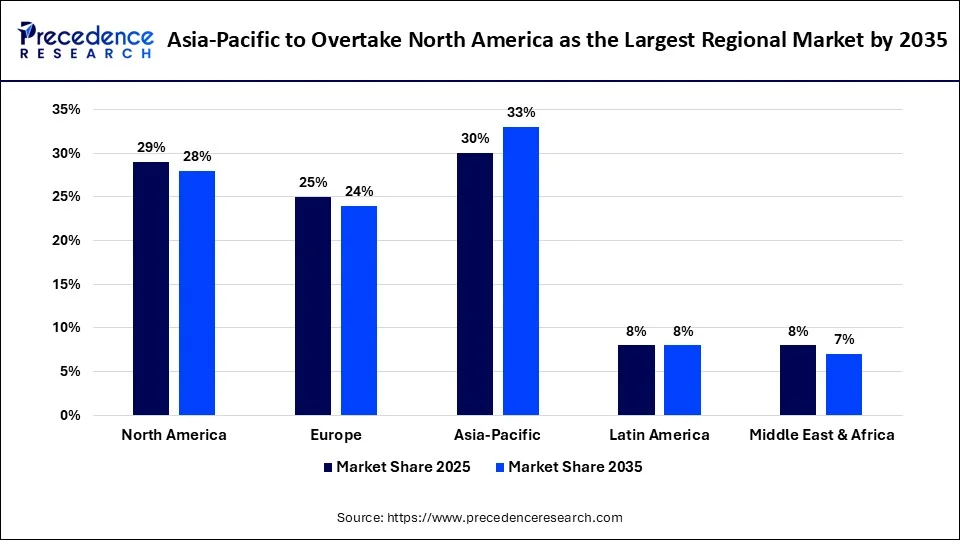
Asia-Pacific Overtakes North America as the Largest Regional Market by 2035
Source: Precedence Research Database
I plotted the graph of the percentage of each region's market to the world's total in 2025 compared with the prediction for the same region's share of the market in 2035. Asia-Pacific's share of the total market in 2025 is 30.0%, and it is the only region seeing growth over the decade as it increases to 33.0% by 2035. North America's share of the total market in 2025 is 29.0%, and this region loses one point over the decade ending in 2035. The situation looks the same in both Europe, turning down from 25.0% to 24.0%, and the Middle East & Africa, which drops from 8.0% to 7.0%, slipping from 8.0% to 7.0%. Latin America is the region holding perfectly flat, unchanged at an 8.0% share across both years. The only region with zero net gain during the period, with a 0% share over both years, is Latin America. This isn't a market in which growth is even across the world. It is a market in which close to all of its share is going from Asia-Pacific, to varying extents, from the three mature markets around it.
- Key Insight: Maturity and replacement demand are declining across the board as Asia-Pacific countries are the only markets in which sales share is increasing, rising from 30.0% to 33.0%. That indicates a decade of regional rebalancing in which replacement demand is declining in mature markets and greenfield industrial build-out is gaining.
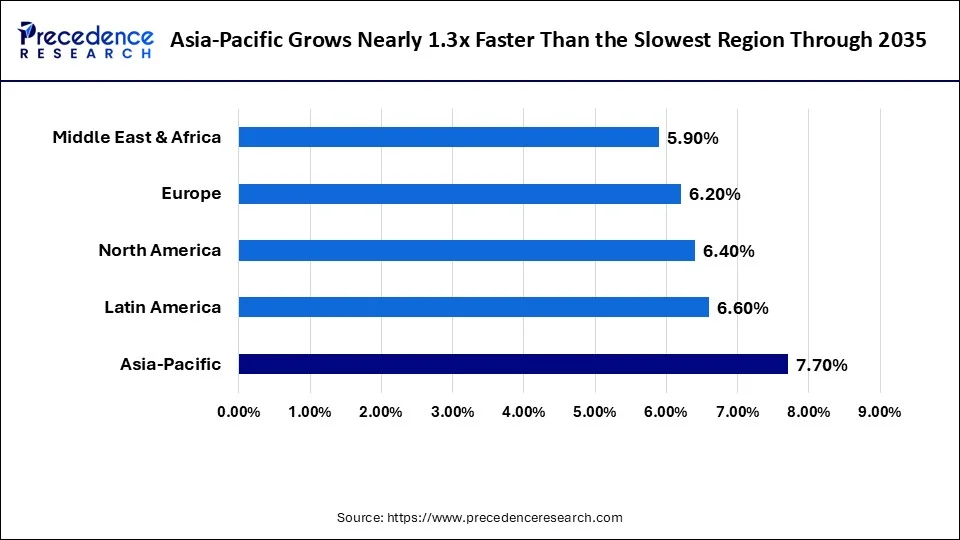
Asia-Pacific Grows Nearly 1.3x Faster Than the Slowest Region Through 2035
Source: Precedence Research Database
Aditi interprets that this chart ranks all five regions by their forecast CAGR and pairs each one with its stated underlying growth driver. Rapid industrialization, massive investments in the energy sector, and a growing capacity for producing chemicals around the world in the Asia Pacific region are driving the 7.7 % CAGR lead over other regions. Tied to oil, gas, and other industrial investments, Latin America stays at 6.6%. In North America, the market is mature and growing at 6.4% CAGR, with replacement demand and growing use of safety systems taking the majority of growth and less emphasis on new industrial construction.
In terms of process-safety regulation, Europe continues to grow at 6.2%, although without any additional capacity, whereas in spite of its modest growth rate, the Middle East and Africa still compound by 5.9% per year, primarily for oil and gas infrastructure. The interesting fact to me about this is how little the difference is in spite of the different underlying driver languages. Rapid industrialization and mature replacement demand read like two completely different market conditions, yet they land within about a point and a half of each other in actual growth terms.
- Key Insight: The CAGR range is wide by region, ranging from 5.9 % to 7.7 %, but the range is not as great as originally thought by the demand-driver language, and even the weakest regional growth rate is still in excess of five percent per year. A market that means no region within this market could be considered structural decline; it's a growth percentage, not a growth trajectory.
Segment Deep-Dives
Gas Detection Is the Anchor Segment, but Integrated Systems Grow Fastest
Source: Precedence Research Database
The market for fixed gas detection systems is the largest, with 42.0% of market share in 2025 and growing by 7.0% CAGR to 43.0% in 2035, as it plays a central role in process industries. While the smallest by share in 2025, at 23.0%, integrated fire and gas systems will see the highest CAGR over the three periods, with a projected 24.0% by 2035. The second most common class of fixed fire detection systems, at 33.0% are slowing from 35.0% at 6.1% CAGR. The basic drivers for integrated systems are very close to the SIS and DCS integration trend and imply a clear preference amongst the market for unified detection architecture over single-purpose fire-only or gas-only detection systems in the future.
- Key Insight: Although the smallest in terms of share at 23.0%, integrated fire and gas systems are projected to experience the strongest CAGR at 7.2%, as highlighted by the SIS and DCS integration trend. This highlights that the direction of the market is more structural towards integrated fire and gas system architectures rather than standalone fire or gas-only installations.
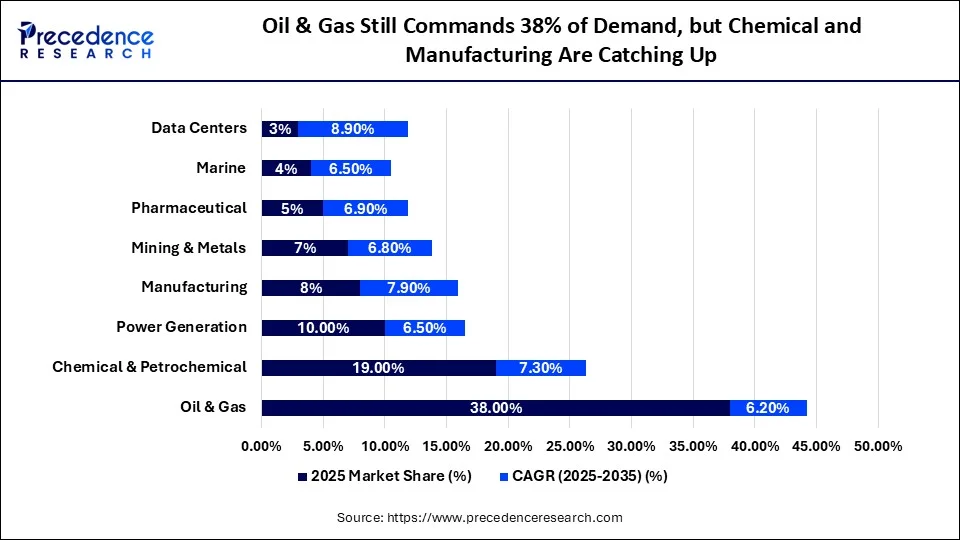
Oil & Gas Still Commands 38% of Demand, but Chemical and Manufacturing Are Catching Up
Source: Precedence Research Database
This chart highlights the top eight industries by end-use for 2025 market share and matches these with the forecast CAGR to identify the biggest buyer industries and tomorrow's fastest-growing industries. While oil and gas continues to dominate the market with a present 38.0%, its dollar growth is going to be largely in line with the market's own growth of 6.74% CAGR, with oil and gas growing at the market average rate of 6.2%.
At the other end of the spectrum are data centers. While only 3.0% of the market today, they have the highest CAGR in the entire end-use data set at 8.9% because they have been seeing a fast adoption of their fire-risk-sensitive-data-center-related capacity. Chemical and petrochemical, the second-largest buyer at a 19.0% share, grows at a healthier 7.3%, ahead of oil and gas, which is the detail buried in the ranking's title worth noticing on its own.
- Key Point: Oil and gas enjoys the largest share, but low double-digit growth, while data centers have the highest CAGR (8.9 %), minuscule, but structurally significant emerging demand pool that is closely related to fire-risk issues for the data center industry.
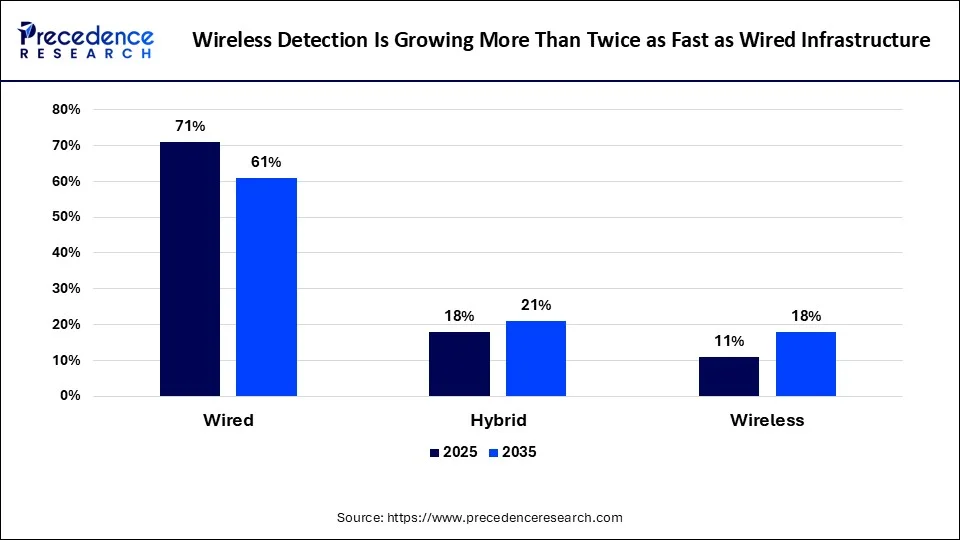
Wireless Detection Is Growing More Than Twice as Fast as Wired Infrastructure
Source: Precedence Research Database
I compared wired, wireless, and hybrid connectivity architectures in 2025 and 2035 share, as it becomes evident that it is the most divergent value from a perspective of the CAGR spread across the entire dataset. Wired connectivity leads by a massive margin in 2025 (71.0%), but it falls measurably by 2035 (61.0%) as this category is growing at the slowest rate (5.2 % CAGR per year) among all these segments. The flip side is wireless connectivity, the smallest market at the moment with an 11.0% share in 2025, expanding at 11.0% CAGR.
Double the growth rate of the wired market, and the fastest of any in the segment between the two lies hybrid connectivity, which doubled its success rate from 18.0% to 21.0% with an eight-point year-on-year steady growth rate of 8.4% CAGR. Retrofit economics are almost certainly what is driving this specific shift. Since wireless detection lets operators add coverage to existing facilities without the cabling and conduit work a wired installation demands, a genuinely material cost and disruption difference on a live industrial site.
- Key Insight: Wireless is the clear fastest-growing segment (CAGR 11.0%) and the most defensible technology-adoption inflection point with 11.0% of the total connectivity market in the data set. It is the smallest connectivity segment, accounting for just 11.0% of the overall market in 2025.
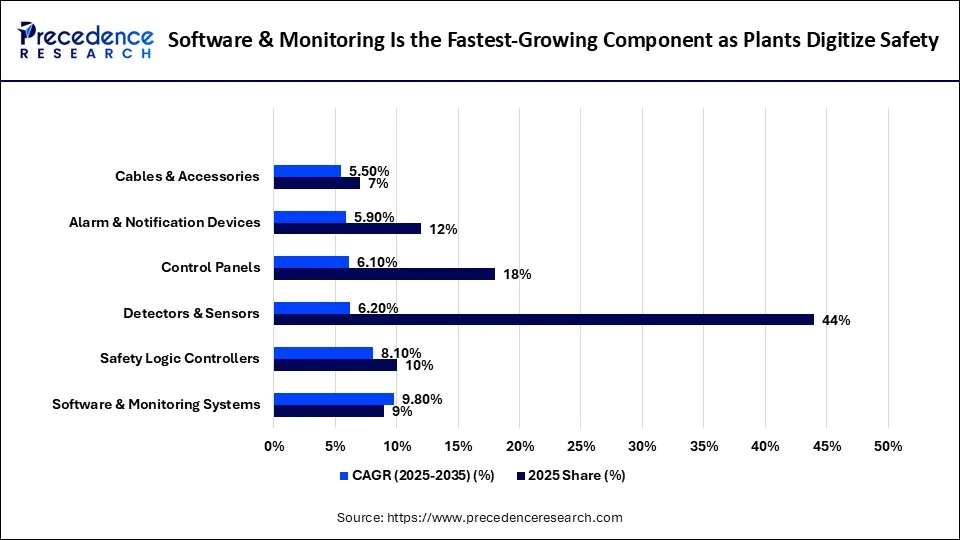
Software & Monitoring Is the Fastest-Growing Component as Plants Digitize Safety
Source: Precedence Research Database
This chart ranks the six component categories that make up a fixed fire and gas system, from detectors through to software, by forecast CAGR, pairing each with its 2025 share of the total market. Detectors and sensors continue to lead by far at 44.0%, but are neck and neck with the market average, around 6.2%, which is basically the market kernel, the hardware at the heart of the market. Software and monitoring systems have a completely different story. Although their current share is modest, 9.0%, this is 9.8% CAGR, almost 60% more than the hardware core above.
That underscores the same point about a moving data layer up from the hardware below that was mentioned in the architecture discussion in this market. The other four categories are control panels, alarm and notification devices, safety logic controllers, and cables and accessories. They have growth rates ranging from 5.5% to 8.1% that are not close to the rates of growth for software and monitoring.
Key Insight: Software and monitoring systems are the smallest of the market's determinants and the smallest segment by share but growing at 9.8% CAGR, almost 60% faster than the hardware core of the market, beginning to prove their ability to differentiate (16.9% share).
Expert Insights
The fixed fire detection and gas detection devices market is coming to an end of conventional, standalone, and hazardous detection and beginning to move towards intelligent, continuous, and integrated industrial safety infrastructure. I believe that there are going to be some good opportunities in the coming years where technology is used for detection in a reliable manner. Coupled with complex infrared and open-path sensing in a way that is still compatible with wireless signal exchange and with the use of software-based monitoring platforms. Competitiveness is projected to be impacted over the next decade by the following developments, including increased safety requirements for industries, obsolete detection infrastructure, brownfields modernization, and safer regulations on process safety.
Our Experts
- Laxmi Narayan led the primary market research, developed the methodology, and analyzed segmentation, regional trends, competition, and forecasts, forming the report's analytical foundation.
- Aman was responsible for collecting and validating regulatory filings, company financial data, commodity pricing, and other independently sourced quantitative datasets, strengthening the evidence base behind the market estimations.
- Aditi reviewed the complete research document, performed quality checks, validated findings, refined content, corrected inconsistencies, and finalized the report, ensuring accuracy and clarity.
Complete Fixed Fire and Gas Detection Systems Market Segmentation
By Detection System
- Fixed Fire Detection Systems
- Fixed Gas Detection Systems
- Integrated Fire & Gas Detection Systems
By Fire Detection Technology
- Smoke Detection
- Heat Detection
- Flame Detection
- Multi-Sensor Detection
- Aspirating Smoke Detection
By Gas Detection Technology
- Catalytic Bead
- Electrochemical
- Infrared
- Photoionization Detection (PID)
- Semiconductor
- Open-Path Gas Detection
By Component
- Detectors & Sensors
- Control Panels
- Alarm & Notification Devices
- Safety Logic Controllers
- Software & Monitoring Systems
- Cables & Accessories
By Installation Type
- New Installation
- Replacement
- Retrofit & Upgrade
By Deployment Environment
- Onshore
- Offshore
By Connectivity
- Wired
- Wireless
- Hybrid
By Application
- Fire Detection
- Flammable Gas Detection
- Toxic Gas Detection
- Flame Detection
- Smoke & Heat Detection
- Leak Detection
- Emergency Shutdown & Alarm
By End-Use Industry
- Oil & Gas
- Chemical & Petrochemical
- Power Generation
- Mining & Metals
- Manufacturing
- Pharmaceutical
- Marine
- Food & Beverage
- Data Centers
- Commercial & Infrastructure
- Other Industries
By Region
- North America (U.S., Canada, Mexico)
- Europe (Germany, U.K., France, Italy, Spain, Netherlands, Norway, Rest of Europe)
- Asia-Pacific (China, Japan, India, South Korea, Australia, Singapore, Southeast Asia, Rest of Asia-Pacific)
- Latin America (Brazil, Argentina, Mexico, Rest of Latin America)
- Middle East & Africa (Saudi Arabia, UAE, Qatar, Kuwait, South Africa, Rest of Middle East & Africa)
For inquiries regarding discounts, bulk purchases, or customization requests, please contact us at sales@precedenceresearch.com
Frequently Asked Questions





Ask For Sample
No cookie-cutter, only authentic analysis – take the 1st step to become a Precedence Research client
 Get a Sample




 sales@precedenceresearch.com
 Schedule a Meeting
