



Servo Motors and Drives Market Size, Key Companies, Company Production Capacity, Manufacturing Efficiency, Production Output, Supply Chain Metrics, Cost Structure, Company Expansion Strategies, and Growth Opportunities
The global servo motors and drives market was valued at USD 23.02 billion in 2025 and is expected to reach approximately USD 44.55 billion by 2035, expanding at a CAGR of 6.83% during the forecast period. The market growth is driven by increasing industrial automation, rising adoption of energy-efficient motor systems, growing demand for precise motion control, expanding Industry 4.0 and IoT adoption, and increasing use of servo motors and drives across automotive, manufacturing, robotics, packaging, and other industrial applications.
Source: https://www.precedenceresearch.com/servo-motors-and-drives-market
 Get a Sample
 Table Of Content


What is the Servo Motors and Drives Market Size?
The global servo motors and drives market size was calculated at USD 23.02 billion in 2025 and is predicted to increase from USD 24.60 billion in 2026 to approximately USD 44.55 billion by 2035, growing at a CAGR of 6.83% from 2026 to 2035. The servo motors and drives market is driven by rising industrial automation, predictive maintenance adoption and rising demand for reliable equipment performance.
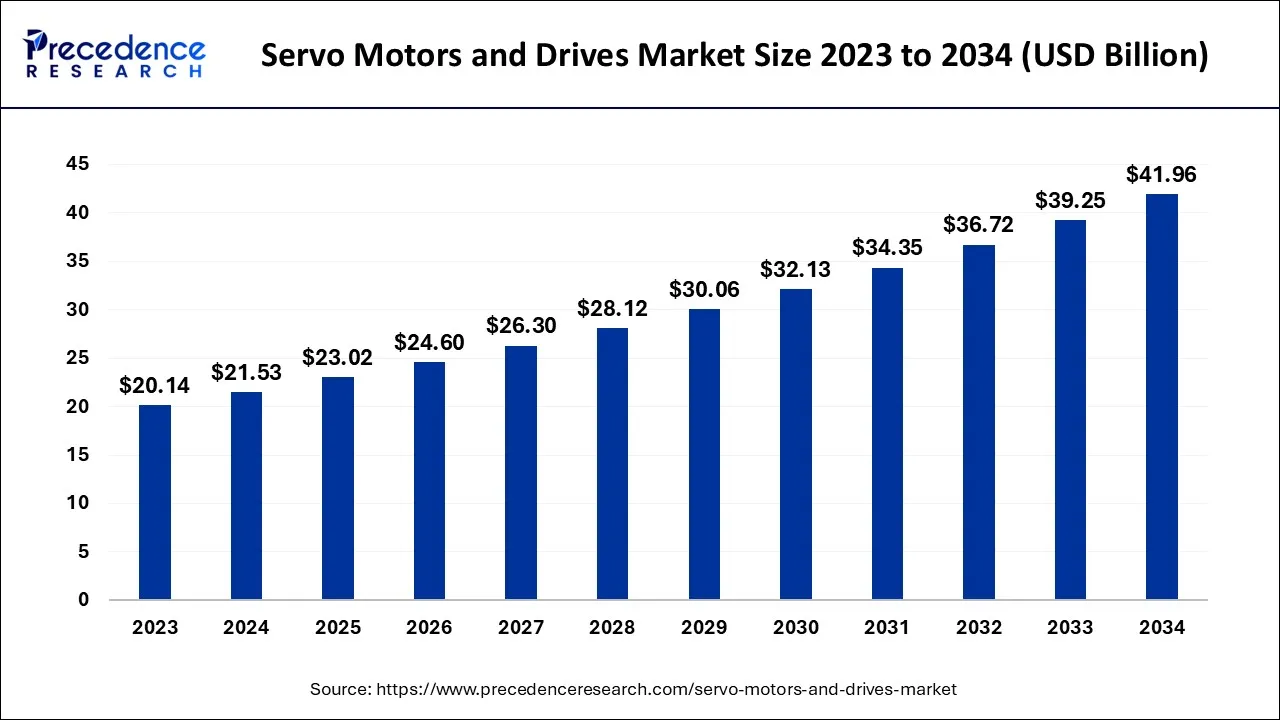
Servo Motors and Drives Market Key Takeaways
- In terms of revenue, the market is valued at $23.53 billion in 2025.
- It is projected to reach $44.55 billion by 2035.
- The market is expected to grow at a CAGR of 6.9% from 2026 to 2035.
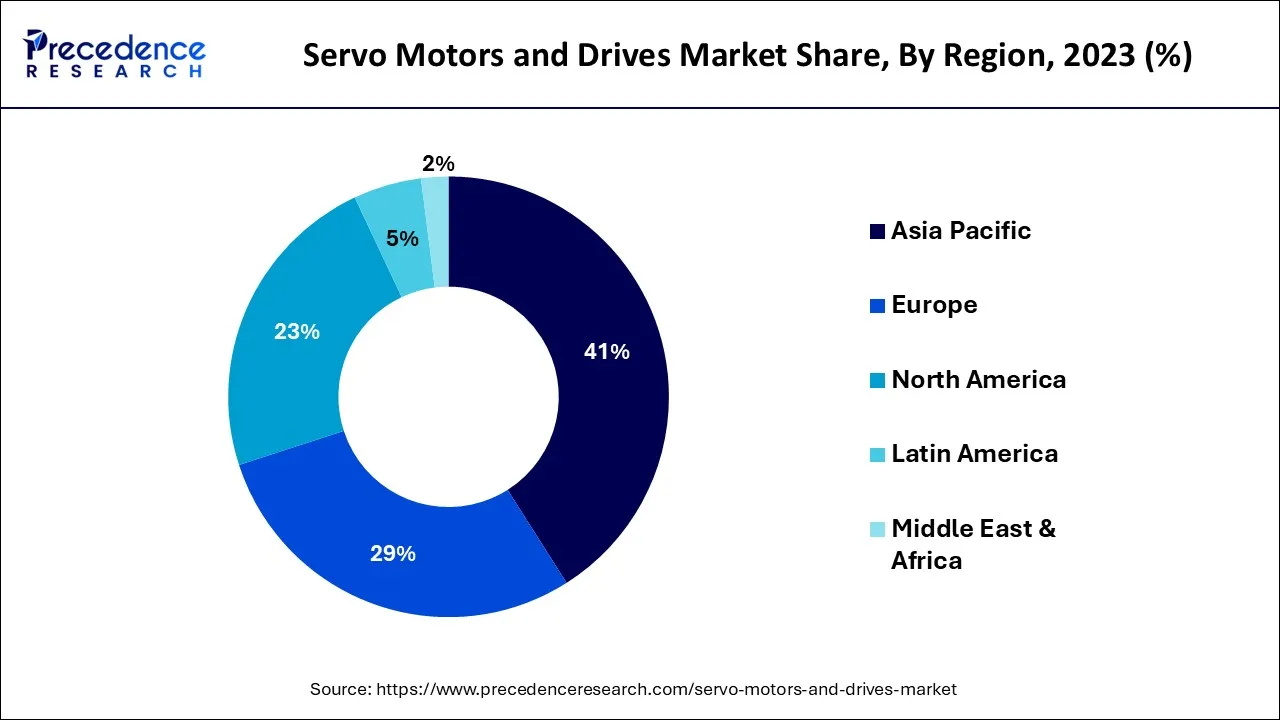
- Asia Pacific led the global market with the highest market share of 41% in 2025.
- By type, the AC motor segment is anticipated to grow at the highest CAGR between 2026 to 2035.
- By application, the automotive segment has held the highest market share in 2025.
Market Overview
Servo motors and drives are integral components in motion control systems, used to regulate the position, speed, and acceleration of machinery and equipment. Specifically, a servo motor is an electric motor that is engineered to deliver precise control over its movements, while a servo drive is an electronic apparatus that supplies the requisite power and control signals to the servo motor. By working together, servo motors and drives enable greater accuracy and reliability in motion control systems, making them essential components for numerous industries that require precise control over their operations. The servo motors and drives industry is responsible for manufacturing and distributing components used in motion control systems. These components are utilized in a wide range of applications such as industrial automation, robotics, aerospace, and medical devices.
Due to the ever-increasing demand for automation in various industries, as well as technological advancements that enable more precise control and higher efficiency, the market for servo motors and drives is expected to expand. The emergence of Industry 4.0 and the Internet of Things (IoT) is also predicted to drive growth in this sector. With more and more industries adopting automated processes, the need for servo motors and drives is expected to rise. These components enable precise control over motion and provide higher efficiency, which translates to significant cost savings in the long run. Additionally, as Industry 4.0 and IoT continue to gain traction, there will be greater demand for sophisticated motion control systems, which will fuel further growth in this industry.
Servo Motors and Drives Market Growth Factors
The emergence of energy-efficient motor systems, driven by recent technological progressions and the implementation of government regulations like the Minimum Energy Performance Standards (MEPS) in various countries, is boosting growth in the servo motor and drive market. These energy-efficient systems are designed to minimize power consumption and reduce carbon emissions, making them more environmentally friendly and cost-effective for users.MEPS are regulations that establish minimum energy performance requirements for motors, which are widely used in industrial processes. These regulations aim to reduce energy consumption and promote the use of energy-efficient technologies. As more countries implement MEPS, the demand for energy-efficient servo motor and drive systems is expected to increase significantly.
- The servo motors' most noteworthy advantage is the flexibility they offer in machine tool operations. They overcome wear and malfunction problems related to traditional gears, belts, and pulleys, thereby enhancing productivity, reliability, and machine throughput. This attribute results in improved operational efficiency.
- Moreover, developments in the market have placed high priority on peak torque, acceleration, and compact design. Servo motors are designed to deliver high peak torque, which is essential for many industrial applications. They also offer high acceleration, allowing for faster and more precise movements. These features are especially critical in industries such as CNC machining, robotics, and advanced automated manufacturing, where precision and speed are vital.
- As more countries strive to achieve digitization, governments are increasingly becoming involved in the process. This trend is expected to create a more conducive business environment, especially as more investment is being directed toward infrastructure development. One area that is expected to benefit from this trend is the industrial sector, where there is a growing demand for high-speed and precision motor systems. This has led to an increase in the use of servo motors and amplifiers.
- The market expansion for these technologies is further expected to be driven by technological progress, which is enabling the development of more advanced and efficient motor systems. Additionally, regulatory tax rebate policies aimed at encouraging operational updates are also expected to provide a boost to the market. Overall, the outlook for the servo motor and amplifier market is positive, as these technologies become increasingly essential in various industries.
- The growing implementation of energy-efficient global norms is propelling the requirement for servo motors and drives. These technologies offer high accuracy, speed, and size reduction, making them a desirable choice for multiple sectors.
Market Outlook
- Industry Outlook: The servo motors and drives market is poised for robust growth in the coming years, driven by the continuous advancements in industrial automation, the increasing emphasis on energy efficiency, and the integration of smart technologies across various sectors. As industries evolve to embrace concepts like Industry 4.0, the demand for sophisticated motion control systems is expected to rise, providing a strong impetus for market expansion.
- Sustainability Trend: Sustainability is increasingly influencing the market, with industries prioritizing energy-efficient systems that reduce power consumption. Companies are developing advanced drives that optimize performance while lowering energy usage, helping meet regulatory standards and cut operational costs.
Market Scope
| Report Coverage | Details |
| Market Size in 2025 | USD 23.02 Billion |
| Market Size in 2026 | USD 24.60 Billion |
| Market Size by 2035 | USD 44.55 Billion |
| Growth Rate from 2026 to 2035 | CAGR of 6.83% |
| Largest Market | Asia-Pacific |
| Base Year | 2025 |
| Forecast Period | 2026 to 2035 |
| Segments Covered | Type, Application, and Region |
| Regions Covered | North America, Europe, Asia-Pacific, Latin America, and Middle East & Africa |
Market Dynamics
Drivers
Adoption of the energy international standards
With a growing focus on energy efficiency and environmental sustainability, governments and organizations worldwide are increasingly implementing regulations and standards for energy consumption and emissions. Additionally, as automation technology continues to advance, servo motors and drives are finding new applications in various sectors. Moreover, the inclusion of motor control components in motors is also contributing to the growth of the servo motors and drives market. These components help improve motor performance and efficiency, thereby increasing the demand for servo motors and drives.
Furthermore, energy international standards are driving the adoption of high-efficiency servo motors and drives in industries such as automotive, packaging, food and beverage, and others. Manufacturers are increasingly investing in R&D to develop advanced servo motors and drives that meet these energy efficiency standards, thereby increasing the demand for these products in the market.
Challenges
Complex installation and maintenance
Servo motors and drives are sophisticated components that demand specialized knowledge and expertise to properly install and maintain. For many companies lacking the necessary in-house expertise, the task of finding and hiring external contractors to install and maintain their servo motors and drives can be a significant challenge. Due to their complex nature, servo motors and drives require a high level of technical expertise to install and operate. Without the proper knowledge, mistakes can be made during installation or maintenance, leading to performance issues or even failure of the equipment.
Opportunities
Expansion into emerging markets
Servo motors and drive manufacturers have a valuable opportunity to tap into emerging markets in India, China, and Southeast Asia. These regions are currently experiencing substantial growth in industries such as manufacturing, automotive, and construction, which creates a significant potential demand for servo motors and drives. As the manufacturing sector in these regions continues to grow, the demand for automation and precision control systems is also increasing. Servo motors and drives are essential components in these systems, providing high levels of accuracy and efficiency, making them a crucial factor in the growth of these industries.
Segment Insights
Type Insights
The AC motor segment is predicted to achieve the highest compound annual growth rate (CAGR) during the forecast period. The growing popularity of electric vehicles is anticipated to be a key driver of this growth, as AC motors are commonly used in these vehicles due to their lighter weight and smaller size. AC motors are also widely used in various industries such as home appliances, HVAC systems, and manufacturing facilities, as they are highly efficient and cost-effective. They typically have low or no maintenance costs, making them an attractive option for businesses looking to reduce operating expenses.
As demand for electric vehicles and energy-efficient equipment continues to rise, the market for AC motors is expected to expand significantly in the coming years. The use of AC motors in a range of applications, combined with their superior efficiency and low maintenance costs, make them a highly sought-after technology in the industrial and commercial sectors. In summary, the AC motor segment is set to experience robust growth in the forecast period, primarily driven by the surging demand for electric vehicles. With their numerous advantages, such as being lightweight, small-sized, cost-effective, and requiring low maintenance, AC motors are an attractive choice for a variety of industries and applications.
Application Insights
The increasing demand for electric and hybrid vehicles is driving the demand for servo motors and drives in the automotive sector. Servo motors and drives are used in electric power steering, braking systems, and engine cooling systems, among others. Additionally, the implementation of automation tools in various application industries has led to reduced operational time and cost savings in manufacturing and inventory processes. Recent advancements in technology, such as the integration of hardware and software, have expanded the capabilities and applications of AC servo motors.
Furthermore, Servo motors and drives are used in various applications in the oil and gas industry, such as pumps, compressors, and drilling equipment. The increasing demand for oil and gas is driving the growth of servo motors and drives the market in this sector. Moreover, Servo motors and drives are used in medical devices such as surgical robots, CT scanners, and MRI machines. The increasing demand for advanced healthcare equipment is driving the growth of servo motors and driving the market in the healthcare sector.
Regional Insights
What is the Asia Pacific Servo Motors and Drives Market Size?
The Asia Pacific servo motors and drives market size is exhibited at USD 9.44 billion in 2025 and is projected to be worth around USD 18.54 billion by 2035, growing at a CAGR of 6.98% from 2026 to 2035.
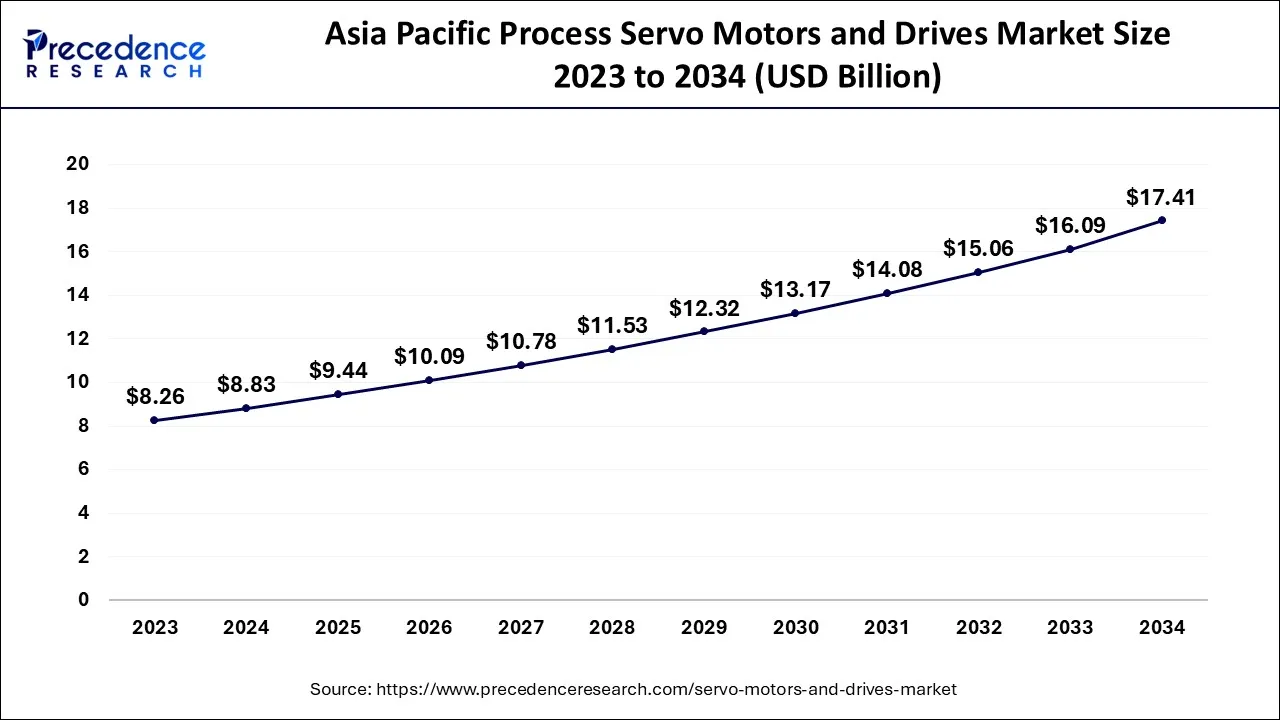
During the forecast period, the Asia-Pacific region is expected to hold the largest market share in servo motors and drives the market. This is due to the increasing number of oil and gas refineries to meet the growing demand for energy and power generation in the region. Additionally, the need for power-efficient voltage systems to support industrialization, urbanization, and population growth in developing economies like China and India is expected to fuel market growth. The demand for goods and services across multiple industry sectors in the region is also expected to drive the growth of the servo motors and drives market.
China Market Trends
China accounts for the largest share of the servo motors and drives market in Asia-Pacific in 2025. The growth is driven by its large manufacturing base, industrial automation and growing investment in infrastructure development. The government in the country is promoting high efficiency motors, the use of CNC machinery, precision manufacturing technologies and equipment upgrades. High demand from electric vehicles production lines and electronics assembly is also supporting market growth. Growing adoption of servo drives, permanent magnet motors and digitally controlled systems is creating opportunities across manufacturing and industrial applications.
The global servo motors and drives market is expected to grow steadily, driven by the increasing adoption of automation in various industries. The North American market, in particular, is significant due to high demand from industries like automotive, food and beverage, packaging, and aerospace. Some of the leading players in the North American servo motors and drives market include ABB, Siemens, Schneider electric, Yaskawa electric corporation, and rockwell automation. These companies are investing in research and development to enhance the efficiency and performance of their servo motors and drives, as well as developing new products to meet the changing needs of their customers.
The automotive industry is a significant consumer of servo motors and drives in North America, driven by the increasing demand for electric and hybrid vehicles. The food and beverage industry is also a major user of servo motors and drives for various applications such as packaging, filling, and labeling.
The market for servo motors and drives in Europe is growing notably. Driven by the region's focus on industrial automation, energy-efficient methods, and intelligent manufacturing. This expansion is driven by a rise in the use of precision motion control systems in the automotive, electronics, food & beverage, and pharmaceutical sectors. Ongoing technological improvements in industrial automation and strict government regulations encouraging environmental sustainability.
The market in Europe is also driven by widespread adoption of industrial automation in manufacturing, automotive, and packaging sectors. Focus on Industry 4.0, smart factories, and energy-efficient motion control systems is increasing demand, while high labor costs encourage precision automation where servo systems are essential. Regulatory pressures on energy efficiency and carbon emissions are also prompting upgrades to advanced servo drives.
The continuous growth of smart manufacturing along with favorable policies for industrial progress will enhance the industry framework. Germany, the United Kingdom, and France are the primary markets in this area, with each playing a crucial role in the regional market dynamics. The area's dedication to Industry 4.0 projects and eco-friendly manufacturing methods persists in propelling the uptake of servo motors and drives within different industrial sectors.
Germany dominates the European servo motors and drives market due to its strong automotive, machine tool, and industrial robotics sectors. Italy drives demand for high-precision motion control in packaging, food processing, and textiles, while France benefits from automation investments in aerospace, pharmaceuticals, and industrial equipment. The market in the UK is supported by upgrades in manufacturing facilities and logistics automation. Eastern European countries like Poland and the Czech Republic are emerging manufacturing hubs, contributing to market growth across the region.
How is the Opportunistic Rise of Latin America in the Servo Motors and Drives Market?
Latin America is experiencing an opportunistic rise in the market, driven by industrial modernization and expanding automation initiatives. Manufacturing sectors are increasingly adopting servo systems to enhance productivity, quality, and operational efficiency, particularly in high-value applications like packaging and assembly lines. Government-led industrial programs, foreign investments, infrastructure development, and renewable energy projects are further supporting demand for precise motion control systems, with long-term industrial automation trends remaining positive despite economic volatility.
Brazil is the major contributor to the Latin American servo motors and drives market due to its large and diversified industrial base, including automotive, food and beverage, and general manufacturing sectors. High adoption of automation and precision motion control in these industries drives strong demand for servo systems, making Brazil the regional leader in market growth.
What Drives the Market in the Middle East & Africa?
The servo motors and drives market in the Middle East & Africa (MEA) is driven by increasing industrial automation, infrastructure development, and efforts to reduce dependence on manual labor. Key sectors such as oil and gas, water treatment, power generation, and manufacturing localization initiatives are boosting demand for reliable, precise, and durable servo-driven systems. Additionally, the adoption of smart factory concepts and the modernization of industrial facilities are further accelerating market growth in the region.
U.S. Market Trends
The United States represents the largest share of the servo motors and drives market in North America. The growth is driven by extensive use across manufacturing, commercial facilities, utilities, pumps and HVAC. The country is experiencing increasing replacement of ageing equipment, energy saving initiatives, and automation, which is encouraging market growth. The government in the country impose strict rules and green targets, which encourage consumers to use energy efficient solutions. The growing investment in automotive modernization is contributing to the market expansion.
Saudi Arabia Market Trends
Saudi Arabia represents the leading market within the Middle East and Africa servo motors and drives market in 2025, supported by strong investment in smart manufacturing and growing adoption of automation across the oil and gas and utilities sectors. Vision 2030 is encouraging automation, advanced manufacturing, local supply chains and higher industrial productivity. The growing investment in large scale projects such as power generation and water treatment requires robust motion control systems. The rapid industrial modernization by deploying high precision robotics, automated machine tools and smart production lines is also supporting market expansion.
Value Chain Analysis
- Raw Material Sourcing: Raw material sourcing forms the base of the servo motors and drives the value chain and has a direct influence on the product's performance, reliability, and cost structure
- Component Manufacturing: Component manufacturing refers to the process of putting raw materials into both high-precision mechanical and electronic parts. Some of the major components are stators, rotors, encoders, bearings, power modules, control boards, firmware, and integrated processors.
- Testing and Quality Control: Testing, along with quality assurance, represent the final, close to them, critical stages aimed at guaranteeing servo motors and drives to satisfy extremely demanding performance, safety, and reliability regulations.
Competitive Landscape
The servo motors and drives market is highly competitive, with well established manufacturing companies competing through broad service networks and technical capabilities. The leading companies in the market include ABB, Siemens, Schneider Electric, WEG, Yaskawa, Emerson, Danfoss, Mitsubishi Electric, and Rockwell Automation. Companies are strengthening their market position by introducing preventive maintenance, equipment refurbishment, modernization remote monitoring and energy efficiency services. Competition is shifting towards predictive maintenance and connected service models, which enable identification of equipment problems before failures.
For future growth in the servo motors and drives market, companies should invest in predictive maintenance, remote diagnostics, energy efficient upgrades, cybersecurity and faster local support.
Top Companies in the Servo Motors and Drives Market and Their Offerings
- Yaskawa Electric Corporation - A Japan based company, a pioneer in motion control and robotics.
- Key offerings - Sigma-7 and Sigma-10 servo motor and drive series
- Mitsubishi Electric Corporation - A Japan based company provide reliable electrical equipment and factory automation solutions.
- Key offerings - MELSERVO-J5 and MELSERVO-JET series
- Siemens AG - A Germany based industrial manufacturing company and global leader in software driven automation and digitalization.
- Key offerings - SIMOTICS servo motors paired with SINAMICS servo drives (such as the S120 and S210 systems)
- FANUC Corporation - A Japan based company and one of the world's largest makers of CNC systems and factory automation robotics.
- Key offerings - Fanuc Alpha i-B and Beta i-B series
- Beckhoff Automation GmbH & Co. KG - A Germany based company specialising in PC based control technology and investing high speed EtherCAT communication protocol.
- Key offerings - AM8000 series of synchronous servo motors featuring One Cable Technology (OCT)
- Kollmorgen (Altra Industrial Motion) - A United States based company known for high performance motors used in aerospace and medical applications.
- Key offerings - AKM and AKM2G synchronous servo motor series and AKD2G servo drives
Servo Motors and Drives Market Companies
- ABB Ltd.
- Siemens AG
- Schneider Electric SE
- Yaskawa Electric Corporation
- Rockwell Automation, Inc.
- Mitsubishi Electric Corporation
- Delta Electronics, Inc.
- Emerson Electric Co.
- Parker Hannifin Corporation
- Kollmorgen Corporation
- Oriental Motor Co., Ltd.
- Moog Inc.
- Fuji Electric Co., Ltd.
- Lenze SE
- BonfiglioliRiduttori S.p.A.
Recent Developments
- In March 2025, Nidec Instruments Corporation, a subsidiary of Nidec Corporation, announced that it will begin accepting orders for the new S-FLAG DYNAMIC MOTION TM MB series motors, expanding the Company's current lineup of S-FLAG AC servo motors available for purchase. The “S-FLAG” models, introduced by Nidec Instruments in 2014, represent an enhanced version of its internally developed AC servo motors that the Company produced and marketed for its transfer robots.
- In November 2024, Oriental Motor introduced its latest OVR Series of compact industrial robots, including articulated, Cartesian, and SCARA designs. The αSTEP Hybrid AZ Series step-servo motors power the robots. Oriental Motor stated that these adaptable robots are set to significantly enhance automation processes.
- In September 2024, ElectroCraft, a top supplier of innovative motor and motion solutions, revealed the introduction of the new “EZ Drive,” a state-of-the-art motor drive tailored for brushless DC motors. This groundbreaking product is poised to transform efficiency and simplicity across various applications, including industrial automation as well as medical and laboratory devices.
- Delta, a notable worldwide supplier of industrial automation solutions, demonstrated its top-performing industrial automation system portfolio in 2022 and the SPS Italia occasion in May. The objective was to meet the rising market's demand for intelligent manufacturing and production solutions.
Segments Covered in the Report
By Type
- AC Servo Motor
- DC Brush Less Servo Motor
- Brushed DC Servo Motor
- Linear Servo Motor
- AC Servo Drive
- DC Servo Drive
- Adjustable Servo Drive
- Other
By Application
- Automotive
- Oil and Gas
- Healthcare
- Packaging
- Semiconductor and Electronics
- Chemicals and Petrochemicals
- Other
By Geography
- North America
- Europe
- Asia-Pacific
- Latin America
- Middle East and Africa
For inquiries regarding discounts, bulk purchases, or customization requests, please contact us at sales@precedenceresearch.com
Frequently Asked Questions





Ask For Sample
No cookie-cutter, only authentic analysis – take the 1st step to become a Precedence Research client
 Get a Sample




 sales@precedenceresearch.com
 Schedule a Meeting
